Atomistic Mechanisms of Stress-Dependent Molten Salt Corrosion in NiCr Alloys
Pith reviewed 2026-05-10 07:55 UTC · model grok-4.3
The pith
Tensile strain speeds intergranular corrosion in NiCr alloys in molten salts by increasing free volume at grain boundaries, while compression slows it by forming a protective ridge.
A machine-rendered reading of the paper's core claim, the machinery that carries it, and where it could break.
Core claim
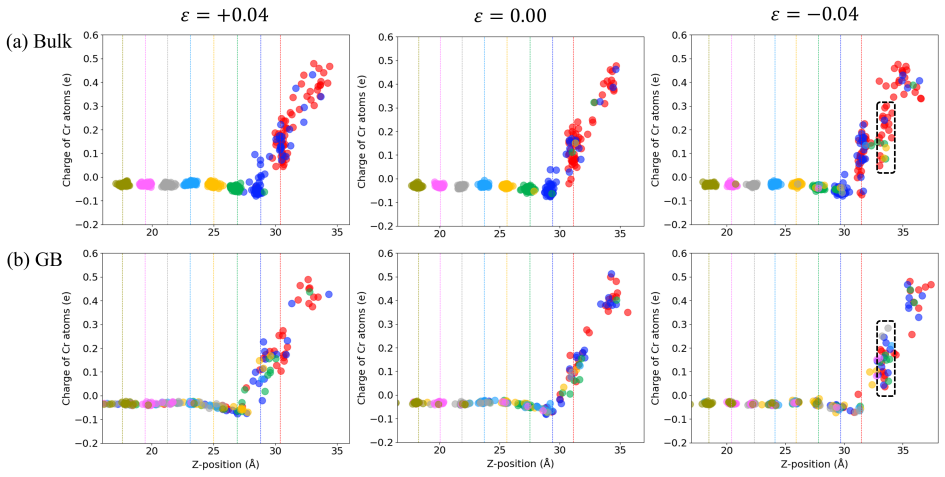
Reactive molecular dynamics simulations of Ni0.75Cr0.25 with a Σ5(210) grain boundary under uniaxial strains ranging from +4 percent tensile to -4 percent compressive in molten FLiNaK at 800 degrees Celsius show that tensile strain accelerates intergranular corrosion through elastic dilation that reduces local atomic packing and raises excess free volume, thereby boosting atomic mobility and fluorine infiltration. Compressive strain instead promotes formation of a ridge-like surface layer along the grain boundary that restricts salt access to the underlying alloy and thereby suppresses corrosion.
What carries the argument
The Σ5(210) grain boundary model under uniaxial strain, which tracks fluorine adsorption, charge redistribution, and boundary evolution to show how changes in atomic packing and surface morphology control salt infiltration.
Load-bearing premise
The selected interatomic potentials and the Σ5(210) grain boundary model in the reactive molecular dynamics simulations accurately represent real atomic interactions and corrosion kinetics under combined strain and molten salt exposure.
What would settle it
Experimental exposure of NiCr samples to molten FLiNaK at 800 degrees Celsius while held under controlled tensile versus compressive strain, followed by measurement of fluorine penetration depth or grain boundary ridge formation via microscopy or spectroscopy, would confirm or refute the simulated differences.
Figures



read the original abstract
Ni-based structural alloys in molten salt environments often experience simultaneous mechanical loading and corrosive attack, yet the mechanisms governing stress-corrosion interactions remain unclear. Prior studies largely emphasize tensile stress, while the role of compressive stress has received limited attention. Here, reactive molecular dynamics simulations are used to investigate the coupled effects of applied strain and corrosion in Ni$_{0.75}$Cr$_{0.25}$ exposed to molten FLiNaK at 800$^\circ$C. A $\Sigma5(210)$ grain boundary model is subjected to tensile (+4%) to compressive (-4%) uniaxial strains, and corrosion behavior is evaluated through fluorine adsorption, charge redistribution, and grain boundary evolution. Tensile strain accelerates intergranular corrosion by reducing local atomic packing through elastic dilation and increasing excess free volume at the grain boundary, which enhances atomic mobility and salt infiltration. In contrast, compressive strain suppresses corrosion by promoting the formation of a ridge-like surface layer along the grain boundary, limiting salt access to the underlying alloy. These results provide atomistic insight into how stress states influence grain boundary corrosion in molten salts.
Editorial analysis
A structured set of objections, weighed in public.
Referee Report
Summary. The manuscript uses reactive molecular dynamics simulations to examine the effects of uniaxial strain (+4% tensile to -4% compressive) on intergranular corrosion of a Σ5(210) grain boundary in Ni0.75Cr0.25 alloy exposed to molten FLiNaK at 800°C. It reports that tensile strain accelerates corrosion by elastic dilation that increases excess free volume, atomic mobility, and salt infiltration at the grain boundary, while compressive strain suppresses corrosion through formation of a ridge-like surface layer that restricts salt access. The analysis tracks fluorine adsorption, charge redistribution, and grain boundary structural evolution to support these atomistic mechanisms.
Significance. If the simulation results hold, the work supplies useful atomistic insight into stress-corrosion coupling at grain boundaries in Ni-based alloys under molten salt conditions, a topic relevant to high-temperature structural materials. The direct simulation of combined mechanical loading and reactive corrosion, including charge effects, is a positive feature that goes beyond purely mechanical or non-reactive models.
major comments (2)
- [Simulation Methods] Simulation Methods (or equivalent section describing the interatomic potentials): The central mechanistic claims—that +4% tension increases GB free volume via dilation while -4% compression induces a blocking ridge—rest on the fidelity of the chosen reactive potentials for the Ni-Cr-F-Li-Na-K system under strain. No benchmarks against DFT, alternative potentials, or experimental corrosion rates under combined strain and salt exposure are provided, leaving open the possibility of systematic bias in charge redistribution or many-body interactions at the deformed metal-halide interface.
- [Results] Results section on grain boundary evolution: The reported ridge-like surface layer under compression is presented as the key suppressor of corrosion, yet the manuscript does not quantify its stability, thickness, or composition over simulation timescales or test sensitivity to strain rate or temperature variations beyond the single 800°C condition.
minor comments (2)
- [Abstract] The abstract and text use Ni$_{0.75}$Cr$_{0.25}$ notation; ensure consistent use of subscripts and alloy composition throughout all figures and tables.
- [Figures] Figure captions describing GB structures under strain should explicitly note the viewing direction and any periodic boundary conditions applied.
Simulated Author's Rebuttal
We thank the referee for their constructive comments and positive assessment of the significance of our work. We provide point-by-point responses to the major comments below, indicating where revisions will be made to strengthen the manuscript.
read point-by-point responses
-
Referee: [Simulation Methods] Simulation Methods (or equivalent section describing the interatomic potentials): The central mechanistic claims—that +4% tension increases GB free volume via dilation while -4% compression induces a blocking ridge—rest on the fidelity of the chosen reactive potentials for the Ni-Cr-F-Li-Na-K system under strain. No benchmarks against DFT, alternative potentials, or experimental corrosion rates under combined strain and salt exposure are provided, leaving open the possibility of systematic bias in charge redistribution or many-body interactions at the deformed metal-halide interface.
Authors: We agree that the reliability of the mechanistic claims depends on the potentials. The ReaxFF parameterization used was developed and validated in our prior work against DFT for key properties including fluoride adsorption energies, charge transfer, and diffusion in Ni-Cr-F-Li-Na-K systems at 800°C. We did not include explicit new benchmarks for the strained grain-boundary interface in the submitted manuscript. In revision we will add a subsection summarizing these literature validations and explicitly discuss possible limitations in many-body interactions and charge redistribution under strain. Direct experimental corrosion rates under simultaneous uniaxial strain and molten-salt exposure are not widely available for direct comparison, but the observed trends are consistent with known stress-corrosion behavior in Ni-based alloys. revision: partial
-
Referee: [Results] Results section on grain boundary evolution: The reported ridge-like surface layer under compression is presented as the key suppressor of corrosion, yet the manuscript does not quantify its stability, thickness, or composition over simulation timescales or test sensitivity to strain rate or temperature variations beyond the single 800°C condition.
Authors: We concur that additional quantification of the ridge-like layer will improve the presentation. In the revised manuscript we will incorporate quantitative measures of its thickness, Cr and F composition, and temporal stability extracted from the existing trajectories over the full simulation timescale. Our study is performed at the representative temperature of 800°C and a fixed strain-application protocol; systematic variation of strain rate and temperature would require substantial new simulations that are outside the scope of the present work. We will add a concise discussion of these limitations and the conditions under which the ridge mechanism is expected to operate. revision: yes
Circularity Check
No significant circularity in forward simulation results
full rationale
The paper reports results from reactive molecular dynamics simulations of a Σ5(210) grain boundary in Ni0.75Cr0.25 under applied uniaxial strains (+4% to -4%) in molten FLiNaK. The central claims—that tensile strain increases excess free volume and accelerates intergranular corrosion while compressive strain induces ridge-like surface layers that suppress corrosion—emerge directly as outputs of the forward simulations rather than from any analytic derivation, parameter fitting to target corrosion metrics, or self-referential definitions. No equations are presented that reduce to their own inputs by construction, and the provided text contains no load-bearing self-citations that justify the mechanisms. The work is therefore self-contained as a simulation study against external benchmarks.
Axiom & Free-Parameter Ledger
free parameters (2)
- Uniaxial strain range (+4% tensile to -4% compressive)
- Temperature 800 °C and alloy composition Ni0.75Cr0.25
axioms (2)
- domain assumption The reactive force field or interatomic potentials employed correctly reproduce Ni-Cr, fluorine, and alkali-metal interactions under strain.
- domain assumption The Σ5(210) grain-boundary geometry is representative of the dominant boundaries in polycrystalline NiCr alloys.
Reference graph
Works this paper leans on
-
[1]
(7) Bell, S.; Steinberg, T.; Will, G
(6) Aitkaliyeva, A.; He, L.; Wen, H.; Miller, B.; Bai, X.-M.; Allen, T.Structural Materials for Generation IV Nuclear Reactors; Elsevier, 2017; pp 253–283. (7) Bell, S.; Steinberg, T.; Will, G. Corrosion mechanisms in molten salt thermal energy storage for concentrating solar power.Renewable and Sustainable Energy Reviews2019, 114, 109328. (8) Amiri, A. A...
work page 2017
-
[2]
15 (18) Liang, W.; Li, X.; Wang, Y.; Leng, B.; Wu, T.; Chang, L. Understanding of the stress- assisted cracking behavior of Ni-based alloy GH3535 in molten LiF-NaF-KF salt.Cor- rosion Science2025, 113038. (19) Williams, K. S.; Chauhan, R. R.; Cooper, K.; Thomas, N.; Ahmed, K.; Shao, L. Com- bining four-point bending and corrosion to map stress-dependent c...
work page 2005
-
[3]
(21) Ming, T.; Xue, H.; Zhang, T.; Han, Y.; Peng, Q. Improving the corrosion and stress corrosion cracking resistance of 316 L stainless steel in high temperature water by water jet cavitation peening.Surface and Coatings Technology2022,438, 128420. (22) Chu, T. Mechanism study of stress corrosion behavior under tensile and compressive stresses for welded...
work page 2023
-
[4]
C.; Dasgupta, S.; Lorant, F.; Goddard, W
(27) Van Duin, A. C.; Dasgupta, S.; Lorant, F.; Goddard, W. A. ReaxFF: A reactive force field for hydrocarbons.The Journal of Physical Chemistry A2001,105, 9396–9409. (28) Senftle, T. P.; Hong, S.; Islam, M. M.; Kylasa, S. B.; Zheng, Y.; Shin, Y. K.; Junker- meier, C.; Engel-Herbert, R.; Janik, M. J.; Aktulga, H. M.; others The ReaxFF reactive force-field...
work page 2024
-
[5]
(40) Stukowski, A. Visualization and analysis of atomistic simulation data with OVITO–the Open Visualization Tool.Modelling and Simulation in Materials Science and Engineer- ing2010,18, 015012. (41) Genin, F. Effect of stress on grain boundary motion in thin films.Journal of Applied Physics1995,77, 5130–5137. 18 (42) Wang, M.; Yan, R.; Han, X.; Wang, H.; ...
work page internal anchor Pith review arXiv 2022
discussion (0)
Sign in with ORCID, Apple, or X to comment. Anyone can read and Pith papers without signing in.