Simultaneous Dual-Plane Multi-Write-Spot Two-Photon Polymerization Using a Single Diffractive Optical Element
Pith reviewed 2026-05-10 08:16 UTC · model grok-4.3
The pith
A single static diffractive optical element generates two independent multi-spot arrays in separate planes to enable simultaneous two-layer writing in two-photon polymerization.
A machine-rendered reading of the paper's core claim, the machinery that carries it, and where it could break.
Core claim
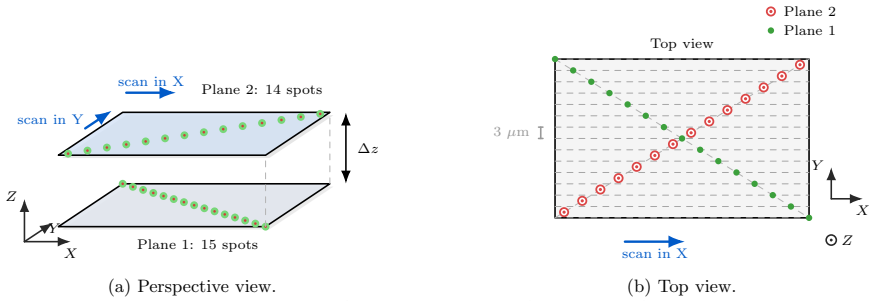
We demonstrate a dual-plane multi-spot two-photon polymerization method using a single static diffractive optical element to produce two focal-spot arrays in distinct planes. This setup permits simultaneous fabrication of two layers during a continuous scan, which is compatible with woodpile structures. Using 29 write spots across planes separated by 1.8 μm, four-layer woodpile structures are fabricated with an effective writing speed of 1 mm² in 90 s, showing a route to higher throughput in 2PP.
What carries the argument
The single static diffractive optical element (DOE) that diffracts the incident beam into two independent arrays of focal spots lying in separate planes.
If this is right
- Two layers can be written simultaneously, halving the number of scans needed for multi-layer 3D parts.
- The scanning strategy stays simple and continuous, avoiding the need for complex layer-by-layer alignment.
- Effective fabrication speeds reach 1 mm² in 90 s for four-layer woodpiles using 29 spots.
- Multi-spot parallelization extends into the third dimension for increased 2PP throughput.
Where Pith is reading between the lines
- Advanced DOEs might allow three or more planes simultaneously for even greater speed gains.
- The technique could extend to other 3D micro-structures such as microfluidic devices or optical components.
- Integration with faster scanning systems might push throughput into industrial scales.
- Verification across different polymer resins would test the generality of the dual-plane independence.
Load-bearing premise
A single static DOE maintains two independent, high-quality focal-spot arrays in distinct planes without significant crosstalk, intensity variation, or alignment drift during continuous scanning.
What would settle it
If the fabricated structures show merged or incomplete layers due to crosstalk between the two focal planes, or if spot intensities vary enough to prevent uniform polymerization, the central claim would be falsified.
Figures



read the original abstract
The serial nature of two-photon polymerization (2PP) limits fabrication throughput. While diffractive optical elements (DOEs) can be used to generate multiple write spots in a single plane, three-dimensional structures still require sequential layer-by-layer fabrication. We demonstrate a dual-plane multi-spot 2PP approach using a single static DOE capable of generating two independent focal-spot arrays in distinct planes. This configuration enables simultaneous fabrication of two layers during continuous scanning while maintaining a simple scanning strategy compatible with woodpile structures. Using 29 write spots distributed across two planes separated by 1.8 $\mu$m, we fabricate four-layer woodpile structures with an effective writing speed of 1 mm 2 in 90 s. The results demonstrate that combining multi-write-spot parallelization with simultaneous multi-plane writing provides a powerful route to significantly increase 2PP fabrication throughput.
Editorial analysis
A structured set of objections, weighed in public.
Referee Report
Summary. The paper claims to demonstrate a dual-plane multi-write-spot two-photon polymerization technique using a single static diffractive optical element (DOE) to generate two independent focal-spot arrays separated by 1.8 μm (totaling 29 spots). This enables simultaneous fabrication of two layers during continuous scanning, allowing four-layer woodpile structures to be written with an effective speed of 1 mm² in 90 s by combining in-plane multi-spot parallelization with out-of-plane simultaneity.
Significance. If the optical performance claims hold, the approach offers a straightforward route to higher 2PP throughput without complex multi-beam or adaptive optics setups, which could benefit scalable fabrication of 3D photonic crystals and metamaterials. The single-static-DOE design is a practical strength for maintaining a simple scanning strategy.
major comments (2)
- [Results] The central claim in the abstract that 29 spots across two planes enable reliable simultaneous layer writing rests on the unquantified assumption that the static DOE produces independent, uniform, high-quality focal arrays without crosstalk, intensity variation, or scan-induced drift. No spot-size, intensity-uniformity, or crosstalk measurements are reported to validate this for the 1.8 μm separation during continuous woodpile scanning.
- [Results] The manuscript provides no direct comparison (e.g., fabrication time, feature fidelity, or yield) between the dual-plane multi-spot process and a single-plane baseline using the same DOE or equivalent total power, leaving the claimed throughput gain of 1 mm² in 90 s without quantitative support.
minor comments (2)
- [Abstract] Clarify the exact meaning of 'effective writing speed of 1 mm 2 in 90 s' (area per time) and specify whether this includes overhead or only active scanning time.
- [Methods] The description of the DOE design and its wavelength/alignment sensitivity would benefit from additional detail or a reference to the specific DOE optimization method used.
Simulated Author's Rebuttal
We thank the referee for their thoughtful review and constructive comments, which help clarify the presentation of our results. We address each major comment below and indicate the revisions we will make to strengthen the manuscript.
read point-by-point responses
-
Referee: [Results] The central claim in the abstract that 29 spots across two planes enable reliable simultaneous layer writing rests on the unquantified assumption that the static DOE produces independent, uniform, high-quality focal arrays without crosstalk, intensity variation, or scan-induced drift. No spot-size, intensity-uniformity, or crosstalk measurements are reported to validate this for the 1.8 μm separation during continuous woodpile scanning.
Authors: We acknowledge that explicit quantitative characterization of the focal arrays would strengthen the validation of our central claim. In the revised manuscript we will add a dedicated section (with supporting figure) reporting measured focal spot sizes, intensity uniformity across all 29 spots, and an analysis of crosstalk based on both the optical design parameters and post-fabrication inspection of the woodpile structures. The 1.8 μm plane separation was chosen to lie well outside the axial point-spread function of the objective, and the absence of interlayer defects in the fabricated samples provides indirect evidence of plane independence; we will make this quantitative in the revision. revision: yes
-
Referee: [Results] The manuscript provides no direct comparison (e.g., fabrication time, feature fidelity, or yield) between the dual-plane multi-spot process and a single-plane baseline using the same DOE or equivalent total power, leaving the claimed throughput gain of 1 mm² in 90 s without quantitative support.
Authors: We agree that a side-by-side comparison would make the throughput advantage more transparent. In the revised manuscript we will include a new paragraph and table that (i) calculates the expected fabrication time for an equivalent single-plane multi-spot process using the same DOE and total laser power, (ii) reports measured feature fidelity (line width and layer registration) from the dual-plane structures, and (iii) contrasts these with the time that would be required for sequential single-plane writing of the same four-layer woodpile. This will provide the quantitative support requested while remaining consistent with the experimental data already obtained. revision: yes
Circularity Check
No significant circularity; purely experimental demonstration
full rationale
The paper is an experimental demonstration of a dual-plane multi-spot 2PP technique using a single static DOE. It reports direct fabrication results (e.g., four-layer woodpiles with 29 spots across planes separated by 1.8 μm) without any mathematical derivation, equations, parameter fitting, or predictive modeling. No load-bearing steps reduce to self-definitions, fitted inputs renamed as predictions, or self-citation chains. The central claims rest on experimental outcomes rather than tautological construction from inputs, making this a standard non-circular experimental report.
Axiom & Free-Parameter Ledger
axioms (1)
- standard math Standard diffraction theory governs the generation of multiple independent focal spots by a single DOE in two planes.
Reference graph
Works this paper leans on
-
[1]
Sensitive photoresists for rapid multiphoton 3d laser micro-and nanoprinting,
Kiefer, P., Hahn, V., Nardi, M., Yang, L., Blasco, E., Barner-Kowollik, C., and Wegener, M., “Sensitive photoresists for rapid multiphoton 3d laser micro-and nanoprinting,”Advanced Optical Materials8(19), 2000895 (2020)
work page 2020
-
[2]
Kessels, M. V., El Bouz, M., Pagan, R., and Heggarty, K., “Versatile stepper based maskless microlithog- raphy using a liquid crystal display for direct write of binary and multilevel microstructures,”Journal of Micro/Nanolithography, MEMS and MOEMS6(3), 033002–033002 (2007)
work page 2007
-
[3]
An autofocus method based on improved differential confocal microscopy in two-photon lithography,
Yang, Z., He, M., Zhou, G., Kuang, C., and Liu, X., “An autofocus method based on improved differential confocal microscopy in two-photon lithography,” in [Photonics],10(3), 338, MDPI (2023)
work page 2023
-
[4]
Review of iterative fourier-transform algorithms for beam shaping applications,
Ripoll, O., Kettunen, V., and Herzig, H. P., “Review of iterative fourier-transform algorithms for beam shaping applications,”Optical Engineering43(11), 2549–2556 (2004)
work page 2004
discussion (0)
Sign in with ORCID, Apple, or X to comment. Anyone can read and Pith papers without signing in.