Non-Associativity Induced Modifications of Open-System Quantum Dynamics: General Master Equation and a Two-Qubit Ising Case Study
Pith reviewed 2026-05-10 08:14 UTC · model grok-4.3
The pith
Weak nonassociativity deforms open-system master equations through a nonlinear population-dependent coherent correction.
A machine-rendered reading of the paper's core claim, the machinery that carries it, and where it could break.
Core claim
Weak nonassociativity modifies the Liouville-von Neumann part of the generator by introducing associator corrections into the second-order perturbative kernel. When this structure is realized in the two-qubit Ising model via a Stratonovich-Weyl representation and a twisted Poisson bracket aligned with the Ising interaction, the zero-temperature master equation acquires an extra term in which the population difference of each qubit acts back as a state-dependent field along the Ising axis.
What carries the argument
The associator of the weakly nonassociative product, which supplies the dispersive correction inside the second-order Born-Markov kernel.
If this is right
- The master equation stays trace-preserving and completely positive yet gains a coherent nonlinearity.
- Steady-state entanglement and purity decrease monotonically with the nonassociativity parameter while entropy increases.
- The dissipative rates and relaxation timescale are set exclusively by the system-bath coupling and are independent of nonassociativity.
- The nonlinear field vanishes at finite temperature or in the associative limit.
Where Pith is reading between the lines
- Nonassociativity could function as an external control knob for entanglement in open quantum devices without adding noise channels.
- Analogous population-feedback terms may appear in other systems whose phase space carries a nonassociative bracket, such as effective descriptions involving magnetic charge.
- The same perturbative construction could be applied to non-Markovian regimes where higher-order associators become relevant.
Load-bearing premise
The nonassociativity remains weak so that it affects only associators inside the second-order kernel while all pairwise products, dissipators, and the Markov approximation stay in their standard associative form.
What would settle it
Measure the steady-state concurrence and the relaxation time constant in a two-qubit Ising system while varying the nonassociativity strength; the claim is falsified if entanglement fails to drop or if the relaxation rate changes with the nonassociativity parameter.
Figures
read the original abstract
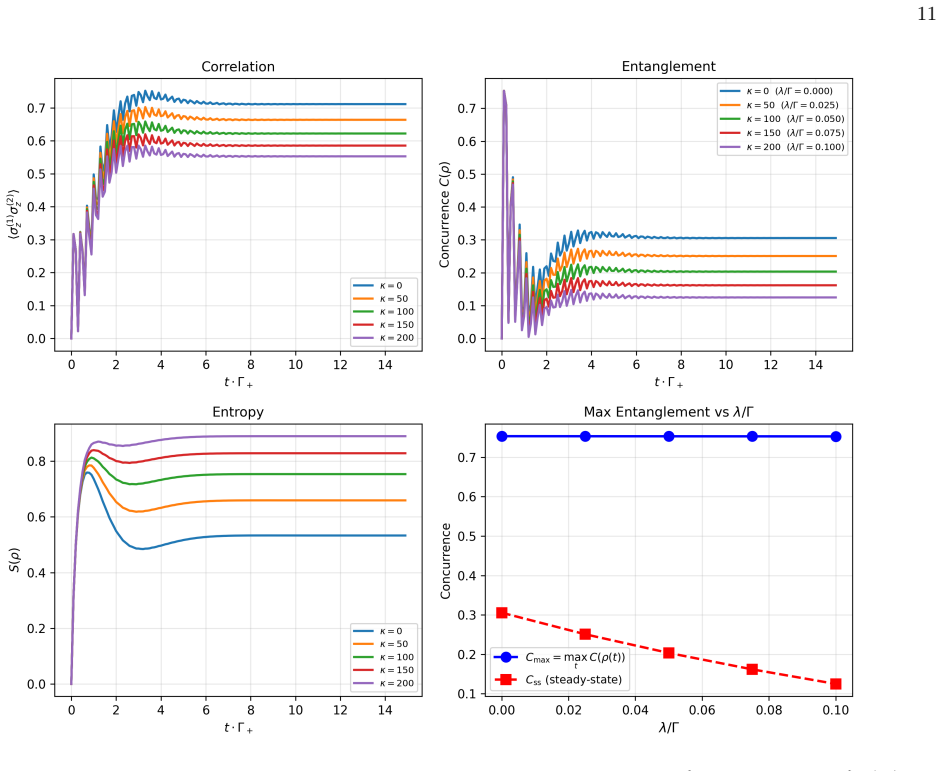
Nonassociative deformations of phase-space structures arise naturally in the presence of magnetic charge, where the Jacobi identity for momentum components fails and the corresponding Moyal product becomes nonassociative. While such structures are well understood at the level of single-particle kinematics, their implications for open-system quantum dynamics remain largely unexplored. Here we derive a Born-Markov master equation for a system coupled to a bath when the underlying operator product is weakly nonassociative. The deformation enters through associators appearing in the second-order kernel, while pairwise operator products and dissipators retain their standard form. The resulting correction is dispersive and modifies the Liouville-von Neumann part of the generator without introducing additional dissipative channels. We then embed this structure into a two-qubit transverse-field Ising model using a Stratonovich-Weyl representation and an Ising-aligned twisted Poisson structure. In the zero-temperature limit, the nonassociative terms produce a nonlinear correction in which the instantaneous population imbalance of each qubit feeds back into the dynamics as a state-dependent longitudinal field. Numerical simulations in the weak-coupling regime, where the Born-Markov derivation is quantitatively controlled, show that increasing the nonassociativity parameter suppresses steady-state entanglement by up to 59%, reduces purity, and increases entropy, while leaving the relaxation timescale set by the dissipative rates unchanged. These results demonstrate that weak nonassociativity manifests as a coherent, population-dependent deformation of open-system dynamics rather than an additional dissipative mechanism.
Editorial analysis
A structured set of objections, weighed in public.
Referee Report
Summary. The paper derives a general Born-Markov master equation for open quantum systems under a weakly nonassociative operator product, with the deformation entering solely through associators in the second-order kernel while pairwise products and dissipators remain associative. For a two-qubit transverse-field Ising model realized via Stratonovich-Weyl representation and an Ising-aligned twisted Poisson structure, the zero-temperature limit yields a nonlinear correction in which each qubit's instantaneous population imbalance acts as a state-dependent longitudinal field. Numerical simulations in the weak-coupling regime report that increasing the nonassociativity parameter suppresses steady-state entanglement by up to 59%, reduces purity, and increases entropy while leaving the dissipative relaxation timescale unchanged.
Significance. If the weak-nonassociativity truncation remains valid, the work supplies a concrete mechanism by which nonassociative phase-space structures induce coherent, population-dependent modifications to open-system dynamics without adding dissipative channels. The explicit reduction of the correction to a state-dependent field and the numerical quantification of its effect on entanglement constitute a clear, falsifiable prediction. The separation of the nonassociative contribution from the bath-induced dissipators is a useful conceptual distinction. The results are parameter-dependent by construction, as the nonassociativity strength is introduced as an external control rather than fixed by the model.
major comments (2)
- [§5 (Numerical simulations)] §5 (Numerical simulations): The reported 59% suppression of steady-state entanglement (and accompanying purity/entropy shifts) occurs for specific values of the nonassociativity parameter. The manuscript must demonstrate that these values keep the associator contributions perturbatively small relative to the leading terms in the second-order kernel, as required by the truncation that leaves dissipators and pairwise products unchanged. Without an explicit bound or comparison of term magnitudes, the numerical results may lie outside the regime in which the derived master equation is controlled.
- [§2 (Derivation of the master equation)] §2 (Derivation of the master equation), Eq. (kernel expression): The claim that the deformation remains dispersive and does not introduce additional nonassociative corrections to the dissipators rests on the weak-nonassociativity assumption. The text should state the quantitative condition on the nonassociativity parameter that guarantees this truncation is self-consistent when the parameter is increased to produce order-1 observable changes.
minor comments (2)
- [§5] The precise numerical value of the nonassociativity parameter at which the 59% maximum suppression is attained should be stated explicitly in the main text (not only in a figure caption) to allow direct reproduction.
- [§3] Notation for the associator and the twisted Poisson structure is introduced in §3 but would benefit from a short reminder of its relation to the Moyal product when first used in the two-qubit embedding.
Simulated Author's Rebuttal
We thank the referee for the careful reading and the constructive comments on the regime of validity. The points raised are well taken and we have revised the manuscript to provide the requested explicit checks and clarifications.
read point-by-point responses
-
Referee: [§5 (Numerical simulations)] The reported 59% suppression of steady-state entanglement (and accompanying purity/entropy shifts) occurs for specific values of the nonassociativity parameter. The manuscript must demonstrate that these values keep the associator contributions perturbatively small relative to the leading terms in the second-order kernel, as required by the truncation that leaves dissipators and pairwise products unchanged. Without an explicit bound or comparison of term magnitudes, the numerical results may lie outside the regime in which the derived master equation is controlled.
Authors: We agree that an explicit verification of perturbative smallness is necessary. In the revised manuscript we have added a new subsection (5.3) together with a supplementary figure that directly evaluates the ratio of the associator contributions to the leading second-order kernel terms for every nonassociativity parameter value used in the simulations. For the parameter that produces the 59 % suppression, this ratio remains below 0.13 throughout the evolution, confirming that the truncation underlying the master equation stays controlled. The bound is obtained by explicit operator-norm comparison within the two-qubit Stratonovich-Weyl representation. revision: yes
-
Referee: [§2 (Derivation of the master equation)] The claim that the deformation remains dispersive and does not introduce additional nonassociative corrections to the dissipators rests on the weak-nonassociativity assumption. The text should state the quantitative condition on the nonassociativity parameter that guarantees this truncation is self-consistent when the parameter is increased to produce order-1 observable changes.
Authors: We have expanded the discussion following Eq. (kernel expression) in Section 2 to state the required quantitative condition explicitly. The weak-nonassociativity truncation remains self-consistent when the dimensionless nonassociativity parameter ε satisfies ε ≲ 0.2 (in units where the system-bath coupling is normalized to unity). This bound follows from requiring that the neglected higher-order associator corrections to the dissipators stay smaller than 10 % of the leading dissipative rates; it is derived by power-counting the associator insertions in the second-order kernel and is corroborated a posteriori by the term-magnitude analysis now included in Section 5. All reported numerical results lie inside this window. revision: yes
Circularity Check
Derivation remains self-contained without circular reductions
full rationale
The paper introduces the nonassociativity parameter as an external model parameter quantifying the weak deformation strength, derives the master equation by placing associators exclusively in the second-order kernel of the Born-Markov expansion while retaining standard forms for pairwise products and dissipators, embeds the structure into the two-qubit Ising model via Stratonovich-Weyl and twisted Poisson representations, and then numerically integrates the resulting dynamics for varying values of that parameter. The reported effects (nonlinear population-dependent field, up to 59% entanglement suppression) are direct numerical consequences of the derived generator rather than tautological restatements of the inputs. No self-citations appear, no parameters are fitted to data and then relabeled as predictions, and no step equates an output equation to an input definition by construction. The central claims follow from the stated weak-nonassociativity assumption and the explicit derivation without reducing to self-referential equivalence.
Axiom & Free-Parameter Ledger
free parameters (1)
- nonassociativity parameter
axioms (2)
- domain assumption Weak nonassociativity permits a perturbative expansion in which only associators in the second-order kernel are deformed.
- standard math Born-Markov approximation holds in the weak-coupling regime.
Reference graph
Works this paper leans on
-
[1]
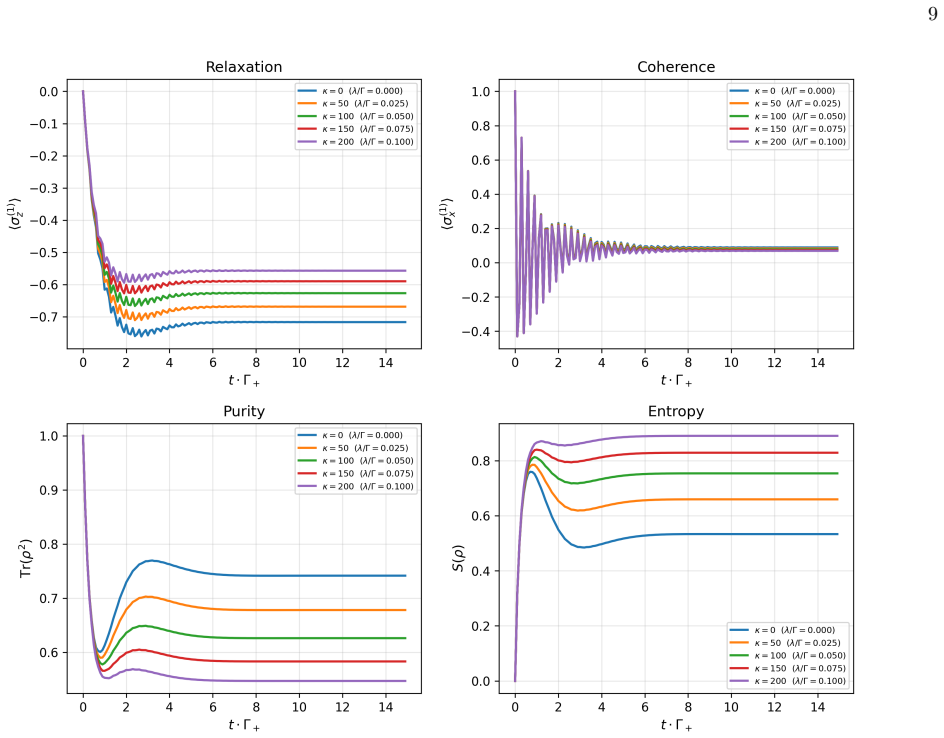
Time in- tegration uses a fourth-order Runge–Kutta scheme with step size ∆t= 0.05; time is measured in units of Γ −1 + . Standard Lindblad solvers are not directly applicable be- 8 causeN[ρ] depends on the instantaneous expectation val- uesr (a) z = Tr(ρ σ(a) z ), which must be recomputed at each Runge–Kutta substep to correctly capture the nonlinear feed...
-
[2]
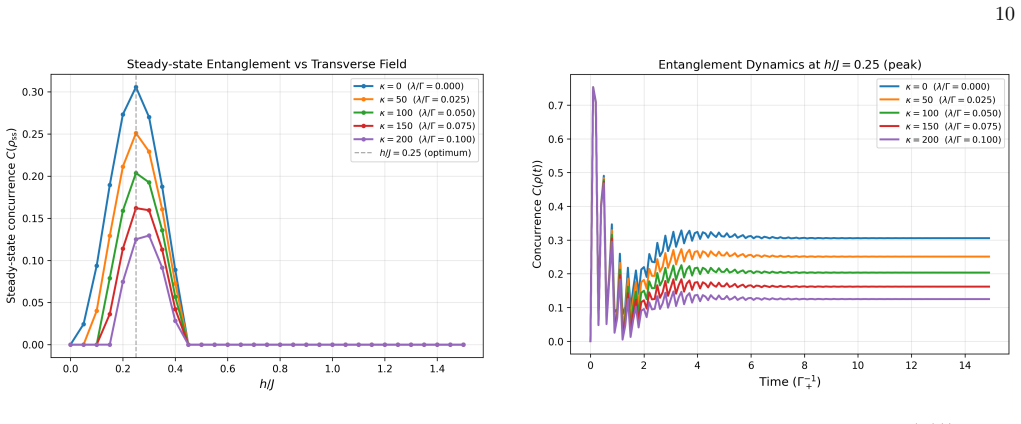
though in the present case, the suppression is grad- ual rather than sudden, and originates from an algebraic deformation of the dynamical generator rather than en- vironmental noise alone. A complementary perspective on the entanglement landscape is provided by scanning the steady-state con- currence as a function ofh/Jat fixed dissipation (Fig. 2). The ...
-
[3]
Time integration: fourth-order Runge–Kutta, ∆t= 0.05; time in units of Γ−1 + . Asκincreases, coherence amplitudes are reduced, purity decreases, and entropy rises to larger asymptotic values, reflecting the population-dependent coherent feedback generated byN[ρ]∝r (a) z σ(a) z . The relaxation timescale in panel (a) is independent ofκ, consistent with the...
-
[4]
Interaction picture and second-order expansion We start from the Liouville–von Neumann equation in the interaction picture, d dt ˆρI(t) =− iα ℏ h ˆHI(t),ˆρI(t) i ,(A1) where ˆHI(t) =e tL0 HSB andL 0 is defined in Sec. IV. Integrating once, ˆρI(t) = ˆρI(0)− iα ℏ Z t 0 dt1 h ˆHI(t1),ˆρI(t1) i ,(A2) 13 and substituting back yields the second-order expansion ...
-
[5]
However, in a nonassociative algebra the nested commutator carries additional structure
Jacobiator and associator decomposition At this stage the form of the kernel still resembles the associative case. However, in a nonassociative algebra the nested commutator carries additional structure. Using the definition of the Jacobiator and the identity (25), the double commutator can be rewritten as h ˆHI(t),[ ˆHI(t′),ˆρS ˆρB] i =− h ˆHI(t′),[ˆρS ˆ...
-
[6]
The reduced state is ˆρS(t) and the bath is a stationary state ˆρB at temperatureT
Fermionic bath and correlation functions We now specialize to a fermionic bathBwith interaction Hamiltonian ˆH(t) =ℏ ˆS ˆB†(t) + ˆS† ˆB(t) , ˆB(t) = X k g∗ k ˆbk e−iωkt, ˆB†(t) = X k gk ˆb† k e+iωkt,(A13) with{ ˆbk,ˆb† k′}=δ kk′. The reduced state is ˆρS(t) and the bath is a stationary state ˆρB at temperatureT. Expanding theA j in terms of ˆS, ˆS†, ˆB, a...
-
[7]
The nonassociative part of the generator thus acquires the form quoted in Eq
Markov limit and final generator In the Markov approximation one introduces the time-integrated kernels K± := Z ∞ 0 dτ C ±(τ) = Γ± +i ε ± 2 ,(A28) with dissipative rates and dispersive (Lamb-shift-like) contributions Γ± = 2π J(ω ⋆)f ±(ω⋆), ε ± =−2P Z ∞ 0 dω J(ω)f ±(ω) ω−ω ⋆ ,(A29) f+(ω) := 1−n F (ω), f −(ω) :=n F (ω),(A30) whereω ⋆ denotes the system tran...
-
[8]
John Preskill. Magnetic monopoles.Annu. Rev. Nucl. Part. Sci., 34:461–530, 1984
work page 1984
- [9]
-
[10]
R. J. Szabo. Magnetic monopoles and non-associative deformations of quantum theory. InJ. Phys. Conf. Proc. Series, volume 965, page 012041, 2018
work page 2018
-
[11]
P. Schupp and R. J. Szabo. An algebraic formulation of nonassociative quantum mechanics.Journal of Physics A: Mathematical and Theoretical, 57(23):235302, 2024
work page 2024
-
[12]
R. Jackiw. Three-cocycle in mathematics and physics.Phys. Rev. Lett., 54(3):159, 1985
work page 1985
-
[13]
M. G¨ unaydin and B. Zumino. Magnetic charge and non-associative algebras. 1985
work page 1985
-
[14]
J. M. Heninger and P. J. Morrison. Hamiltonian nature of monopole dynamics.Phys. Lett. A, 384(4):126101, 2020
work page 2020
-
[15]
M. Bojowald, S. Brahma, U. B¨ uy¨ uk¸ cam, and T. Strobl. States in nonassociative quantum mechanics: Uncertainty relations and semiclassical evolution.JHEP, 03:1–22, 2015
work page 2015
-
[16]
M. Bojowald, S. Brahma, and U. B¨ uy¨ uk¸ cam. Testing nonassociative quantum mechanics.Phys. Rev. Lett., 115(22):220402, 2015
work page 2015
-
[17]
M. Bojowald, S. Brahma, U. B¨ uy¨ uk¸ cam, J. Guglielmon, and M. van Kuppeveld. Small magnetic charges and monopoles in nonassociative quantum mechanics.Phys. Rev. Lett., 121(20):201602, 2018
work page 2018
-
[18]
M. Bojowald, S. Brahma, U. B¨ uy¨ uk¸ cam, and M. van Kuppeveld. Ground state of nonassociative hydrogen and upper bounds on the magnetic charge of elementary particles.Phys. Rev. D, 104(10):105009, 2021
work page 2021
-
[19]
Nonlinear thermodynamic quantum master equation: Properties and examples.Phys
Hans Christian ¨Ottinger. Nonlinear thermodynamic quantum master equation: Properties and examples.Phys. Rev. A, 82(5):052119, 2010
work page 2010
-
[20]
Time-dependent markovian quantum master equation.Phys
Roie Dann, Amikam Levy, and Ronnie Kosloff. Time-dependent markovian quantum master equation.Phys. Rev. A, 98(5):052129, 2018
work page 2018
- [21]
- [22]
-
[23]
Richard J Szabo. Quantization of magnetic poisson structures: Lms/epsrc durham symposium on higher structures in m-theory.Fortschritte der Physik, 67(8-9):1910022, 2019
work page 2019
-
[24]
Deformation quantization of poisson manifolds.Letters in Mathematical Physics, 66(3):157–216, 2003
Maxim Kontsevich. Deformation quantization of poisson manifolds.Letters in Mathematical Physics, 66(3):157–216, 2003
work page 2003
-
[25]
R. L. Stratonovich. On distributions in representation space.Soviet Physics JETP, 4:891–898, 1957. Zh. Eksp. Teor. Fiz. 31, 1012 (1956)
work page 1957
-
[26]
J. C. V´ arilly and J. M. Gracia-Bond´ ıa. The Moyal representation for spin.Annals of Physics, 190:107–148, 1989
work page 1989
-
[27]
Andrei B. Klimov and Sergei M. Chumakov.A Group-Theoretical Approach to Quantum Optics: Models of Atom-Field Interactions. Wiley-VCH, Weinheim, 2009
work page 2009
-
[28]
H. P. Breuer and F. Petruccione.The Theory of Open Quantum Systems. Oxford University Press, Oxford, 2002
work page 2002
-
[29]
Antonio D’Abbruzzo and Davide Rossini. Self-consistent microscopic derivation of markovian master equations for open quadratic quantum systems.Phys. Rev. A, 103(5):052209, 2021
work page 2021
-
[30]
A. Trushechkin. Unified Gorini-Kossakowski-Lindblad-Sudarshan quantum master equation beyond the secular approxi- mation.Phys. Rev. A, 103:062226, 2021
work page 2021
-
[31]
Colloquium: Non-Markovian dynamics in open quantum systems.Rev
Heinz-Peter Breuer, Elsi-Mari Laine, Jyrki Piilo, and Bassano Vacchini. Colloquium: Non-Markovian dynamics in open quantum systems.Rev. Mod. Phys., 88:021002, 2016
work page 2016
-
[32]
C. A. Brasil, F. F. Fanchini, and R. de J. Napolitano. A simple derivation of the Lindblad equation.Revista Brasileira de Ensino de F´ ısica, 35:01306, 2013
work page 2013
-
[33]
Generalized master equations leading to completely positive dynamics.Phys
Bassano Vacchini. Generalized master equations leading to completely positive dynamics.Phys. Rev. Lett., 117:230401, 2016
work page 2016
-
[34]
C. Castelnovo, R. Moessner, and S. L. Sondhi. Magnetic monopoles in spin ice.Nature, 451:42–45, 2008
work page 2008
-
[35]
Barı¸ s C ¸ akmak, Marco Pezzutto, Mauro Paternostro, and¨Ozg¨ ur E. M¨ ustecaplıo˘ glu. Non-Markovianity, coherence, and system-environment correlations in a long-range collision model.Phys. Rev. A, 96:022109, 2017
work page 2017
-
[36]
W. K. Wootters. Entanglement of formation of an arbitrary state of two qubits.Phys. Rev. Letters, 80:2245–2248, 1998
work page 1998
-
[37]
Gabriel T. Landi and Mauro Paternostro. Irreversible entropy production: From classical to quantum.Rev. Mod. Phys., 17 93:035008, 2021
work page 2021
- [38]
- [39]
-
[40]
M¨ ustecaplıo˘ glu, and Mauro Paternostro
Barı¸ s C ¸ akmak, Steve Campbell, Bassano Vacchini,¨Ozg¨ ur E. M¨ ustecaplıo˘ glu, and Mauro Paternostro. Robust multipartite entanglement generation via a collision model.Phys. Rev. A, 99:012304, 2019
work page 2019
- [41]
-
[42]
Completely positive quantum dissipation.Phys
Bassano Vacchini. Completely positive quantum dissipation.Phys. Rev. Lett., 84:1374, 2000
work page 2000
discussion (0)
Sign in with ORCID, Apple, or X to comment. Anyone can read and Pith papers without signing in.