Fermion Zero Modes and Fermion number 1/2 of the Electroweak Monopole
Pith reviewed 2026-05-10 07:06 UTC · model grok-4.3
The pith
The electroweak monopole has fermion number exactly 1/2 because its fermion spectrum is symmetric about zero and contains only one zero mode.
A machine-rendered reading of the paper's core claim, the machinery that carries it, and where it could break.
Core claim
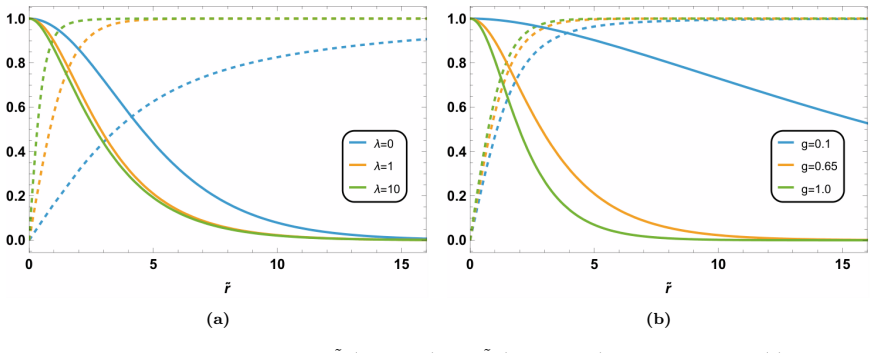
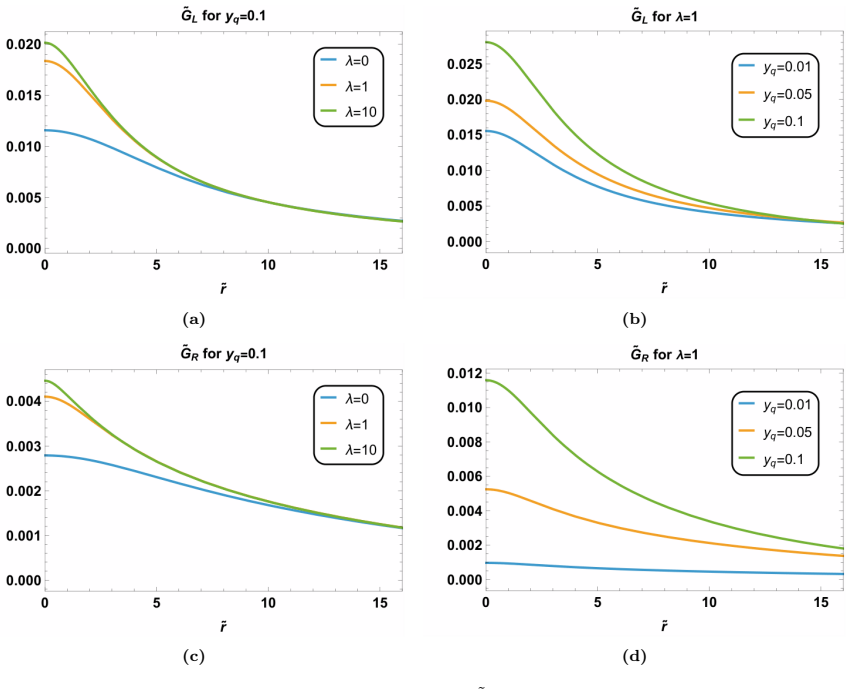
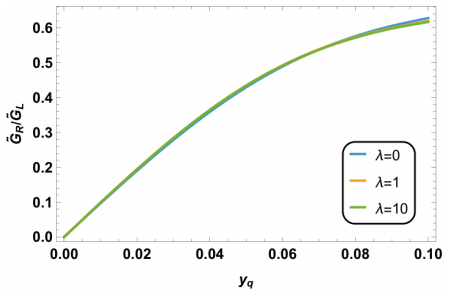
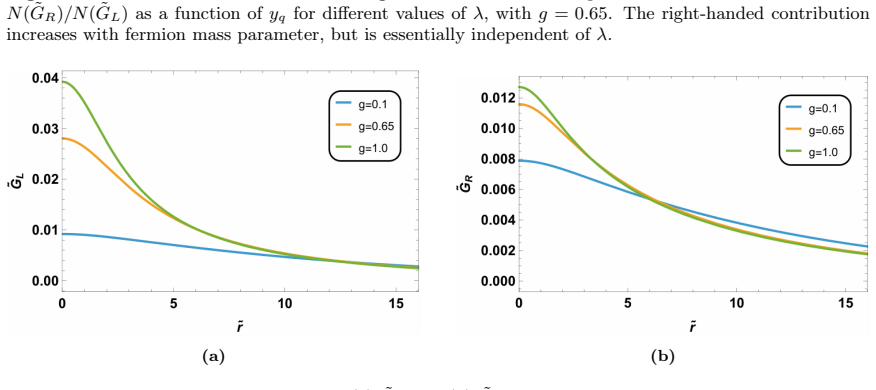
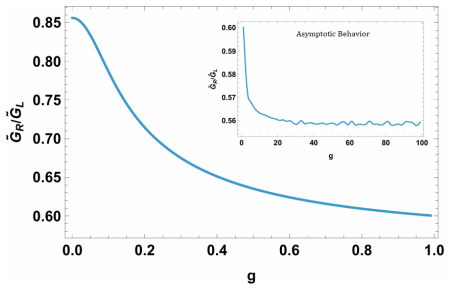
Numerical solutions to the coupled differential equations for the fermion wave functions in the monopole background, performed at selected points in the (g, λ, y_q) parameter space, reveal only a single zero mode, supported by an analytic argument for its existence. The monopole and zero-mode profiles become more localized as g and λ increase, while the right-handed component of the zero mode decreases with g yet increases with y_q. The zero mode obtained in the limit g approaching zero differs from the zero mode supported by the Higgs field alone. The Dirac spectrum obeys an exact mirror symmetry that maps every positive-energy state to a negative-energy state; combined with the isolated, n
What carries the argument
Spectral mirror symmetry of the fermion Dirac operator in the monopole background, which enforces exact pairing of positive and negative eigenvalues and, together with the single zero eigenvalue, fixes the net fermion number at one half.
If this is right
- The monopole carries fermion number exactly 1/2 for all physical values of the couplings.
- The fermion spectrum contains no bound states other than the single zero mode.
- The zero-mode wave function and the monopole profiles both localize more strongly as the gauge coupling g and the Higgs self-coupling λ increase.
- The right-handed component of the zero-mode wave function decreases as g grows and increases as the Yukawa coupling y_q grows.
- The zero mode does not reduce to the pure-Higgs zero mode when the gauge coupling is taken to zero.
Where Pith is reading between the lines
- Lattice simulations of the electroweak theory should detect a fractional fermion charge localized on monopole configurations.
- The nonlinear interplay between the gauge and Higgs fields prevents the zero mode from decoupling into the Higgs-only solution even at arbitrarily small gauge coupling.
- Analogous spectral symmetries may fix fractional quantum numbers on other topological defects that couple to chiral fermions.
Load-bearing premise
Numerical checks at a finite set of points in the three-dimensional space of gauge, Higgs, and Yukawa couplings suffice to prove that no additional bound states exist and that the zero mode persists for every physically allowed value of the couplings.
What would settle it
An explicit solution or numerical scan that finds a second bound state with nonzero energy, or that breaks the positive-negative energy pairing, at any physical point in the (g, λ, y_q) space would falsify the claim that the fermion number is exactly one half.
Figures
read the original abstract
Fermion bound states in the background of the electroweak SU(2) monopole are investigated for various values of gauge coupling constant $g$, the Higgs self-coupling constant $\lambda$, and the Yukawa coupling constant $y_q$. Numerical solutions to the set of coupled differential equations for various selected points in the parameter space reveal only a zero mode, for which we also present an analytic argument. We show that the monopole profile functions and the zero mode wave function become more localized with increasing $g$ and $\lambda$, while the right-handed component of the latter decreases with $g$. However, as expected, this component increases with $y_q$. We find that the zero mode in the limit $g\to 0$ differs from the zero mode held by the Higgs alone, highlighting the nonlinear and nonperturbative character of the system. Finally, we prove the spectral mirror symmetry of the fermion, whence, together with the existence of the zero mode, we infer the fermion number $1/2$ of the electroweak monopole.
Editorial analysis
A structured set of objections, weighed in public.
Referee Report
Summary. The manuscript investigates fermion bound states in the background of the electroweak SU(2) monopole by numerically solving the coupled radial Dirac equations for selected values of the gauge coupling g, Higgs self-coupling λ, and Yukawa coupling y_q. It reports that only a zero-energy mode is found, supplies an analytic argument for the existence of this mode, demonstrates its localization properties as functions of the couplings, and proves spectral mirror symmetry of the fermion spectrum under E ↔ −E. From the combination of the zero mode and the symmetry, the authors conclude that the monopole carries fermion number exactly 1/2.
Significance. If the central claims are established rigorously, the result would provide a concrete realization of fractional fermion number for the electroweak monopole, with implications for anomaly inflow and monopole-induced processes. The analytic proof of spectral mirror symmetry and the explicit zero-mode construction are strengths that go beyond pure numerics; the observation that the g → 0 limit differs from the pure-Higgs case also usefully highlights the non-perturbative character of the full system.
major comments (2)
- [Numerical results (implicit in abstract and main text)] The assertion that “numerics reveal only a zero mode” rests on integration at a finite set of selected points in (g, λ, y_q) space. No error bars, convergence tests with respect to radial grid size or cutoff, or exhaustive scan are reported; without these, the absence of additional non-zero-energy bound states cannot be regarded as established for all physically relevant couplings, directly affecting the spectral-asymmetry counting that yields fermion number 1/2.
- [Analytic zero-mode argument] The analytic argument for the zero mode is invoked but its explicit form, boundary conditions, and domain of validity (especially outside the numerically sampled region) are not stated in sufficient detail to allow independent verification that the mode persists for arbitrary physical values of the couplings.
minor comments (2)
- [Abstract and numerical section] The abstract and main text should specify the precise ranges and sampling density of the parameters g, λ, y_q that were explored numerically.
- [Technical setup] Notation for the radial profile functions and the decomposition of the fermion spinor into left- and right-handed components should be defined once at the beginning of the technical sections to improve readability.
Simulated Author's Rebuttal
We thank the referee for the careful reading and constructive comments on our manuscript. We address each major comment below and outline the revisions we will implement.
read point-by-point responses
-
Referee: [Numerical results (implicit in abstract and main text)] The assertion that “numerics reveal only a zero mode” rests on integration at a finite set of selected points in (g, λ, y_q) space. No error bars, convergence tests with respect to radial grid size or cutoff, or exhaustive scan are reported; without these, the absence of additional non-zero-energy bound states cannot be regarded as established for all physically relevant couplings, directly affecting the spectral-asymmetry counting that yields fermion number 1/2.
Authors: The spectral mirror symmetry is established analytically and guarantees that any non-zero-energy states appear in ±E pairs, so they do not alter the spectral asymmetry. The fermion number 1/2 therefore follows rigorously from the existence of the single zero mode together with this symmetry, without requiring the absence of non-zero bound states. We nevertheless agree that the numerical evidence is limited to selected points. In the revised manuscript we will add convergence tests with respect to radial grid size and cutoff, together with estimates of numerical accuracy, to better document the reported solutions. revision: partial
-
Referee: [Analytic zero-mode argument] The analytic argument for the zero mode is invoked but its explicit form, boundary conditions, and domain of validity (especially outside the numerically sampled region) are not stated in sufficient detail to allow independent verification that the mode persists for arbitrary physical values of the couplings.
Authors: We agree that the analytic construction requires more explicit detail. The revised manuscript will present the full explicit form of the zero-mode solution, specify the boundary conditions at the origin and at spatial infinity, and discuss its validity for general values of the couplings g, λ, and y_q, thereby allowing independent verification beyond the numerically sampled region. revision: yes
Circularity Check
No circularity; derivation is self-contained
full rationale
The paper presents an independent analytic argument for the zero mode, proves spectral mirror symmetry of the Dirac operator (E ↔ −E) as a separate step, and infers fermion number 1/2 directly from their combination. Numerical integration at selected (g, λ, y_q) points is used only to support the absence of additional bound states; it is not a fit that is then relabeled as a prediction, nor does any central equation reduce to its own input by definition. No load-bearing self-citation or ansatz smuggling is present in the derivation chain.
Axiom & Free-Parameter Ledger
axioms (2)
- domain assumption The background gauge and Higgs fields are given by the standard spherically symmetric electroweak monopole solution.
- domain assumption The radial reduction of the Dirac operator yields a closed set of ordinary differential equations whose only normalizable solution at zero energy is the reported zero mode.
Reference graph
Works this paper leans on
-
[1]
Quantised singularities in the electromagnetic field,,
P. A. M. Dirac, “Quantised singularities in the electromagnetic field,,”Proc. Roy. Soc. Lond. A, vol. 133, no. 821, pp. 60–72, 1931
work page 1931
-
[2]
Dirac monopole without strings: Monopole harmonics,
T. T. Wu and C. N. Yang, “Dirac monopole without strings: Monopole harmonics,”Nuclear Physics B, vol. 107, no. 3, pp. 365–380, 1976
work page 1976
- [3]
-
[4]
Magnetic Monopoles in Unified Gauge Theories,
G. ’t Hooft, “Magnetic Monopoles in Unified Gauge Theories,”Nucl. Phys. B, vol. 79, pp. 276– 284, 1974
work page 1974
-
[5]
Particle Spectrum in Quantum Field Theory,
A. M. Polyakov, “Particle Spectrum in Quantum Field Theory,”JETP Lett., vol. 20, pp. 194– 195, 1974
work page 1974
-
[6]
S. Weinberg, “A Model of Leptons,”Phys. Rev. Lett., vol. 19, pp. 1264–1266, 1967
work page 1967
-
[7]
Elementary particle physics: Relativistic groups and analyticity,
A. Salam, “Elementary particle physics: Relativistic groups and analyticity,” inProceedings of the Eighth Nobel Symposium(N. Svartholm, ed.), (Stockholm), p. 367, Almqvist and Wiksell,
-
[8]
Reprinted inRev. Mod. Phys.52, 525 (1980)
work page 1980
-
[9]
Monopole configuration in weinberg–salam model,
Y. M. Cho and D. Maison, “Monopole configuration in weinberg–salam model,”Physics Letters B, vol. 391, pp. 360–365, 1997
work page 1997
-
[10]
Electroweak monopoles and their stability,
R. Gervalle and M. S. Volkov, “Electroweak monopoles and their stability,”Nuclear Physics B, vol. 984, p. 115937, Nov. 2022
work page 2022
-
[11]
Physical implications of electroweak monopole,
Y. M. Cho, “Physical implications of electroweak monopole,”Philosophical Transactions of the Royal Society A: Mathematical, Physical and Engineering Sciences, vol. 377, p. 20190038, 11 2019
work page 2019
-
[12]
Solitons with fermion number 1/2,
R. Jackiw and C. Rebbi, “Solitons with fermion number 1/2,”Phys. Rev. D, vol. 13, pp. 3398– 3409, 1976. Seminal work demonstrating fermion zero modes in soliton/monopole backgrounds
work page 1976
-
[13]
Zero modes of the ’t hooft-polyakov monopole,
E. Mottola, “Zero modes of the ’t hooft-polyakov monopole,”Phys. Lett. B, vol. 79, pp. 242–244,
-
[14]
Explicit solution of zero-energy fluctuations around the non-Abelian monopole
-
[15]
Zero modes of the vortex-fermion system,
R. Jackiw and P. Rossi, “Zero modes of the vortex-fermion system,”Nucl. Phys. B, vol. 190, pp. 681–691, 1981. Analysis of fermion zero modes in vortex backgrounds and connection to index theorems
work page 1981
-
[16]
The index of elliptic operators on compact manifolds,
M. F. Atiyah and I. M. Singer, “The index of elliptic operators on compact manifolds,”Bull. Am. Math. Soc., vol. 69, pp. 422–433, 1969. 15
work page 1969
-
[17]
Kaluza-klein monopoles and their zero modes,
N. S. et al., “Kaluza-klein monopoles and their zero modes,”Phys. Rev. Lett., vol. 120, p. 071603,
-
[18]
Study of zero modes in KK monopoles, relevant for SUSY and compactified theories
-
[19]
Observation of monopole topological mode,
H. C. et al., “Observation of monopole topological mode,”Nature Commun., vol. 15, p. 51670,
-
[20]
Experimental realization of monopole-bound zero modes in Dirac acoustic crystals
-
[21]
Comments on nonlinear wave equations as models for elementary particles,
G. H. Derrick, “Comments on nonlinear wave equations as models for elementary particles,”J. Math. Phys., vol. 5, pp. 1252–1254, 1964
work page 1964
-
[22]
Explicit construction of constrained instantons,
M. Nielsen and N. K. Nielsen, “Explicit construction of constrained instantons,”Phys. Rev. D, vol. 61, p. 105020, Apr 2000
work page 2000
-
[23]
Process of fermion level crossing in the electroweak instanton.,
Yang, “Process of fermion level crossing in the electroweak instanton.,”Physical review. D, Particles and fields, vol. 49 10, pp. 5491–5496, 1994
work page 1994
-
[24]
Fermion number 1/2 of sphalerons and spectral mirror sym- metry,
M. Mehraeen and S. S. Gousheh, “Fermion number 1/2 of sphalerons and spectral mirror sym- metry,”The European Physical Journal C, vol. 80, Sept. 2020
work page 2020
-
[25]
Exact solutions of a fermion-soliton system in two dimen- sions,
L. Shahkarami and S. S. Gousheh, “Exact solutions of a fermion-soliton system in two dimen- sions,”Journal of High Energy Physics, vol. 2011, June 2011
work page 2011
-
[26]
N. Manton and P. Sutcliffe,Topological Solitons. Cambridge Monographs on Mathematical Physics, Cambridge University Press, 2004
work page 2004
-
[27]
North-Holland personal library, North-Holland Publishing Company, 1982
R.Rajaraman,Solitons and Instantons: An Introduction to Solitons and Instantons in Quantum Field Theory. North-Holland personal library, North-Holland Publishing Company, 1982
work page 1982
-
[28]
Electroweak monopoles and the electroweak phase transi- tion,
S. Arunasalam and A. Kobakhidze, “Electroweak monopoles and the electroweak phase transi- tion,”The European Physical Journal C, vol. 77, July 2017
work page 2017
-
[29]
Answer to a mathematica stack exchange question
Mathematica Stack Exchange user, “Answer to a mathematica stack exchange question.”https: //mathematica.stackexchange.com/a/127997, 2016. Accessed January 2026
work page 2016
-
[30]
C. G. Callan, “Dyon-fermion dynamics,”Phys. Rev. D, vol. 26, pp. 2058–2068, Oct 1982
work page 2058
-
[31]
Skyrmions, vacuum polarization, and the adiabatic method,
S. S. Gousheh, “Skyrmions, vacuum polarization, and the adiabatic method,”Phys. Rev. D, vol. 45, pp. 2920–2928, Apr 1992
work page 1992
-
[32]
Sphalerons, spectral flow, and anomalies,
F. R. Klinkhamer and C. Rupp, “Sphalerons, spectral flow, and anomalies,”Journal of Mathe- matical Physics, vol. 44, p. 3619–3639, Aug. 2003. 16
work page 2003
discussion (0)
Sign in with ORCID, Apple, or X to comment. Anyone can read and Pith papers without signing in.