ParikkhaChain: Blockchain-Based Result Processing and Privacy-Preserving Academic Record Management for the Complete Examination Lifecycle
Pith reviewed 2026-05-10 07:21 UTC · model grok-4.3
The pith
Blockchain system covers entire physical exam process with anonymous marking and transparent audits.
A machine-rendered reading of the paper's core claim, the machinery that carries it, and where it could break.
Core claim
ParikkhaChain is the first system to integrate support for physical examination processes with anonymous marking via cryptographic hashing of answer scripts, transparent evaluation and scrutiny workflows using immutable on-chain audit trails, and privacy-preserving verification with zero-knowledge proofs, as shown by successful simulation of full exam cycles to grade-sheet generation on a large scale.
What carries the argument
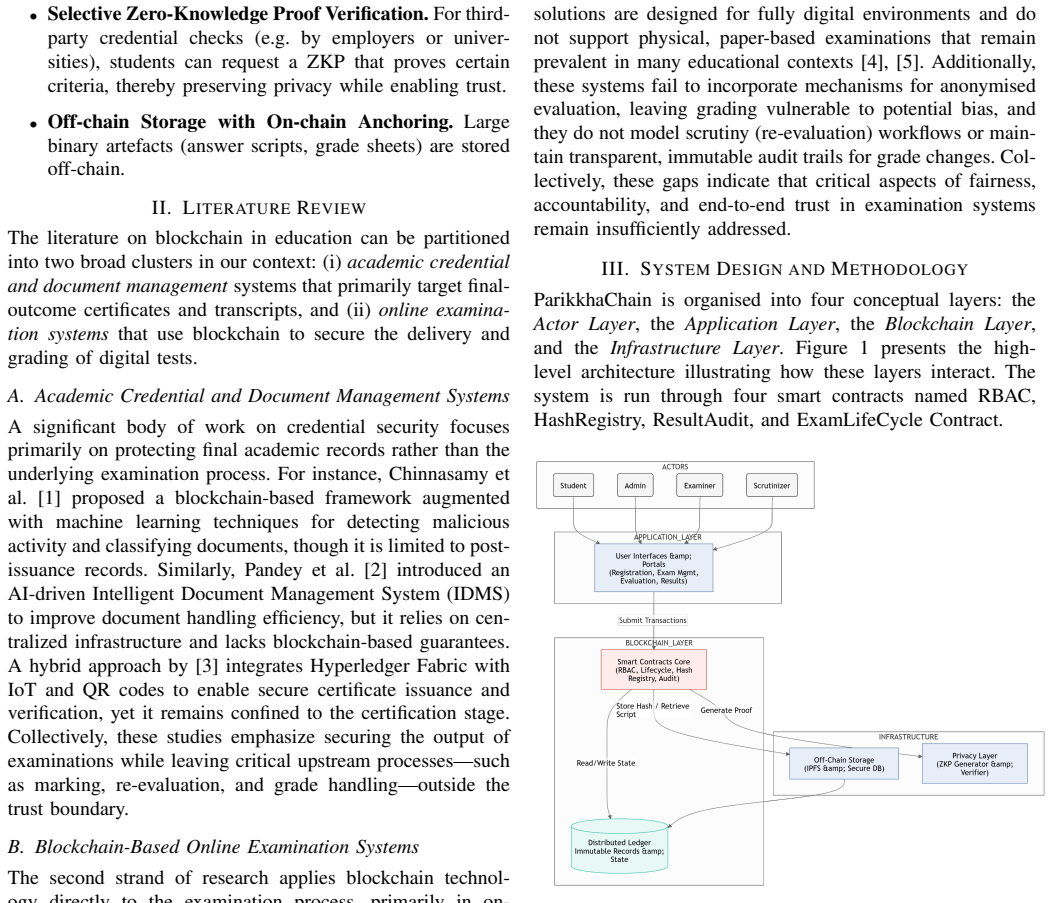
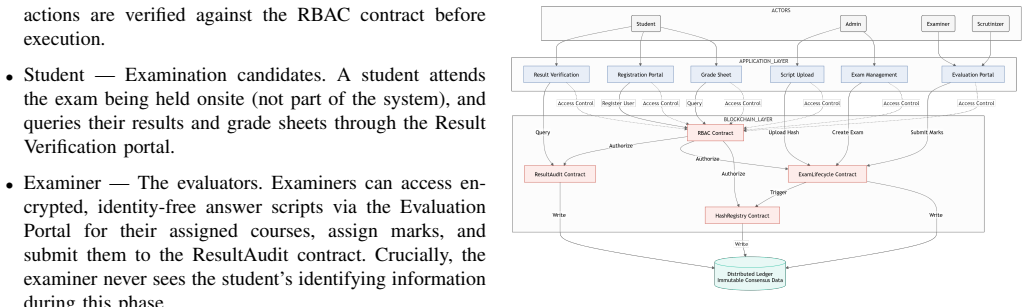
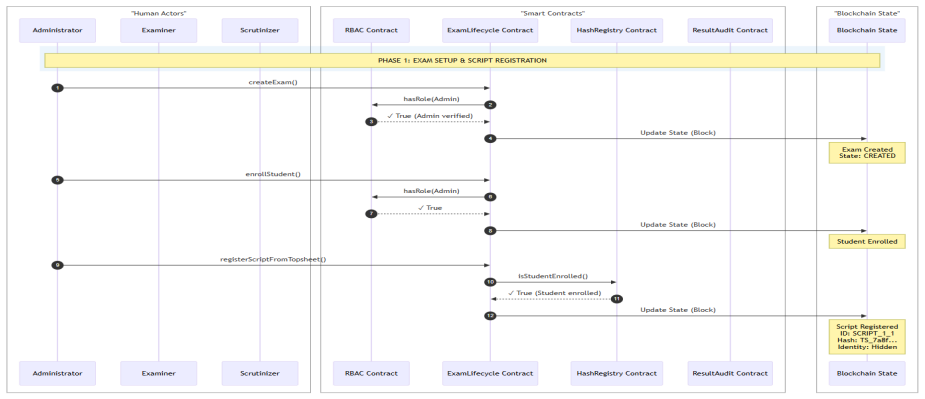
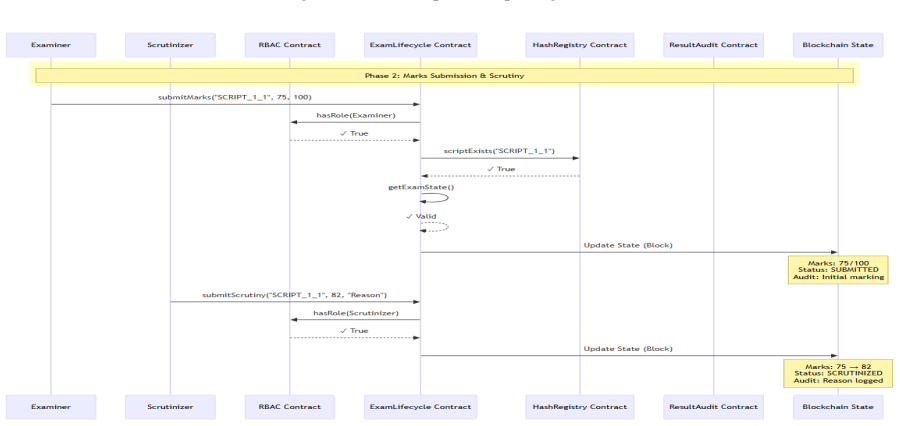
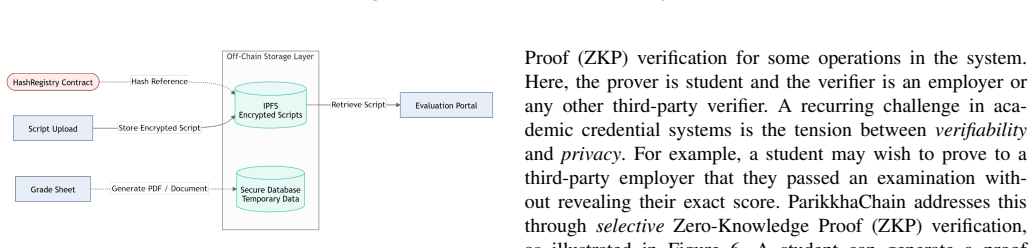
Four Solidity smart contracts deployed on the Ethereum blockchain that handle the workflow of hashing physical answer scripts before evaluation, recording marks and revisions on the blockchain, and supporting zero-knowledge proof verifications with off-chain data storage.
If this is right
- Examiners cannot access student identities during marking, reducing bias.
- Every step in grading and re-evaluation leaves a permanent, tamper-proof record.
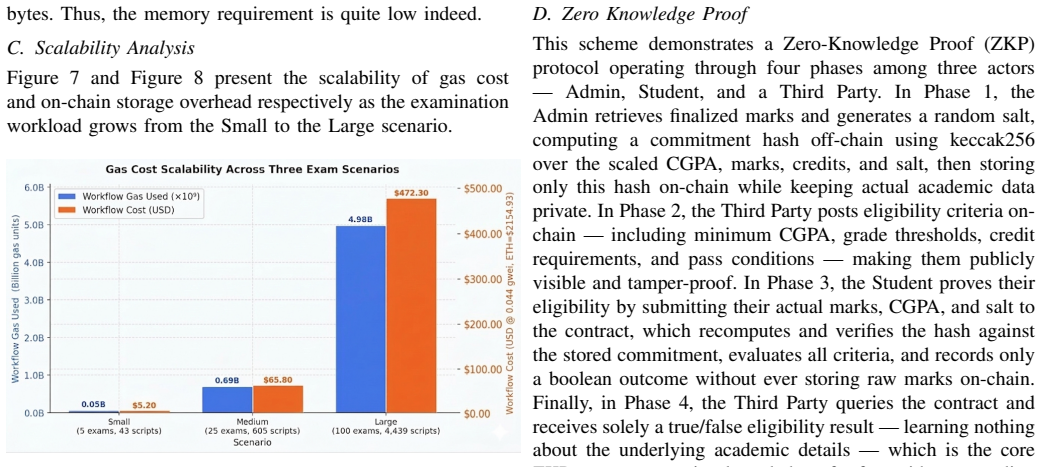
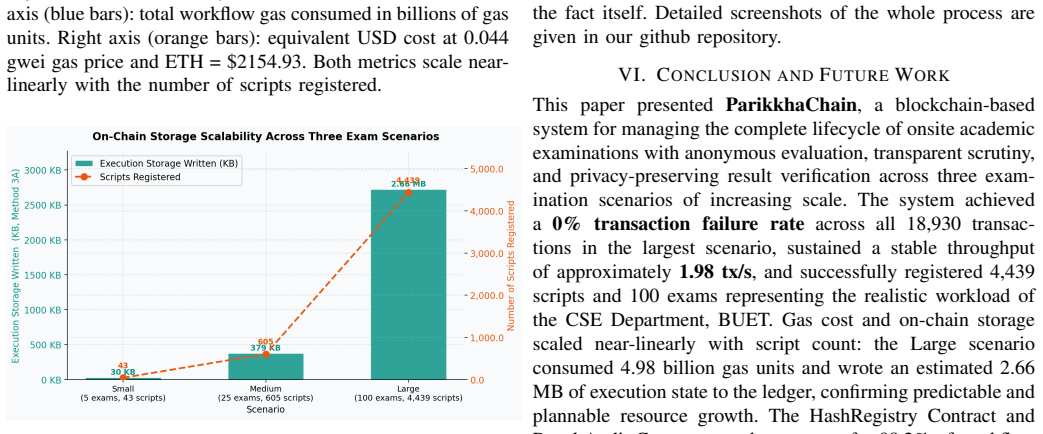
- The prototype handles operations for 100 courses with low storage and transaction costs.
- Records can be verified privately without exposing sensitive information.
Where Pith is reading between the lines
- Adopting such a system could extend to other areas requiring anonymous review and audit trails, such as research paper submissions or grant evaluations.
- Further development might include integration with biometric or digital identity systems for even stronger verification.
- Real-world deployment would need to address potential scalability issues beyond the simulated environment and user training for the new processes.
Load-bearing premise
Cryptographic hashing of physical answer scripts together with on-chain records and zero-knowledge proofs will consistently remove identity-based bias and provide practical privacy without introducing new vulnerabilities or scalability problems in institutional settings.
What would settle it
Deploy the working prototype in an actual university examination involving physical scripts, multiple courses, and real participants, then verify whether student identities remain hidden during marking, all changes are auditable, and verification functions without data leaks or excessive costs.
Figures

read the original abstract
Academic examination systems worldwide continue to rely on centralised, opaque record-keeping that is often vulnerable to credential forgery, result tampering, examiner bias, and the absence of transparent re-evaluation pathways. Existing blockchain-based approaches in education focus predominantly on post-hoc certificate storage or online-only examination portals, leaving the complete onsite examination lifecycle, from conducting exams through scrutiny, largely unaddressed. This paper proposes ParikkhaChain, a blockchain-based framework that covers the entire examination lifecycle of an onsite examination system with three distinguishing contributions: (i) anonymous script evaluation through cryptographic hashing of answer scripts before examiner access, thereby eliminating identity-based bias; (ii) a transparent evaluation and scrutiny workflow backed by an immutable on-chain audit trail that records every mark submission and grade revision; and (iii) inclusion of privacy-preserving verification using zero-knowledge proofs and off-chain storage mechanisms. The system is architected around four Solidity smart contracts deployed on the Ethereum blockchain. The proposed architecture is the first initiative to our knowledge to support physical examination process, anonymous marking, and re-evaluation transparency. We successfully simulate full exam cycles of an onsite exam to grade-sheet generation using a working prototype on a large scale of 100 courses and hundreds of teachers and students. The experimental results show that the system can manage online examinations of hundreds of courses, students and faculties efficiently with great throughput, low storage, and transaction cost. Our codebase is available in open source form at https://github.com/AhmedRumi/CSE6608-ParikkhaChain
Editorial analysis
A structured set of objections, weighed in public.
Referee Report
Summary. The manuscript proposes ParikkhaChain, a blockchain-based framework for managing the complete lifecycle of onsite academic examinations using four Solidity smart contracts on Ethereum. It claims to enable anonymous marking by cryptographic hashing of physical answer scripts to eliminate examiner bias, provide transparent re-evaluation with immutable audit trails, and ensure privacy via zero-knowledge proofs and off-chain storage. The authors present a working prototype simulation that handles full exam cycles for 100 courses involving hundreds of teachers and students, reporting high throughput, low storage, and transaction costs, and assert this is the first such system supporting physical exams, anonymous marking, and re-evaluation transparency.
Significance. If the privacy and bias-elimination properties are validated, the work could offer a practical approach to improving trust and transparency in traditional examination systems by integrating blockchain with physical processes. The open-source prototype and simulation at scale provide a foundation for further development, though the significance is limited by the absence of real-world deployment data and rigorous security analysis.
major comments (2)
- [Evaluation section] Evaluation section: The prototype simulation for 100 courses reports throughput and cost metrics supporting basic feasibility, but includes no adversarial analysis, threat model validation, or testing of the scanning/upload pipeline for re-identification or correlation attacks. This leaves the central claims of reliable bias elimination and practical privacy unverified.
- [System Architecture and Privacy Mechanisms sections] System Architecture and Privacy Mechanisms sections: The assumption that cryptographic hashing of physical scripts plus ZK proofs severs student identity from examiners is presented without formal analysis of vulnerabilities in the physical-to-digital transition or scalability under concurrent re-evaluation requests, which is load-bearing for the bias-free and privacy claims.
minor comments (2)
- [Introduction] The related work discussion could include more recent blockchain-in-education references to strengthen the novelty positioning.
- Workflow diagrams would benefit from clearer labeling of off-chain vs. on-chain components for improved readability.
Simulated Author's Rebuttal
We thank the referee for their constructive feedback on our manuscript. We address each major comment point by point below, indicating the revisions we plan to make to strengthen the presentation of our claims.
read point-by-point responses
-
Referee: The prototype simulation for 100 courses reports throughput and cost metrics supporting basic feasibility, but includes no adversarial analysis, threat model validation, or testing of the scanning/upload pipeline for re-identification or correlation attacks. This leaves the central claims of reliable bias elimination and practical privacy unverified.
Authors: We agree that the Evaluation section focuses on performance and feasibility metrics from the simulation rather than security validation. In the revised manuscript we will add a dedicated threat model subsection that explicitly outlines potential adversaries, attack surfaces in the physical-to-digital scanning and upload pipeline, and how cryptographic hashing combined with ZK proofs is intended to mitigate re-identification and correlation risks. We will also discuss the limitations of the current simulation-based approach and note that comprehensive adversarial testing would require real examination data, which is planned as future work. This addition will better ground the bias-elimination and privacy claims. revision: partial
-
Referee: The assumption that cryptographic hashing of physical scripts plus ZK proofs severs student identity from examiners is presented without formal analysis of vulnerabilities in the physical-to-digital transition or scalability under concurrent re-evaluation requests, which is load-bearing for the bias-free and privacy claims.
Authors: We acknowledge that the current manuscript presents the architecture without a detailed vulnerability analysis. We will revise the System Architecture and Privacy Mechanisms sections to include an informal security analysis of the physical-to-digital transition, covering potential issues such as scanning artifacts, metadata leakage, or hash collisions, and how the design counters them. We will also add simulation results or analytical discussion on handling concurrent re-evaluation requests to address scalability. A full formal cryptographic proof lies outside the scope of this feasibility study and will be identified as future work. revision: partial
Circularity Check
No derivation chain or fitted predictions; architecture uses standard primitives
full rationale
The paper describes an engineering architecture and working prototype for blockchain-based exam lifecycle management using Solidity contracts on Ethereum, cryptographic hashing of physical scripts, and zero-knowledge proofs. No mathematical equations, first-principles derivations, or predictions appear in the provided text or abstract. Claims rest on established blockchain and cryptographic building blocks without self-referential fitting, self-citation load-bearing premises, or ansatzes that reduce to inputs by construction. The simulation results on throughput and cost are empirical demonstrations of the implemented system rather than outputs forced by prior fits or definitions.
Axiom & Free-Parameter Ledger
axioms (2)
- domain assumption Ethereum blockchain provides immutable transaction records and reliable smart contract execution
- domain assumption Cryptographic hashing of answer scripts prevents examiner access to student identities
Reference graph
Works this paper leans on
-
[1]
11em plus .33em minus .07em 4000 4000 100 4000 4000 500 `\.=1000 = #1 \@IEEEnotcompsoconly \@IEEEcompsoconly #1 * [1] 0pt [0pt][0pt] #1 * [1] 0pt [0pt][0pt] #1 * \| ** #1 \@IEEEauthorblockNstyle \@IEEEcompsocnotconfonly \@IEEEauthorblockAstyle \@IEEEcompsocnotconfonly \@IEEEcompsocconfonly \@IEEEauthordefaulttextstyle \@IEEEcompsocnotconfonly \@IEEEauthor...
-
[2]
P. Chinnasamy, B. Subashini, R. K. Ayyasamy, A. Kiran, B. K. Pandey, D. Pandey, and M. E. Lelisho, ``Blockchain based electronic educational document management with role-based access control using machine learning model,'' Scientific Reports, vol. 15, p. 18828, May 2025. https://doi.org/10.1038/s41598-025-99683-5
-
[3]
M. Pandey, M. Arora, S. Arora, and C. Goyal, ``AI-based integrated approach for the development of intelligent document management system (IDMS),'' Procedia Computer Science, vol. 230, pp. 725--736, 2023. https://doi.org/10.1016/j.procs.2023.12.127
-
[4]
``Hybrid digital certificate management system with QR code and IoT integrated on Hyperledger Fabric blockchain,'' International Journal of Maritime Engineering, vol. 1, no. 1, 2024. https://www.intmaritimeengineering.org/index.php/ijme/article/view/1392
work page 2024
-
[5]
Md. R. I. Sattar, Md. T. B. H. Efty, T. S. Rafa, T. Das, Md. S. Samad, A. Pathak, M. U. Khandaker, and Md. H. Ullah, ``An advanced and secure framework for conducting online examination using blockchain method,'' Cyber Security and Applications, vol. 1, p. 100005, 2023. https://doi.org/10.1016/S2772-9184(22)00005-4
-
[6]
C. D. Shirke, R. O. Gupta, D. N. Chinta, and N. Gowalker, ``Trust Examinator: A secure, transparent, blockchain-based examination system,'' International Journal of Research in Computer Science (IJRCS), vol. 9, no. 2, pp. 19--27, Feb. 2025. https://ijrcs.org/wp-content/uploads/IJRCS202502004-min.pdf
work page 2025
-
[7]
G. Wood, ``Ethereum: A secure decentralised generalised transaction ledger,'' Ethereum Project Yellow Paper, vol. 151, pp. 1--32, 2014. https://ethereum.github.io/yellowpaper/paper.pdf
work page 2014
discussion (0)
Sign in with ORCID, Apple, or X to comment. Anyone can read and Pith papers without signing in.