VASCO: A fully automated CASA pipeline for large volume VLBI data calibration
Pith reviewed 2026-05-10 05:45 UTC · model grok-4.3
The pith
VASCO shows CASA can fully automate calibration of heterogeneous archival VLBI data.
A machine-rendered reading of the paper's core claim, the machinery that carries it, and where it could break.
Core claim
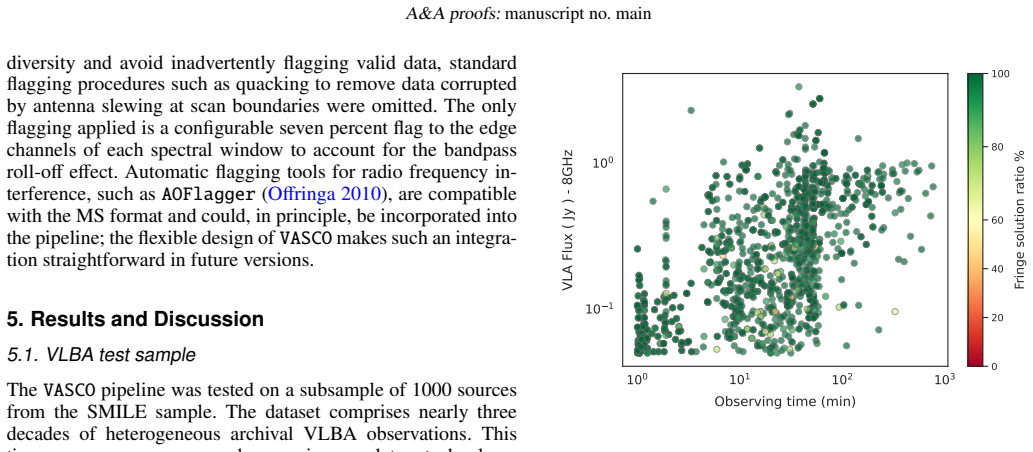
The VASCO pipeline automates the calibration of archival VLBA data in CASA by extending the rPICARD framework with automated preprocessing for FITS-IDI and Measurement Set formats, FFT-based fringe detection for calibrator and reference antenna selection, execution of the full calibration workflow, and real-time progress tracking via ALFRD. Validation on 1000 NRAO archival sources spanning 1995-2023 across S, C, X, U, and K bands produced calibrated output for 978 sources with a mean execution time of about 30 minutes per source using MPI parallelization.
What carries the argument
The FFT-based fringe detection for automatic calibrator and reference antenna selection, which enables blind operation without manual overrides across heterogeneous data.
If this is right
- The automated selection will be incorporated into a future rPICARD release, extending blind calibration to any supported array.
- Large volumes of archival VLBI data can now be processed with minimal human effort.
- Mean processing time of 30 minutes per source allows scaling to thousands of observations.
- Open-source availability enables community use and further development.
Where Pith is reading between the lines
- Similar automation techniques could be adapted for other radio astronomy arrays or data formats not covered here.
- Processing historical VLBI data might reveal new insights into variable sources or long-term monitoring that were previously too labor-intensive.
- Success on 97.8% suggests the method is robust but the 2.2% failures from corrupted data highlight the need for data quality checks upstream.
Load-bearing premise
The FFT-based fringe detection can reliably identify suitable calibrators and reference antennas for all types of VLBA data without needing manual adjustments or causing errors in the results.
What would settle it
A dataset where the automated pipeline selects a poor calibrator leading to phase errors or low signal-to-noise in the calibrated images, while a manual selection would succeed.
Figures



read the original abstract
Calibrating large volumes of Very Long Baseline Interferometry (VLBI) data traditionally requires significant human intervention at every stage. While the Common Astronomy Software Applications (CASA) package is the standard data reduction tool across major radio observatories, no existing CASA-based pipeline operates in a fully automated manner across the heterogeneous data formats produced by the Very Long Baseline Array (VLBA) over three decades of operations. The Search for Milli-Lenses (SMILE) project, requiring the calibration of ~5000 VLBA sources, makes such blind automation a practical necessity. We introduce the VLBI and SMILE-based CASA Optimizations (VASCO) pipeline, which automates the calibration of archival VLBA data. VASCO extends the CASA-based rPICARD framework by automating preprocessing of FITS-IDI and Measurement Set data formats, calibrator and reference antenna selection via FFT-based fringe detection, and execution of the full calibration workflow. Progress tracking is handled by ALFRD (Automated Logical Framework for executing Dynamic scripts), which orchestrates pipeline execution and records results in real time. VASCO was validated on 1000 NRAO archival sources spanning 1995-2023, covering 1372 band-separated observations across the S, C, X, U, and K bands. Calibrated output was produced for 978 sources (97.8%), with 22 failures due to corrupted or incomplete data. Mean per-source execution time was ~30 minutes using MPI parallelization with up to 20 cores. VASCO demonstrates that fully blind calibration of heterogeneous archival VLBA data is achievable with CASA. The automated calibrator and reference antenna selection will be incorporated into a future rPICARD release, extending blind calibration to any supported array. VASCO and ALFRD are available as open-source Python packages.
Editorial analysis
A structured set of objections, weighed in public.
Referee Report
Summary. The manuscript presents VASCO, a CASA-based pipeline extending the rPICARD framework to enable fully automated, blind calibration of large volumes of heterogeneous archival VLBA VLBI data. It automates preprocessing of FITS-IDI and Measurement Set formats, uses FFT-based fringe detection for calibrator and reference antenna selection, executes the full calibration workflow, and employs ALFRD for orchestration and progress tracking. Validation on 1000 NRAO archival sources (1995–2023, S/C/X/U/K bands, 1372 observations) produced calibrated outputs for 978 sources (97.8% success), with failures only from corrupted data; mean runtime was ~30 minutes per source using MPI on up to 20 cores. The pipeline is released open-source, with plans to incorporate the automated selection into rPICARD.
Significance. If the automated outputs prove scientifically reliable, VASCO would substantially lower the barrier to processing thousands of VLBI sources for projects such as SMILE, shifting calibration from labor-intensive manual work to scalable, reproducible pipelines. The large-scale test on real, multi-decade, multi-band archival data supplies concrete empirical support for blind automation feasibility within CASA. Open-source release and planned rPICARD integration add immediate community value by providing reusable infrastructure for VLBI arrays.
major comments (1)
- [Abstract and Validation results] Validation results (as summarized in the Abstract): The 97.8% success rate is defined solely by production of output files for 978/1000 sources, with no reported quantitative metrics on calibration quality (residual phase/amplitude errors, dynamic range, rms noise) or direct comparisons against manual CASA reductions of the same datasets. This limits evaluation of whether the FFT-based fringe detection and automated workflow produce results equivalent to human calibration across heterogeneous formats and conditions.
minor comments (1)
- [Abstract] The abstract would be strengthened by briefly stating the precise success criteria (file production only) and noting the absence of quality metrics in the current validation.
Simulated Author's Rebuttal
We thank the referee for their positive summary of the manuscript and constructive recommendation for minor revision. We address the major comment on the validation results below.
read point-by-point responses
-
Referee: [Abstract and Validation results] Validation results (as summarized in the Abstract): The 97.8% success rate is defined solely by production of output files for 978/1000 sources, with no reported quantitative metrics on calibration quality (residual phase/amplitude errors, dynamic range, rms noise) or direct comparisons against manual CASA reductions of the same datasets. This limits evaluation of whether the FFT-based fringe detection and automated workflow produce results equivalent to human calibration across heterogeneous formats and conditions.
Authors: We agree that the validation presented focuses on the pipeline's success in completing automated calibration and producing output files for 978 of 1000 sources, with the 22 failures explicitly attributed to corrupted or incomplete input data. This metric was selected to demonstrate the feasibility of fully blind, scalable processing of heterogeneous archival VLBA data spanning multiple decades and bands, which is the core contribution for projects such as SMILE. The FFT-based fringe detection and automated workflow are shown to handle the full CASA calibration sequence without manual intervention in the vast majority of cases. However, we acknowledge that the manuscript does not currently provide quantitative metrics on calibration quality (such as residual phase/amplitude errors, dynamic range, or rms noise) or direct comparisons to manual CASA reductions of the same datasets. In the revised manuscript, we will add a new subsection in the validation section that includes such metrics and comparisons for a representative subset of sources across bands and epochs. This will allow a direct assessment of whether the automated results are equivalent to human calibration. revision: yes
Circularity Check
No circularity: empirical pipeline validation on external data
full rationale
The paper presents an implemented software pipeline (VASCO) for automated VLBI calibration and validates it by running on 1000 independent archival NRAO VLBA datasets spanning 1995-2023. Success is defined and measured as production of output files for 978 sources (97.8%), with failures attributed to input corruption. No equations, predictions, or first-principles derivations are claimed; there are no fitted parameters renamed as predictions, no self-definitional loops, and no load-bearing self-citations that reduce the central claim to prior author work. The FFT-based fringe detection and calibrator selection are algorithmic choices whose performance is assessed against external data rather than by construction from the pipeline's own outputs. This is a standard engineering validation paper whose results are falsifiable by re-running on the same public archives.
Axiom & Free-Parameter Ledger
axioms (2)
- domain assumption CASA provides all required calibration tasks and can be scripted for batch processing of VLBI data
- domain assumption FFT-based fringe detection can identify usable calibrators and reference antennas from the visibility data without human judgment
Reference graph
Works this paper leans on
-
[1]
M., Kumar, A., & Janssen, M
Álvarez-Ortega, D., Casadio, C., Pötzl, F. M., Kumar, A., & Janssen, M. 2025, A&A, 703, A196 Astropy Collaboration, Robitaille, T. P., Tollerud, E. J., et al. 2013, A&A, 558, A33
2025
-
[2]
Benson, J. M. 1995, in Astronomical Society of the Pacific Conference Series, V ol. 82, Very Long Baseline Interferometry and the VLBA, ed. J. A. Zensus, P. J. Diamond, & P. J. Napier, 117
1995
-
[3]
B., et al
Blackburn, L., Chan, C.-k., Crew, G. B., et al. 2019, ApJ, 882, 23
2019
-
[4]
Casadio, C., Blinov, D., Readhead, A. C. S., et al. 2021, MNRAS, 507, L6
2021
-
[5]
T., Tingay, S
Deller, A. T., Tingay, S. J., Bailes, M., & West, C. 2007, PASP, 119, 318
2007
-
[6]
Greisen, E. W. 2003, in Astrophysics and Space Science Library, V ol. 285, In- formation Handling in Astronomy - Historical Vistas, ed. A. Heck, 109
2003
-
[7]
P., Bregman, J
Hamaker, J. P., Bregman, J. D., & Sault, R. J. 1996, A&AS, 117, 137
1996
-
[8]
A., Lee, S.-S., Zhao, G.-Y ., et al
Hodgson, J. A., Lee, S.-S., Zhao, G.-Y ., et al. 2016, Journal of Korean Astro- nomical Society, 49, 137
2016
-
[9]
M., et al
Janssen, M., Goddi, C., van Bemmel, I. M., et al. 2019, A&A, 626, A75 Article number, page 8 A. Kumar et al.: V ASCO: A fully automated CASA pipeline for large volume VLBI data calibration
2019
-
[10]
F., & Wagner, J
Janssen, M., Radcliffe, J. F., & Wagner, J. 2022, Universe, 8, 527
2022
-
[11]
P., et al
Kim, D.-W., Janssen, M., Krichbaum, T. P., et al. 2023, A&A, 680, L3 Martí-Vidal, I. 2010, A&A, 517, A83
2023
-
[12]
P., Waters, B., Schiebel, D., Young, W., & Golap, K
McMullin, J. P., Waters, B., Schiebel, D., Young, W., & Golap, K. 2007, in As- tronomical Society of the Pacific Conference Series, V ol. 376, Astronomical Data Analysis Software and Systems XVI, ed. R. A. Shaw, F. Hill, & D. J. Bell, 127
2007
-
[13]
T., Jackson, N
Myers, S. T., Jackson, N. J., Browne, I. W. A., et al. 2003, MNRAS, 341, 1
2003
-
[14]
Offringa, A. R. 2010, AOFlagger: RFI Software, Astrophysics Source Code Li- brary, record ascl:1010.017, ascl:1010.017
2010
-
[15]
1999, in Astronomical Society of the Pacific Conference Series, V ol
Pence, W. 1999, in Astronomical Society of the Pacific Conference Series, V ol. 172, Astronomical Data Analysis Software and Systems VIII, ed. D. M
1999
-
[16]
Petrov, L. Y . & Kovalev, Y . Y . 2025, ApJS, 276, 38 Pötzl, F. M., Casadio, C., Kalaitzidakis, G., et al. 2025, A&A, 695, A169
2025
-
[17]
2002, arXiv e-prints, astro
Reynolds, C., Paragi, Z., & Garrett, M. 2002, arXiv e-prints, astro
2002
-
[18]
Schwab, F. R. & Cotton, W. D. 1983, AJ, 88, 688
1983
-
[19]
Shepherd, M. C. 1997, in Astronomical Society of the Pacific Conference Series, V ol. 125, Astronomical Data Analysis Software and Systems VI, ed. G. Hunt & H. Payne, 77
1997
-
[20]
& Moellenbrock, G
Small, D. & Moellenbrock, G. 2022, CASA Memo 12: The Fringefit Task in
2022
-
[21]
Smirnov, O. M. 2011, A&A, 527, A106 The CASA Team et al. 2022, Publications of the Astronomical Society of the Pacific, 134, 114501
2011
-
[22]
R., Moran, J
Thompson, A. R., Moran, J. M., & Swenson, Jr., G. W. 2017, Interferometry and Synthesis in Radio Astronomy, 3rd Edition, 3rd edn. (Cham :: Springer International Publishing) van Bemmel, I. M., Kettenis, M., Small, D., et al. 2022, PASP, 134, 114502 van Diepen, G. N. J. 2015, Astronomy and Computing, 12, 174
2017
-
[23]
N., Henstock, D
Wilkinson, P. N., Henstock, D. R., Browne, I. W., et al. 2001, Phys. Rev. Lett., 86, 584 Article number, page 9
2001
discussion (0)
Sign in with ORCID, Apple, or X to comment. Anyone can read and Pith papers without signing in.