Metal Atom (Dis)Order and Superconductivity in YCaH_(n) (n=8-20) High-Pressure Superhydrides
Pith reviewed 2026-05-10 04:15 UTC · model grok-4.3
The pith
Equimolar yttrium and calcium in YCaH8 positions the Fermi level at a density-of-states peak and raises Tc to 170 K at 180 GPa.
A machine-rendered reading of the paper's core claim, the machinery that carries it, and where it could break.
Core claim
In YCaH8 the 1:1 yttrium-to-calcium ratio places the Fermi energy at a maximum in the density of states, which, within the isotropic Eliashberg formalism, yields superconducting critical temperatures of 149 K for the P4/mmm structure and 170 K for the Cmmm structure at 180 GPa. Numerous metal-atom arrangements are nearly isoenthalpic, indicating that configurational entropy will help stabilize the disordered phases. For YCaH12 the ordered variants display Tc values ranging from 105 K to 253 K at 200 GPa, demonstrating that metal ordering can either enhance or suppress superconductivity. Only single stable phases appear for YCaH18 and YCaH20, consistent with the structural mismatch between Y-
What carries the argument
The equimolar Y:Ca ratio that shifts the Fermi level onto a peak in the electronic density of states, thereby increasing the available states for electron-phonon pairing in the hydride lattice.
If this is right
- Configurational entropy from metal-atom disorder can stabilize phases that would otherwise lie above the convex hull.
- In YCaH12, changing the metal-atom ordering can swing Tc by more than 140 K, offering a route to either improve or degrade superconductivity relative to the binary parents.
- For hydrogen contents of 18 and 20, only one dynamically stable mixed phase survives because the parent binary structures differ strongly.
- Metal mixing therefore provides a compositional lever that can be used to optimize Tc in other superhydride families once the 1:1 ratio condition is met.
Where Pith is reading between the lines
- Similar equimolar mixing of dissimilar metals could be tested in other known superhydride systems to see whether a comparable density-of-states shift appears.
- If anharmonic phonon corrections turn out to be large, the reported Tc values would drop, suggesting that full ab initio molecular-dynamics phonon spectra should be computed next.
- Experimental probes sensitive to local metal-atom arrangements, such as extended X-ray absorption fine structure, could confirm whether the predicted disorder persists at synthesis pressures.
Load-bearing premise
The DFT-relaxed structures remain dynamically stable and the isotropic Eliashberg equations capture the pairing strength without large corrections from anharmonic phonons or strong-coupling effects.
What would settle it
High-pressure synthesis of a YCaH8 sample at 180 GPa followed by a direct measurement of its critical temperature; a value far below 149 K or the absence of superconductivity would show that the predicted density-of-states enhancement does not occur.
Figures
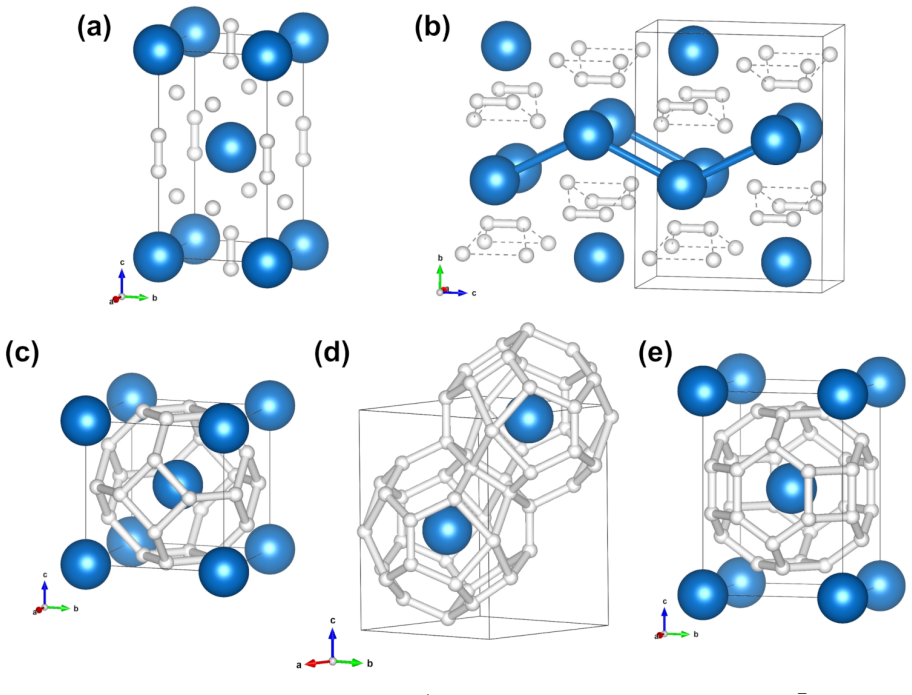
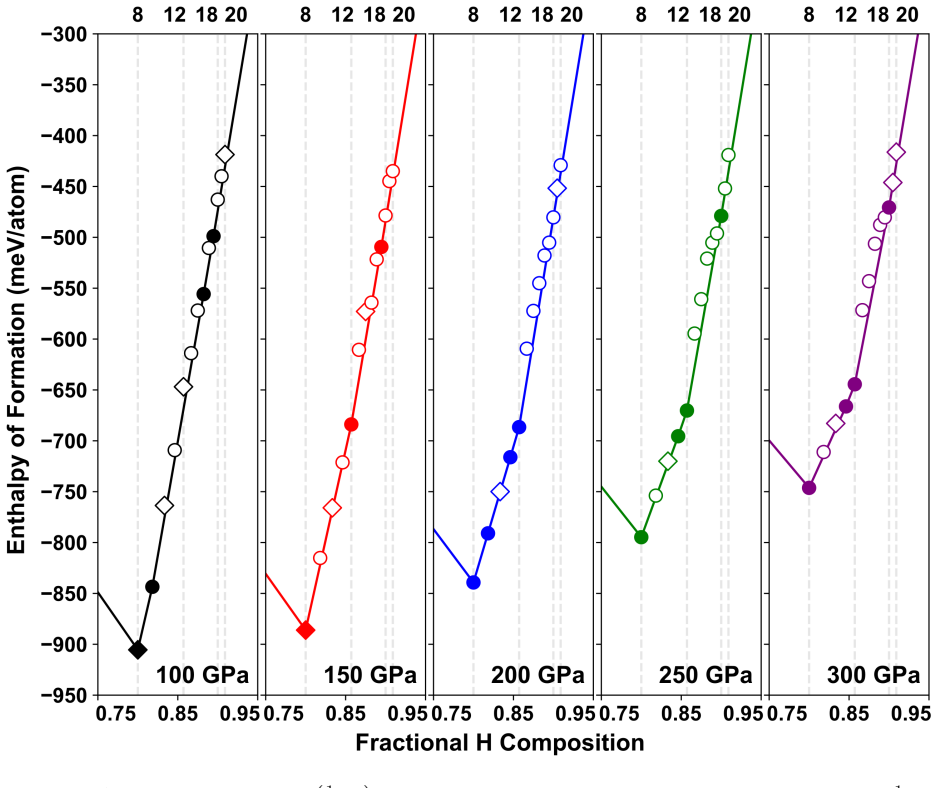
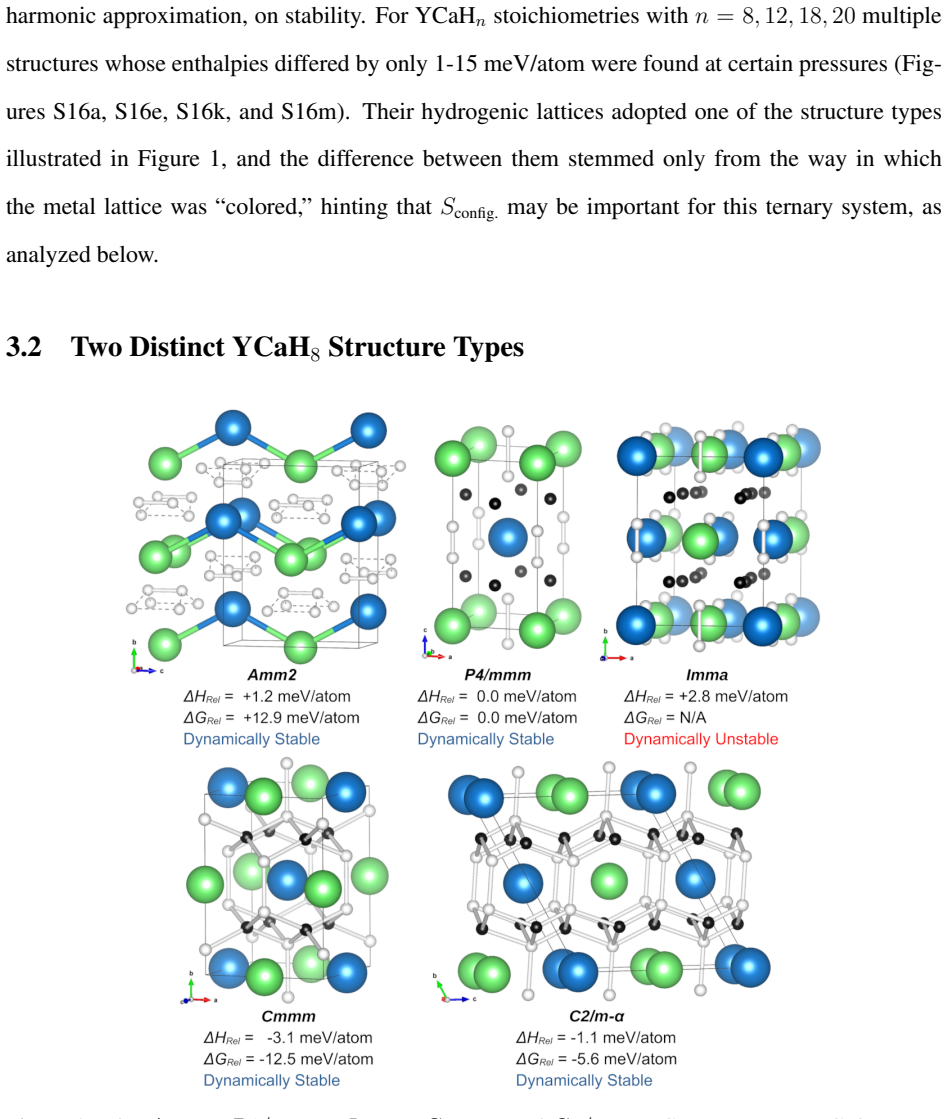
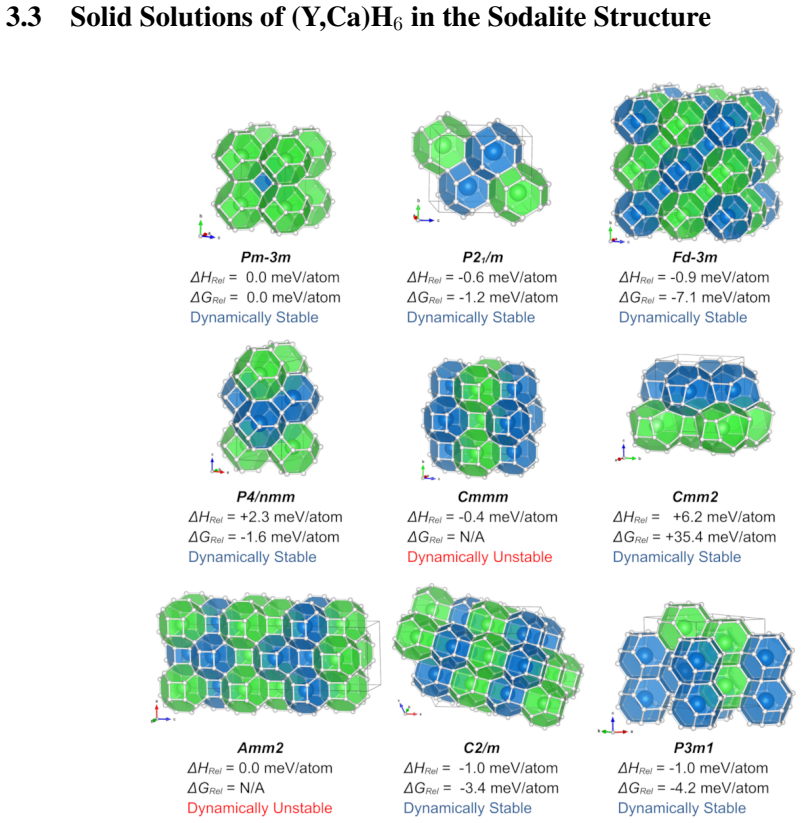
read the original abstract
High-pressure superhydrides have attracted much attention due to their high superconducting critical temperatures ($T_\text{c}$s). Herein, density functional theory (DFT) calculations are used to study the structures and properties, including potential for metal atom disorder and doping-enhanced $T_\text{c}$, within Y-Ca superhydrides with YCaH$_{n}$ ($n=8-20$) compositions. For YCaH$_8$ numerous phases that differed in the arrangement of the metal atoms were found to be nearly isoenthalpic, suggesting the importance of configurational entropy on stability. The equimolar ratio of the two metal atoms brought the Fermi level to a peak in the density of states, enhancing $T_\text{c}$ to 149~K and 170~K for $P4/mmm$ and $Cmmm$ YCaH$_{8}$, respectively, at 180~GPa within the isotropic Eliashberg formalism. YCaH$_{12}$ was also predicted to be disordered, however the $T_\text{c}$s of the ordered variants spanned a wide range from 105-253~K at 200~GPa, showing that doping could either mildly enhance or drastically reduce $T_\text{c}$ from that of the parent compounds. For YCaH$_{18}$ and YCaH$_{20}$, only a single dynamically stable superhydride was predicted, which we attribute to the differences in the structures of the stable binary parents.
Editorial analysis
A structured set of objections, weighed in public.
Referee Report
Summary. The manuscript uses DFT calculations to explore crystal structures, dynamical stability, and superconducting properties of YCaH_n (n=8-20) high-pressure superhydrides. It finds numerous nearly isoenthalpic metal-atom arrangements for YCaH8, implying configurational entropy stabilization, and reports Tc values up to 149 K (P4/mmm) and 170 K (Cmmm) at 180 GPa for ordered equimolar structures due to EF alignment with a DOS peak within isotropic Eliashberg theory. YCaH12 shows a wide Tc range (105-253 K at 200 GPa) across ordered variants, while YCaH18 and YCaH20 have fewer stable phases linked to binary parent structures.
Significance. If the results hold, the work usefully illustrates how equimolar metal doping can position EF at DOS peaks to raise Tc and how near-degenerate arrangements signal disorder effects in superhydrides. The parameter-free first-principles approach (DFT + Eliashberg on multiple configurations) and explicit discussion of isoenthalpic disorder provide concrete guidance for materials design in the field.
major comments (3)
- [YCaH8 results] Results section on YCaH8: The central claim that equimolar Y/Ca ratio enhances Tc to 149 K and 170 K by placing EF at a DOS peak is derived exclusively from ordered P4/mmm and Cmmm supercells. The manuscript notes multiple metal arrangements are nearly isoenthalpic, implying disorder, yet provides no configuration-averaged DOS, effective-medium electronic structure, or phonon calculations for the disordered state; in alloys such averaging typically broadens sharp DOS features and would likely lower the reported Tc values.
- [YCaH12 results] YCaH12 subsection: The wide Tc span (105-253 K at 200 GPa) across ordered variants is presented as evidence that doping can drastically reduce Tc, but no convergence tests (k-mesh density, plane-wave cutoff, or pseudopotential choice) or error estimates are reported. This leaves open whether the span reflects physical sensitivity or numerical variation, directly affecting the doping-tuning claim.
- [Methods] Computational methods and Eliashberg section: Isotropic Eliashberg is used without comparison to anisotropic calculations or assessment of anharmonic phonon corrections, despite predicted Tc > 150 K where strong-coupling or anharmonicity can alter results; the assumption that ordered-cell outputs remain representative under disorder is load-bearing for the DOS-peak mechanism.
minor comments (2)
- [Abstract] Abstract: The phrasing 'doping-enhanced Tc' is imprecise given that YCaH12 results show both enhancement and strong suppression relative to parent binaries.
- [Figures] Figure captions and phonon plots: Explicitly state the absence of imaginary frequencies for all claimed dynamically stable phases and include supercell sizes used for disorder sampling.
Simulated Author's Rebuttal
We thank the referee for their thorough review and valuable suggestions. We have addressed each of the major comments in detail below, making revisions to the manuscript where appropriate to improve clarity and address concerns about the calculations and approximations used.
read point-by-point responses
-
Referee: [YCaH8 results] Results section on YCaH8: The central claim that equimolar Y/Ca ratio enhances Tc to 149 K and 170 K by placing EF at a DOS peak is derived exclusively from ordered P4/mmm and Cmmm supercells. The manuscript notes multiple metal arrangements are nearly isoenthalpic, implying disorder, yet provides no configuration-averaged DOS, effective-medium electronic structure, or phonon calculations for the disordered state; in alloys such averaging typically broadens sharp DOS features and would likely lower the reported Tc values.
Authors: We agree with the referee that configuration averaging for the disordered state would provide a more complete picture, as disorder could broaden the DOS peak and affect the Tc. However, the near-isoenthalpic arrangements highlight the role of configurational entropy in stabilizing the phase. In the revised manuscript, we have included results from additional metal-atom arrangements, demonstrating that the alignment of EF with a DOS peak is a recurring feature across several low-enthalpy configurations. We have also added a discussion acknowledging that while full averaging is beyond the current scope, the ordered structures illustrate the potential for Tc enhancement via doping, and disorder effects are noted as a direction for future study. This partially addresses the concern without altering the core findings. revision: partial
-
Referee: [YCaH12 results] YCaH12 subsection: The wide Tc span (105-253 K at 200 GPa) across ordered variants is presented as evidence that doping can drastically reduce Tc, but no convergence tests (k-mesh density, plane-wave cutoff, or pseudopotential choice) or error estimates are reported. This leaves open whether the span reflects physical sensitivity or numerical variation, directly affecting the doping-tuning claim.
Authors: We appreciate this observation. Convergence tests for k-mesh, plane-wave cutoff, and pseudopotential choice have been performed and are now reported in the Methods section and Supplementary Material. The Tc values are converged to within approximately 10 K. The wide range in Tc arises from significant differences in the electronic and phononic structures of the various ordered variants, as shown by their distinct Eliashberg spectral functions. We have added error bars to the Tc values in the revised text to reflect numerical uncertainties, confirming that the span is primarily physical rather than numerical. revision: yes
-
Referee: [Methods] Computational methods and Eliashberg section: Isotropic Eliashberg is used without comparison to anisotropic calculations or assessment of anharmonic phonon corrections, despite predicted Tc > 150 K where strong-coupling or anharmonicity can alter results; the assumption that ordered-cell outputs remain representative under disorder is load-bearing for the DOS-peak mechanism.
Authors: We recognize the importance of these considerations for high-Tc predictions. The isotropic Eliashberg formalism is a standard approximation in the field for such systems, but we agree that anisotropic effects and anharmonicity could modify the results. We have expanded the Methods and Discussion sections to include a more detailed justification of the approximations, along with references to studies on similar materials where these effects were assessed. Full anisotropic or anharmonic calculations for the multiple configurations would require substantial additional resources. Regarding the representativeness under disorder, we have clarified that the DOS-peak mechanism is demonstrated in ordered cells but may be affected by averaging; we note this as a limitation. revision: partial
- Full configuration-averaged DOS, effective-medium electronic structure, or phonon calculations for the disordered states
- Anisotropic Eliashberg calculations and anharmonic phonon corrections for all reported structures
Circularity Check
No circularity: Tc values computed directly from DFT-derived DOS and Eliashberg equations on explicit ordered structures.
full rationale
The paper performs standard first-principles DFT structure searches, identifies nearly isoenthalpic metal arrangements, then computes electronic DOS and solves the isotropic Eliashberg equations to obtain Tc. The placement of EF at a DOS peak for equimolar Y/Ca is an output of these calculations, not an input or definition. No parameters are fitted to the target Tc and then relabeled as predictions. No load-bearing uniqueness theorem or ansatz is imported via self-citation. The derivation chain is self-contained against external benchmarks (DFT + Eliashberg) and does not reduce to its own inputs by construction.
Axiom & Free-Parameter Ledger
axioms (2)
- domain assumption Density functional theory with chosen functionals accurately describes structures, phonons, and electronic density of states in high-pressure metal hydrides.
- domain assumption The isotropic Eliashberg formalism yields reliable superconducting critical temperatures for these systems.
Reference graph
Works this paper leans on
-
[1]
Drozdov, A. P.; Eremets, M. I.; Troyan, I. A.; Ksenofontov, V .; Shylin, S. I. Conventional superconductivity at 203 kelvin at high pressures in the sulfur hydride system.Nature2015, 525, 73–76
-
[2]
Drozdov, A. P.; Kong, P. P.; Minkov, V . S.; Besedin, S. P.; Kuzovnikov, M. A.; Mozaffari, S.; Balicas, L.; Balakirev, F. F.; Graf, D. E.; Prakapenka, V . B.; Greenberg, E.; Knyazev, D. A.; Tkacz, M.; Eremets, M. I. Superconductivity at 250 K in lanthanum hydride under high pressures.Nature2019,569, 528–531. 31
-
[3]
Somayazulu, M.; Ahart, M.; Mishra, A. K.; Geballe, Z. M.; Baldini, M.; Meng, Y .; Struzhkin, V . V .; Hemley, R. J. Evidence for superconductivity above 260 K in lanthanum superhydride at megabar pressures.Phys. Rev. Lett.2019,122, 027001 (1–6)
work page 2019
-
[4]
High-Pressure Synthesis of Supercon- ducting Clathratelike YH4.Phys
Shao, M.; Chen, W.; Zhang, K.; Huang, X.; Cui, T. High-Pressure Synthesis of Supercon- ducting Clathratelike YH4.Phys. Rev. B2021,104, 174509
-
[5]
Syn- thesis and superconductivity in yttrium superhydrides under high pressure.Chinese Phys
Wang, Y .; Wang, K.; Sun, Y .; Ma, L.; Wang, Y .; Zou, B.; Liu, G.; Zhou, M.; Wang, H. Syn- thesis and superconductivity in yttrium superhydrides under high pressure.Chinese Phys. B 2022,31, 106201
work page 2022
-
[6]
Troyan, I. A.; Semenok, D. V .; Kvashnin, A. G.; Sadakov, A. V .; Sobolevskiy, O. A.; Pudalov, V . M.; Ivanova, A. G.; Prakapenka, V . B.; Greenberg, E.; Gavriliuk, A. G.; Lyubutin, I. S.; Struzhkin, V . V .; Bergara, A.; Errea, I.; Bianco, R.; Calandra, M.; Mauri, F.; Monacelli, L.; Akashi, R.; Oganov, A. R. Anomalous High-Temperature Superconductivity i...
work page 2021
-
[7]
Kong, P.; Minkov, V . S.; Kuzovnikov, M. A.; Drozdov, A. P.; Besedin, S. P.; Mozaffari, S.; Balicas, L.; Balakirev, F. F.; Prakapenka, V . B.; Chariton, S.; Knyazev, D. A.; Greenberg, E.; Eremets, M. I. Superconductivity up to 243 K in the Yttrium-Hydrogen System under High Pressure.Nat. Commun.2021,12, 5075
work page 2021
-
[8]
Ma, L.; Wang, K.; Xie, Y .; Yang, X.; Wang, Y .; Zhou, M.; Liu, H.; Yu, X.; Zhao, Y .; Wang, H.; Liu, G.; Ma, Y . High-Temperature Superconducting Phase in Clathrate Calcium Hydride CaH6 up to 215 K at a Pressure of 172 GPa.Phys. Rev. Lett.2022,128, 167001
work page 2022
-
[9]
A.; Bass, J.; Yuan, S.; Liu, H.; Jin, C
Li, Z.; He, X.; Zhang, C.; Wang, X.; Zhang, S.; Jia, Y .; Feng, S.; Lu, K.; Zhao, J.; Zhang, J.; Min, B.; Long, Y .; Yu, R.; Wang, L.; Ye, M.; Zhang, Z.; Prakapenka, V .; Chariton, S.; Gins- berg, P. A.; Bass, J.; Yuan, S.; Liu, H.; Jin, C. Superconductivity above 200 K discovered in superhydrides of calcium.Nat. Commun.2022,13, 2863 (1–5). 32
work page 2022
-
[10]
Semenok, D. V .; Kvashnin, A. G.; Ivanova, A. G.; Svitlyk, V .; Fominski, V . Y .; Sadakov, A. V .; Sobolevskiy, O. A.; Pudalov, V . M.; Troyan, I. A.; Oganov, A. R. Supercon- ductivity at 161 K in thorium hydride ThH10: Synthesis and properties.Mater . Today2020, 33, 36–44
-
[11]
V .; Huang, X.; Shu, H.; Li, X.; Duan, D.; Cui, T.; Oganov, A
Chen, W.; Semenok, D. V .; Huang, X.; Shu, H.; Li, X.; Duan, D.; Cui, T.; Oganov, A. R. High-Temperature Superconducting Phases in Cerium Superhydride with a T c up to 115 K below a Pressure of 1 Megabar.Phys. Rev. Lett.2021,127, 117001
work page 2021
-
[12]
Bhattacharyya, P.; Chen, W.; Huang, X.; Chatterjee, S.; Huang, B.; Kobrin, B.; Lyu, Y .; Smart, T. J.; B lock, M.; Wang, E.; Wang, Z.; Wu, W.; Hsieh, S.; Ma, H.; Mandyam, S.; Chen, B.; Davis, E.; Geballe, Z. M.; Zu, C.; Struzhkin, V .; Jeanloz, R.; Moore, J. E.; Cui, T.; Galli, G.; Halperin, B. I.; Laumann, C. R.; Yao, N. Y . Imaging the Meissner Effect i...
-
[13]
Hilleke, K. P.; Zurek, E. Tuning Chemical Precompression: Theoretical Design and Crys- tal Chemistry of Novel Hydrides in the Quest for Warm and Light Superconductivity at Ambient Pressures.J. Appl. Phys.2022,131, 070901 (1–19)
work page 2022
-
[14]
Hilleke, K. P.; Zurek, E. InComprehensive Inorganic Chemistry III, third edition ed.; Reed- ijk, J., Poeppelmeier, K. R., Eds.; Elsevier: Oxford, 2023; pp 421–445
work page 2023
-
[15]
A.; Boeri, L.; Sanna, A.; Profeta, G.; Arita, R.; Eremets, M
Flores-Livas, J. A.; Boeri, L.; Sanna, A.; Profeta, G.; Arita, R.; Eremets, M. A perspective on conventional high-temperature superconductors at high pressure: Methods and materials. Phys. Rep.2020,856, 1–78
work page 2020
-
[16]
Sun, Y .; Zhong, X.; Liu, H.; Ma, Y . Clathrate Metal Superhydrides Under High-Pressure Conditions: Enroute to Room-Temperature Superconductivity.Natl. Sci. Rev.2024,11, nwad270
work page 2024
-
[17]
Electronic Structure and Superconductivity of Compressed Metal Tetrahy- drides.Chem
Bi, T.; Zurek, E. Electronic Structure and Superconductivity of Compressed Metal Tetrahy- drides.Chem. - Eur . J.2021,27, 14858–14870. 33
work page 2021
-
[18]
S.; Tanaka, K.; Iitaka, T.; Ma, Y
Wang, H.; Tse, J. S.; Tanaka, K.; Iitaka, T.; Ma, Y . Superconductive Sodalite-like Clathrate Calcium Hydride at High Pressures.Proc. Natl. Acad. Sci. U. S. A.2012,109, 6463–6466
work page 2012
-
[19]
Composition and Constitution of Compressed Strontium Polyhydrides.J
Hooper, J.; Terpstra, T.; Shamp, A.; Zurek, E. Composition and Constitution of Compressed Strontium Polyhydrides.J. Phys. Chem. C2014,118, 6433–6447
-
[20]
Peng, F.; Sun, Y .; Pickard, C. J.; Needs, R. J.; Wu, Q.; Ma, Y . Hydrogen Clathrate Structures in Rare Earth Hydrides at High Pressures: Possible Route to Room-Temperature Supercon- ductivity.Phys. Rev. Lett.2017,119, 107001
work page 2017
-
[21]
Zurek, E.; Bi, T. High-Temperature Superconductivity in Alkaline and Rare Earth Polyhy- drides at High Pressure: A Theoretical Perspective.J. Chem. Phys.2019,150, 050901
work page 2019
-
[22]
Sun, Y .; Lv, J.; Xie, Y .; Liu, H.; Ma, Y . Route to a superconducting phase above room temperature in electron-doped hydride compounds under high pressure.Phys. Rev. Lett. 2019,123, 097001 (1–5)
work page 2019
-
[23]
Redington, M.; Zurek, E. Predicted High-Pressure Hot Superconductivity in Li 2CaH16 and Li2CaH17 Phases that Resemble the Type-II Clathrate Structure.Chem. Mater .2024,36, 8412–8423
work page 2024
-
[24]
He, X.-L.; Zhao, W.; Xie, Y .; Hermann, A.; Hemley, R. J.; Liu, H.; Ma, Y . Predicted Hot Superconductivity in LaSc 2H24under Pressure.Proc. Natl. Acad. Sci. U. S. A.2024,121, e2401840121
work page 2024
-
[25]
Pham, T.-T.; Chu, V .-H.; Nguyen, D.-L. First Principles Prediction Unveils High-Tc Su- perconductivity in YSc 2H24 Cage Structures under Pressure.J. Mater . Chem. C2024,12, 17254–17262
-
[26]
LaBH 8: Towards high-T c low- pressure Superconductivity in ternary superhydrides.Phys
Di Cataldo, S.; Heil, C.; von der Linden, W.; Boeri, L. LaBH 8: Towards high-T c low- pressure Superconductivity in ternary superhydrides.Phys. Rev. B2021,104, L020511. 34
-
[27]
Song, Y .; Bi, J.; Nakamoto, Y .; Shimizu, K.; Liu, H.; Zou, B.; Liu, G.; Wang, H.; Ma, Y . Stoichiometric Ternary Superhydride LaBeH 8 as a New Template for High-Temperature Superconductivity at 110 K under 80 GPa.Phys. Rev. Lett.2023,130, 266001 (1–8)
work page 2023
-
[28]
Rational Design of Superconducting Metal Hydrides via Chemical Pressure Tuning.Angew
Hilleke, K.; Zurek, E. Rational Design of Superconducting Metal Hydrides via Chemical Pressure Tuning.Angew. Chem. Int. Ed.2022,61, e202207589 (1–7)
work page 2022
-
[29]
Fan, Y .; Li, B.; Zhu, C.; Cheng, J.; Liu, S.; Shi, Z. Superconductive Sodalite-Like Clathrate Hydrides with Critical Temperatures of near 300 K under Pressures.Phys. Status Solidi B 2025,262, 2400240
work page 2025
-
[30]
Pre- diction of Pressure-Induced Superconductivity in the Novel Ternary System ScCaH 2n (n = 1–6).J
Shi, L.-T.; Wei, Y .-K.; Liang, A.-K.; Turnbull, R.; Cheng, C.; Chen, X.-R.; Ji, G.-F. Pre- diction of Pressure-Induced Superconductivity in the Novel Ternary System ScCaH 2n (n = 1–6).J. Mater . Chem. C2021,9, 7284–7291
-
[31]
Yuan, W.; Yang, X.; Li, S.; Feng, C.; Chen, B.; Chang, Y .; Li, D. A systematic study on the phase diagram and superconductivity of ternary clathrate Ca–Sc–H at high pressures.Phys. Chem. Chem. Phys.2024,26, 3408–3414
work page 2024
-
[32]
Zhao, J.; Chen, B.; Li, S.; Chang, Y .; Yang, X.; Chen, M.; Li, D. Prediction of Pressure- Induced Superconductivity in the Ternary Systems CaYH2n (n = 3–6) at Moderate Pressures. J. Mater . Chem. C2025,13, 4128–4136
-
[33]
Pressure-Induced High-Tc Superconductivity in the Ternary Clathrate System Y-Ca-H.Phys
Zhao, W.; Duan, D.; Du, M.; Yao, X.; Huo, Z.; Jiang, Q.; Cui, T. Pressure-Induced High-Tc Superconductivity in the Ternary Clathrate System Y-Ca-H.Phys. Rev. B2022,106, 014521
-
[34]
Potential high-T c Superconductivity in CaYH 12 under pressure.Phys
Liang, X.; Bergara, A.; Wang, L.; Wen, B.; Zhao, Z.; Zhou, X.-F.; He, J.; Gao, G.; Tian, Y . Potential high-T c Superconductivity in CaYH 12 under pressure.Phys. Rev. B2019,99, 100505
-
[35]
35 High-Temperature Superconductivity in Ternary Clathrate YCaH12 under High Pressures.J
Xie, H.; Duan, D.; Shao, Z.; Song, H.; Wang, Y .; Xiao, X.; Li, D.; Tian, F.; Liu, B.; Cui, T. 35 High-Temperature Superconductivity in Ternary Clathrate YCaH12 under High Pressures.J. Phys.: Condens. Matter2019,31, 245404
-
[36]
N.; Lucrezi, R.; Guilhon, I.; Marques, M.; Teles, L
Ferreira, P. N.; Lucrezi, R.; Guilhon, I.; Marques, M.; Teles, L. K.; Heil, C.; Eleno, L. T. F. Ab Initio Modeling of Superconducting Alloys.Mater . Today Phys.2024,48, 101547
work page 2024
-
[37]
Prediction of pressure- induced superconductivity in the ternary systems YScH2n (n=3–6).Phys
Shi, L.-T.; Si, J.-G.; Turnbull, R.; Liang, A.; Liu, P.-F.; Wang, B.-T. Prediction of pressure- induced superconductivity in the ternary systems YScH2n (n=3–6).Phys. Rev. B2024,109, 054512
-
[38]
Sukmas, W.; Tsuppayakorn-aek, P.; Pinsook, U.; Ahuja, R.; Bovornratanaraks, T. Roles of optical phonons and logarithmic profile of electron-phonon coupling integration in super- conducting Sc0.5Y0.5H6 superhydride under pressures.J. Alloys Compd.2022,901, 163524
work page 2022
-
[39]
Pressure-induced high-temperature superconductivity in ternary Y–Zr–H compounds.Phys
Zhao, W.; Song, H.; Du, M.; Jiang, Q.; Ma, T.; Xu, M.; Duan, D.; Cui, T. Pressure-induced high-temperature superconductivity in ternary Y–Zr–H compounds.Phys. Chem. Chem. Phys.2023,25, 5237–5243
work page 2023
-
[40]
Ghaffar, A.; Song, P.; Maezono, R.; Hongo, K. Theoretical Insights into High-Tc Supercon- ductivity of Structurally Ordered YThH 18: A First-Principles Study.ACS Omega2024,9, 49470–49479
-
[41]
Chen, W.; Ma, T.; Huo, Z.; Yu, H.; Cui, T.; Duan, D. High-Temperature Superconductivity in Clathrate Thorium-Doped HexahydridesA 1−xThxH6 (A= La, Ac, and Y) at Moderate Pressure.Phys. Rev. B2024,109, 224505
-
[42]
P.; Hou, Z.; Ghaffar, A.; Dahule, R.; Szcze ¸ ´sniak, R.; Hongo, K.; Maezono, R
Song, P.; Durajski, A. P.; Hou, Z.; Ghaffar, A.; Dahule, R.; Szcze ¸ ´sniak, R.; Hongo, K.; Maezono, R. (La,Th)H 10: Potential High-T c (242 K) Superconductors Stabilized Thermo- dynamically below 200 GPa.J. Phys. Chem. C2024,128, 2656–2665
-
[43]
Semenok, D. V .; Troyan, I. A.; Ivanova, A. G.; Kvashnin, A. G.; Kruglov, I. A.; Hanfland, M.; Sadakov, A. V .; Sobolevskiy, O. A.; Pervakov, K. S.; Lyubutin, I. S.; 36 Glazyrin, K. V .; Giordano, N.; Karimov, D. N.; Vasiliev, A. L.; Akashi, R.; Pudalov, V . M.; Oganov, A. R. Superconductivity at 253 K in lanthanum–yttrium ternary hydrides.Mater . Today20...
-
[44]
P.; Zheng, F.; Antropov, V .; Ho, K.-M.; Wu, S
Wu, Z.; Sun, Y .; Durajski, A. P.; Zheng, F.; Antropov, V .; Ho, K.-M.; Wu, S. Effect of Doping on the Phase Stability and Superconductivity in LaH 10.Phys. Rev. Mater .2023,7, L101801
work page 2023
-
[45]
Song, P.; Hou, Z.; Castro, P. B. d.; Nakano, K.; Hongo, K.; Takano, Y .; Maezono, R. High- Tc Superconducting Hydrides Formed by LaH24 and YH24 Cage Structures as Basic Blocks. Chem. Mater .2021,33, 9501–9507
work page 2021
-
[46]
Du, M.; Song, H.; Zhang, Z.; Duan, D.; Cui, T. Room-Temperature Superconductivity in Yb/Lu Substituted Clathrate Hexahydrides under Moderate Pressure.Research2022,2022
work page 2022
-
[47]
Ma, Y .; Luo, J.; Meng, S.; Zhong, X.; Liu, G.; Liu, H.; Ma, Y . Substitution of Y , Ce, and Th for La in LaBeH8 as a path towards lower synthesis pressures of superconducting hydrides. Phys. Rev. B2025,111, 184512
-
[48]
Zhang, P.; Guan, H.; Li, H.; Zhong, X.; Hemley, R. J.; Liu, H. High-temperature supercon- ductivity in quinary clathrate hydrides under pressure.Phys. Rev. B2025,112, 054516
-
[49]
Unavoidable Disorder and Entropy in Multi- Component Systems.npj Comput
Toher, C.; Oses, C.; Hicks, D.; Curtarolo, S. Unavoidable Disorder and Entropy in Multi- Component Systems.npj Comput. Mater .2019,5, 1–3
work page 2019
-
[50]
Superconducting ternary hydrides: progress and challenges.Natl
Zhao, W.; Huang, X.; Zhang, Z.; Chen, S.; Du, M.; Duan, D.; Cui, T. Superconducting ternary hydrides: progress and challenges.Natl. Sci. Rev.2023,11, nwad307
work page 2023
-
[51]
Liu, H.; Naumov, I. I.; Hoffmann, R.; Ashcroft, N. W.; Hemley, R. J. Potential High-T c Superconducting Lanthanum and Yttrium Hydrides at High Pressure.Proc. Natl. Acad. Sci. U. S. A.2017,114, 6990–6995. 37
work page 2017
-
[52]
Manayil Marathamkottil, A. H.; Wang, K.; Salke, N. P.; Ahart, M.; Mark, A. C.; Hru- biak, R.; Chariton, S.; Smith, D.; Prakapenka, V . B.; Somayazulu, M.; Velisavljevic, N.; Hemley, R. J. X-Ray-Diffraction and Electrical-Transport Imaging of Superconducting Su- perhydride (La,Y)H10.Nat. Commun.2025,16, 11222
work page 2025
-
[53]
Bi, J.; Nakamoto, Y .; Zhang, P.; Wang, Y .; Ma, L.; Wang, Y .; Zou, B.; Shimizu, K.; Liu, H.; Zhou, M.; Wang, H.; Liu, G.; Ma, Y . Stabilization of superconductive La–Y alloy superhy- dride with Tc above 90 K at megabar pressure.Mater . Today Phys.2022,28, 100840
work page 2022
-
[54]
Giant Enhancement of Superconducting Critical Temperature in Substitutional Alloy (La,Ce)H9.Nat
Bi, J.; Nakamoto, Y .; Zhang, P.; Shimizu, K.; Zou, B.; Liu, H.; Zhou, M.; Liu, G.; Wang, H.; Ma, Y . Giant Enhancement of Superconducting Critical Temperature in Substitutional Alloy (La,Ce)H9.Nat. Commun.2022,13, 5952
work page 2022
-
[55]
V .; Chen, S.; Zhou, D.; Zhang, K.; Oganov, A
Chen, W.; Huang, X.; Semenok, D. V .; Chen, S.; Zhou, D.; Zhang, K.; Oganov, A. R.; Cui, T. Enhancement of superconducting properties in the La–Ce–H system at moderate pressures.Nat. Commun.2023,14, 2660 (1–8)
work page 2023
-
[56]
A.; Zhong, G.-H.; Lin, H.-Q.; Chen, X.-J
Chen, L.-C.; Luo, T.; Cao, Z.-Y .; Dalladay-Simpson, P.; Huang, G.; Peng, D.; Zhang, L.-L.; Gorelli, F. A.; Zhong, G.-H.; Lin, H.-Q.; Chen, X.-J. Synthesis and superconductivity in yttrium-cerium hydrides at high pressures.Nat. Commun.2024,15, 1809 (1–7)
work page 2024
-
[57]
Chen, S.; Wang, Y .; Bai, F.; Wu, X.; Wu, X.; Pakhomova, A.; Guo, J.; Huang, X.; Cui, T. Su- perior Superconducting Properties Realized in Quaternary La–Y–Ce Hydrides at Moderate Pressures.J. Am. Chem. Soc.2024,146, 14105–14113
work page 2024
-
[58]
Ma, C.; Zhou, M.; Bi, J.; Ma, Y .; Li, D.; Liu, H.; Liu, G.; Wang, H.; Ma, Y . Synthesis of Medium-Entropy Alloy Superhydride (La,Y ,Ce)H10±x with High-Temperature Supercon- ductivity under High Pressure.Phys. Rev. B2025,111, 024505
-
[59]
Belli, F.; Torres, S.; Contreras-Garc ´ıa, J.; Zurek, E. Refining Tc Prediction in Hydrides via Symbolic-Regression-Enhanced Electron-Localization-Function-Based Descriptors.Ann. Phys.2025,537, e00280. 38
work page 2025
-
[60]
InReviews in computational chemistry; Parrill, A
Zurek, E. InReviews in computational chemistry; Parrill, A. L., Lipkowitz, K. B., Eds.; John Wiley & Sons, Inc.: Hoboken, New Jersey, 2016; V ol. 29; pp 274–326
work page 2016
-
[61]
Lonie, D. C.; Zurek, E. XtalOpt: An Open-Source Evolutionary Algorithm for Crystal Structure Prediction.Comput. Phys. Commun.2011,182, 372–387
work page 2011
-
[62]
XtalOpt Version R12: An Open-Source Evo- lutionary Algorithm for Crystal Structure Prediction.Comput
Avery, P.; Toher, C.; Curtarolo, S.; Zurek, E. XtalOpt Version R12: An Open-Source Evo- lutionary Algorithm for Crystal Structure Prediction.Comput. Phys. Commun.2019,237, 274–275
work page 2019
-
[63]
Falls, Z.; Avery, P.; Wang, X.; Hilleke, K. P.; Zurek, E. The XtalOpt Evolutionary Algorithm for Crystal Structure Prediction.J. Phys. Chem. C2021,125, 1601–1620
-
[64]
XtalOpt version 13: Multi-objective evolutionary search for novel functional materials.Comput
Hajinazar, S.; Zurek, E. XtalOpt version 13: Multi-objective evolutionary search for novel functional materials.Comput. Phys. Commun.2024,304, 109306
work page 2024
-
[65]
Avery, P.; Zurek, E. RandSpg: An Open-Source Program for Generating Atomistic Crystal Structures with Specific Spacegroups.Comput. Phys. Commun.2017,213, 208–216
work page 2017
-
[66]
Lonie, D. C.; Zurek, E. Identifying Duplicate Crystal Structures: XtalComp, an Open- Source Solution.Comput. Phys. Commun.2012,183, 690–697
work page 2012
-
[67]
Ab initio molecular dynamics for liquid metals.Phys
Kresse, G.; Hafner, J. Ab initio molecular dynamics for liquid metals.Phys. Rev. B1993, 47, 558–561
-
[68]
Kresse, G.; Furthm ¨uller, J. Efficiency of Ab-Initio Total Energy Calculations for Metals and Semiconductors Using a Plane-Wave Basis Set.Comp. Mater . Sci.1996,6, 15–50
work page 1996
-
[69]
Kresse, G.; Furthm ¨uller, J. Efficient Iterative Schemes for Ab Initio Total-Energy Calcula- tions Using a Plane-Wave Basis Set.Phys. Rev. B1996,54, 11169–11186
-
[70]
Perdew, J. P.; Burke, K.; Ernzerhof, M. Generalized Gradient Approximation Made Simple. Phys. Rev. Lett.1996,77, 3865–3868. 39
work page 1996
-
[71]
Bl ¨ochl, P. E. Projector augmented-wave method.Phys. Rev. B1994,50, 17953–17979
-
[72]
From Ultrasoft Pseudopotentials to the Projector Augmented-Wave Method.Phys
Kresse, G.; Joubert, D. From Ultrasoft Pseudopotentials to the Projector Augmented-Wave Method.Phys. Rev. B1999,59, 1758–1775
-
[73]
Monkhorst, H. J.; Pack, J. D. Special points for Brillouin-zone integrations.Phys. Rev. B 1976,13, 5188–5192
work page 1976
-
[74]
Becke, A. D.; Edgecombe, E. A simple measure of electron localization in atomic and molecular systems.J. Chem. Phys.1990,92, 5397–5403
work page 1990
-
[75]
Silvi, B.; Savin, A. Classification of chemical bonds based on topological analysis of elec- tron localization functions.Nature1994,371, 683–686
-
[76]
A Fast and Robust Algorithm for Bader De- composition of Charge Density.Comput
Henkelman, G.; Arnaldsson, A.; J ´onsson, H. A Fast and Robust Algorithm for Bader De- composition of Charge Density.Comput. Mater . Sci.2006,36, 354–360
work page 2006
-
[77]
Sanville, E.; Kenny, S. D.; Smith, R.; Henkelman, G. Improved grid-based algorithm for Bader charge allocation.J. Comput. Chem.2007,28, 899–908
work page 2007
-
[78]
A Grid-Based Bader Analysis Algorithm without Lattice Bias.J
Tang, W.; Sanville, E.; Henkelman, G. A Grid-Based Bader Analysis Algorithm without Lattice Bias.J. Phys.: Condens. Matter2009,21, 084204
-
[79]
Parlinski, K.; Li, Z. Q.; Kawazoe, Y . First-Principles Determination of the Soft Mode in Cubic ZrO2.Phys. Rev. Lett.1997,78, 4063–4066
work page 1997
-
[80]
Phonon-phonon interactions in transition metals
Chaput, L.; Togo, A.; Tanaka, I.; Hug, G. Phonon-phonon interactions in transition metals. Phys. Rev. B2011,84, 094302
discussion (0)
Sign in with ORCID, Apple, or X to comment. Anyone can read and Pith papers without signing in.