The trigger and localization system of SVOM-GRM
Pith reviewed 2026-05-10 04:09 UTC · model grok-4.3
The pith
The GRM on SVOM localizes gamma-ray bursts to roughly 4 degrees by combining a fast on-board algorithm with ground MCMC spectral fitting.
A machine-rendered reading of the paper's core claim, the machinery that carries it, and where it could break.
Core claim
The authors establish that the on-board localization algorithm for the three-detector GRM, when supplemented by a ground-based MCMC method that accounts for spectral characteristics, yields a localization error of approximately 4.14 degrees for the detected burst that is consistent with the position from another gamma-ray instrument.
What carries the argument
The three gamma-ray detectors with distinct pointing directions, whose relative count rates feed both the on-board localization algorithm and the ground MCMC joint spectral-localization fit.
If this is right
- The on-board algorithm supplies fast positions that support immediate alerts to other telescopes.
- The ground MCMC approach reduces systematic position errors by incorporating full spectral information.
- GRM supplies temporal, spectral, and positional data across the 15-5000 keV band for transient events.
- Successful performance on the first detected event indicates the system can support routine burst monitoring.
Where Pith is reading between the lines
- If the response models prove robust across burst types, the dual on-board and ground approach could be adapted to other multi-detector gamma-ray instruments.
- Consistent localization at this precision would let the instrument contribute positions for coordinated observations with gravitational-wave or neutrino detectors.
- Repeated tests on additional events would show whether the quoted error is typical or applies only under favorable conditions.
- The methods could be extended to improve localization when the satellite's other instruments provide complementary data on the same transients.
Load-bearing premise
That the detector response models, background subtraction, and spectral assumptions in the algorithms are accurate enough that consistency on one event means the methods work reliably for gamma-ray bursts in general.
What would settle it
A later gamma-ray burst whose position measured by the GRM methods differs from a high-precision position obtained by another observatory by more than the reported error.
Figures


read the original abstract
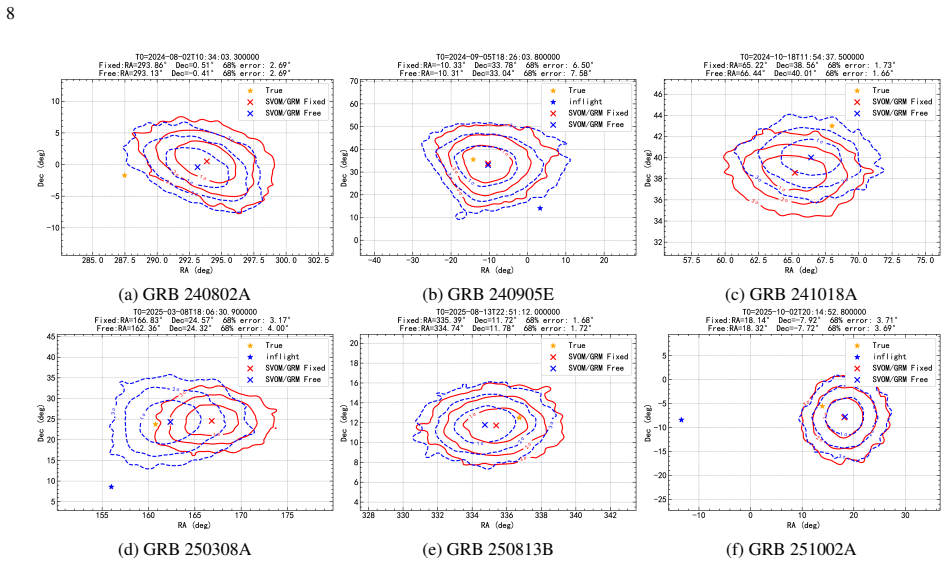
The Space multi-band Variable Object Monitor (SVOM) is an astronomical satellite jointly developed by China and France, primarily focused on the detection of gamma-ray bursts (GRBs) and transient sources. The SVOM satellite was launched on 22nd June, 2024 with four payloads installed onboard. As one of payload, GRM comprises 3 gamma-ray detectors (each detector has an effective area of approximately 200~cm$^{2}$) with distinct pointing directions, enabling the temporal and spectral measurements as well as localization of GRBs in the energy range of 15-5000 keV. This article firstly introduces the on-board localization algorithm design for GRM and presents preliminary test results. Then, leveraging abundant ground-based computational resources, a joint fitting method for spectral and localization analysis using Monte Carlo Markov Chain (MCMC) is implemented. In contrast to the on-board localization algorithm, the on-ground MCMC method comprehensively considers the influence of spectral characteristics, thereby mitigating systematic biases. Finally, a systematic analysis based on this method is provided, highlighting the localization and spectral measurement capabilities of GRM. The preliminary localization analysis result for the on-board detected GRB 240629A by both GRM and Fermi/GBM shows that the localization result (error$\sim$4.14$^{\circ}$) of GRM is consistent with the Fermi/GBM result.
Editorial analysis
A structured set of objections, weighed in public.
Referee Report
Summary. The paper describes the on-board trigger and localization algorithm for the three-detector GRM instrument on SVOM, presents preliminary test results, and introduces a ground-based MCMC method for joint spectral and localization fitting that accounts for spectral shape to reduce biases relative to the on-board approach. It reports a systematic analysis of GRM capabilities and shows that the localization of the on-board detected GRB 240629A yields an error radius of ~4.14° that is consistent with the independent Fermi/GBM result.
Significance. If the response models and background handling prove accurate, the work would be useful for SVOM operations by documenting practical on-board and ground localization pipelines and their performance on a real GRB. The MCMC method's explicit inclusion of spectral parameters is a clear improvement over simpler on-board estimators and could support prompt multi-wavelength follow-up. The direct comparison to Fermi/GBM data for GRB 240629A provides an external cross-check, though the single-event nature limits broader claims about accuracy.
major comments (2)
- [GRB 240629A localization analysis and abstract] The central consistency claim for GRB 240629A (error ~4.14°) rests on a single real event with no accompanying error budget, systematic uncertainty breakdown, or recovery statistics from simulations; this is load-bearing because the abstract and results section present it as evidence of GRM localization capability without demonstrating that the three-detector response functions and background subtraction are free of large unmodeled biases.
- [MCMC method description and systematic analysis] The assertion that the MCMC method 'mitigates systematic biases' by considering spectral characteristics lacks a quantitative before/after comparison (e.g., offset or bias metrics) even for the presented event; without this, it is unclear whether the reported consistency arises from correct modeling or from the relatively large error circle.
minor comments (2)
- [Abstract] The abstract refers to 'preliminary test results' for the on-board algorithm without specifying the test dataset, injected signals, or quantitative performance metrics (e.g., efficiency, false-positive rate).
- [GRM instrument description] Notation for detector pointing directions and effective areas is introduced but not cross-referenced to any table or figure that would allow a reader to reproduce the response matrix assumptions.
Simulated Author's Rebuttal
We thank the referee for the constructive feedback and the recommendation for major revision. We have addressed the concerns regarding the GRB 240629A analysis and the quantitative demonstration of the MCMC method's benefits. The revisions will strengthen the manuscript by providing additional supporting details while preserving the preliminary nature of the results.
read point-by-point responses
-
Referee: The central consistency claim for GRB 240629A (error ~4.14°) rests on a single real event with no accompanying error budget, systematic uncertainty breakdown, or recovery statistics from simulations; this is load-bearing because the abstract and results section present it as evidence of GRM localization capability without demonstrating that the three-detector response functions and background subtraction are free of large unmodeled biases.
Authors: We agree that the localization result for GRB 240629A is based on a single real event and that the current manuscript does not include a full error budget or simulation recovery statistics in the presented sections. This event represents the first on-board detection by GRM, and the reported consistency with the independent Fermi/GBM localization serves as an external cross-check. In the revised manuscript, we will add a dedicated subsection detailing the statistical and systematic uncertainty components (including contributions from response modeling and background subtraction), supported by ground calibration data and Monte Carlo simulations of GRB recovery. This will explicitly address potential unmodeled biases in the three-detector system. revision: yes
-
Referee: The assertion that the MCMC method 'mitigates systematic biases' by considering spectral characteristics lacks a quantitative before/after comparison (e.g., offset or bias metrics) even for the presented event; without this, it is unclear whether the reported consistency arises from correct modeling or from the relatively large error circle.
Authors: We concur that a quantitative before/after comparison is necessary to substantiate the claim that the MCMC approach mitigates biases relative to the on-board algorithm. The current text describes the methodological improvement but does not provide explicit metrics for the GRB 240629A event. In the revision, we will include a table or figure presenting the localization offsets and bias metrics computed both with and without spectral parameter inclusion, using the real event data as well as simulated GRBs with varying spectral shapes. This will clarify the improvement and demonstrate that the consistency is not solely due to the error circle size. revision: yes
Circularity Check
No circularity: algorithms described and validated against independent external data
full rationale
The paper describes the on-board trigger/localization algorithm for the three GRM detectors and a separate ground MCMC joint spectral+localization fit. The only quantitative claim is consistency of the GRB 240629A localization (∼4.14°) with Fermi/GBM. No equation or result is shown to be derived from a fitted parameter that is then re-used as a prediction, nor does any load-bearing step reduce to a self-citation or self-defined ansatz. The comparison uses an external instrument, so the reported agreement is not forced by construction. This is the normal non-circular case for an instrumentation paper.
Axiom & Free-Parameter Ledger
Reference graph
Works this paper leans on
-
[1]
Abbott, B. P., Abbott, R., Abbott, T. D., et al. 2017, ApJ, 848, L13 1
work page 2017
-
[2]
2023, arXiv e-prints, arXiv:2303.01203 1
An, Z.-H., Antier, S., Bi, X.-Z., et al. 2023, arXiv e-prints, arXiv:2303.01203 1
-
[3]
Berlato, F., Greiner, J., & Burgess, J. M. 2019, ApJ, 873, 60 4
work page 2019
-
[4]
M., Yu, H.-F., Greiner, J., & Mortlock, D
Burgess, J. M., Yu, H.-F., Greiner, J., & Mortlock, D. J. 2018, MNRAS, 476, 1427 4
work page 2018
-
[5]
Connaughton, V ., Briggs, M. S., Goldstein, A., et al. 2015, ApJS, 216, 32 3 Fermi GBM Team. 2024, GRB Coordinates Network, 36787, 1 6
work page 2015
- [6]
-
[7]
Gehrels, N., Ramirez-Ruiz, E., & Fox, D. B. 2009, ARA&A, 47, 567 1
work page 2009
-
[8]
Goldstein, A., Veres, P., Burns, E., et al. 2017, ApJ, 848, L14 1
work page 2017
- [9]
-
[10]
2025, Experimental Astronomy, 59, 15 1 IceCube Collaboration, Achterberg, A., Ackermann, M., et al
He, J., Sun, J.-C., Dong, Y .-W., et al. 2025, Experimental Astronomy, 59, 15 1 IceCube Collaboration, Achterberg, A., Ackermann, M., et al. 2006, Astroparticle Physics, 26, 155 1
work page 2025
- [11]
-
[12]
Lacour, S. 2018, SVOM: Challenge of implementing a worldwide coverage VHF Network in the equatorial re- gion, 2018 SpaceOps Conference 1
work page 2018
- [13]
- [14]
- [15]
- [16]
-
[17]
Pendleton, G. N., Briggs, M. S., Kippen, R. M., et al. 1999, ApJ, 512, 362 3
work page 1999
-
[18]
2022, Nuclear Electronics & Detection Technology, 42, 62 3
Shi, H., He, J., & Liu, J. 2022, Nuclear Electronics & Detection Technology, 42, 62 3
work page 2022
-
[19]
Sun, J. C., Dong, Y . W., He, J., et al. 2026, RAA (Research in Astronomy and Astrophysics), this issue, 1 2 SVOM/GRM Team. 2024, GRB Coordinates Network, 36805, 1 6
work page 2026
-
[20]
2011, Comptes Rendus Physique, 12, 206 1
Zhang, B. 2011, Comptes Rendus Physique, 12, 206 1
work page 2011
-
[21]
2018, The Physics of Gamma-Ray Bursts 1
Zhang, B. 2018, The Physics of Gamma-Ray Bursts 1
work page 2018
-
[22]
Zhang, W.-L., Xue, W.-C., Li, C.-K., et al. 2025, ApJ, 986, 170 1 9
work page 2025
-
[23]
2013, Research in Astronomy and Astrophysics, 13, 1381 1
Zhao, D.-H., Wu, B.-B., Song, L.-M., et al. 2013, Research in Astronomy and Astrophysics, 13, 1381 1
work page 2013
-
[24]
Zhao, Y ., Xue, W.-C., Xiong, S.-L., et al. 2023, ApJS, 265, 17 4
work page 2023
-
[25]
2024, Research in Astronomy and Astrophysics, 24, 104003 4
Zhao, Y ., Xue, W., Xiong, S., et al. 2024, Research in Astronomy and Astrophysics, 24, 104003 4
work page 2024
discussion (0)
Sign in with ORCID, Apple, or X to comment. Anyone can read and Pith papers without signing in.