A Slow-Time Receiver Interface for Turbulent Free-Space Quantum Polarization Links
Pith reviewed 2026-05-10 04:15 UTC · model grok-4.3
The pith
Turbulent free-space quantum polarization links require time-dependent receiver interfaces rather than static parameterizations.
A machine-rendered reading of the paper's core claim, the machinery that carries it, and where it could break.
Core claim
By modeling the receiver-plane phase field, beam-centroid displacement, and scintillation as hidden slow-time stochastic processes and applying a leading-order closure to map phase roughness to polarization-mixing variance, the paper generates an aperture-conditioned slow-time receiver interface that produces time-dependent effective depolarization, coherence, and detection descriptors for turbulent quantum links.
What carries the argument
The slow-time receiver interface, constructed by extending an aperture-conditioned static model using stochastic processes for phase, displacement, and scintillation, with a leading-order closure for polarization-mixing variance.
If this is right
- Time-dependent effective depolarization, coherence, and detection descriptors can be generated from the hidden stochastic processes.
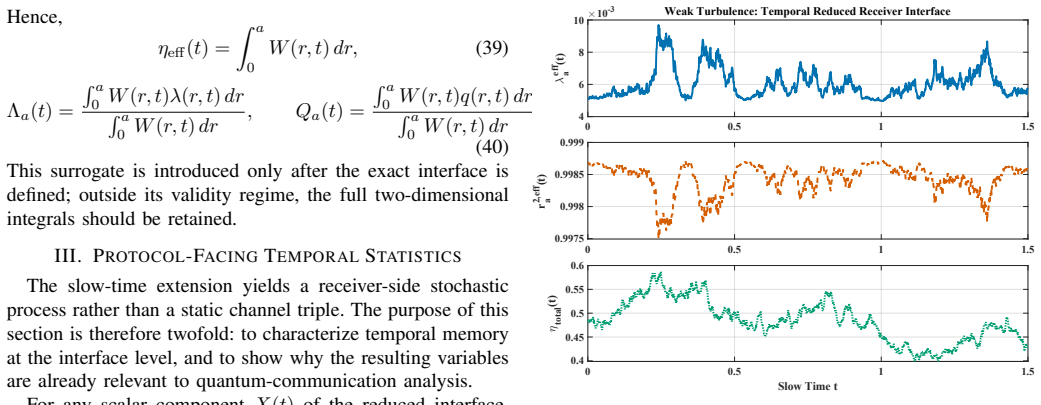
- The polarization branch remains close to the near-ideal regime with depolarization on the order of 10^{-3} and coherence near unity.
- The detection branch exhibits visibly stronger fluctuations and a longer correlation time than the polarization branch.
- A single static receiver-side parameterization fails to characterize the temporal behavior of turbulent free-space quantum links.
- The resulting interface supports receiver-side characterization for downstream applications such as MDI-QKD.
Where Pith is reading between the lines
- The interface could be tested by comparing predicted detection fluctuation statistics against laboratory turbulence simulations of varying strength.
- Integration into MDI-QKD performance models would show how detection-branch variability affects overall key rates over time.
- Similar slow-time extensions might apply to other quantum protocols using free-space channels with scintillation.
- Higher-order corrections to the phase-roughness closure could be derived to extend validity beyond weak turbulence.
Load-bearing premise
The leading-order closure that maps coarse-grained phase roughness to an effective polarization-mixing variance while preserving the local polarization-channel family is valid.
What would settle it
Direct measurement of effective depolarization levels in a weak-turbulence free-space link that deviate substantially from the order of 10 to the minus 3 while the detection branch correlation time mismatches the predicted value.
Figures

read the original abstract
Atmospheric turbulence makes free-space quantum polarization links intrinsically time varying, whereas receiver-side reduced interfaces are often treated as static. This paper develops a slow-time receiver interface by extending an aperture-conditioned static model to the temporal domain. The receiver-plane phase field, beam-centroid displacement, and scintillation are modeled as hidden slow-time stochastic processes, from which the reduced interface is generated at each instant. A leading-order closure maps coarse-grained phase roughness to an effective polarization-mixing variance while preserving the inherited local polarization-channel family. Aperture conditioning then yields time-dependent effective depolarization, coherence, and detection descriptors. In a representative weak-turbulence case, the polarization branch remains close to the near-ideal regime, with effective depolarization on the order of \(10^{-3}\) and effective coherence close to unity, whereas the detection branch exhibits visibly stronger fluctuations and a longer correlation time. These results show that a single static receiver-side parameterization is insufficient to characterize the temporal behavior of turbulent free-space quantum links. The resulting interface is intended for receiver-side characterization of time-varying quantum links, with MDI-QKD as one representative downstream application.
Editorial analysis
A structured set of objections, weighed in public.
Referee Report
Summary. The manuscript develops a slow-time receiver interface for turbulent free-space quantum polarization links by extending an aperture-conditioned static model into the temporal domain. The receiver-plane phase field, beam-centroid displacement, and scintillation are treated as hidden slow-time stochastic processes; at each instant a reduced interface is generated via a leading-order closure that maps coarse-grained phase roughness to an effective polarization-mixing variance while preserving the inherited local polarization-channel family. Aperture conditioning then produces time-dependent descriptors for effective depolarization, coherence, and detection. In a representative weak-turbulence case the polarization branch remains near-ideal (depolarization on the order of 10^{-3}, coherence near unity) while the detection branch shows stronger fluctuations and longer correlation time. The central conclusion is that a single static receiver-side parameterization is insufficient to characterize the temporal behavior of such links, with MDI-QKD cited as a downstream application.
Significance. If the modeling steps and closure hold, the work supplies a concrete framework for moving beyond static approximations in free-space quantum links, directly relevant to adaptive receiver design and time-varying quantum protocols. The stochastic-process treatment of hidden slow-time variables and the separation of polarization versus detection branches offer a practical route to quantifying temporal statistics under weak turbulence.
major comments (2)
- [leading-order closure description] The leading-order closure (described in the abstract and the section that introduces the time-dependent interface) that maps coarse-grained phase roughness to effective polarization-mixing variance while preserving the local polarization-channel family is load-bearing for the reported temporal fluctuations and the insufficiency claim. The manuscript must supply the explicit mathematical definition of this closure, its derivation from the phase-field model, and a demonstration (analytic or numerical) that higher-order contributions remain negligible throughout the weak-turbulence regime considered; without this the ~10^{-3} depolarization fluctuations could be artifacts of the approximation.
- [representative weak-turbulence case] The representative weak-turbulence case (abstract and results section) reports order-of-magnitude descriptors but provides neither the explicit turbulence parameters (e.g., C_n^2, link distance, aperture size) nor the stochastic-process definitions (correlation times, variances) used to drive the hidden variables. These omissions prevent independent verification of the claimed fluctuations and correlation times, directly affecting the strength of the central claim.
minor comments (3)
- [Abstract] The abstract refers to 'the inherited local polarization-channel family' without a citation or brief recap of the static model being extended; this should be supplied on first use for readers outside the immediate subfield.
- [results] Add a figure or table that displays sample time traces of the effective depolarization, coherence, and detection descriptors together with their autocorrelation functions; this would make the reported difference in fluctuation strength and correlation time visually concrete.
- [throughout] All symbols appearing in the closure and in the final descriptors (e.g., the precise definition of 'effective depolarization') should be defined at their first occurrence in the main text.
Simulated Author's Rebuttal
We thank the referee for the careful and constructive review. The two major comments identify areas where additional detail is required for rigor and reproducibility. We address each below and will incorporate the requested material in the revised manuscript.
read point-by-point responses
-
Referee: The leading-order closure (described in the abstract and the section that introduces the time-dependent interface) that maps coarse-grained phase roughness to an effective polarization-mixing variance while preserving the local polarization-channel family is load-bearing for the reported temporal fluctuations and the insufficiency claim. The manuscript must supply the explicit mathematical definition of this closure, its derivation from the phase-field model, and a demonstration (analytic or numerical) that higher-order contributions remain negligible throughout the weak-turbulence regime considered; without this the ~10^{-3} depolarization fluctuations could be artifacts of the approximation.
Authors: We agree that the leading-order closure is central to the temporal fluctuations and the claim that static parameterizations are insufficient. While the manuscript describes the closure conceptually in the section introducing the time-dependent interface, we acknowledge that an explicit mathematical statement, its derivation from the receiver-plane phase-field model, and a quantitative check that higher-order terms remain negligible were not provided. In the revised manuscript we will add the precise definition (the mapping from coarse-grained phase roughness to polarization-mixing variance), the derivation steps, and either an analytic bound or numerical verification confirming that higher-order contributions stay below ~10^{-4} across the weak-turbulence parameter range used. This will directly address the concern that the reported 10^{-3} depolarization levels could be artifacts. revision: yes
-
Referee: The representative weak-turbulence case (abstract and results section) reports order-of-magnitude descriptors but provides neither the explicit turbulence parameters (e.g., C_n^2, link distance, aperture size) nor the stochastic-process definitions (correlation times, variances) used to drive the hidden variables. These omissions prevent independent verification of the claimed fluctuations and correlation times, directly affecting the strength of the central claim.
Authors: We agree that the specific turbulence parameters and stochastic-process definitions must be stated explicitly to allow independent verification. The representative case was selected to illustrate typical weak-turbulence behavior, yet the exact values of C_n^2, link distance, aperture size, and the correlation times/variances (or power spectra) of the hidden processes for the phase field, beam-centroid displacement, and scintillation were omitted. In the revised manuscript we will insert a dedicated parameter table or subsection that lists all numerical values together with the definitions of the driving stochastic processes, thereby enabling direct reproduction of the reported fluctuation amplitudes and correlation times. revision: yes
Circularity Check
No significant circularity; derivation remains self-contained
full rationale
The paper extends a prior static aperture-conditioned model by treating the receiver-plane phase field, centroid displacement, and scintillation as independent hidden slow-time stochastic processes, then applies a leading-order closure to obtain time-dependent descriptors. These steps introduce new modeling assumptions and approximations rather than reducing the output descriptors to quantities defined solely by internal fits or self-referential equations. The central claim (static parameterization is insufficient) follows from the resulting fluctuations in depolarization, coherence, and detection metrics, which are not forced by construction from the inputs. No self-citation load-bearing steps, self-definitional mappings, or fitted-input predictions are present that collapse the derivation chain.
Axiom & Free-Parameter Ledger
axioms (2)
- domain assumption Atmospheric turbulence effects on the receiver plane can be represented as hidden slow-time stochastic processes for phase field, beam-centroid displacement, and scintillation.
- ad hoc to paper A leading-order closure maps coarse-grained phase roughness to effective polarization-mixing variance while preserving the local polarization-channel family.
Reference graph
Works this paper leans on
-
[1]
H. Peng, S. Koudia, and S. Chatzinotas, “Security Analysis of MDI- QKD in Turbulent Free-Space Polarization Channels—A Composite Channel Framework,”arXiv preprint arXiv:2509.02087, 2025
-
[2]
Entanglement-based quantum communication over 144 km,
R. Ursin, F. Tiefenbacher, T. Schmitt-Manderbach, H. Weier, T. Scheidl, M. Lindenthal, B. Blauensteiner, T. Jennewein, J. Perdigues, P. Trojek, B. ”Omer, M. F”urst, M. Meyenburg, J. Rarity, Z. Sodnik, C. Barbieri, and A. Zeilinger, “Entanglement-based quantum communication over 144 km,”Nature Phys., vol. 3, no. 7, pp. 481–486, 2007
work page 2007
-
[3]
Satellite-based entanglement distribution over 1200 kilometers,
J. Yin, Y . Cao, Y .-H. Li, S.-K. Liao, L. Zhang, J.-G. Ren, W.-Q. Cai, W.-Y . Liu, B. Li, H. Dai, G.-B. Li, Q.-M. Lu, Y .-H. Gong, Y . Xu, S.- L. Li, F.-Z. Li, Y .-Y . Yin, Z.-Q. Jiang, M. Li, J.-J. Jia, G. Ren, D. He, Y .-L. Zhou, X.-X. Zhang, N. Wang, X. Chang, Z.-C. Zhu, N.-L. Liu, Y .-A. Chen, C.-Y . Lu, R. Shu, C.-Z. Peng, J.-Y . Wang, and J.-W. Pan...
work page 2017
-
[4]
Satellite-to-ground quantum-limited com- munication using a 50-kg-class microsatellite,
H. Takenaka, A. Carrasco-Casado, M. Fujiwara, M. Kitamura, M. Sasaki, and M. Toyoshima, “Satellite-to-ground quantum-limited com- munication using a 50-kg-class microsatellite,”Nature Photon., vol. 11, pp. 502–508, 2017
work page 2017
-
[5]
Measurement-device-independent quantum key distribution,
H.-K. Lo, M. Curty, and B. Qi, “Measurement-device-independent quantum key distribution,”Phys. Rev. Lett., vol. 108, no. 13, p. 130503, 2012
work page 2012
-
[6]
Continuous-variable measurement-device- independent quantum key distribution in free-space channels,
M. Ghalaii and S. Pirandola, “Continuous-variable measurement-device- independent quantum key distribution in free-space channels,”Phys. Rev. A, vol. 108, p. 042621, 2023
work page 2023
-
[7]
Limits and security of free-space quantum communica- tions,
S. Pirandola, “Limits and security of free-space quantum communica- tions,”Phys. Rev. Research, vol. 3, p. 013279, 2021
work page 2021
-
[8]
Satellite-mediated quantum atmo- spheric links,
D. Vasylyev, W. V ogel, and F. Moll, “Satellite-mediated quantum atmo- spheric links,”Phys. Rev. A, vol. 99, p. 053830, 2019
work page 2019
-
[9]
L. C. Andrews and R. L. Phillips,Laser Beam Propagation through Random Media, 2nd ed. Bellingham, W A, USA: SPIE Press, 2005
work page 2005
-
[10]
Wander of an optical beam in the turbulent atmosphere,
J. H. Churnside and R. J. Lataitis, “Wander of an optical beam in the turbulent atmosphere,”Appl. Opt., vol. 29, no. 7, pp. 926–930, 1990
work page 1990
-
[11]
Level crossing statistics for optical beam wander in a ground-to-space communications link,
H. T. Yura, “Level crossing statistics for optical beam wander in a ground-to-space communications link,”Appl. Opt., vol. 50, no. 18, pp. 2875–2882, 2011
work page 2011
-
[12]
Scintillation and beam-wander analysis in an optical ground station–satellite uplink,
F. Dios, J. A. Rubio, A. Rodr ´ıguez, and A. Comer ´on, “Scintillation and beam-wander analysis in an optical ground station–satellite uplink,” Appl. Opt., vol. 43, no. 19, pp. 3866–3873, 2004
work page 2004
-
[13]
F. Dios, J. Recolons, A. Rodr ´ıguez, and O. Batet, “Temporal analysis of laser beam propagation in the atmosphere using computer-generated long phase screens,”Opt. Express, vol. 16, no. 3, pp. 2206–2220, 2008
work page 2008
-
[14]
A.-R. Camboulives, M.-T. Velluet, S. Poulenard, L. Saint-Antonin, and V . Michau, “Statistical and temporal irradiance fluctuations modeling for a ground-to-geostationary satellite optical link,”Appl. Opt., vol. 57, no. 4, pp. 709–721, 2018
work page 2018
-
[15]
Atmospheric scintillation of optical and infrared waves: a laboratory simulation,
L. R. Bissonnette, “Atmospheric scintillation of optical and infrared waves: a laboratory simulation,”Appl. Opt., vol. 16, no. 8, pp. 2242– 2251, 1977
work page 1977
-
[16]
G. I. Taylor, “The spectrum of turbulence,”Proc. Roy. Soc. London A, vol. 164, no. 919, pp. 476–490, 1938
work page 1938
-
[17]
C. R. V ogel, G. A. Tyler, and D. J. Wittich, “Spatial-temporal- covariance-based modeling, analysis, and simulation of aero-optics wavefront aberrations,”J. Opt. Soc. Am. A, vol. 31, no. 7, pp. 1666– 1679, 2014
work page 2014
-
[18]
Extended Taylor frozen-flow hypothesis and statistics of optical phase in aero-optics,
S. Prasad, “Extended Taylor frozen-flow hypothesis and statistics of optical phase in aero-optics,”J. Opt. Soc. Am. A, vol. 34, no. 6, pp. 931–942, 2017
work page 2017
-
[19]
Atmospheric quantum channels with weak and strong turbulence,
D. Vasylyev, A. A. Semenov, and W. V ogel, “Atmospheric quantum channels with weak and strong turbulence,”Phys. Rev. Lett., vol. 117, p. 090501, 2016
work page 2016
-
[20]
Time correlations in atmospheric quantum channels,
M. Klen, D. Vasylyev, W. V ogel, and A. A. Semenov, “Time correlations in atmospheric quantum channels,”Phys. Rev. A, vol. 109, p. 033712, 2024
work page 2024
discussion (0)
Sign in with ORCID, Apple, or X to comment. Anyone can read and Pith papers without signing in.