Scalable Physics-Informed Neural Differential Equations and Data-Driven Algorithms for HVAC Systems
Pith reviewed 2026-05-10 04:42 UTC · model grok-4.3
The pith
A physics-informed neural framework for HVAC systems delivers multi-fold speedups over high-fidelity simulation while holding errors below a few percent even at 16-component scale.
A machine-rendered reading of the paper's core claim, the machinery that carries it, and where it could break.
Core claim
The central claim is that implicit physics-informed neural ordinary differential equations for individual heat exchangers, combined with differential-algebraic equation solvers for network constraints and a short-trajectory corrector network, produce scalable HVAC simulations. When trained to predict conserved quantities and stabilized via gated architectures and layer normalization, the models integrate directly with solvers such as IDA and DASSL. Bayesian optimization further refines the accuracy-efficiency balance, yielding multi-fold speedups relative to high-fidelity references while maintaining MAPE below a few percent up to systems containing 16 compressor-condenser pairs.
What carries the argument
The core mechanism is the implicit PINODE that predicts refrigerant mass and internal energy as outputs for automatic differentiation of mass and energy balances, integrated with DAE solvers that enforce junction constraints and augmented by a corrector network trained on brief segments.
If this is right
- The method scales component count without linear growth in runtime while preserving low error.
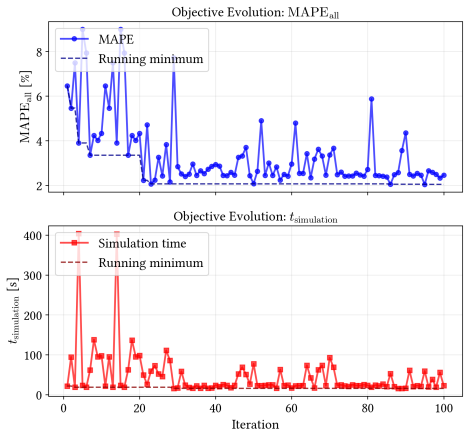
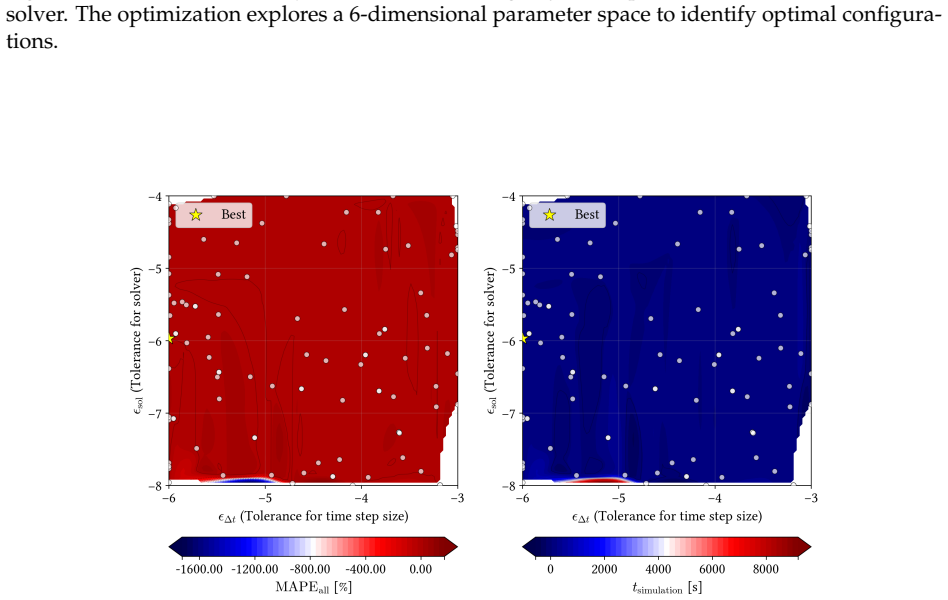
- Bayesian tuning of solver parameters allows explicit control over speed-accuracy trade-offs.
- Component-level physics losses plus system-level constraint enforcement keep global consistency without retraining at every scale.
- The corrector network reduces systematic bias that would otherwise accumulate from learned components alone.
- Long-horizon stability holds when latent evolution is regularized through gating and normalization.
Where Pith is reading between the lines
- Similar hybrid neural-DAE structures could replace parts of simulators in other networked flow systems such as district heating or refrigeration plants.
- The separation of learned components from explicit constraint solvers suggests a template for building digital twins that mix data-driven speed with physical guarantees.
- Extending the corrector to adapt online from live sensor streams would test whether the short-trajectory training generalizes under changing operating conditions.
Load-bearing premise
The assumption that gradient stabilization in gated architectures plus a corrector trained only on short segments will produce stable, unbiased predictions when the full system runs for long times at larger scales.
What would settle it
A side-by-side run of the learned model against a high-fidelity simulator on a 32-pair HVAC network over an extended time horizon that shows MAPE rising well above a few percent would falsify the scalability claim.
Figures






read the original abstract
We present a scalable, data-driven simulation framework for large-scale heating, ventilation, and air conditioning (HVAC) systems that couples physics-informed neural ordinary differential equations (PINODEs) with differential-algebraic equation (DAE) solvers. At the component level, we learn heat-exchanger dynamics using an implicit PINODE formulation that predicts conserved quantities (refrigerant mass $M_r$ and internal energy $E_\text{hx}$) as outputs, enabling physics-informed training via automatic differentiation of mass/energy balances. Stable long-horizon prediction is achieved through gradient-stabilized latent evolution with gated architectures and layer normalization. At the system level, we integrate learned components with DAE solvers (IDA and DASSL) that explicitly enforce junction constraints (pressure equilibrium and mass-flow consistency), and we use Bayesian optimization to tune solver parameters for accuracy--efficiency trade-offs. To reduce residual system-level bias, we introduce a lightweight corrector network trained on short trajectory segments. Across dual-compressor and scaled network studies, the proposed approach attains multi-fold speedups over high-fidelity simulation while keeping errors low (MAPE below a few percent) and scales to systems with up to 16 compressor-condenser pairs.
Editorial analysis
A structured set of objections, weighed in public.
Referee Report
Summary. The manuscript presents a hybrid simulation framework for large-scale HVAC systems that couples physics-informed neural ODEs (PINODEs) for component dynamics—predicting conserved quantities like refrigerant mass and internal energy—with DAE solvers (IDA, DASSL) to enforce junction constraints, plus Bayesian optimization for solver tuning and a lightweight corrector network trained on short trajectories to reduce residual bias. It claims multi-fold speedups over high-fidelity simulation with MAPE below a few percent, scaling to systems with up to 16 compressor-condenser pairs via gradient-stabilized latent evolution and gated architectures.
Significance. If the scaling and accuracy claims hold under rigorous validation, the work could enable substantially faster yet physically consistent simulations of complex HVAC networks, supporting applications in real-time optimization and control; the explicit use of external DAE solvers and Bayesian tuning avoids pure data-driven circularity and provides a template for hybrid neural-physics modeling in engineering systems.
major comments (2)
- [Abstract and scaled network studies] Abstract and results section on scaled studies: the headline claims of multi-fold speedups with MAPE below a few percent at 16 compressor-condenser pairs are presented without reported details on training data volume, number of long-horizon generalization tests, error bars, or ablation of the corrector network, leaving the central performance and scaling assertions only partially supported.
- [Corrector network formulation] Description of the corrector network: the assumption that training exclusively on short trajectory segments suffices to remove system-level bias while preserving stability in long-horizon 16-pair simulations is load-bearing for the scaling claim, yet no evidence is provided that short-segment residuals are representative of emergent inter-component couplings or longer-term drift under DAE constraints.
minor comments (1)
- [PINODE component model] Ensure all equations for mass and energy balances are explicitly numbered and cross-referenced when discussing automatic differentiation for physics-informed training.
Simulated Author's Rebuttal
We thank the referee for the constructive and detailed feedback. We address each major comment below with clarifications and indicate where revisions will be made to strengthen the manuscript.
read point-by-point responses
-
Referee: [Abstract and scaled network studies] Abstract and results section on scaled studies: the headline claims of multi-fold speedups with MAPE below a few percent at 16 compressor-condenser pairs are presented without reported details on training data volume, number of long-horizon generalization tests, error bars, or ablation of the corrector network, leaving the central performance and scaling assertions only partially supported.
Authors: We agree that the abstract and results section would benefit from greater specificity to fully support the scaling claims. In the revised manuscript we will add explicit reporting of the training data volume (number of trajectories and total timesteps), the number of independent long-horizon generalization tests performed on the 16-pair systems, error bars obtained across multiple random seeds, and a dedicated ablation isolating the corrector network's contribution to accuracy and stability. These additions will be placed in the results section and referenced from the abstract. revision: yes
-
Referee: [Corrector network formulation] Description of the corrector network: the assumption that training exclusively on short trajectory segments suffices to remove system-level bias while preserving stability in long-horizon 16-pair simulations is load-bearing for the scaling claim, yet no evidence is provided that short-segment residuals are representative of emergent inter-component couplings or longer-term drift under DAE constraints.
Authors: The corrector is intended to capture local residual biases that arise from the learned component models; the DAE solver is relied upon to enforce global constraints. We acknowledge that direct evidence linking short-segment residuals to long-horizon behavior is currently limited. In the revision we will include additional validation experiments that compare error accumulation and inter-component coupling metrics over extended horizons with and without the corrector, together with an analysis of residual drift under the DAE constraints. This will provide the requested substantiation. revision: yes
Circularity Check
No significant circularity; derivation relies on external solvers and independent data-driven training
full rationale
The paper couples learned PINODE components with external DAE solvers (IDA, DASSL) and Bayesian optimization for tuning, while the corrector network is trained on short trajectory segments to address residual bias. This structure uses standard physics-informed training via automatic differentiation of conservation laws and empirical validation on scaled systems, without any self-definitional loops, fitted parameters renamed as predictions, or load-bearing self-citations. The scaling and speedup claims rest on reported MAPE and runtime comparisons rather than tautological reductions to inputs.
Axiom & Free-Parameter Ledger
free parameters (1)
- DAE solver parameters
axioms (1)
- domain assumption Mass and energy conservation hold for heat-exchanger dynamics
Reference graph
Works this paper leans on
-
[1]
Energy Information Administration
U.S. Energy Information Administration. Annual energy outlook 2021. Technical report, U.S. Energy Information Administration, 2021
work page 2021
-
[2]
Review of modeling methods for hvac systems
Abdul Afram and Farrokh Janabi-Sharifi. Review of modeling methods for hvac systems. Applied Thermal Engineering, 67(1–2):507–519, June 2014. 47 Figure 28: Loss history for the training and testing sets of the evaporator (outdoor heat exchanger) PINODE model. The stable convergence with minimal gap between training and testing losses in- dicates good gene...
work page 2014
-
[3]
Ankush Chakrabarty, Emilio Maddalena, Hongtao Qiao, and Christopher Laughman. Scal- able bayesian optimization for model calibration: Case study on coupled building and hvac dynamics. Energy and Buildings, 253:111460, December 2021
work page 2021
-
[4]
Modelica Association. Modelica–a unified object-oriented language for physical systems modeling: Language specification version 3.0. Technical report, Modelica Association, 2005
work page 2005
-
[5]
Energy- plus: creating a new-generation building energy simulation program
Drury B Crawley, Linda K Lawrie, Frederick C Winkelmann, W F Buhl, Y Joe Huang, Curtis O Pedersen, Richard K Strand, Richard J Liesen, Daniel E Fisher, Michael J Witte, et al. Energy- plus: creating a new-generation building energy simulation program. Energy and buildings, 33(4):319–331, 2001
work page 2001
-
[6]
Transient modeling of a flash tank vapor injection heat pump system–part i: Model development
Hongtao Qiao, Vikrant Aute, and Reinhard Radermacher. Transient modeling of a flash tank vapor injection heat pump system–part i: Model development. International journal of refrig- eration, 49:169–182, 2015
work page 2015
-
[7]
A review of data-driven building en- ergy consumption prediction studies
Yixing Chen, Tianzhen Hong, and Mary Ann Piette. A review of data-driven building en- ergy consumption prediction studies. Renewable and Sustainable Energy Reviews, 81:1192–1205, 2018
work page 2018
-
[8]
Whole-building simulation with symbolic dae equations and general purpose solvers
Per Sahlin, Lars Eriksson, Pavel Grozman, Hans Johnsson, Alexander Shapovalov, and Mika Vuolle. Whole-building simulation with symbolic dae equations and general purpose solvers. Building and Environment, 39(8):949–958, August 2004
work page 2004
-
[9]
Approximation of Large Stiff Acausal Models
Ranjan Anantharaman. Approximation of Large Stiff Acausal Models. PhD thesis, Massachusetts Institute of Technology, Cambridge, MA, 2023
work page 2023
- [10]
-
[11]
Ankush Chakrabarty, Emilio Maddalena, Hongtao Qiao, and Christopher Laughman. Data- driven calibration of joint building and hvac dynamic models using scalable bayesian opti- mization. In Proceedings of Building Simulation 2021: 17th Conference of IBPSA , BS 2021. KU Leuven, September 2021
work page 2021
-
[12]
Data-driven online energy management framework for hvac systems: An experimental study
Dafang Zhao, Daichi Watari, Yuki Ozawa, Ittetsu Taniguchi, Toshihiro Suzuki, Yoshiyuki Shimoda, and Takao Onoye. Data-driven online energy management framework for hvac systems: An experimental study. Applied Energy, 352:121921, December 2023
work page 2023
-
[13]
Neural differential equations for temperature control in buildings under demand response programs
Vincent Taboga, Clement Gehring, Mathieu Le Cam, Hanane Dagdougui, and Pierre-Luc Bacon. Neural differential equations for temperature control in buildings under demand response programs. Applied Energy, 368:123433, August 2024
work page 2024
-
[14]
Smoothing techniques in dynamic building system simulation
Zhelun Chen, Jin Wen, Anthony Kearsley, and Amanda Pertzborn. Smoothing techniques in dynamic building system simulation. In 2021 International Conference on Instrumentation, Control, and Automation (ICA), page 156–161. IEEE, August 2021
work page 2021
-
[15]
Physics-informed neural ode (pinode): embedding physics into models using collocation points
Aleksei Sholokhov, Yuying Liu, Hassan Mansour, and Saleh Nabi. Physics-informed neural ode (pinode): embedding physics into models using collocation points. Scientific Reports, 13(1), June 2023
work page 2023
-
[16]
https://computing.llnl.gov/projects/sundials/ida, 2025
Ida – sundials: An open-source software library of time integrators and nonlinear solvers. https://computing.llnl.gov/projects/sundials/ida, 2025. Accessed: 2025-12-10
work page 2025
-
[17]
A description of dassl: A differential/algebraic system solver
Linda R Petzold. A description of dassl: A differential/algebraic system solver. Technical Report SAND82-8637, Sandia National Labs., 1982
work page 1982
- [18]
-
[19]
A. F. I. Mamadou, M. O. K. Idrissou, S. A. O. Sanya, J. V . C. Vargas, and A. R. Alexandra. Intel- ligent optimal control of endoreversible single-effect hvac-ar system using machine learning. International Journal of Air-Conditioning and Refrigeration, 33(1), October 2025
work page 2025
-
[20]
Maziar Raissi, Paris Perdikaris, and George Em Karniadakis. Physics-informed neural net- works: A deep learning framework for solving forward and inverse problems involving non- linear partial differential equations. Journal of Computational Physics, 378:686–707, 2019
work page 2019
-
[21]
Neural ordinary differential equations
Ricky TQ Chen, Yulia Rubanova, Jesse Bettencourt, and David K Duvenaud. Neural ordinary differential equations. Advances in neural information processing systems, 31, 2018
work page 2018
-
[22]
Gru-ode-bayes: Continu- ous modeling of sporadically-observed time series
Edward De Brouwer, Jaak Simm, Adam Arany, and Yves Moreau. Gru-ode-bayes: Continu- ous modeling of sporadically-observed time series. Advances in neural information processing systems, 32, 2019
work page 2019
-
[23]
Eigen-informed neuralodes: Dealing with stability and convergence issues of neuralodes
Tobias Thummerer and Lars Mikelsons. Eigen-informed neuralodes: Dealing with stability and convergence issues of neuralodes. arXiv preprint arXiv:2302.10892, 2023
-
[24]
Ppinn: Parareal physics-informed neural network for time-dependent pdes
Xuhui Meng, Zhen Li, Dongkun Zhang, and George Em Karniadakis. Ppinn: Parareal physics-informed neural network for time-dependent pdes. Computer Methods in Applied Me- chanics and Engineering, 370:113250, 2020
work page 2020
-
[25]
Predicting micro-bubble dynamics with semi- physics-informed deep learning
Hanfeng Zhai, Quan Zhou, and Guohui Hu. Predicting micro-bubble dynamics with semi- physics-informed deep learning. AIP Advances, 12(3), 2022. 49
work page 2022
-
[26]
Deepxde: A deep learning library for solving differential equations
Lu Lu, Xuhui Meng, Zhiping Mao, and George Em Karniadakis. Deepxde: A deep learning library for solving differential equations. SIAM review, 63(1):208–228, 2021
work page 2021
-
[27]
Peter I Frazier. Bayesian optimization. In Recent advances in optimization and modeling of con- temporary problems, pages 255–278. Informs, 2018
work page 2018
-
[28]
Computational design of antimicrobial active surfaces via automated bayesian optimization
Hanfeng Zhai and Jingjie Yeo. Computational design of antimicrobial active surfaces via automated bayesian optimization. ACS Biomaterials Science & Engineering, 9(1):269–279, 2022
work page 2022
-
[29]
Jimmy Lei Ba, Jamie Ryan Kiros, and Geoffrey E Hinton. Layer normalization. arXiv preprint arXiv:1607.06450, 2016
work page internal anchor Pith review Pith/arXiv arXiv 2016
-
[30]
On bayesian methods for seeking the extremum
Jonas Mockus, Vytautas Tiesis, and Antanas Zilinskas. On bayesian methods for seeking the extremum. Optimization techniques IFIP technical conference, pages 400–404, 1975. 50
work page 1975
discussion (0)
Sign in with ORCID, Apple, or X to comment. Anyone can read and Pith papers without signing in.