Colour Extraction Pipeline for Odonates using Computer Vision
Pith reviewed 2026-05-10 04:32 UTC · model grok-4.3
The pith
A deep neural network pipeline segments Odonates from citizen science images into head, thorax, abdomen and wings then extracts a color palette for each part.
A machine-rendered reading of the paper's core claim, the machinery that carries it, and where it could break.
Core claim
The authors demonstrate a computer vision pipeline that, after training on a limited annotated dataset and refinement with pseudo-supervised data drawn from citizen science platforms, can locate each visible Odonate subject, divide it into head, thorax, abdomen, and wings, and produce a color palette for every body part.
What carries the argument
Deep neural network segmentation model that isolates the four main body parts of each Odonate before per-part color palette extraction.
If this is right
- Large-scale statistical analysis of how Odonate coloration correlates with climate change, habitat loss, or geolocation becomes feasible without new manual annotation campaigns.
- Existing open-source citizen science images can replace costly, locally scoped annotation efforts for trait studies.
- Quantification of ecosystem biodiversity status through color-based traits can be performed at greater scale and lower cost.
- Morphological responses to environmental pressures can be tracked across wider geographic and temporal ranges.
Where Pith is reading between the lines
- The same segmentation-plus-palette approach could be retrained on images of other insect orders to extract comparable traits.
- Color data generated at scale could be merged with existing climate or land-use datasets to test trait-environment relationships that remain under-studied.
- If segmentation accuracy holds across diverse poses and backgrounds, the pipeline could be embedded in mobile apps to crowd-source further validation data.
Load-bearing premise
A model trained on a limited annotated dataset and refined with pseudo-supervised data will produce accurate enough segmentations and color extractions to support reliable large-scale ecological correlations.
What would settle it
Direct comparison of the pipeline's extracted color values against manual color measurements performed on the same test images would reveal systematic mismatches in hue or saturation for one or more body parts.
Figures






read the original abstract
The correlation between insect morphological traits and climate has been documented in physiological studies, but such studies remain limited by the time-consuming nature of the data analysis. In particular, the open source datasets often lack annotations of species' morphological traits, making dedicated annotations campaigns necessary; these efforts are typically local in scale and costly. In this paper, we propose a pipeline to identify and segment body parts of Odonates (dragonflies and damselflies) using deep neural networks, with the ultimate goal of extracting body parts' colouration. The pipeline is trained on a limited annotated dataset and refined with pseudo supervised data. We show that, by using open source images from citizen science platforms, our approach can segment each visible subject (Odonates) into head, thorax, abdomen, and wings and then extract a colour palette for each body part. This will enable large-scale statistical analysis of ecological correlations (e.g., between colouration and climate change, habitat loss, or geolocation) which are crucial for quantifying and assessing ecosystem biodiversity status.
Editorial analysis
A structured set of objections, weighed in public.
Referee Report
Summary. The manuscript proposes a deep neural network pipeline to segment Odonate (dragonfly and damselfly) images sourced from citizen science platforms into four body parts—head, thorax, abdomen, and wings—and to extract a color palette for each part. The pipeline is initially trained on a limited annotated dataset and then refined using pseudo-supervised learning, with the stated goal of enabling large-scale statistical analyses of ecological correlations such as between coloration and climate change or habitat loss.
Significance. If the pipeline were shown through rigorous quantitative evaluation to produce accurate segmentations and unbiased color extractions across variable images, it would offer a valuable tool for automating morphological trait extraction from large public datasets, thereby addressing the scalability limitations of manual annotation campaigns in biodiversity and climate-impact studies.
major comments (2)
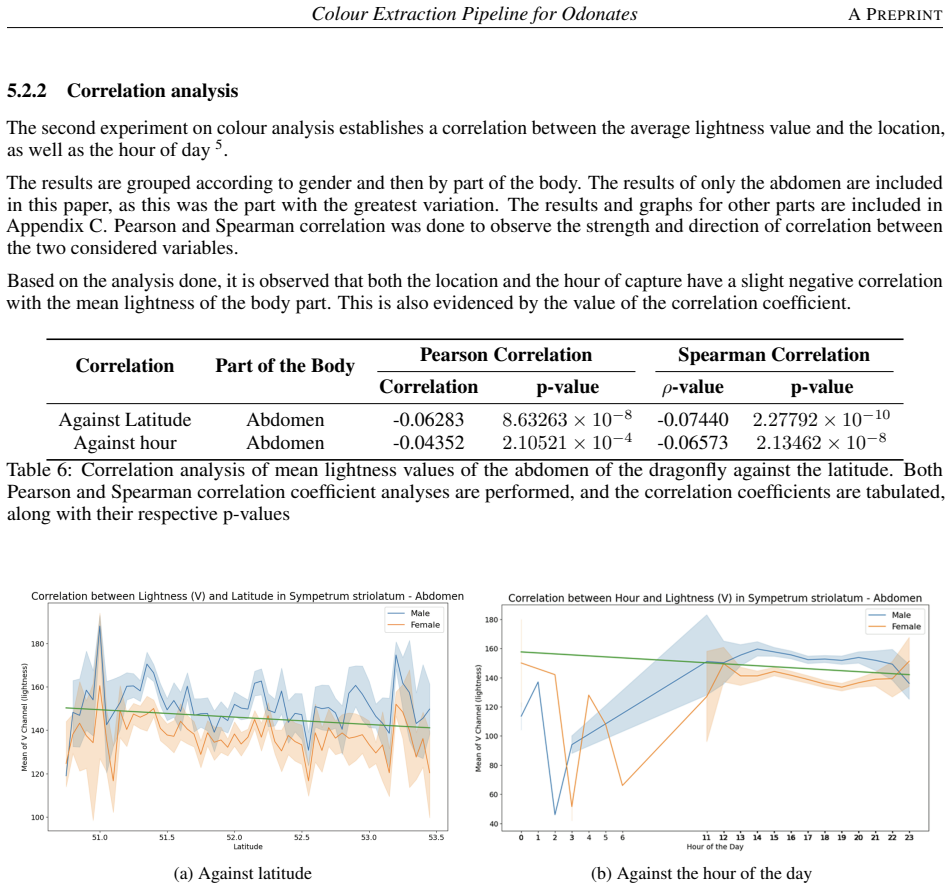
- Abstract: The central claim that the pipeline 'can segment each visible subject (Odonates) into head, thorax, abdomen, and wings and then extract a colour palette for each body part' to support 'large-scale statistical analysis of ecological correlations' is not accompanied by any quantitative validation. No segmentation metrics (IoU, Dice, or pixel accuracy), color extraction fidelity measures (e.g., CIE ΔE or palette similarity scores), held-out test results, or error analysis on unseen citizen-science images are reported, leaving the generalization across pose, lighting, occlusion, and species variation unverified and the leap to reliable ecological correlations unsupported.
- Abstract / Methods description: The pseudo-supervised refinement step is presented as improving the model trained on limited annotations, yet no details are given on pseudo-label generation, confidence thresholding, or ablation experiments comparing the base model against the refined version; without these, it is impossible to assess whether the refinement actually mitigates the data-scarcity problem or introduces label noise that could bias color extraction.
minor comments (1)
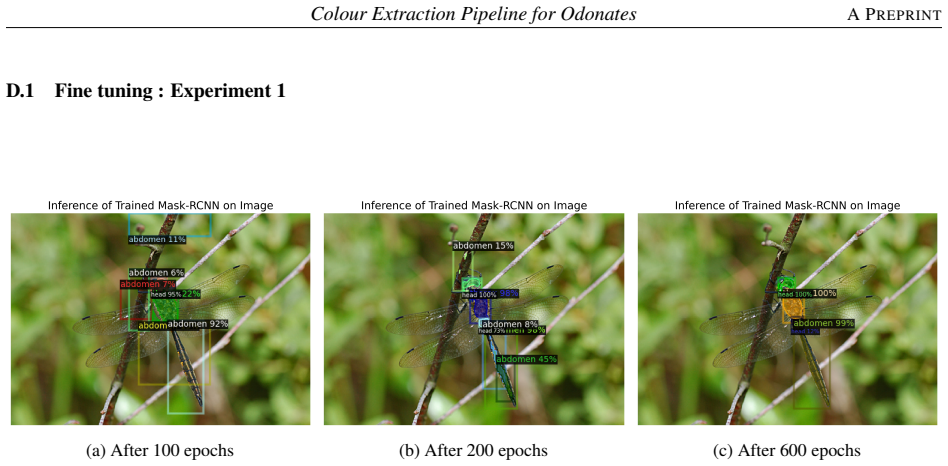
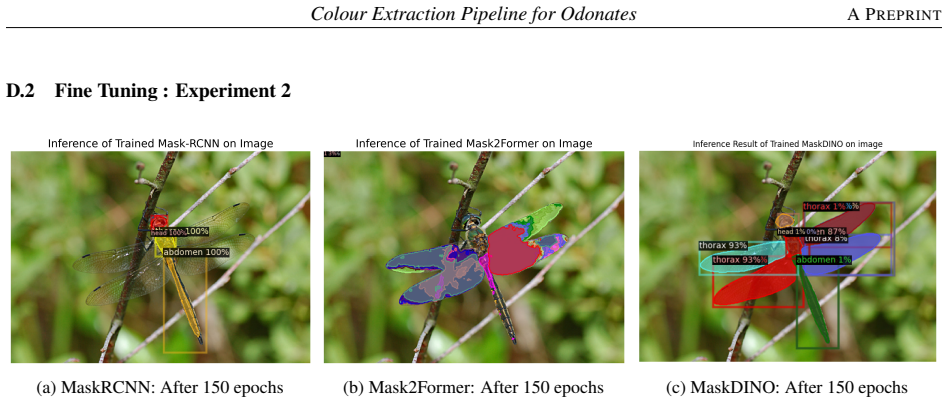
- The manuscript would benefit from the inclusion of qualitative example outputs (segmentation masks and extracted palettes) alongside any future quantitative tables to illustrate performance on representative images.
Simulated Author's Rebuttal
We thank the referee for their constructive comments, which correctly highlight gaps in quantitative validation and methodological detail. We will revise the manuscript to address these points by adding the requested evaluations and clarifications, thereby strengthening the evidence for the pipeline's performance.
read point-by-point responses
-
Referee: Abstract: The central claim that the pipeline 'can segment each visible subject (Odonates) into head, thorax, abdomen, and wings and then extract a colour palette for each body part' to support 'large-scale statistical analysis of ecological correlations' is not accompanied by any quantitative validation. No segmentation metrics (IoU, Dice, or pixel accuracy), color extraction fidelity measures (e.g., CIE ΔE or palette similarity scores), held-out test results, or error analysis on unseen citizen-science images are reported, leaving the generalization across pose, lighting, occlusion, and species variation unverified and the leap to reliable ecological correlations unsupported.
Authors: We agree that the current manuscript does not report quantitative validation metrics. The presented results are primarily qualitative demonstrations on citizen-science images. In the revised manuscript we will add a dedicated evaluation section that reports segmentation metrics (IoU, Dice, pixel accuracy) and color extraction fidelity measures (including CIE ΔE and palette similarity) on a held-out test set. We will also include error analysis across variations in pose, lighting, occlusion, and species to substantiate the generalization claims and support the pipeline's suitability for large-scale ecological studies. revision: yes
-
Referee: Abstract / Methods description: The pseudo-supervised refinement step is presented as improving the model trained on limited annotations, yet no details are given on pseudo-label generation, confidence thresholding, or ablation experiments comparing the base model against the refined version; without these, it is impossible to assess whether the refinement actually mitigates the data-scarcity problem or introduces label noise that could bias color extraction.
Authors: We acknowledge that the description of the pseudo-supervised refinement lacks necessary specifics. The manuscript states that the model is refined with pseudo-supervised data but does not detail the pseudo-label generation procedure, any confidence thresholds used, or provide ablation comparisons. In the revision we will expand the Methods section to describe the pseudo-label generation process, confidence thresholding strategy, and include ablation experiments that compare the base model against the refined version. These additions will allow assessment of whether the refinement reduces data scarcity without introducing problematic label noise. revision: yes
Circularity Check
No circularity in standard ML pipeline description
full rationale
The paper describes an empirical computer vision pipeline: train a segmentation model on a limited annotated dataset, refine with pseudo-supervised data from citizen-science images, then extract per-part color palettes. No equations, derivations, fitted parameters, or predictions are presented that reduce to the inputs by construction. No self-citations are invoked as load-bearing uniqueness theorems or ansatzes. The central claim rests on the (unquantified) generalization performance of the trained model rather than any self-referential logic, making the derivation chain self-contained and non-circular.
Axiom & Free-Parameter Ledger
axioms (1)
- domain assumption Deep neural networks can learn accurate body-part segmentation from limited labeled data when refined via pseudo-supervision.
Reference graph
Works this paper leans on
-
[1]
Catherine Duryea, Ryo Futahashi, Bengt Hansson, M
Seth Bybee, Alex Córdoba-Aguilar, M. Catherine Duryea, Ryo Futahashi, Bengt Hansson, M. Olalla Lorenzo- Carballa, Ruud Schilder, Robby Stoks, Anton Suvorov, Erik I. Svensson, Janne Swaegers, Yuma Takahashi, Phillip C. Watts, and Maren Wellenreuther. Odonata (dragonflies and damselflies) as a bridge between ecology and evolutionary genomics. 13:46
-
[2]
Tharaka S. Priyadarshana and Eleanor M. Slade. A meta-analysis reveals that dragonflies and damselflies can provide effective biological control of mosquitoes.Journal of Animal Ecology, 92(8):1589–1600, 2023. _eprint: https://besjournals.onlinelibrary.wiley.com/doi/pdf/10.1111/1365-2656.13965 TLDR: The results provided strong evidence that dragonflies/dam...
-
[3]
Michael L. May. Odonata: Who They Are and What They Have Done for Us Lately: Classification and Ecosystem Services of Dragonflies.Insects, 10(3):62, March 2019. TLDR: Odonata (dragonflies and damselflies) are well-known but often poorly understood insects whose phylogeny and classification have proved difficult to understand but, through use of modern mor...
work page 2019
-
[4]
Sherratt, and Adolfo Cordero-Rivera
Hans Van Gossum, Tom N. Sherratt, and Adolfo Cordero-Rivera. The evolution of sex-limited colour polymor- phism. In Alex Córdoba-Aguilar, editor,Dragonflies and Damselflies: Model Organisms for Ecological and Evolutionary Research, page 0. Oxford University Press, August 2008
work page 2008
-
[5]
Moore, Cassandra Lis, Iulian Gherghel, and Ryan A
Michael P. Moore, Cassandra Lis, Iulian Gherghel, and Ryan A. Martin. Temperature shapes the costs, benefits and geographic diversification of sexual coloration in a dragonfly.Ecology Letters, 22(3):437–446, 2019. _eprint: https://onlinelibrary.wiley.com/doi/pdf/10.1111/ele.13200 TLDR: Temperature’s capacity to promote and constrain the evolution of sexua...
-
[6]
Christopher Hassall and David J. Thompson. The effects of environmental warming on odonata: a review. 11(2):131–153. _eprint: https://doi.org/10.1080/13887890.2008.9748319 TLDR: Directions for research are suggested, particularly laboratory studies that investigate underlying causes of climate-driven macroecological patterns, and studies on other inverteb...
-
[7]
M. J. Samways, A. Córdoba-Aguilar, C. Deacon, F. Alves-Martins, I. R. C. Baird, S. H. Barmentlo, L. S. Brasil, J. T. Bried, V . Clausnitzer, A. Cordero-Rivera, F. H. Datto-Liberato, G. De Knijf, A. Dolný, R. Futahashi, R. Guillermo-Ferreira, C. Hassall, L. Juen, R. Khelifa, F. Lozano, J. Muzón, G. Sahlén, M. S. Herrera, J. P. Simaika, R. Stoks, C. M. Suár...
-
[8]
Dittogym: Learning to control soft robots with differentiable simulation,
Aditya Jain, Fagner Cunha, Michael James Bunsen, Juan Sebastián Cañas, Léonard Pasi, Nathan Pinoy, Flemming Helsing, JoAnne Russo, Marc Botham, Michael Sabourin, Jonathan Fréchette, Alexandre Anctil, Yacksecari Lopez, Eduardo Navarro, Filonila Perez Pimentel, Ana Cecilia Zamora, José Alejandro Ramirez Silva, Jonathan Gagnon, Tom August, Kim Bjerge, Alba G...
-
[9]
Motion Informed Object Detection of Small Insects in Time-lapse Camera Recordings, June 2023
Kim Bjerge, Carsten Eie Frigaard, and Henrik Karstoft. Motion Informed Object Detection of Small Insects in Time-lapse Camera Recordings, June 2023. arXiv:2212.00423 [cs]
-
[10]
Zakharov, Iuliia Zarubiieva, Akshita Gupta, Scott C
Johanna Orsholm, John Quinto, Hannu Autto, Gaia Banelyte, Nicolas Chazot, Jeremy deWaard, Stephanie deWaard, Arielle Farrell, Brendan Furneaux, Bess Hardwick, Nao Ito, Amlan Kar, Oula Kalttopää, Deirdre Kerdraon, Erik Kristensen, Jaclyn McKeown, Tommi Mononen, Ellen Nein, Hanna Rogers, Tomas Roslin, Paula Schmitz, Jayme Sones, Maija Sujala, Amy Thompson, ...
-
[11]
Using computer vision to understand the global biogeography of ant color
Jacob Idec, Tom Bishop, and Brian Fisher. Using computer vision to understand the global biogeography of ant color
-
[12]
Lawrence Zitnick, and Piotr Dollár
Tsung-Yi Lin, Michael Maire, Serge Belongie, Lubomir Bourdev, Ross Girshick, James Hays, Pietro Perona, Deva Ramanan, C. Lawrence Zitnick, and Piotr Dollár. Microsoft COCO: Common objects in context
-
[13]
The cityscapes dataset for semantic urban scene understanding
Marius Cordts, Mohamed Omran, Sebastian Ramos, Timo Rehfeld, Markus Enzweiler, Rodrigo Benenson, Uwe Franke, Stefan Roth, and Bernt Schiele. The cityscapes dataset for semantic urban scene understanding
-
[14]
The mapillary vistas dataset for semantic understanding of street scenes
Gerhard Neuhold, Tobias Ollmann, Samuel Rota Bulò, and Peter Kontschieder. The mapillary vistas dataset for semantic understanding of street scenes. In2017 IEEE International Conference on Computer Vision (ICCV), pages 5000–5009. 19 Colour Extraction Pipeline for OdonatesA PREPRINT
-
[15]
Peter Bankhead, Maurice B. Loughrey, José A. Fernández, Yvonne Dombrowski, Darragh G. McArt, Philip D. Dunne, Stephen McQuaid, Ronan T. Gray, Liam J. Murray, Helen G. Coleman, Jacqueline A. James, Manuel Salto-Tellez, and Peter W. Hamilton. QuPath: Open source software for digital pathology image analysis. 7(1):16878
-
[16]
Fantastic animals and where to find them: Segment any marine animal with dual SAM
Pingping Zhang, Tianyu Yan, Yang Liu, and Huchuan Lu. Fantastic animals and where to find them: Segment any marine animal with dual SAM
-
[17]
Learning part segmentation from synthetic animals
Jiawei Peng, Ju He, Prakhar Kaushik, Zihao Xiao, Jiteng Mu, and Alan Yuille. Learning part segmentation from synthetic animals
-
[18]
Tiny deep learning model for insect segmentation and counting on resource-constrained devices
Amin Kargar, Dimitrios Zorbas, Michael Gaffney, Brendan O’Flynn, and Salvatore Tedesco. Tiny deep learning model for insect segmentation and counting on resource-constrained devices. 236:110378
-
[19]
David H. Foster and Kinjiro Amano. Hyperspectral imaging in color vision research: tutorial. 36(4):606–627
-
[20]
Xuquan Wang, Zhiyuan Ma, Yujie Xing, Tianfan Peng, Xiong Dun, Zhuqing He, Jian Zhang, and Xinbin Cheng. Rapid species discrimination of similar insects using hyperspectral imaging and lightweight edge artificial intelligence. 11(7):240485
-
[21]
Siqiao Tan, Shuzhen Hu, Shaofang He, Lei Zhu, Yanlin Qian, and Yangjun Deng. Leveraging hyperspectral images for accurate insect classification with a novel two-branch self-correlation approach. 14(4):863
-
[22]
Virginie Lacotte, Elisa Dell’Aglio, Sergio Peignier, Fadéla Benzaoui, Abdelaziz Heddi, Rita Rebollo, and Pedro Da Silva. A comparative study revealed hyperspectral imaging as a potential standardized tool for the analysis of cuticle tanning over insect development. 9(3):e13962
-
[23]
Serena Price, Robert Guralnick, Coleman M. Sheehy, and Jacob Idec. Using large-scale community science data and computer vision to evaluate thermoregulation as an adaptive driver of physiological color change in anolis carolinensis. 22(1):31
- [24]
- [25]
-
[26]
dragonflyproject. Odonata dataset version 1. https://universe.roboflow.com/dragonflyproject/ dataset-v1-vmcmi, apr 2026. visited on 2026-04-02
work page 2026
-
[27]
andaoai/yolo-label-vs: A VS code extension for quickly browsing and editing YOLO dataset annotations through Y AML configuration files
-
[28]
dragonflyproject. Odonata dataset version 2. https://universe.roboflow.com/dragonflyproject/ dataset-v2-v7v7f, apr 2026. visited on 2026-04-02
work page 2026
-
[29]
YOLOv11: An overview of the key architectural enhancements
Rahima Khanam and Muhammad Hussain. YOLOv11: An overview of the key architectural enhancements. version: 1 TLDR: The paper explores YOLOv11’s expanded capabilities across various computer vision tasks, including object detection, instance segmentation, pose estimation, and oriented object detection (OBB), and reviews the model’s performance improvements i...
- [30]
-
[31]
Feng Li, Hao Zhang, Huaizhe xu, Shilong Liu, Lei Zhang, Lionel M. Ni, and Heung-Yeung Shum. Mask DINO: Towards a unified transformer-based framework for object detection and segmentation
-
[32]
Schwing, Alexander Kirillov, and Rohit Girdhar
Bowen Cheng, Ishan Misra, Alexander G. Schwing, Alexander Kirillov, and Rohit Girdhar. Masked-attention mask transformer for universal image segmentation
-
[33]
Dominant colors in an image using k-means clustering | by shivam thakkar | BuzzRobot | medium
-
[34]
Evaluation of accuracy formulier
itismeganrms. Evaluation of accuracy formulier. https://github.com/itismeganrms/ dragonfly-formulier/blob/96326e41d95fbcb6245397a499c7b0d71547146c/evaluation_of_ accuracy_formulier-compressed.pdf, 2026. Accessed: 2026-01-11. 20
work page 2026
discussion (0)
Sign in with ORCID, Apple, or X to comment. Anyone can read and Pith papers without signing in.