Coordination-number dependent universality in Mixed Wet Percolation
Pith reviewed 2026-05-10 02:55 UTC · model grok-4.3
The pith
Mixed-wet percolation follows ordinary site percolation on high-coordination dual lattices but hull scaling on low-coordination ones.
A machine-rendered reading of the paper's core claim, the machinery that carries it, and where it could break.
Core claim
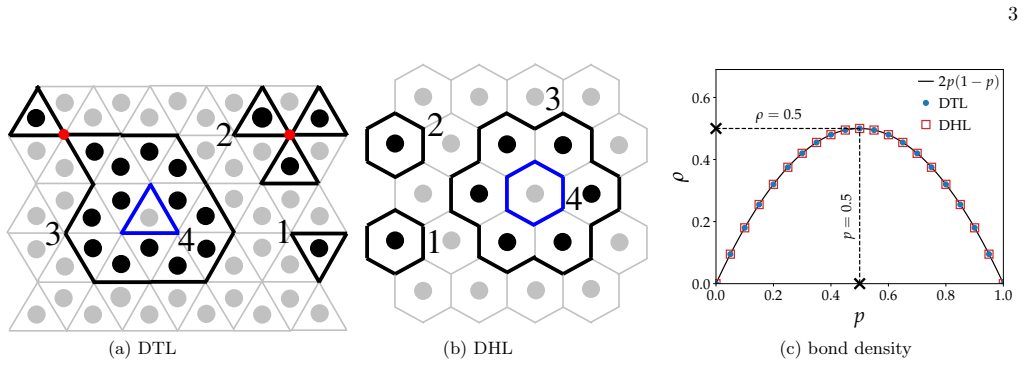
In mixed-wet percolation the perimeter clusters on the dual triangular lattice (z=6) are the complete boundaries of the occupied site clusters in the primal lattice and therefore belong to the ordinary site percolation universality class. On the dual honeycomb lattice (z=3) the same construction produces isolated external and internal perimeters whose scaling matches that of the hulls of ordinary site percolation clusters; only when external and internal perimeters are combined do they recover the full cluster boundaries of the site percolation class.
What carries the argument
The coordination number z of the dual lattice, which determines whether perimeter clusters formed by mixed-wet bonds act as full site-cluster boundaries or as isolated hulls.
If this is right
- Perimeter clusters can be used interchangeably with ordinary site clusters when modeling two-phase flow on high-coordination lattices.
- Low-coordination lattices allow separate measurement of hull and bulk scaling in the same percolation realization.
- The combined perimeters on low-coordination lattices still belong to the site percolation class, so standard critical exponents remain usable once external and internal contributions are summed.
- Porous-media simulations must track coordination number when predicting percolation thresholds or cluster statistics under mixed-wet conditions.
Where Pith is reading between the lines
- Real porous media with heterogeneous pore coordination numbers may display position-dependent scaling regimes rather than a single universal class.
- The result suggests a route to isolate hull statistics experimentally by fabricating low-coordination pore networks.
- Similar coordination-number effects could appear in other interface or hull models once the dual lattice is allowed to vary.
Load-bearing premise
The difference in scaling behavior is produced by the value of the coordination number rather than by other geometric features that distinguish the triangular and honeycomb lattices.
What would settle it
Observing that perimeter clusters on a different lattice with coordination number three still scale as ordinary site percolation clusters rather than as hulls, or that altering the mixed-wet bond rule while keeping z fixed erases the hull-like scaling on the honeycomb lattice.
Figures



read the original abstract
Mixed-wet percolation was introduced recently in the context of two-phase flow in porous media. In this model, the sites of the primal lattice are occupied with a certain probability $p$, and bonds are placed on the dual lattice between two adjacent occupied and unoccupied sites of the primal lattice. The occupied bonds on the dual lattice form perimeter clusters. In this paper, we investigate the scaling properties of the geometric quantities associated with the perimeter clusters of mixed-wet percolation on the dual triangular and dual honeycomb lattices. Although mixed-wet percolation on the dual triangular lattice with a higher coordination number ($z=6$) exhibits ordinary site percolation, the model on the dual honeycomb lattice with a lower coordination number ($z=3$) exhibits the properties of the hull of ordinary site percolation clusters. Such a $z$ dependent breakdown of universality in mixed-wet percolation is rare in the percolation literature. The perimeter clusters in the triangular lattice represent the boundary of the site clusters in the primal lattice, whereas the perimeters in the honeycomb lattice represent their hulls. Because of the low $z$ of the honeycomb lattice, the external and internal perimeters remain isolated. However, the combined external and internal perimeters form cluster boundaries of the site clusters that belong to the site percolation universality class.
Editorial analysis
A structured set of objections, weighed in public.
Referee Report
Summary. The manuscript studies mixed-wet percolation, in which primal-lattice sites are occupied with probability p and dual-lattice bonds are placed between adjacent occupied and unoccupied primal sites. It compares the resulting perimeter clusters on the dual triangular lattice (z=6) and dual honeycomb lattice (z=3). The central claim is that the triangular-lattice perimeters belong to the ordinary site-percolation universality class while the honeycomb-lattice perimeters belong to the hull class of ordinary site percolation; this difference is attributed to the lower coordination number on the honeycomb lattice, which isolates external and internal perimeters.
Significance. If the scaling analysis is confirmed and the attribution to coordination number is isolated from other lattice features, the result would constitute a rare documented breakdown of universality within a single percolation family, with direct relevance to two-phase flow modeling in porous media. The explicit distinction drawn between boundary and hull representations of the same primal clusters is a useful geometric clarification.
major comments (1)
- [Abstract and concluding discussion] The manuscript attributes the shift from ordinary site-percolation scaling (dual triangular, z=6) to hull scaling (dual honeycomb, z=3) to the value of the coordination number z. However, the comparison is performed on only two lattices whose duality relations, nearest-neighbor angles, and bond-placement rules also differ. No third lattice, no controlled modification of the bond rule that holds geometry fixed while varying z, and no explicit test that the isolation of external and internal perimeters is caused by the numerical value z=3 rather than the three-fold symmetry are presented. This leaves the central title claim of “coordination-number dependent universality” unisolated and therefore load-bearing for the abstract and conclusion.
minor comments (2)
- [Abstract] The abstract states that the triangular perimeters “represent the boundary of the site clusters” while the honeycomb perimeters “represent their hulls,” but does not define the precise algorithmic distinction between boundary and hull in the mixed-wet bond-placement rule; a short clarifying sentence or reference to the original mixed-wet paper would help readers.
- [Figures] Figure captions and axis labels should explicitly state the measured exponents (e.g., fractal dimension, cluster-size exponent) and the literature values they are compared against, rather than leaving the reader to infer the universality-class assignment solely from visual collapse.
Simulated Author's Rebuttal
We thank the referee for the careful reading and for identifying the need to better isolate the coordination-number effect from other lattice properties. We have revised the abstract and concluding discussion to qualify our claims, emphasize the geometric mechanism, and acknowledge the limitations of the two-lattice comparison.
read point-by-point responses
-
Referee: [Abstract and concluding discussion] The manuscript attributes the shift from ordinary site-percolation scaling (dual triangular, z=6) to hull scaling (dual honeycomb, z=3) to the value of the coordination number z. However, the comparison is performed on only two lattices whose duality relations, nearest-neighbor angles, and bond-placement rules also differ. No third lattice, no controlled modification of the bond rule that holds geometry fixed while varying z, and no explicit test that the isolation of external and internal perimeters is caused by the numerical value z=3 rather than the three-fold symmetry are presented. This leaves the central title claim of “coordination-number dependent universality” unisolated and therefore load-bearing for the abstract and conclusion.
Authors: We agree that the comparison is restricted to two standard dual lattices and that other geometric features (symmetry, angles) necessarily differ. The bond-placement rule itself is identical by definition of mixed-wet percolation. The manuscript’s geometric argument is that z=3 on the honeycomb dual isolates external and internal perimeters (producing hull scaling), while z=6 permits their merger into ordinary boundaries. This mechanism is tied to the numerical value of z in these lattices, but we acknowledge that a controlled variation at fixed geometry or a third lattice would be required to fully separate z from symmetry. We have therefore revised the abstract and conclusion to state that the results “suggest” a coordination-number-dependent breakdown of universality, to remove the stronger title phrasing from the abstract, and to add an explicit caveat on the two-lattice limitation. These changes address the referee’s concern while remaining faithful to the evidence presented. revision: partial
Circularity Check
No significant circularity; scaling claims rest on independent lattice comparisons
full rationale
The paper reports numerical observations of perimeter-cluster scaling on two distinct dual lattices (triangular z=6 vs. honeycomb z=3) under the mixed-wet bond-placement rule. The central statements—that one case matches ordinary site percolation while the other matches hull scaling—are presented as direct consequences of the model definitions on each lattice geometry, without any derivation, equation, or fitted parameter that reduces the reported universality-class difference to a tautology or to the input data by construction. Background citations to the model's recent introduction are not load-bearing for the new z-dependent claim. The analysis therefore remains self-contained and externally falsifiable via independent simulation on the same lattices.
Axiom & Free-Parameter Ledger
axioms (2)
- domain assumption Random site occupation with probability p on a lattice defines the mixed-wet configuration.
- domain assumption Perimeter clusters are formed by dual-lattice bonds between occupied and unoccupied primal sites.
Reference graph
Works this paper leans on
-
[1]
Stanley, Introduction to phase transitions and critical phenomena, Oxford University Press, 1987
E. Stanley, Introduction to phase transitions and critical phenomena, Oxford University Press, 1987
work page 1987
-
[2]
Yeomans, Statistical mechanics of phase transitions, Clarendon Press, 1992
J. Yeomans, Statistical mechanics of phase transitions, Clarendon Press, 1992
work page 1992
-
[3]
J. J. Binney, N. J. Dowrick, A. J. Fisher, M. E. J. New- man, The theory of critical phenomena: an introduction to the renormalization group, Oxford University Press, 1992
work page 1992
-
[4]
Goldenfeld, Lectures on phase transitions and the renormalization group, CRC Press, 1992
N. Goldenfeld, Lectures on phase transitions and the renormalization group, CRC Press, 1992
work page 1992
-
[5]
S. R. Broadbent, J. M. Hammersley, Mathematical Proceedings of the Cambridge Philosophical Society 53 (1957) 629
work page 1957
-
[6]
D. Stauffer, A. Aharony, Introduction to percolation the- ory, Taylor & Francis, 1994. 13
work page 1994
-
[7]
K. Christensen, N. R. Moloney, Complexity and critical- ity, Imperial College Press, 2005
work page 2005
- [8]
-
[9]
Malthe-Sørenssen, Percolation Theory Using Python, Springer Nature, 2024
A. Malthe-Sørenssen, Percolation Theory Using Python, Springer Nature, 2024
work page 2024
-
[10]
L. B¨ ottcher, H. J. Herrmann, Computational Statistical Physics, Cambridge University Press, 2021
work page 2021
-
[11]
M. Sahimi, Flow and transport in porous media and fractured rock: from classical methods to modern ap- proaches, WILEY-VCH Verlag GmbH & Co. KGaA, 2011
work page 2011
-
[12]
M. J. Blunt, Multiphase flow in permeable media: A pore-scale perspective, Cambridge University Press, 2017
work page 2017
- [13]
-
[14]
R. Lenormand, E. Touboul, C. Zarcone, Journal of fluid mechanics 189 (1988) 165
work page 1988
- [15]
-
[16]
F. Guo, S. A. Aryana, Energies 12 (2019) 1390
work page 2019
-
[17]
A. Irannezhad, B. K. Primkulov, R. Juanes, B. Zhao, Physical Review Fluids 8 (2023) L012301
work page 2023
-
[18]
A. Irannezhad, B. K. Primkulov, R. Juanes, B. Zhao, Journal of Fluid Mechanics 967 (2023) A27
work page 2023
-
[19]
H. Fyhn, S. Sinha, S. Roy, A. Hansen, Transport in Porous Media 139 (2021) 491
work page 2021
-
[20]
H. Fyhn, S. Sinha, A. Hansen, Frontiers in Physics 11 (2023) 1175426
work page 2023
-
[21]
J. R. Das, S. Sinha, A. Hansen, S. B. Santra, Physica A: Statistical Mechanics and its Applications 679 (2025) 130957
work page 2025
-
[22]
R. M. Ziff, P. T. Cummings, G. Stells, Journal of Physics A: Mathematical and General 17 (1984) 3009
work page 1984
-
[23]
M. E. J. Newman, R. M. Ziff, Physical Review Letters 85 (2000) 4104
work page 2000
-
[24]
H. J. Herrmann, D. C. Hong, H. E. Stanley, Journal of Physics A: Mathematical and General 17 (1984) L261
work page 1984
-
[25]
Malarz, Chaos: An Interdisciplinary Journal of Non- linear Science 32 (2022) 083123
K. Malarz, Chaos: An Interdisciplinary Journal of Non- linear Science 32 (2022) 083123
work page 2022
-
[26]
Z. Xun, D. Hao, R. M. Ziff, Physical Review E 105 (2022) 024105
work page 2022
-
[27]
P. N. Suding, R. M. Ziff, Physical Review E 60 (1999) 275
work page 1999
-
[28]
Malarz, Chaos: An Interdisciplinary Journal of Non- linear Science 30 (2020) 123123
K. Malarz, Chaos: An Interdisciplinary Journal of Non- linear Science 30 (2020) 123123
work page 2020
-
[29]
M. E. Fisher, Physics Physique Fizika 3 (1967) 255
work page 1967
- [30]
-
[31]
R. M. Ziff, Physical review letters 56 (1986) 545
work page 1986
-
[32]
Feder, Fractals, Springer Science & Business Media, 2013
J. Feder, Fractals, Springer Science & Business Media, 2013
work page 2013
-
[33]
S. Roux, E. Guyon, D. Sornette, Journal of Physics A: Mathematical and General 21 (1988) L475
work page 1988
- [34]
discussion (0)
Sign in with ORCID, Apple, or X to comment. Anyone can read and Pith papers without signing in.