Capacity Expansion Planning for Puerto Rico's Electric Power System
Pith reviewed 2026-05-10 02:58 UTC · model grok-4.3
The pith
Puerto Rico requires at least 1.5 GW of new combined-cycle gas capacity beyond planned projects to maintain grid reliability.
A machine-rendered reading of the paper's core claim, the machinery that carries it, and where it could break.
Core claim
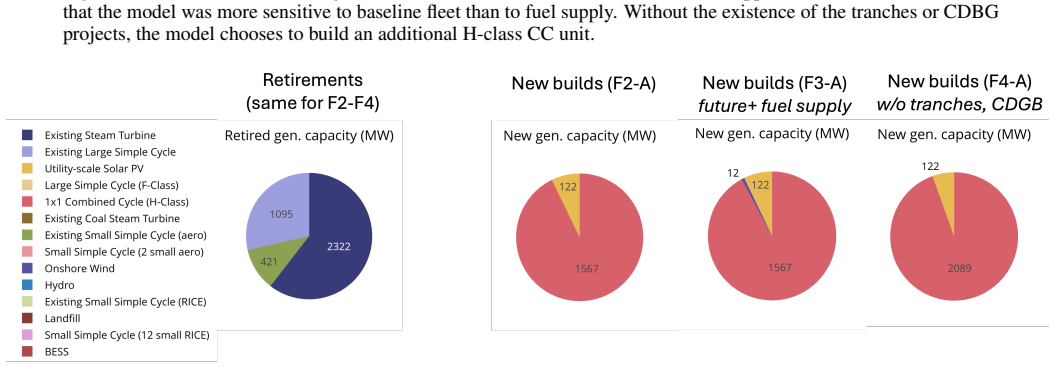
The study finds that an optimal portfolio includes at least 1.5 GW of new H-class combined cycle capacity beyond planned projects. These additions are needed mainly to replace unreliable legacy thermal units rather than to serve new load. The new combined cycle units eliminate modeled bulk-system load shedding and restore a strong reserve margin, even under stressed load and outage conditions.
What carries the argument
A stochastic capacity expansion model that co-optimizes new generation and storage investments with thermal retirements, using nodal transmission at 38 kV and above, hourly chronological operations, explicit unit commitment with ramping and startup costs, system-wide fuel constraints, and scenarios for load, renewables, and outages.
If this is right
- The least-cost plan calls for new combined-cycle capacity even when future load growth is modest.
- Planned projects alone leave the system exposed to load shedding under high-outage scenarios.
- Relaxation of near-term renewable targets allows the model to select thermal replacements that improve reliability.
- System-wide fuel supply limits influence the scale and location of new thermal additions.
Where Pith is reading between the lines
- The same level of operational detail could be applied to other island systems facing aging thermal fleets.
- Refining the outage rate assumptions with recent operational data would produce updated capacity recommendations.
- Pairing the new combined-cycle units with additional storage might further reduce fuel consumption while preserving reliability.
Load-bearing premise
The input data from LUMA, PREPA, DOE, and public sources, together with the assumed high forced outage rates of legacy units and the stochastic scenarios, accurately represent real-world conditions and future uncertainties.
What would settle it
If measured forced outage rates of legacy thermal units are substantially lower than the modeled values, or if planned projects deliver higher reliability than assumed, then the modeled requirement for at least 1.5 GW of additional combined-cycle capacity would no longer hold.
Figures


read the original abstract
This study presents a mathematical optimization framework and preliminary analysis for long-term investment planning in Puerto Rico's electric power system. We develop a high-resolution capacity expansion model to identify least-cost generation and storage investments that improve system reliability. The model co-optimizes new investments and thermal generator retirements while representing generator dispatch, unit commitment, fuel selection, and storage operations under constraints of equipment engineering limits, fuel supply limitations, and load satisfaction. Key methodological advances relative to prior long-term planning studies for Puerto Rico include: (i) nodal transmission modeling at 38 kV and above, (ii) hourly chronological operations for representative days, (iii) explicit unit commitment for existing and new thermal units with realistic ramping, minimum up and down times, and startup costs, (iv) system-wide fuel supply constraints, and (v) stochastic operating scenarios reflecting load variation, renewable availability, and the high forced outage rates of legacy units. Using data from LUMA, PREPA, DOE, and public sources, we build present-day (2024) and future (2030) test systems, with the latter including planned generation and storage projects. We evaluate planning scenarios that vary future load, fuel supply assumptions, realization of planned expansion, and allowable new technologies. Results show that, given the recent relaxation of interim renewable goals for the near future in Puerto Rico, an optimal portfolio includes at least 1.5 GW of new H-class combined cycle capacity beyond planned projects. These additions are needed mainly to replace unreliable legacy thermal units rather than to serve new load. The new combined cycle units eliminate modeled bulk-system load shedding and restore a strong reserve margin, even under stressed load and outage conditions.
Editorial analysis
A structured set of objections, weighed in public.
Referee Report
Summary. The paper develops a high-resolution capacity expansion optimization model for Puerto Rico's electric power system that co-optimizes new generation/storage investments with thermal unit retirements. It incorporates nodal transmission (38 kV+), hourly chronological dispatch with unit commitment (ramping, min up/down times, startup costs), system-wide fuel constraints, and stochastic scenarios for load, renewables, and outages. Using 2024/2030 test systems built from LUMA/PREPA/DOE/public data and including planned projects, the analysis concludes that at least 1.5 GW of new H-class combined-cycle capacity beyond planned projects is required in the optimal portfolio, primarily to replace unreliable legacy thermal units, eliminate bulk-system load shedding, and restore reserve margins under stressed conditions.
Significance. If the input assumptions hold, the work provides a methodologically advanced least-cost planning tool for a real-world system undergoing energy transition, with explicit co-optimization of retirements and investments plus stochastic reliability modeling that goes beyond typical long-term studies. Credit is due for the detailed engineering constraints, use of real data sources, and quantitative result on the 1.5 GW figure; these elements make the framework potentially useful for policy if validated.
major comments (2)
- [Abstract and §5] Abstract and §5 (Results): The central claim that the 1.5 GW of new H-class CC is needed 'mainly to replace unreliable legacy thermal units rather than to serve new load' is load-bearing for the headline result, yet the manuscript does not appear to include a decomposition or sensitivity run isolating the contribution of legacy forced outage rates versus load growth or renewable variability. Without this (e.g., a table comparing optimal portfolios under baseline vs. reduced outage rates), the attribution remains an interpretation rather than a demonstrated output of the co-optimization.
- [§4.2 and §6] §4.2 (Model formulation) and §6 (Scenarios): The stochastic scenarios for outages are described as reflecting 'the high forced outage rates of legacy units,' but no explicit validation against historical LUMA/PREPA outage data or sensitivity table on these rates is referenced. Because the abstract states that the new CC units 'eliminate modeled bulk-system load shedding' under these rates, a load-bearing robustness check is required to confirm the 1.5 GW figure does not shift materially under plausible lower rates.
minor comments (3)
- [Table 2] Table 2 (2030 test system): Planned projects are listed but the exact MW breakdown of 'beyond planned' additions is not cross-referenced to the optimization output table; adding a column for incremental capacity would improve traceability.
- [§3.1] Notation in §3.1: The distinction between 'representative days' and full-year stochastic sampling is introduced but the mapping from scenarios to representative days is not shown in an equation or pseudocode; a small diagram or equation would clarify.
- [References] References: Several DOE and LUMA reports cited in the data section lack DOIs or access dates; standardizing the bibliography would aid reproducibility.
Simulated Author's Rebuttal
We thank the referee for the constructive feedback on our capacity expansion model for Puerto Rico. The comments highlight opportunities to strengthen the attribution of results and the robustness of outage modeling. We address each point below and will revise the manuscript accordingly.
read point-by-point responses
-
Referee: [Abstract and §5] The central claim that the 1.5 GW of new H-class CC is needed 'mainly to replace unreliable legacy thermal units rather than to serve new load' is load-bearing for the headline result, yet the manuscript does not appear to include a decomposition or sensitivity run isolating the contribution of legacy forced outage rates versus load growth or renewable variability. Without this (e.g., a table comparing optimal portfolios under baseline vs. reduced outage rates), the attribution remains an interpretation rather than a demonstrated output of the co-optimization.
Authors: We agree that the current attribution relies on interpretation of the co-optimization under baseline conditions. To address this directly, we will add a new sensitivity analysis in revised §5 (and update the abstract if needed) that compares optimal portfolios under baseline legacy outage rates versus reduced rates (e.g., 50% lower to simulate improved maintenance). This will include a table quantifying differences in new CC capacity, load shedding, and reserve margins, isolating the reliability-driven need. The core 1.5 GW finding is expected to hold but will now be demonstrated rather than interpreted. revision: yes
-
Referee: [§4.2 and §6] The stochastic scenarios for outages are described as reflecting 'the high forced outage rates of legacy units,' but no explicit validation against historical LUMA/PREPA outage data or sensitivity table on these rates is referenced. Because the abstract states that the new CC units 'eliminate modeled bulk-system load shedding' under these rates, a load-bearing robustness check is required to confirm the 1.5 GW figure does not shift materially under plausible lower rates.
Authors: The outage rates in §4.2 and §6 are based on aggregated data from PREPA/LUMA reports and comparable Caribbean systems as cited in the data sources section. We did not include a dedicated historical validation table in the original version. We will revise §4.2 to add explicit references to the source data and include a sensitivity table in §6 varying the rates (baseline, -30%, -50%). This will confirm robustness of the 1.5 GW requirement and load-shedding elimination. If lower rates reduce the need, we will report the threshold explicitly. revision: partial
Circularity Check
Optimization model derives portfolio results from external data and constraints with no circular reduction
full rationale
The paper constructs a high-resolution capacity expansion optimization model that co-optimizes generation/storage investments and thermal retirements subject to nodal transmission, hourly unit commitment, fuel constraints, and stochastic scenarios for load/renewables/outages. All inputs (data from LUMA/PREPA/DOE/public sources, forced outage rates, engineering limits) are stated as exogenous; the reported optimal need for ≥1.5 GW new H-class combined cycle capacity is produced as the solver output under those inputs rather than being defined in terms of itself or obtained by fitting a parameter to a related quantity and relabeling it a prediction. No equations, self-citations, or imported uniqueness theorems reduce the central claim to the inputs by construction.
Axiom & Free-Parameter Ledger
free parameters (2)
- Future load growth and fuel supply parameters
- Forced outage rates for legacy thermal units
axioms (3)
- domain assumption Hourly chronological operations on representative days adequately represent annual system behavior
- domain assumption Stochastic scenarios capture the joint variation of load, renewable availability, and forced outages
- domain assumption Unit commitment constraints with realistic ramping, minimum up/down times, and startup costs correctly model thermal generator flexibility
Reference graph
Works this paper leans on
-
[1]
Puerto Rico Electric Power Authority (PREPA)
Puerto Rico Electric Power Authority, “Puerto Rico Electric Power Authority (PREPA).” [Online]. Available: https://www.aafaf.pr.gov/puerto-rico-issuers/puerto-rico-electric-power-authority-prepa
-
[2]
L. Aramayo, “Even without hurricanes, customers in Puerto Rico lose about 27 hours of power per year - U.S. Energy Information Administration (EIA),” Aug. 2025. [Online]. Available: https: //www.eia.gov/todayinenergy/detail.php?id=65925
work page 2025
-
[3]
Enernex, “EnerNex Report - Review of Puerto Rico Energy System Expense Projec- tions in the 2025 PREPA Fiscal Plan.” [Online]. Available: https://oversightboard.pr.gov/ enernex-report-review-of-puerto-rico-energy-system-expense-projections-in-the-2025-prepa-fiscal-plan/
work page 2025
-
[4]
Monthly Generation Performance Report,
LUMA, “Monthly Generation Performance Report,” LUMA, Tech. Rep., Oct. 2025. [Online]. Available: https://lumapr.com/wp-content/uploads/2025/12/2025.10-October_Generation-Performance-Report-1.pdf
work page 2025
-
[5]
Integrated Resource Plan 2025,
LUMA, “Integrated Resource Plan 2025,” LUMA Energy, LLC, San Juan, Puerto Rico, Integrated Resource Plan Docket NEPR-AP-2023-004, Nov. 2024. [Online]. Available: https://setpr.com/wp-content/uploads/2025/10/0. 00_IRP-Report_Main-Report_Revised_Redacted.pdf
work page 2025
-
[6]
Electric System Priority Stabilization Plan,
Negociado de Energía de Puerto Rico, “Electric System Priority Stabilization Plan,” Mar. 2025. [Online]. Available: https://energia.pr.gov/wp-content/uploads/sites/7/2025/04/20250328-MI20240005-Resolution-and-Order.pdf
work page 2025
-
[7]
Competitive Procurement for New Generation Sources,
——, “Competitive Procurement for New Generation Sources,” Mar. 2025. [Online]. Available: https://energia.pr.gov/wp-content/uploads/sites/7/2025/03/20250319-MI202500001-Resolution-and-Order.pdf
work page 2025
-
[8]
“I promised I would deliver, and here I am
A. Acosta Vilanova, ““I promised I would deliver, and here I am”: Governor after lawsuit against LUMA,”El V ocero, Dec. 2025. [Online]. Available: https://www.wjournalpr. com/top-stories/i-promised-i-would-deliver-and-here-i-am-governor-after-lawsuit-against-luma/article_ eac1042e-a7b1-54b9-ac21-d848b98e5ad0.html
work page 2025
-
[9]
Puerto Rico Grid Resilience and Transitions to 100% Renewable Energy Study (PR100): Final Report,
“Puerto Rico Grid Resilience and Transitions to 100% Renewable Energy Study (PR100): Final Report,” National Renewable Energy Laboratory, Golden, CO, Technical Report NREL/TP-6A20-88384, 2024. [Online]. Available: https://www.nrel.gov/docs/fy24osti/88384.pdf
work page 2024
-
[10]
Evaluating the value of high spatial resolution in national capacity expansion models using ReEDS,
V . Krishnan and W. Cole, “Evaluating the value of high spatial resolution in national capacity expansion models using ReEDS,” in2016 IEEE Power and Energy Society General Meeting (PESGM), 2016, pp. 1–5
work page 2016
-
[11]
E. Glista, B. Knueven, and J.-P. Watson, “From zonal to nodal capacity expansion planning: Spatial aggregation impacts on a realistic test-case,”To appear in 2026 Power Systems Computation Conference (PSCC), 2025
work page 2026
-
[12]
B. S. Palmintier and M. D. Webster, “Impact of Operational Flexibility on Electricity Generation Planning With Renewable and Carbon Targets,”IEEE Transactions on Sustainable Energy, vol. 7, no. 2, pp. 672–684, 2016
work page 2016
-
[13]
K. Poncelet, E. Delarue, and W. D’haeseleer, “Unit commitment constraints in long-term planning models: Relevance, pitfalls and the role of assumptions on flexibility,”Applied Energy, vol. 258, p. 113843, Jan. 2020
work page 2020
-
[14]
Impact of model resolution on scenario outcomes for electricity sector system expansion,
D. S. Mallapragada, D. J. Papageorgiou, A. Venkatesh, C. L. Lara, and I. E. Grossmann, “Impact of model resolution on scenario outcomes for electricity sector system expansion,”Energy, vol. 163, pp. 1231–1244, Nov. 2018
work page 2018
-
[15]
Comparison of temporal resolution selection approaches in energy systems models,
C. Marcy, T. Goforth, D. Nock, and M. Brown, “Comparison of temporal resolution selection approaches in energy systems models,”Energy, vol. 251, p. 123969, Jul. 2022
work page 2022
-
[16]
I. J. Scott, P. M. Carvalho, A. Botterud, and C. A. Silva, “Long-term uncertainties in generation expansion planning: Implications for electricity market modelling and policy,”Energy, vol. 227, p. 120371, 2021
work page 2021
-
[17]
F. D. Muñoz, B. F. Hobbs, J. L. Ho, and S. Kasina, “An Engineering-Economic Approach to Transmission Planning Under Market and Regulatory Uncertainties: WECC Case Study,”IEEE Transactions on Power Systems, vol. 29, no. 1, pp. 307–317, 2014
work page 2014
-
[18]
R. S. Go, F. D. Munoz, and J.-P. Watson, “Assessing the economic value of co-optimized grid-scale energy storage investments in supporting high renewable portfolio standards,”Applied Energy, pp. 902–913, 2016
work page 2016
-
[19]
T. Valencia Zuluaga, A. Musselman, J.-P. Watson, and S. S. Oren, “Parallel computing for power system climate resiliency: Solving a large-scale stochastic capacity expansion problem with mpi-sppy,”Electric Power Systems Research, vol. 235, p. 110720, 2024, publisher: Elsevier
work page 2024
-
[20]
Climate-resilient nodal power system expansion planning for a realistic California test case,
A. Musselman, T. Valencia Zuluaga, E. Glista, M. Monteagudo, J. M. Grappone, and J.-P. Watson, “Climate-resilient nodal power system expansion planning for a realistic California test case,”Optimization-online,
-
[21]
[Online]. Available: https://optimization-online.org/?p=29697 30 Capacity Expansion Planning for Puerto RicoLLNL-JRNL-2017618
-
[22]
On mixed-integer programming formulations for the unit commitment problem,
B. Knueven, J. Ostrowski, and J.-P. Watson, “On mixed-integer programming formulations for the unit commitment problem,”INFORMS Journal on Computing, vol. 32, no. 4, pp. 857–876, 2020
work page 2020
-
[23]
LUMA, “Bulk Power System Monitoring.” [Online]. Available: https://lumapr.com/bps-monitoring/?lang=en
-
[24]
——, “LUMA Resource Adequacy Study,” Mar. 2025, available at NEPR Docket NEPR-MI-2022-0002. [Online]. Available: https://energia.pr.gov/wp-content/uploads/sites/7/2025/03/ 20250319-MI202500001-Resolution-and-Order.pdf
work page 2025
-
[25]
O&M Concession Independent Engineering Report: Central Hidro Gas Mayagüez Plant,
Sargent & Lundy, “O&M Concession Independent Engineering Report: Central Hidro Gas Mayagüez Plant,” Puerto Rico Electric Power Authority, Technical Report SL-015976.MG, Aug. 2021. [Online]. Available: https://www.energia.pr.gov
work page 2021
-
[26]
Independent Engineering Report: Palo Seco Steam Plant,
——, “Independent Engineering Report: Palo Seco Steam Plant,” Puerto Rico Electric Power Authority, Technical Report SL-015976.PS, Oct. 2021. [Online]. Available: https://www.energia.pr.gov
work page 2021
-
[27]
O&M Concession Independent Engineering Report: San Juan Power Plant,
——, “O&M Concession Independent Engineering Report: San Juan Power Plant,” Puerto Rico Electric Power Authority, Technical Report SL-015976.SJ, Nov. 2020. [Online]. Available: https://www.energia.pr.gov
work page 2020
-
[28]
O&M Concession Independent Engineering Report: Vega Baja Power Plant,
——, “O&M Concession Independent Engineering Report: Vega Baja Power Plant,” Puerto Rico Electric Power Authority, Technical Report SL-015976.VB, Sep. 2021. [Online]. Available: https://www.energia.pr.gov
work page 2021
-
[29]
Independent Engineering Report: Cambalache Power Plant,
——, “Independent Engineering Report: Cambalache Power Plant,” Puerto Rico Electric Power Authority, Technical Report SL-015976.CA, Sep. 2021. [Online]. Available: https://www.energia.pr.gov
work page 2021
-
[30]
Independent Engineering Report: Costa Sur Steam Plant,
——, “Independent Engineering Report: Costa Sur Steam Plant,” Puerto Rico Electric Power Authority, Technical Report SL-015976.CS, Oct. 2021. [Online]. Available: https://www.energia.pr.gov
work page 2021
-
[31]
Independent Engineering Report: Aguirre Power Plant Complex,
——, “Independent Engineering Report: Aguirre Power Plant Complex,” Puerto Rico Electric Power Authority, Technical Report SL-015976.AG, Sep. 2021. [Online]. Available: https://www.energia.pr.gov
work page 2021
-
[32]
Bureau of Labor Statistics, “CPI Inflation Calculator,” 2025, published: Online calculator. [Online]. Available: https://www.bls.gov/data/inflation_calculator.htm
work page 2025
-
[33]
Form EIA-923 with Detailed Data with Previous Form Data (EIA-906/920),
U.S. Energy Information Administration, “Form EIA-923 with Detailed Data with Previous Form Data (EIA-906/920),” Washington, DC, 2023, published: Online database. [Online]. Available: https://www.eia.gov/electricity/data/eia923/
work page 2023
-
[34]
M. Oakes, J. Konrade, M. Bleckinger, M. Turner, S. Hughes, H. Hoffman, T. Shultz, and E. Lewis, “Cost and performance baseline for fossil energy plants, volume 5: Natural gas electricity generating units for flexible operation,” National Energy Technology Laboratory (NETL), Pittsburgh, PA, Morgantown, WV , and Albany, OR (United States), Tech. Rep., May 2...
-
[35]
Henry hub natural gas spot price (dollars per million btu) - monthly,
U.S. Energy Information Administration, “Henry hub natural gas spot price (dollars per million btu) - monthly,” https://www.eia.gov/dnav/ng/hist/rngwhhdm.htm, 2025
work page 2025
-
[36]
——, “Annual Energy Outlook 2025,” U.S. Energy Information Administration, Washington, DC, Report, 2025. [Online]. Available: https://www.eia.gov/outlooks/aeo/
work page 2025
-
[37]
M. L. Bynum, G. A. Hackebeil, W. E. Hart, C. D. Laird, B. L. Nicholson, J. D. Siirola, J.-P. Watson, and D. L. Woodruff,Pyomo – Optimization Modeling in Python, 3rd Edition. Springer, 2021, vol. 67
work page 2021
-
[38]
Pyomo: modeling and solving mathematical programs in python,
W. E. Hart, J.-P. Watson, and D. L. Woodruff, “Pyomo: modeling and solving mathematical programs in python,” Mathematical Programming Computation, vol. 3, no. 3, pp. 219–260, 2011
work page 2011
-
[39]
A parallel hub-and-spoke system for large-scale scenario-based optimization under uncertainty,
B. Knueven, D. Mildebrath, C. Muir, J. D. Siirola, J.-P. Watson, and D. L. Woodruff, “A parallel hub-and-spoke system for large-scale scenario-based optimization under uncertainty,”Math. Prog. Comp., vol. 15, pp. 591–619, 2023. 6 Appendix 6.1 Symbols used in the CEP mathematical model 31 Capacity Expansion Planning for Puerto RicoLLNL-JRNL-2017618 Table 9...
work page 2023
discussion (0)
Sign in with ORCID, Apple, or X to comment. Anyone can read and Pith papers without signing in.