From Entropy to Compression: Competing Thermodynamic Drivers of Structural Transitions in Transition Metals
Pith reviewed 2026-05-10 02:45 UTC · model grok-4.3
The pith
Under strong electronic excitation, structural stability in transition metals is set by the competition between electronic effects and compression rather than pressure or density alone.
A machine-rendered reading of the paper's core claim, the machinery that carries it, and where it could break.
Core claim
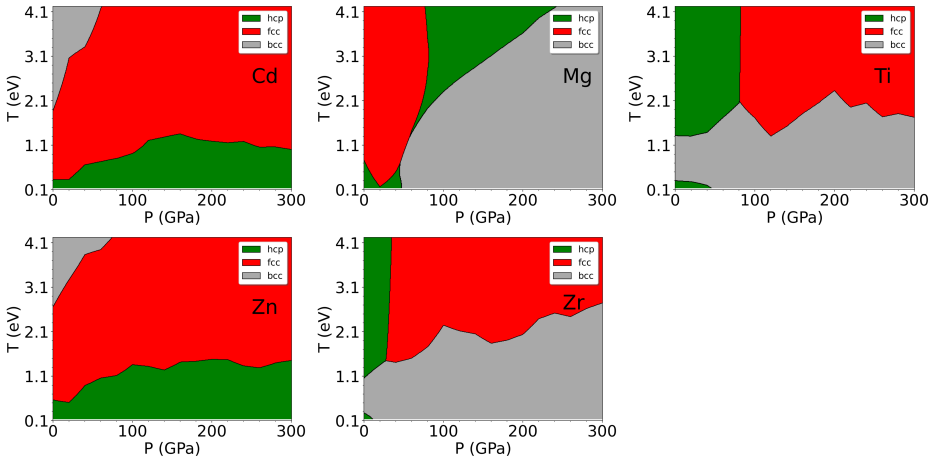
The authors show that under strong electronic excitation, structural stability is governed by the interplay between electronic effects and compression. Finite-temperature density functional theory calculations for fifteen metals reveal a systematic reduction of structural diversity with increasing electronic temperature, with stability increasingly dominated by the fcc structure, hcp remaining a persistent secondary phase, and bcc stability progressively suppressed. At elevated temperatures fcc is broadly favored, whereas bcc is stabilized primarily by compression, producing a material-dependent competition across the periodic table.
What carries the argument
Pressure-temperature phase diagrams obtained from finite-temperature density functional theory that quantify the free-energy competition between electronic entropy and compressive enthalpy for hcp, fcc, and bcc lattices.
Load-bearing premise
Finite-temperature density functional theory without additional corrections for strong electron correlations accurately ranks the structural free energies of these metals at elevated electronic temperatures.
What would settle it
Time-resolved diffraction on a metal held at high electronic temperature but low lattice temperature and modest pressure that finds bcc persisting without extra compression, or that shows no net loss of structural diversity, would contradict the central claim.
Figures


read the original abstract
Solid-solid phase transitions in metals are traditionally driven by changes in density or external pressure. Here we show that, under strong electronic excitation, structural stability is governed by the interplay between electronic effects and compression. Using finite-temperature density functional theory, we construct pressure-temperature phase diagrams for 15 metals spanning hcp-, fcc-, and bcc-ground-state structures. The results reveal a systematic reduction of structural diversity with increasing electronic temperature, with stability increasingly dominated by the fcc structure, while hcp remains a persistent secondary phase and bcc stability is progressively suppressed. At elevated temperatures, fcc is broadly favored, whereas bcc is stabilized primarily by compression, leading to a material-dependent competition across the periodic table. These findings provide a unified framework for understanding structural transformations in electronically excited metals and highlight the importance of considering both electronic excitation and pressure in describing phase stability far from equilibrium.
Editorial analysis
A structured set of objections, weighed in public.
Referee Report
Summary. The paper uses finite-temperature density functional theory (FT-DFT) to construct pressure-temperature phase diagrams for 15 transition metals with hcp, fcc, and bcc ground states. It claims that increasing electronic temperature systematically reduces structural diversity, with fcc becoming dominant due to electronic entropy, hcp persisting as a secondary phase, and bcc stability being suppressed and primarily stabilized by compression, arising from the competition between electronic effects and volume changes.
Significance. If the computational trends hold after validation, this provides a unified framework for non-equilibrium structural stability in electronically excited metals, with potential relevance to laser-driven or high-energy processes. The systematic coverage of 15 metals across the periodic table is a strength, as is the direct construction of phase diagrams from electronic free-energy comparisons without apparent parameter fitting.
major comments (2)
- [Abstract and Methods] The abstract and overall description provide no details on validation, error bars, convergence tests, or post-processing of DFT results to support the claimed systematic trends in structural diversity and phase dominance; this is load-bearing for the reliability of the fcc-dominance and bcc-suppression conclusions across all 15 metals.
- [Methods] The central assumption that standard FT-DFT suffices without additional corrections for strong correlations (relevant for several transition metals in the set) is not addressed, which directly impacts the accuracy of the electronic-entropy-driven trends at elevated electronic temperatures.
minor comments (1)
- [Notation] Notation for electronic temperature and free-energy components could be clarified with explicit definitions or a table of symbols to aid readability of the phase-diagram construction.
Simulated Author's Rebuttal
We thank the referee for their constructive comments on our manuscript. We address each major comment below and have revised the manuscript to provide additional details on validation and to discuss the applicability of standard FT-DFT.
read point-by-point responses
-
Referee: [Abstract and Methods] The abstract and overall description provide no details on validation, error bars, convergence tests, or post-processing of DFT results to support the claimed systematic trends in structural diversity and phase dominance; this is load-bearing for the reliability of the fcc-dominance and bcc-suppression conclusions across all 15 metals.
Authors: We agree that the abstract is concise and omits these technical details. The original Methods section specifies the DFT settings (PBE functional, k-point meshes, energy cutoffs, and Fermi-Dirac smearing for electronic temperature), but to directly support the reliability of the trends, we have added a new subsection on numerical convergence and error analysis. This includes tests for k-point density, plane-wave cutoff, and smearing width, along with estimated uncertainties in the electronic free energies. Revised figures now include error bars on phase boundaries derived from these free-energy differences. These additions confirm that the systematic reduction in structural diversity and fcc dominance are robust within the reported precision. revision: yes
-
Referee: [Methods] The central assumption that standard FT-DFT suffices without additional corrections for strong correlations (relevant for several transition metals in the set) is not addressed, which directly impacts the accuracy of the electronic-entropy-driven trends at elevated electronic temperatures.
Authors: We acknowledge that strong correlations can be significant in several transition metals (e.g., those with half-filled d shells). Our work employs standard finite-temperature DFT with the PBE functional, a common choice for broad surveys across the periodic table. In the revised manuscript we have added an explicit discussion in the Methods section on this approximation, noting its limitations for correlated systems and referencing prior studies that have used similar FT-DFT approaches for these elements. We also state that more advanced treatments (DFT+U or dynamical mean-field theory) lie beyond the present scope but could be applied in follow-up work for specific metals. The observed trends remain consistent with available experimental and theoretical benchmarks at this level of theory. revision: partial
Circularity Check
No significant circularity detected
full rationale
The paper's derivation chain consists of direct finite-temperature DFT computations of electronic free energies for hcp, fcc, and bcc structures at varying volumes and electronic temperatures, followed by explicit comparison to construct pressure-temperature phase diagrams for 15 metals. These comparisons yield the reported trends in structural diversity and fcc dominance without any reduction to fitted parameters renamed as predictions, self-definitional loops, or load-bearing self-citations. The thermodynamic construction (free energy minimization under electronic excitation) is self-contained and externally falsifiable via the underlying DFT methodology, with no ansatz or uniqueness theorem imported from prior author work that would force the outcome by construction.
Axiom & Free-Parameter Ledger
axioms (1)
- domain assumption Finite-temperature density functional theory sufficiently describes electronic excitation and phase stability in the studied metals
Reference graph
Works this paper leans on
-
[1]
I. B. Bersuker,Electronic Structure and Properties of Transition Metal Compounds: Introduc- tion to the Theory(Wiley–Blackwell, 1996)
1996
-
[2]
Belonoshko, R
A. Belonoshko, R. Ahuja, and B. Johansson, Quasi–ab initio molecular dynamic study of fe melting, Phys. Rev. Lett.84, 3638 (2000)
2000
-
[3]
Steinle-Neumann, L
G. Steinle-Neumann, L. Stixrude, R. Cohen, and O. G¨ ulseren, Elasticity of iron at the tem- perature of the earth’s inner core, Nature413, 57 (2001)
2001
-
[4]
Dubrovinsky, N
L. Dubrovinsky, N. Dubrovinskaia, O. Narygina, I. Kantor, A. Kuznetzov, V. B. Prakapenka, L. Vitos, B. Johansson, A. S. Mikhaylushkin, S. I. Simak, and I. A. Abrikosov, Body-centered cubic iron-nickel alloy in earth’s core, Science316, 1880 (2007). 13
2007
-
[5]
Voˇ cadlo, D
L. Voˇ cadlo, D. Alf´ e’, M. Gillan, I. Wood, J. Brodholt, and G. D. Price, Possible thermal and chemical stabilization of body-centred-cubic iron in the earth’s core, Nature424, 536 (2003)
2003
-
[6]
Beaurepaire, J
E. Beaurepaire, J. C. Merle, A. Daunois, and J. Y. Bigot, Ultrafast spin dynamics in ferro- magnetic nickel, Phys. Rev. Lett.76, 4250 (1996)
1996
-
[7]
Recoules, J
V. Recoules, J. Cl´ erouin, G. Z´ erah, P. Anglade, and S. Mazevet, Effect of intense laser irra- diation on the lattice stability of semiconductors and metals., Phys. Rev. Lett.96, 055503 (2006)
2006
-
[8]
Ernstorfer and et al., The formation of warm dense matter: experimental evidence for electronic bond hardening in gold, Science323, 1033 (2009)
R. Ernstorfer and et al., The formation of warm dense matter: experimental evidence for electronic bond hardening in gold, Science323, 1033 (2009)
2009
-
[9]
O. S. Humphries, R. S. Marjoribanks, Q. Y. van den Berg, E. C. Galtier, M. F. Kasim, H. J. Lee, A. J. F. Miscampbell, B. Nagler, R. Royle, J. S. Wark, and S. M. Vinko, Probing the electronic structure of warm dense nickel via resonant inelastic x-ray scattering, Phys. Rev. Lett.125, 195001 (2020)
2020
-
[10]
G. Kang, G. Lee, S. Azadi, R. Carley, L. L. Guyader, L. P. Hoang, H. B. Kim, M. Kim, C. Lee, L. Mercadier, G. Mercurio, S. Parchenko, A. Seong, D. Shin, M. Teichmann, B. E. V. Kuiken, Z. Yin, S. M. Vinko, A. Scherz, and B. I. Cho, Nonequilibrium electron-phonon and electron-ion couplings in warm dense copper, Applied Surface Science713, 164304 (2025)
2025
-
[11]
Sundaram and E
S. Sundaram and E. Mazur, Inducing and probing non-thermal transitions in semiconductors using femtosecond laser pulses, Nat. Mat.1, 217 (2002)
2002
-
[12]
Evans, W
R. Evans, W. J. Fan, P. Chureemart, T. A. Ostler, M. Ellis, and R. W. Chantrell, Coupled atomistic spin-lattice simulations of ultrafast demagnetization in 3d ferromagnets, Phys. Rev. B89, 104423 (2014)
2014
-
[13]
M. Harb, R. Ernstorfer, C. T. Hebeisen, G. Sciaini, W. Peng, T. Dartigalongue, M. A. Eriks- son, M. G. Lagally, S. G. Kruglik, and R. J. D. Miller, Electronically driven structure changes of Si captured by femtosecond electron diffraction, Phys. Rev. Lett.100, 155504 (2008)
2008
-
[14]
Crepisson, A
C. Crepisson, A. Amouretti, M. Harmand, C. Sanloup, P. Heighway, S. Azadi, D. McGonegle, T. Campbell, J. Pintor, D. A. Chin, and et al, Shock-driven amorphization and melting in Fe2O3, Phys. Rev. B111, 024209 (2025)
2025
-
[15]
Amouretti, C
A. Amouretti, C. Crepisson, S. Azadi, F. Brisset, D. Cabaret, T. Campbell, D. Chin, G. Collins, L. Hansen, G. Fiquet, and et al, Isostructural phase transition of Fe 2O3 under laser shock compression, Phys. Rev. Lett.134, 176102 (2025). 14
2025
-
[16]
J.-W. Lee, V. Vozda, G. Kang, S. M. Vinko, and et al., Investigation of nonequilibrium electronic dynamics of warm dense copper with femtosecond x-ray absorption spectroscopy, Phys. Rev. Lett.127, 175003 (2021)
2021
-
[17]
A. S. Johnson, D. Perez-Salinas, K. M. Siddiqui, S. C. S. Kim3, K. Volckaert, P. E. Majchrzak, S. Ulstrup, N. Agarwal, K. Hallman, R. F. H. Jr, C. M. Gu¨ unther, B. Pfau, S. Eisebitt, D. Backes, F. Maccherozzi, A. Fitzpatrick, S. S. Dhesi, P. Gargiani, M. Valvidares, N. Artrith, F. de Groot, H. Choi, D. Jang, A. Katoch, S. Kwon, S. H. Park, H. Kim, and S....
2022
-
[18]
S. Wall, S. Yang, L. Vidas, M. Chollet, M. Glownia, M. Kozina, T. Katayama, T. Henighan, M. Jiang, T. A. Miller, D. A. Reis, L. A. Boatner, O. Delaire, and M. Trigo, Ultrafast disor- dering of vanadium dimers in photoexcited VO 2, Science362, 572 (2018)
2018
-
[19]
Sokolowski-Tinten, C
K. Sokolowski-Tinten, C. Blome, J. Blums, A. Cavalleri, C. Dietrich, A. Tarasevitch, I. Uschmann, E. F¨ orster, M. Kammler, M. H. von Hoegen, and D. von der Linde, Fem- tosecond x-ray measurement of coherent lattice vibrations near the lindemann stability limit, Nature422, 287 (2003)
2003
-
[20]
M. Z. Mo, Z. Chen, R.K.Li, M. Dunning, B.B.L.Witte, J. K. Baldwin, L. B. Fletcher, J. B. Kim, A.Ng, R. Redmer, A. H. Reid, P. Shekhar, X. Z. Shen, M. Shen, K. Sokolowski-Tinten, Y. Y. Tsui, Y. Q. Wang, Q. Zheng, X. J. Wang, and S. H. Glenzer, Heterogeneous to ho- mogeneous melting transition visualized with ultrafast electron diffraction, Science360, 6396 (2018)
2018
-
[21]
Fujimoto, J
J. Fujimoto, J. Liu, and E. Ippen, Femtosecond laser interaction with metallic tungsten and nonequilibrium electron and lattice temperatures, Phys. Rev. Lett.53, 1837 (1984)
1984
-
[22]
Azadi, J
S. Azadi, J. S. Wark, and S. M. Vinko, Nonthermal solid-solid phase transition in ferromagnetic iron, Phys. Rev. B110, 214434 (2024)
2024
-
[23]
Azadi, J
S. Azadi, J. S. Wark, and S. M. Vinko, Lattice stability of ultrafast-heated gold, Scientific Reports15, 5350 (2025)
2025
-
[24]
Azadi and S
S. Azadi and S. M. Vinko, Electronic temperature driven phase stability and structural evo- lution of iron at high pressure, Phys. Rev. B112, 134103 (2025)
2025
-
[25]
Azadi, S
S. Azadi, S. Vinko, A. Principi, T. Kuehne, and M. Bahramy, Electronic-entropy-driven solid- solid phase transitions in elemental metals, Phys. Rev. Materials10, 045001 (2026). 15
2026
-
[26]
Azadi, A
S. Azadi, A. Principi, and M. Bahramy, Hot electron driven structural expansion and magnetic collapse in bilayer fese, Phys. Rev. B111, 115118 (2025)
2025
-
[27]
Anisimov, B
S. Anisimov, B. Kapeliovich, and T. Perelman, Electron emission from metal surfaces exposed to ultrashort laser pulse, Zh. Eksp. Teor. Fiz.66, 375 (1974)
1974
-
[28]
Alexopoulou and A
V. Alexopoulou and A. Markopoulos, A critical assessment regarding two-temperature models: An investigation of the different forms of two-temperature models, the various ultrashort pulsed laser models and computational methods, Arch Computat Methods Eng31, 93 (2024)
2024
-
[29]
N. D. Mermin, Thermal properties of the inhomogenous electron gas, Phys. Rev.137:A, 1441 (1965)
1965
-
[30]
Pribram-Jones, S
A. Pribram-Jones, S. Pittalis, E. Gross, and K. Burke, Thermal density functional theory in context, Frontiers and Challenges in Warm Dense Matter25, 60 (2014)
2014
-
[31]
Pittalis, C
S. Pittalis, C. R. Proetto, A. Floris, A. Sanna, C. Bersier, K. Burke, and E. K. U. Gross, Exact conditions in finite-temperature density-functional theory, Phys. Rev. Lett.107, 163001 (2011)
2011
-
[32]
Dufty and S
J. Dufty and S. Trickey, Scaling, bounds, and inequalities for the noninteracting density func- tionals at finite temperature, Phys. Rev. B84, 125118 (2011)
2011
-
[33]
Burke, J
K. Burke, J. Smith, P. Grabowski, and A. Pribram-Jones, Exact conditions on the temperature dependence of density functionals, Phys. Rev. B93, 195132 (2016)
2016
-
[34]
Ashcroft and N
N. Ashcroft and N. Mermin,Solid State Physics(Saunders College Publishing, 1976)
1976
-
[35]
Grimwall, B
G. Grimwall, B. Magyari-K¨ ope, V. Ozolinˇ s, and K. A. Persson, Lattice instabilities in metallic elements, Rev. Mod. Phys.84, 945 (2012)
2012
-
[36]
D. A. Porter and K. E. Easterling,Phase Transformations in Metals and Alloys, 2nd ed. (Chapman and Hall, London, 1992)
1992
-
[37]
Azadi, N
S. Azadi, N. Drummond, and S. Vinko, Correlation energy of the paramagnetic electron gas at the thermodynamic limit, Phys. Rev. B107, L121105 (2023)
2023
-
[38]
Azadi, N
S. Azadi, N. Drummond, and S. Vinko, Correlation energy of the spin-polarized electron liquid studied using quantum monte carlo simulations, Phys. Rev. B108, 115134 (2023)
2023
-
[39]
V. V. Karasiev, T. Sjostrom, J. Dufty, and S. B. Trickey, Accurate homogeneous electron gas exchangecorrelation free energy for local spin-density calculations, Phys. Rev. Lett.112, 076403 (2014). 16
2014
-
[40]
V. S. Filinov, V. E. Fortov, M. Bonitz, and Z. Moldabekov, Fermionic path-integral monte carlo results for the uniform electron gas at finite temperature, Phys. Rev. E91, 033108 (2015)
2015
-
[41]
Schoof, S
T. Schoof, S. Groth, J. Vorberger, and M. Bonitz, Ab initio thermodynamic results for the degenerate electron gas at finite temperature, Phys. Rev. Lett.115, 130402 (2015)
2015
-
[42]
Giannozzi and et al., Quantum espresso: a modular and open-source software project for quantum simulations of materials, Journal of physics: Condensed matter39, 395502 (2009)
P. Giannozzi and et al., Quantum espresso: a modular and open-source software project for quantum simulations of materials, Journal of physics: Condensed matter39, 395502 (2009)
2009
-
[43]
J. P. Perdew, K. Burke, and M. Ernzerhof, Generalized gradient approximation made simple, Phys. Rev. Lett.77, 3865 (1996)
1996
-
[44]
17 Supplementary Information VIII
A detailed comparison between helmholtz and gibbs free energy phase diagrams are presented in supplementary materials. 17 Supplementary Information VIII. HELMHOL TZ PHASE DIAGRAM To elucidate the thermodynamic origin of the phase behavior, we compare phase dia- grams constructed from the Helmholtz and Gibbs free energies. The Helmholtz formulation, isolat...
discussion (0)
Sign in with ORCID, Apple, or X to comment. Anyone can read and Pith papers without signing in.