Integrating Anomaly Detection into Agentic AI for Proactive Risk Management in Human Activity
Pith reviewed 2026-05-10 01:46 UTC · model grok-4.3
The pith
Fall detection and prediction become anomaly detection tasks solvable by proactive agentic AI systems.
A machine-rendered reading of the paper's core claim, the machinery that carries it, and where it could break.
Core claim
Fall detection and fall prediction can usefully be formulated as anomaly detection problems and more effectively addressed through an agentic AI system that dynamically selects tools and integrates them into adaptive decision-making workflows for risk management, rather than relying on static configurations for narrowly defined scenarios.
What carries the argument
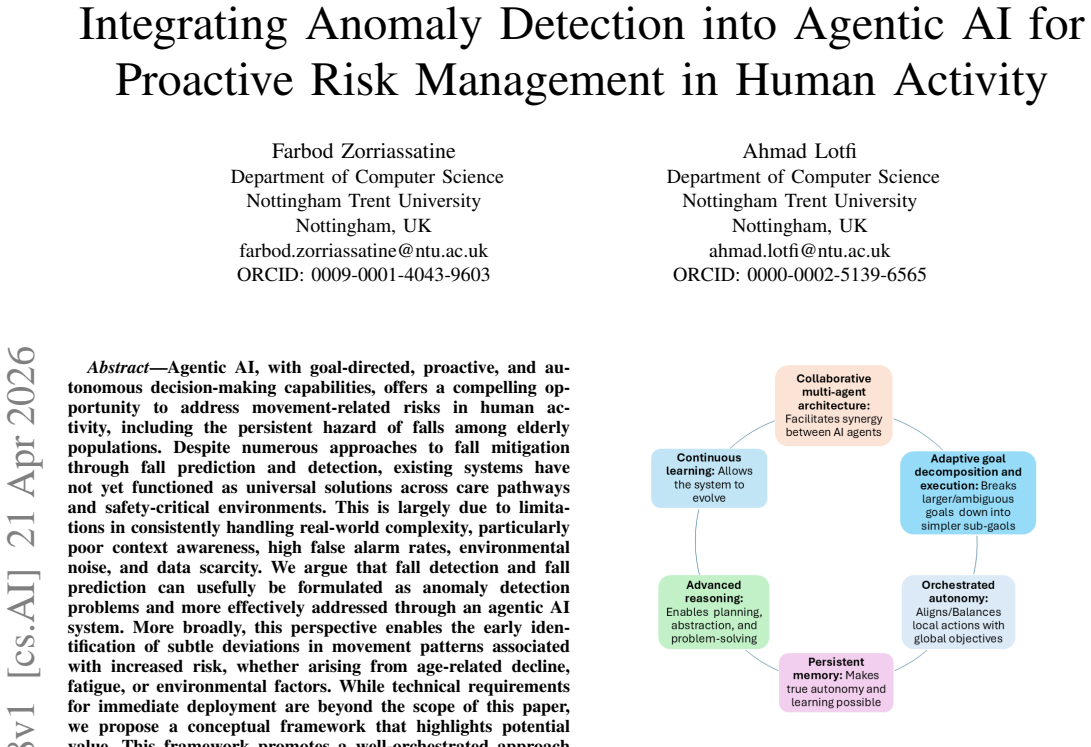
A conceptual framework in which agentic AI agents orchestrate anomaly detection on movement patterns by selecting and combining tools into goal-directed, adaptive workflows.
Load-bearing premise
That treating falls as anomalies inside an agentic AI system will overcome limitations such as poor context awareness and high false alarm rates even without any implementation details or performance evidence.
What would settle it
A real-world deployment of the proposed framework in which false alarm rates and context-awareness failures remain as high as in conventional systems when tested on noisy sensor data from elderly participants.
Figures


read the original abstract
Agentic AI, with goal-directed, proactive, and autonomous decision-making capabilities, offers a compelling opportunity to address movement-related risks in human activity, including the persistent hazard of falls among elderly populations. Despite numerous approaches to fall mitigation through fall prediction and detection, existing systems have not yet functioned as universal solutions across care pathways and safety-critical environments. This is largely due to limitations in consistently handling real-world complexity, particularly poor context awareness, high false alarm rates, environmental noise, and data scarcity. We argue that fall detection and fall prediction can usefully be formulated as anomaly detection problems and more effectively addressed through an agentic AI system. More broadly, this perspective enables the early identification of subtle deviations in movement patterns associated with increased risk, whether arising from age-related decline, fatigue, or environmental factors. While technical requirements for immediate deployment are beyond the scope of this paper, we propose a conceptual framework that highlights potential value. This framework promotes a well-orchestrated approach to risk management by dynamically selecting relevant tools and integrating them into adaptive decision-making workflows, rather than relying on static configurations tailored to narrowly defined scenarios.
Editorial analysis
A structured set of objections, weighed in public.
Referee Report
Summary. The paper claims that fall detection and fall prediction can usefully be formulated as anomaly detection problems and more effectively addressed through an agentic AI system. It proposes a conceptual framework for proactive risk management in human activity (particularly elderly falls) that uses dynamic tool selection and adaptive decision-making workflows to overcome limitations in existing systems such as poor context awareness, high false alarm rates, environmental noise, and data scarcity, rather than relying on static configurations.
Significance. If developed with concrete mechanisms, the integration of anomaly detection into agentic AI could offer a fresh perspective on proactive, context-aware risk management by enabling early detection of subtle movement deviations. The work is purely conceptual with no experiments, derivations, code, or empirical validation, so its significance is prospective and depends on future implementation details.
major comments (1)
- [Abstract] Abstract (description of the proposed framework): The central claim that an agentic AI system will 'more effectively' address poor context awareness, high false alarm rates, environmental noise, and data scarcity is load-bearing but unsupported. The text states only that the framework 'promotes a well-orchestrated approach... by dynamically selecting relevant tools and integrating them into adaptive decision-making workflows' without enumerating any tools, defining a selection policy, specifying an anomaly scoring method, or providing an example or analysis showing how the dynamism mitigates the listed limitations.
minor comments (1)
- The term 'agentic AI' is used repeatedly without a definition or reference to prior literature, which may reduce clarity for readers unfamiliar with the subfield.
Simulated Author's Rebuttal
We thank the referee for their constructive feedback, which correctly identifies the high-level nature of our conceptual framework. We appreciate the recognition that the integration of anomaly detection into agentic AI holds prospective value for proactive risk management. We address the major comment below and outline revisions to strengthen the manuscript while preserving its conceptual scope.
read point-by-point responses
-
Referee: [Abstract] Abstract (description of the proposed framework): The central claim that an agentic AI system will 'more effectively' address poor context awareness, high false alarm rates, environmental noise, and data scarcity is load-bearing but unsupported. The text states only that the framework 'promotes a well-orchestrated approach... by dynamically selecting relevant tools and integrating them into adaptive decision-making workflows' without enumerating any tools, defining a selection policy, specifying an anomaly scoring method, or providing an example or analysis showing how the dynamism mitigates the listed limitations.
Authors: We agree that the abstract and framework description remain at a high level of abstraction and do not enumerate specific tools, policies, or scoring methods, nor do they include a worked example. This is consistent with the manuscript's explicit positioning as a conceptual proposal (rather than an implementation or empirical study), which is why concrete mechanisms were not provided. To address the concern, we will revise the abstract and expand the framework section in the next version to include a high-level illustrative scenario. This scenario will describe example tools (e.g., sensor fusion modules, context-aware classifiers, and risk-threshold adjusters), a simple dynamic selection heuristic based on detected environmental noise or data availability, and a conceptual anomaly scoring approach (e.g., deviation from learned movement baselines). The revision will clarify how these elements could mitigate the listed limitations in principle, without claiming empirical validation or implementation details. revision: yes
Circularity Check
No circularity in conceptual proposal
full rationale
The paper is a high-level conceptual perspective piece with no equations, derivations, fitted parameters, or mathematical steps. Its central claim—that falls can be formulated as anomaly detection and addressed via agentic AI—is presented as an argument rather than derived from prior results or self-referential definitions within the text. The description of the framework as promoting 'dynamically selecting relevant tools and integrating them into adaptive decision-making workflows' is a restatement of the proposal itself, not a reduction to inputs by construction. No self-citations are invoked as load-bearing uniqueness theorems or ansatzes. The work is self-contained against external benchmarks as a non-technical position paper.
Axiom & Free-Parameter Ledger
axioms (1)
- domain assumption Agentic AI systems can dynamically select relevant tools and integrate them into adaptive decision-making workflows to address real-world complexity in human activity monitoring.
Reference graph
Works this paper leans on
-
[1]
In: 2024 IEEE Inter- national Conference on Advanced Intelligent Mechatronics (AIM)
Ahamad, S.U., Ataei, M., Devabhaktuni, V .: Omobot: a low-cost mobile robot for autonomous search and fall detection. In: 2024 IEEE Inter- national Conference on Advanced Intelligent Mechatronics (AIM). pp. 453–460. IEEE (2024)
2024
-
[2]
arXiv preprint arXiv:2507.15676 (2025)
Barenji, R.V ., Khoshgoftar, S.: Agentic ai for autonomous anomaly management in complex systems. arXiv preprint arXiv:2507.15676 (2025)
-
[3]
Authorea Preprints (2026)
Belay, M.A., Haghipour, A., Rasheed, A., Rossi, P.S.: Agentic and llm-based multimodal anomaly detection: Architectures, challenges, and prospects. Authorea Preprints (2026)
2026
-
[4]
Age and ageing53(7), afae131 (2024)
Dormosh, N.: A systematic review of fall prediction models for community-dwelling older adults: comparison between models based on research cohorts and models based on routinely collected data. Age and ageing53(7), afae131 (2024)
2024
-
[5]
Sensors25(21), 6540 (2025)
Gorce, P., Jacquier-Bret, J.: Fall detection in elderly people: A systematic review of ambient assisted living and smart home-related technology performance. Sensors25(21), 6540 (2025)
2025
-
[6]
In: Trends in Practical Applications of Agents and Multiagent Systems: 9th Interna- tional Conference on Practical Applications of Agents and Multiagent Systems
Kaluža, B.: A multi-agent system for remote eldercare. In: Trends in Practical Applications of Agents and Multiagent Systems: 9th Interna- tional Conference on Practical Applications of Agents and Multiagent Systems. pp. 33–40. Springer (2011)
2011
-
[7]
In: 2024 7th International Conference on Internet Applications, Protocols, and Services (NETAPPS)
Khan, M.A.: Adaptive generative ai for elderly-assisted living environ- ments: A proactive approach. In: 2024 7th International Conference on Internet Applications, Protocols, and Services (NETAPPS). pp. 1–
2024
-
[8]
Sensors23(19), 8294 (2023)
Kocuvan, P., Hrasti ˇc, A., Kareska, A., Gams, M.: Predicting a fall based on gait anomaly detection: A comparative study of wrist-worn three-axis and mobile phone-based accelerometer sensors. Sensors23(19), 8294 (2023)
2023
-
[9]
Measurement: Sensors p
Maruf, M., Haque, M.M., Hasan, M.M., Farhan, M., Islam, A.: State- of-the-art review on fall prediction among older adults: Exploring edge devices as a promising approach for the future. Measurement: Sensors p. 101878 (2025)
2025
-
[10]
J Integrated Health4(1), 380–385 (2025)
Moyer, M., Hoque, F., et al.: Artificial intelligence in fall risk assess- ment: A systematic literature review. J Integrated Health4(1), 380–385 (2025)
2025
-
[11]
arXiv preprint arXiv:2403.19735 (2024)
Park, T.: Enhancing anomaly detection in financial markets with an llm- based multi-agent framework. arXiv preprint arXiv:2403.19735 (2024)
-
[12]
medRxiv (2024)
Pillai, M., Blumke, T.L., Studnia, J., Wang, Y ., Veigulis, Z.P., Ware, A.D., Hoover, P.J., Carroll, I.R., Humphreys, K., Osborne, T.F., et al.: Improving postsurgical fall detection for older americans using llm- driven analysis of clinical narratives. medRxiv (2024)
2024
-
[13]
International Journal of Ambient Computing and Intelligence (IJACI)13(1), 1–22 (2022)
Ramanujam, E., Perumal, T.: Aifms autonomous intelligent fall moni- toring system for the elderly persons. International Journal of Ambient Computing and Intelligence (IJACI)13(1), 1–22 (2022)
2022
-
[14]
Journal of Clinical Medicine14(5), 1580 (2025)
Rango, D.: A large language model-based approach for coding in- formation from free-text reported in fall risk surveillance systems: New opportunities for in-hospital risk management. Journal of Clinical Medicine14(5), 1580 (2025)
2025
-
[15]
IEEE access7, 77702–77722 (2019)
Ren, L., Peng, Y .: Research of fall detection and fall prevention technologies: A systematic review. IEEE access7, 77702–77722 (2019)
2019
-
[16]
Journal of Computational Design and Engineering9(1), 187–200 (2022)
Samani, H., Yang, C.Y ., Li, C., Chung, C.L., Li, S.: Anomaly detection with vision-based deep learning for epidemic prevention and control. Journal of Computational Design and Engineering9(1), 187–200 (2022)
2022
-
[17]
Annals of Data Science10(3), 829–850 (2023)
Samariya, D., Thakkar, A.: A comprehensive survey of anomaly detec- tion algorithms. Annals of Data Science10(3), 829–850 (2023)
2023
-
[18]
Agentic AI: A Conceptual Taxonomy, Applications and Challenges
Sapkota, R., Roumeliotis, K.I., Karkee, M.: Ai agents vs. agentic ai: A conceptual taxonomy, applications and challenge. arXiv preprint arXiv:2505.10468 (2025)
-
[19]
JMIR research protocols12(1), e46930 (2023)
Sczuka, K.S.: Evaluating the effect of activity and environment on fall risk in a paradigm-depending laboratory setting: protocol for an experimental pilot study. JMIR research protocols12(1), e46930 (2023)
2023
-
[20]
Frontiers in digital health4, 921506 (2022)
Subramaniam, S., Faisal, A.I., Deen, M.J.: Wearable sensor systems for fall risk assessment: A review. Frontiers in digital health4, 921506 (2022)
2022
-
[21]
Sensors22(3), 756 (2022)
Sunny, J.S.: Anomaly detection framework for wearables data: a per- spective review on data concepts, data analysis algorithms and prospects. Sensors22(3), 756 (2022)
2022
-
[22]
In: NeurIPS 2024 Workshop on Open-World Agents (2024)
Timms, A., Langbridge, A., O’Donncha, F.: Agentic anomaly detection for shipping. In: NeurIPS 2024 Workshop on Open-World Agents (2024)
2024
-
[23]
Mathematics13(11), 1756 (2025)
Wen, Z., Mo, M., Xu, J.: Evolution and simulation analysis of digital transformation in rural elderly care services from a multi-agent perspec- tive in china. Mathematics13(11), 1756 (2025)
2025
-
[24]
arXiv preprint arXiv:2505.12594 (2025)
Yang, T., Liu, J., Siu, W., Wang, J., Qian, Z., Song, C., Cheng, C., Hu, X., Zhao, Y .: Ad-agent: A multi-agent framework for end-to-end anomaly detection. arXiv preprint arXiv:2505.12594 (2025)
-
[25]
arXiv preprint arXiv:2312.01488 (2023)
Yang, X., Howley, E., Schukat, M.: Adt: Agent-based dynamic thresh- olding for anomaly detection. arXiv preprint arXiv:2312.01488 (2023)
discussion (0)
Sign in with ORCID, Apple, or X to comment. Anyone can read and Pith papers without signing in.