Efficient optimisation of multi-parameter quantum control protocols for strongly-coupled systems
Pith reviewed 2026-05-10 01:54 UTC · model grok-4.3
The pith
Automatic differentiation paired with non-Markovian simulation optimizes multi-pulse control to raise exciton preparation fidelities in quantum dots above standard methods.
A machine-rendered reading of the paper's core claim, the machinery that carries it, and where it could break.
Core claim
The central claim is that automatic differentiation through the uniTEMPO algorithm enables efficient gradient-based optimization of complex multi-parameter objective functions for quantum control in the presence of strong non-Markovian noise, yielding enhanced fidelities for single- and bi-exciton generation when applied to SUPER and FTPE protocols augmented by adiabatic rapid passage in quantum dots, with these optimized schemes outperforming conventional resonant pi-pulses and two-photon excitation especially at elevated temperatures.
What carries the argument
The automatic differentiation of objective functions evaluated by the uniTEMPO algorithm, which computes gradients of non-Markovian quantum dynamics to enable direct optimization of pulse parameters.
If this is right
- Higher fidelity preparation of single-exciton states through optimized SUPER protocols in quantum dots.
- Improved bi-exciton generation via FTPE schemes enhanced by adiabatic rapid passage.
- Consistent outperformance of resonant pi-pulses and two-photon excitation under the same noise conditions.
- Increased thermal robustness, with the fidelity advantage over standard methods growing at higher temperatures.
Where Pith is reading between the lines
- The same automatic-differentiation approach could be applied to other solid-state systems whose dynamics are dominated by non-Markovian coupling.
- The reduction in manual parameter tuning could shorten the experimental calibration time required to reach high-fidelity operation in quantum hardware.
- The framework supplies a route to test whether multi-pulse adiabatic strategies remain advantageous when additional decoherence channels not captured by uniTEMPO become dominant.
Load-bearing premise
The uniTEMPO algorithm must accurately capture the non-Markovian noise and decoherence present in the physical quantum-dot device while the resulting optimized parameters remain experimentally realizable.
What would settle it
Direct experimental comparison of exciton preparation fidelities measured on a real quantum-dot device using the optimized SUPER and FTPE pulse parameters versus standard pi-pulses, performed at both low and elevated temperatures to check whether the predicted performance gap appears and widens with temperature.
Figures

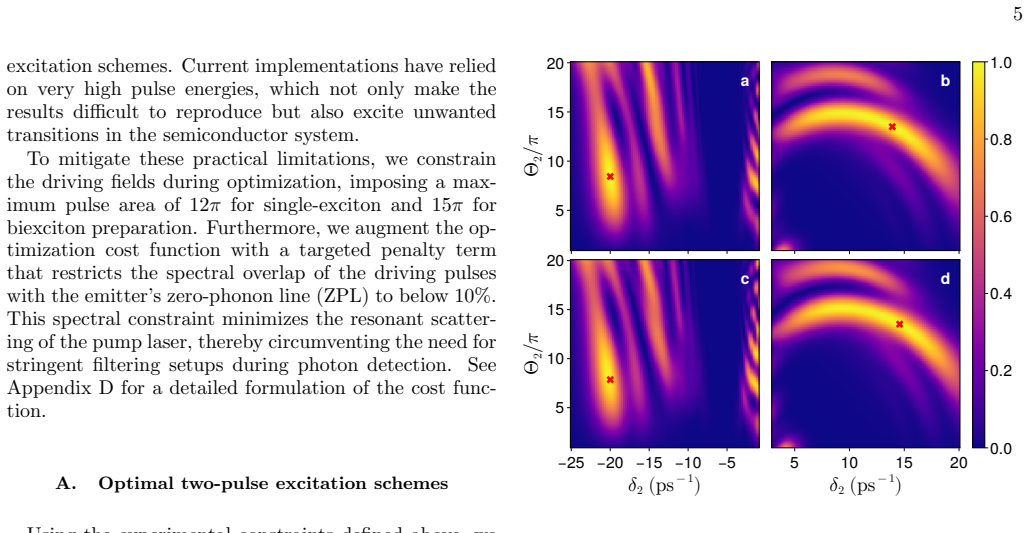


read the original abstract
Achieving high-fidelity control in the presence of strong non-Markovian noise is critical for the optimization of emergent solid-state quantum devices. We present a highly efficient optimization framework that combines automatic differentiation with the non-Markovian uniTEMPO algorithm, enabling direct gradient-based optimization of complex objective functions. We apply this method to semiconductor quantum dots, optimizing multi-pulse excitation schemes: specifically Swing-UP of a Quantum EmmiteR (SUPER) and Floquet-engineered Two-Photon Excitation (FTPE) for single- and bi-exciton generation. Our approach yields high preparation fidelities within experimentally accessible parameter regimes. By integrating adiabatic rapid passage (ARP), we systematically enhance both SUPER and FTPE, demonstrating that these optimized protocols consistently outperform standard resonant pi-pulses and two-photon excitation. Notably, this performance gap widens at elevated temperatures, establishing the superior thermal robustness of our optimized multi-pulse strategies for real-world quantum hardware.
Editorial analysis
A structured set of objections, weighed in public.
Referee Report
Summary. The manuscript introduces an optimization framework combining automatic differentiation with the non-Markovian uniTEMPO algorithm for gradient-based optimization of multi-parameter quantum control protocols under strong coupling. It applies this to semiconductor quantum dots, optimizing SUPER and FTPE multi-pulse schemes (enhanced by adiabatic rapid passage) for single- and bi-exciton generation, claiming higher fidelities than resonant pi-pulses or standard two-photon excitation, with the advantage increasing at elevated temperatures.
Significance. If the uniTEMPO-based simulations are accurate, the work provides a practical tool for designing thermally robust control protocols in solid-state systems with non-Markovian noise, potentially improving hardware performance in quantum-dot devices. The gradient-based approach for complex objectives is a methodological strength that could generalize beyond the specific protocols studied.
major comments (2)
- [Abstract and Results] Abstract and Results sections: The headline claims of high fidelities and a widening performance gap at elevated temperatures are presented without any quantitative values, tables of fidelities, error bars, or specific comparisons to resonant pulses; this makes it impossible to assess the magnitude or statistical significance of the reported advantages.
- [Methods] Methods (uniTEMPO modeling): The central claim of superior thermal robustness rests entirely on uniTEMPO faithfully reproducing phonon-induced non-Markovian noise and its temperature scaling in quantum dots. No direct benchmarking is reported against experimental observables such as temperature-dependent Rabi oscillations, Ramsey decay times, or exciton lifetimes in comparable devices, raising the risk that the simulated advantage is an artifact of the bath spectral density or truncation parameters rather than a hardware prediction.
minor comments (2)
- [Throughout] Ensure all acronyms (SUPER, FTPE, ARP) are defined at first use and used consistently.
- [Figures] Figures comparing fidelities versus temperature should include uncertainty estimates or convergence checks from the optimization runs.
Simulated Author's Rebuttal
We thank the referee for their detailed and constructive report. We address the major comments below and have made revisions to improve the clarity and robustness of our claims.
read point-by-point responses
-
Referee: [Abstract and Results] Abstract and Results sections: The headline claims of high fidelities and a widening performance gap at elevated temperatures are presented without any quantitative values, tables of fidelities, error bars, or specific comparisons to resonant pulses; this makes it impossible to assess the magnitude or statistical significance of the reported advantages.
Authors: We agree with this observation. The original abstract and results sections indeed lacked specific numerical values. In the revised manuscript, we have added quantitative fidelity values for the optimized SUPER and FTPE protocols, including direct comparisons to resonant pi-pulses and standard two-photon excitation at various temperatures. We have also included error bars and a table summarizing the fidelities to allow assessment of the performance gap and its temperature dependence. revision: yes
-
Referee: [Methods] Methods (uniTEMPO modeling): The central claim of superior thermal robustness rests entirely on uniTEMPO faithfully reproducing phonon-induced non-Markovian noise and its temperature scaling in quantum dots. No direct benchmarking is reported against experimental observables such as temperature-dependent Rabi oscillations, Ramsey decay times, or exciton lifetimes in comparable devices, raising the risk that the simulated advantage is an artifact of the bath spectral density or truncation parameters rather than a hardware prediction.
Authors: We acknowledge the referee's concern regarding the validation of the uniTEMPO algorithm. Our manuscript applies uniTEMPO as an established method for non-Markovian dynamics in quantum dots, with parameters chosen based on standard models for phonon baths in these systems. However, to strengthen the presentation, we have added references to previous works where uniTEMPO has been benchmarked against experimental data on temperature-dependent decoherence and Rabi oscillations in quantum dots. We also include a brief discussion on the choice of spectral density and truncation to mitigate concerns about artifacts. Direct new benchmarking experiments are outside the scope of this theoretical optimization study. revision: partial
Circularity Check
Optimization framework yields numerical results without circular reduction to inputs
full rationale
The paper describes a computational optimization procedure that combines automatic differentiation with the uniTEMPO non-Markovian simulator to tune multi-pulse parameters for SUPER and FTPE protocols in quantum dots. All reported fidelities and performance comparisons (including temperature dependence and ARP enhancements) are direct outputs of this numerical search within the model; no derivation chain equates a claimed prediction to a fitted parameter or self-citation by algebraic identity. Self-citations to uniTEMPO or related methods are present but serve only as the simulation engine rather than load-bearing justification for the superiority claims. The work therefore contains no self-definitional, fitted-input-renamed-as-prediction, or uniqueness-imported steps.
Axiom & Free-Parameter Ledger
axioms (1)
- domain assumption uniTEMPO provides an accurate forward model of the non-Markovian open-system dynamics in the quantum-dot device.
Reference graph
Works this paper leans on
- [1]
-
[2]
H.-P. Breuer and F. Petruccione,The Theory of Open Quantum Systems(Oxford University Press, Oxford, 2002)
work page 2002
-
[3]
D. P. S. McCutcheon, N. S. Dattani, E. M. Gauger, B. W. Lovett, and A. Nazir, A general approach to quantum dynamics using a variational master equation: applica- tion to phonon-damped rabi rotations in quantum dots, Physical Review B84, 081305 (2011)
work page 2011
-
[4]
D. P. S. McCutcheon and A. Nazir, Coherent and inco- herent dynamics in excitonic energy transfer: Correlated fluctuations and off-resonance effects, Phys. Rev. B83, 165101 (2011)
work page 2011
-
[5]
P. Michler, A. Kiraz, C. Becher, W. V. Schoenfeld, P. Petroff, L. D. Zhang, E. Hu, and A. Imamoglu, A quantum dot single-photon turnstile device, Science290, 2282 (2000)
work page 2000
- [6]
- [7]
-
[8]
N. Akopian, N. H. Lindner, E. Poem, Y. Berlatzky, J. Avron, D. Gershoni, B. D. Gerardot, and P. M. Petroff, Entangled photon pairs from semiconductor quantum dots, Phys. Rev. Lett.96, 130501 (2006)
work page 2006
-
[9]
R. Stevenson, R. J. Young, P. Atkinson, K. Cooper, D. A. Ritchie, and A. J. Shields, A semiconductor source of triggered entangled photon pairs, Nature439, 179 (2006)
work page 2006
- [10]
-
[11]
T. K. Bracht, M. Cosacchi, T. Seidelmann, M. Cygorek, A. Vagov, V. M. Axt, T. Heindel, and D. E. Reiter, Swing-up of quantum emitter population using detuned pulses, PRX Quantum2, 040354 (2021). 14
work page 2021
-
[12]
J. H. Quilter, A. J. Brash, F. Liu, M. Gl¨ assl, A. M. Barth, V. M. Axt, A. J. Ramsay, M. S. Skolnick, and A. M. Fox, Phonon-assisted population inversion of a single InGaAs/GaAs quantum dot by pulsed laser ex- citation, Phys. Rev. Lett.114, 137401 (2015)
work page 2015
-
[13]
M. Cosacchi, F. Ungar, M. Cygorek, A. Vagov, and V. M. Axt, Emission-frequency separated high quality single- photon sources enabled by phonons, Phys. Rev. Lett. 123, 017403 (2019)
work page 2019
-
[14]
A. M. Barth, S. L¨ uker, A. Vagov, D. E. Reiter, T. Kuhn, and V. M. Axt, Fast and selective phonon-assisted state preparation of a quantum dot by adiabatic undressing, Phys. Rev. B94, 045306 (2016)
work page 2016
- [15]
-
[16]
A. Strathearn, P. Kirton, D. Kilda, and et al., Efficient non-markovian quantum dynamics using time-evolving matrix product operators, Nature Communications9, 3322 (2018)
work page 2018
-
[17]
M. R. Jørgensen and F. A. Pollock, Exploiting the causal tensor network structure of quantum processes to ef- ficiently simulate non-markovian path integrals, Phys. Rev. Lett.123, 240602 (2019)
work page 2019
-
[18]
A. G. Baydin, B. A. Pearlmutter, A. A. Radul, and J. M. Siskind, Automatic differentiation in machine learning: a survey (2018), arXiv:1502.05767 [cs.SC]
work page Pith review arXiv 2018
-
[19]
Don't Unroll Adjoint: Differentiating SSA-Form Programs
M. Innes, Don’t unroll adjoint: Differentiating ssa-form programs (2019), arXiv:1810.07951 [cs.PL]
work page Pith review arXiv 2019
-
[20]
V. Link, H.-H. Tu, and W. T. Strunz, Open quantum system dynamics from infinite tensor network contraction (2024), arXiv:2307.01802 [quant-ph]
-
[21]
F. Kahlert, V. Link, R. Hartmann, and W. T. Strunz, Simulating the Landau–Zener sweep in deeply sub-Ohmic environments, The Journal of Chemical Physics161, 184108 (2024)
work page 2024
- [22]
-
[23]
E. P. Butler, G. E. Fux, C. Ortega-Taberner, B. W. Lovett, J. Keeling, and P. R. Eastham, Optimizing per- formance of quantum operations with non-markovian de- coherence: The tortoise or the hare?, Phys. Rev. Lett. 132, 060401 (2024)
work page 2024
-
[24]
C. Ortega-Taberner, E. O’Neill, E. Butler, G. E. Fux, and P. R. Eastham, Unifying methods for optimal control in non-Markovian quantum systems via process tensors, The Journal of Chemical Physics161, 124119 (2024)
work page 2024
-
[25]
T. H. Stievater, X. Li, D. G. Steel, D. Gammon, D. S. Katzer, D. Park, C. Piermarocchi, and L. J. Sham, Rabi oscillations of excitons in single quantum dots, Physical Review Letters87, 133603 (2001)
work page 2001
- [26]
-
[27]
S. Stufler, P. Machnikowski, P. Ester, M. Bichler, V. M. Axt, T. Kuhn, and A. Zrenner, Two-photon rabi oscilla- tions in a single in xga1−xAs/GaAs quantum dot, Phys. Rev. B73, 125304 (2006)
work page 2006
-
[28]
R. H. Byrd, P. Lu, J. Nocedal, and C. Zhu, A Limited Memory Algorithm for Bound Constrained Optimiza- tion, SIAM Journal on Scientific Computing16, 1190 (1995)
work page 1995
-
[29]
R. Bollapragada, J. Nocedal, D. Mudigere, H.-J. Shi, and P. T. P. Tang, A progressive batching l-BFGS method for machine learning, inProceedings of the 35th Interna- tional Conference on Machine Learning, Proceedings of Machine Learning Research, Vol. 80, edited by J. Dy and A. Krause (PMLR, 2018) pp. 620–629
work page 2018
-
[30]
D. P. Kingma and J. Ba, Adam: A method for stochastic optimization (2017), arXiv:1412.6980 [cs.LG]
work page internal anchor Pith review Pith/arXiv arXiv 2017
-
[31]
An overview of gradient descent optimization algorithms
S. Ruder, An overview of gradient descent optimization algorithms (2017), arXiv:1609.04747 [cs.LG]
work page Pith review arXiv 2017
-
[32]
J. Zhang, Derivative-free global optimization algorithms: Population based methods and random search ap- proaches (2019), arXiv:1904.09368 [cs.LG]
-
[33]
R. Storn and K. Price, Differential evolution—a simple and efficient heuristic for global optimization over con- tinuous spaces, Journal of Global Optimization11, 341 (1997)
work page 1997
-
[34]
C. Ortega-Taberner, E. O’Neill, and P. Eastham, Quan- tum control of the environment in open quantum sys- tems enables rapid qubit reset (2026), arXiv:2603.09913 [quant-ph]
-
[35]
A. Nazir and D. P. S. McCutcheon, Modelling exci- ton–phonon interactions in optically driven quantum dots, Journal of Physics: Condensed Matter28, 103002 (2016)
work page 2016
-
[36]
E. V. Denning, J. Iles-Smith, N. Gregersen, and J. Mork, Phonon effects in quantum dot single-photon sources, Opt. Mater. Express10, 222 (2020)
work page 2020
-
[37]
T. Kaldewey, S. L¨ uker, A. V. Kuhlmann, S. R. Valentin, J.-M. Chauveau, A. Ludwig, A. D. Wieck, D. E. Reiter, T. Kuhn, and R. J. Warburton, Demonstrating the de- coupling regime of the electron-phonon interaction in a quantum dot using chirped optical excitation, Phys. Rev. B95, 241306 (2017)
work page 2017
- [38]
-
[39]
Y. Wu, I. M. Piper, M. Ediger, P. Brereton, E. R. Schmidgall, P. R. Eastham, M. Hugues, M. Hopkinson, and R. T. Phillips, Population inversion in a single In- GaAs quantum dot using the method of adiabatic rapid passage, Phys. Rev. Lett.106, 067401 (2011)
work page 2011
-
[40]
J. S. Melinger, S. R. Gandhi, A. Hariharan, J. X. Tull, and W. S. Warren, Generation of narrowband inversion with broadband laser pulses, Phys. Rev. Lett.68, 2000 (1992)
work page 2000
-
[41]
V. S. Malinovsky and J. L. Krause, General theory of population transfer by adiabatic rapid passage with in- tense, chirped laser pulses, European Physical Journal D 14, 147 (2001)
work page 2001
- [42]
-
[43]
M. Cygorek and E. M. Gauger, Ace: A general-purpose non-markovian open quantum systems simulation toolkit based on process tensors, The Journal of Chemical Physics161, 074111 (2024). 15
work page 2024
-
[44]
N. Makri and D. E. Makarov, Tensor propagator for it- erative quantum time evolution of reduced density ma- trices. i. theory, The Journal of Chemical Physics102, 4600 (1995)
work page 1995
-
[45]
N. Makri and D. E. Makarov, Tensor propagator for iter- ative quantum time evolution of reduced density matri- ces. ii. numerical methodology, The Journal of Chemical Physics102, 4611 (1995)
work page 1995
-
[46]
M. Cygorek, J. Keeling, B. W. Lovett, and E. M. Gauger, Sublinear scaling in non-markovian open quantum sys- tems simulations, Phys. Rev. X14, 011010 (2024)
work page 2024
-
[47]
M. R. Jørgensen and F. A. Pollock, Exploiting the Causal Tensor Network Structure of Quantum Processes to Effi- ciently Simulate Non-Markovian Path Integrals, Physical Review Letters123, 240602 (2019)
work page 2019
-
[48]
J. A. Gyamfi, Fundamentals of quantum mechanics in liouville space, European Journal of Physics41, 063002 (2020)
work page 2020
-
[49]
G. Vidal, Efficient Simulation of One-Dimensional Quan- tum Many-Body Systems, Physical Review Letters93, 040502 (2004)
work page 2004
-
[50]
G. Vidal, Classical Simulation of Infinite-Size Quantum Lattice Systems in One Spatial Dimension, Physical Re- view Letters98, 070201 (2007)
work page 2007
-
[51]
A. Strathearn, B. W. Lovett, and P. Kirton, Efficient real- time path integrals for non-Markovian spin-boson mod- els, New Journal of Physics19, 093009 (2017)
work page 2017
-
[52]
M. Aehle, J. Bl¨ uhdorn, M. Sagebaum, and N. R. Gauger, Forward-mode automatic differentiation of compiled pro- grams, ACM Trans. Math. Softw.51, 10.1145/3716309 (2025)
- [53]
-
[54]
Julia: A Fast Dynamic Language for Technical Computing
J. Bezanson, S. Karpinski, V. B. Shah, and A. Edelman, Julia: A Fast Dynamic Language for Technical Comput- ing (2012), arXiv:1209.5145 [cs]
work page Pith review arXiv 2012
-
[55]
J. Bezanson, A. Edelman, S. Karpinski, and V. B. Shah, Julia: A fresh approach to nu- merical computing, SIAM Review59, 65 (2017), https://doi.org/10.1137/141000671
-
[56]
G. Dalle and A. Hill, A common interface for automatic differentiation (2025), arXiv:2505.05542 [cs.MS]
-
[57]
V. K. Dixit and C. Rackauckas, Optimization.jl: A uni- fied optimization package (2023)
work page 2023
-
[58]
P. K. Mogensen and A. N. Riseth, Optim: A mathe- matical optimization package for julia, Journal of Open Source Software3, 615 (2018)
work page 2018
-
[59]
C. Ortega-Taberner, E. O’Neill, and P. Eastham, Qubit reset beyond the born-markov approximation: opti- mal driving to overcome polaron formation (2026), arXiv:2603.09914 [quant-ph]
discussion (0)
Sign in with ORCID, Apple, or X to comment. Anyone can read and Pith papers without signing in.