Recognition: unknown
Vertex misalignment and changepoint localization in network time series
Pith reviewed 2026-05-09 23:32 UTC · model grok-4.3
The pith
Vertex misalignment impairs changepoint localization only when the signal lies in joint distributions of latent positions
A machine-rendered reading of the paper's core claim, the machinery that carries it, and where it could break.
Core claim
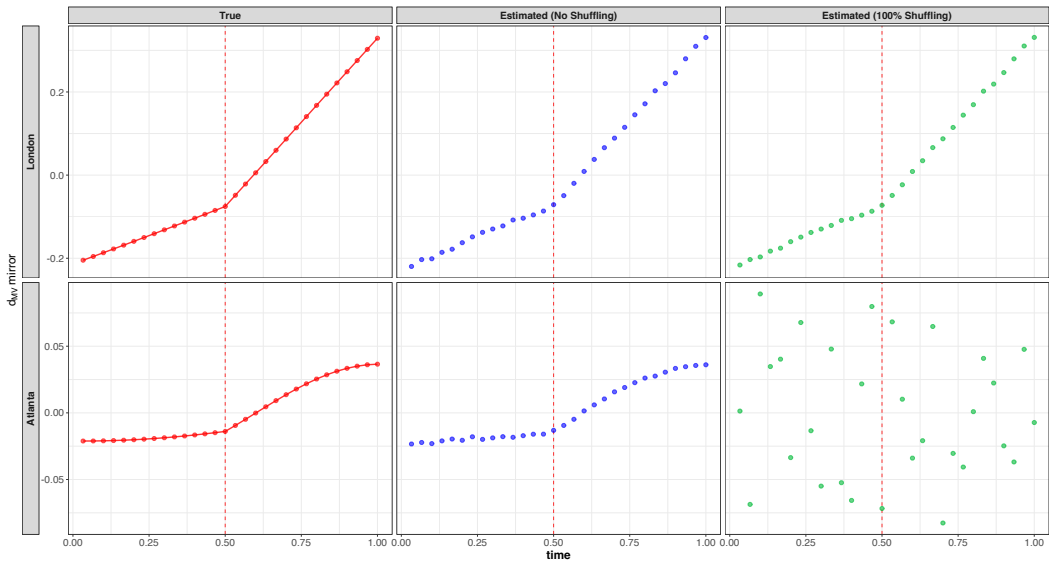
Through two illustrative models of dynamic networks with similar changepoints, vertex misalignment causes little error in changepoint localization when the information resides in marginal distributions of latent positions, but impairs localization in ways that cannot be corrected through graph matching or optimal transport when the information resides in joint distributions; these two alignment procedures are shown to be closely related in the setting.
What carries the argument
The pair of models that isolate marginal versus joint changepoint information in networks with time-varying latent positions, together with the comparison of localization methods ranging from average degree to Euclidean mirrors.
If this is right
- Localization accuracy depends on whether the changepoint signal is marginal or joint, so methods must be chosen accordingly.
- Graph matching and optimal transport cannot be relied upon to restore performance after misalignment when the signal is joint.
- Simple statistics such as average degree remain useful for localization in marginal cases but not in joint cases.
- Robust network time-series inference requires explicit handling of both marginal and joint distributional information.
Where Pith is reading between the lines
- The marginal-versus-joint distinction may extend to other dynamic-network tasks such as community detection or link prediction.
- Procedures that jointly estimate alignment and changepoint location could reduce the errors identified here.
- Applied analysts working with evolving networks should first determine whether their data more closely match the marginal or the joint model before selecting an alignment strategy.
Load-bearing premise
The two illustrative models sufficiently capture the distinction between changepoint information contained in marginal versus joint distributions of the time-varying latent positions.
What would settle it
A network time series in which vertex misalignment produces comparable localization error in both the marginal-information model and the joint-information model, or in which optimal transport removes the localization error in the joint-information model.
Figures


read the original abstract
Inference for time series of networks often relies on accurate vertex correspondence between network realizations at different times. In practice, however, such vertex alignments can be misspecified or unknown. We study the impact of vertex alignment on changepoint localization for dynamic networks through two illustrative models, each with a similar changepoint, with the key distinction being whether changepoint information is contained in marginal or joint distributions of the time-varying latent positions. We compare localization techniques ranging from the simple network statistic of average degree to the modern procedure of Euclidean mirrors. In one model, vertex misalignment causes little error, and in the other, it impairs localization in ways that cannot be corrected through graph matching or optimal transport, which we show are closely related in this setting. Our results demonstrate that robust network inference necessitates reckoning with the subtle interplay of marginal and joint information in the observed network time series.
Editorial analysis
A structured set of objections, weighed in public.
Referee Report
Summary. The paper studies the impact of vertex misalignment on changepoint localization in dynamic networks. It introduces two illustrative models with similar changepoints but differing in whether changepoint information resides in the marginal or joint distributions of time-varying latent positions. Localization methods ranging from average degree to Euclidean mirrors are compared, showing negligible error from misalignment in the marginal case but uncorrectable impairment in the joint case; graph matching and optimal transport are shown to be closely related yet insufficient to recover performance in the latter setting. The results underscore the need to account for the interplay between marginal and joint information in network time series inference.
Significance. If the illustrative models accurately capture the marginal-versus-joint distinction, the work provides a clear demonstration that standard alignment corrections cannot always restore changepoint localization accuracy. This is a useful cautionary result for practitioners and motivates further development of methods that explicitly handle joint distributional shifts in latent-position models. The explicit comparison of graph matching and optimal transport within the same framework is a concrete contribution that clarifies their relationship in this setting.
minor comments (2)
- [Abstract] The abstract and introduction would benefit from a brief, explicit statement of the two model families (e.g., their generative assumptions on latent positions) so that readers can immediately map the marginal/joint distinction to the reported outcomes.
- [Section 4] Notation for the Euclidean-mirror procedure and the optimal-transport formulation should be aligned more closely with the graph-matching section to make the claimed equivalence easier to verify without cross-referencing.
Simulated Author's Rebuttal
We thank the referee for their careful reading and positive assessment of our manuscript, including the accurate summary of our illustrative models and the recommendation for minor revision. The significance statement correctly identifies the cautionary nature of the results regarding alignment corrections in the presence of joint distributional shifts.
Circularity Check
No significant circularity
full rationale
The paper defines two explicit illustrative models that isolate whether changepoint information resides in marginal or joint distributions of latent positions, then directly compares localization performance (average degree through Euclidean mirrors) under vertex misalignment within those models. Results on error magnitude and (non-)correctability via graph matching or optimal transport are computed from the model equations themselves rather than recovered by fitting or self-referential definition. No load-bearing step reduces to a prior self-citation, ansatz smuggled via citation, or renaming of a known result; the argument remains self-contained against the stated model assumptions.
Axiom & Free-Parameter Ledger
Reference graph
Works this paper leans on
-
[1]
Joshua Agterberg, Zachary Lubberts, and Jes´ us Arroyo. Joint spectral clustering in multilayer degree-corrected stochastic blockmodels.arXiv preprint arXiv:2212.05053, 2022
-
[2]
Entrywise estimation of singular vectors of low-rank matrices with heteroskedasticity and dependence.IEEE Transactions on Information Theory, 68(7):4618–4650, 2022
Joshua Agterberg, Zachary Lubberts, and Carey E Priebe. Entrywise estimation of singular vectors of low-rank matrices with heteroskedasticity and dependence.IEEE Transactions on Information Theory, 68(7):4618–4650, 2022
2022
-
[3]
Jes´ us Arroyo, Carey E Priebe, and Vince Lyzinski. Graph matching between bipartite and unipar- tite networks: to collapse, or not to collapse, that is the question.IEEE transactions on network science and engineering, 8(4):3019–3033, 2021
2021
-
[4]
Maximum likelihood estima- tion and graph matching in errorfully observed networks.Journal of Computational and Graphical Statistics, 30(4):1111–1123, 2021
Jes´ us Arroyo, Daniel L Sussman, Carey E Priebe, and Vince Lyzinski. Maximum likelihood estima- tion and graph matching in errorfully observed networks.Journal of Computational and Graphical Statistics, 30(4):1111–1123, 2021
2021
-
[5]
Euclidean mirrors and dynamics in network time series.Journal of the American Statistical Association, pages 1–12, 2025
Avanti Athreya, Zachary Lubberts, Youngser Park, and Carey Priebe. Euclidean mirrors and dynamics in network time series.Journal of the American Statistical Association, pages 1–12, 2025
2025
-
[6]
The riemannian convex bundle method.Preprint, 2024
Ronny Bergmann, Roland Herzog, and Hajg Jasa. The riemannian convex bundle method.Preprint, 2024
2024
-
[7]
John Wiley & Sons, 2015
George EP Box, Gwilym M Jenkins, Gregory C Reinsel, and Greta M Ljung.Time series analysis: forecasting and control. John Wiley & Sons, 2015
2015
-
[8]
Optimal structured principal subspace estimation: Metric entropy and minimax rates.Journal of machine learning research, 22(46):1–45, 2021
Tony Cai, Hongzhe Li, and Rong Ma. Optimal structured principal subspace estimation: Metric entropy and minimax rates.Journal of machine learning research, 22(46):1–45, 2021
2021
-
[9]
Signal-plus-noise matrix models: eigenvector deviations and fluctuations.Biometrika, 106(1):243–250, 2019
Joshua Cape, Minh Tang, and Carey E Priebe. Signal-plus-noise matrix models: eigenvector deviations and fluctuations.Biometrika, 106(1):243–250, 2019
2019
-
[10]
The two-to-infinity norm and singular subspace geometry with applications to high-dimensional statistics.Annual of Statistics, 2019
Joshua Cape, Minh Tang, and Carey E Priebe. The two-to-infinity norm and singular subspace geometry with applications to high-dimensional statistics.Annual of Statistics, 2019
2019
-
[11]
Efficient graph matching for correlated stochastic block models
Shuwen Chai and Mikl´ os Z R´ acz. Efficient graph matching for correlated stochastic block models. Advances in Neural Information Processing Systems, 37:116388–116461, 2024
2024
-
[12]
Chen, J.T
L. Chen, J.T. Vogelstein, V. L. Lyzinski, and C. E. Priebe. A joint graph inference case study: the C. Elegans chemical and electrical connectomes.Worm, 5:e1142041, 2016
2016
-
[13]
Analysis of tensor time series: tensorts.Journal of Statistical Software, 323, 2022
Rong Chen, Yuefeng Han, Zebang Li, Han Xiao, Dan Yang, and Ruofan Yu. Analysis of tensor time series: tensorts.Journal of Statistical Software, 323, 2022
2022
-
[14]
Tianyi Chen, Zachary Lubberts, Avanti Athreya, Youngser Park, and Carey E Priebe. Euclidean mirrors and first-order changepoints in network time series.arXiv preprint arXiv:2405.11111, 2024. 49
-
[15]
Discov- ering a change point and piecewise linear structure in a time series of organoid networks via the iso-mirror.Applied Network Science, 8(1):45, 2023
Tianyi Chen, Youngser Park, Ali Saad-Eldin, Zachary Lubberts, Avanti Athreya, Benjamin D Pedigo, Joshua T Vogelstein, Francesca Puppo, Gabriel A Silva, Alysson R Muotri, et al. Discov- ering a change point and piecewise linear structure in a time series of organoid networks via the iso-mirror.Applied Network Science, 8(1):45, 2023
2023
-
[16]
Springer, 2025
Sinho Chewi, Jonathan Niles-Weed, and Philippe Rigollet.Statistical optimal transport. Springer, 2025
2025
-
[17]
Conte, P
D. Conte, P. Foggia, C. Sansone, and M. Vento. Thirty years of graph matching in pattern recog- nition.International Journal of Pattern Recognition and Artificial Intelligence, 18:265–298, 2004
2004
-
[18]
Thirty years of graph match- ing in pattern recognition.International journal of pattern recognition and artificial intelligence, 18(03):265–298, 2004
Donatello Conte, Pasquale Foggia, Carlo Sansone, and Mario Vento. Thirty years of graph match- ing in pattern recognition.International journal of pattern recognition and artificial intelligence, 18(03):265–298, 2004
2004
-
[19]
Marco De Angelis and Ander Gray. Why the 1-wasserstein distance is the area between the two marginal cdfs.arXiv preprint arXiv:2111.03570, 2021
-
[20]
Seeded graph matching.Pattern recognition, 87:203–215, 2019
Donniell E Fishkind, Sancar Adali, Heather G Patsolic, Lingyao Meng, Digvijay Singh, Vince Lyzinski, and Carey E Priebe. Seeded graph matching.Pattern recognition, 87:203–215, 2019
2019
-
[21]
Spectral embedding for dynamic net- works with stability guarantees.Advances in Neural Information Processing Systems, 34:10158– 10170, 2021
Ian Gallagher, Andrew Jones, and Patrick Rubin-Delanchy. Spectral embedding for dynamic net- works with stability guarantees.Advances in Neural Information Processing Systems, 34:10158– 10170, 2021
2021
-
[22]
Exact community recovery in correlated stochastic block models
Julia Gaudio, Miklos Z Racz, and Anirudh Sridhar. Exact community recovery in correlated stochastic block models. InConference on Learning Theory, pages 2183–2241. PMLR, 2022
2022
-
[23]
Swarming network inference with importance clustering of relative interactions.Journal of Physics: Complexity, 5(4):045009, 2024
Jason Hindes, Kevin Daley, George Stantchev, and Ira B Schwartz. Swarming network inference with importance clustering of relative interactions.Journal of Physics: Complexity, 5(4):045009, 2024
2024
-
[24]
Pro- crustes problems on random matrices.arXiv preprint arXiv:2510.05182, 2025
Hajg Jasa, Ronny Bergmann, Christian K¨ ummerle, Avanti Athreya, and Zachary Lubberts. Pro- crustes problems on random matrices.arXiv preprint arXiv:2510.05182, 2025
-
[25]
Community detection on mixture multilayer networks via regularized tensor decomposition.The Annals of Statistics, 49(6):3181–3205, 2021
Bing-Yi Jing, Ting Li, Zhongyuan Lyu, and Dong Xia. Community detection on mixture multilayer networks via regularized tensor decomposition.The Annals of Statistics, 49(6):3181–3205, 2021
2021
-
[26]
John Wiley & Sons, 2005
Benjamin Kedem and Konstantinos Fokianos.Regression models for time series analysis. John Wiley & Sons, 2005
2005
-
[27]
Kivel¨ a, A
M. Kivel¨ a, A. Arenas, M. Barthelemy, J. P. Gleeson, Y. Moreno, and M. A. Porter. Multilayer networks.Journal of complex networks, 2(3):203–271, 2014
2014
-
[28]
Eigenvalues and eigenvectors of tridiagonal matrices.The Electronic Journal of Linear Algebra, 15:115–133, 2006
Said Kouachi. Eigenvalues and eigenvectors of tridiagonal matrices.The Electronic Journal of Linear Algebra, 15:115–133, 2006
2006
-
[29]
Computational and statistical thresholds in multi-layer stochastic block models.The Annals of Statistics, 52(5):2431–2455, 2024
Jing Lei, Anru R Zhang, and Zihan Zhu. Computational and statistical thresholds in multi-layer stochastic block models.The Annals of Statistics, 52(5):2431–2455, 2024
2024
-
[30]
Lyzinski
V. Lyzinski. Information recovery in shuffled graphs via graph matching.IEEE Transactions on Information Theory, 64(5):3254–3273, 2018. 50
2018
-
[31]
Lyzinski, S
V. Lyzinski, S. Adali, J. T. Vogelstein, Y. Park, and C. E. Priebe. Seeded graph matching via joint optimization of fidelity and commensurability. Arxiv preprint athttp://arxiv.org/abs/1401. 3813, 2014
2014
-
[32]
Lyzinski, D
V. Lyzinski, D. E. Fishkind, M. Fiori, J. T. Vogelstein, C. E. Priebe, and G. Sapiro. Graph match- ing: Relax at your own risk.IEEE Transactions on Pattern Analysis and Machine Intelligence, 38:60–73, 2016
2016
-
[33]
Latent space models for multiplex networks with shared structure.Biometrika, 109(3):683–706, 2022
Peter W MacDonald, Elizaveta Levina, and Ji Zhu. Latent space models for multiplex networks with shared structure.Biometrika, 109(3):683–706, 2022
2022
-
[34]
Vito M.R. Muggeo. segmented: an r package to fit regression models with broken-line relationships. R News, 8(1):20–25, 2008
2008
-
[35]
Interval estimation for the breakpoint in segmented regression: A smoothed score-based approach.Australian & New Zealand Journal of Statistics, 59(3):311–322, 2017
Vito MR Muggeo. Interval estimation for the breakpoint in segmented regression: A smoothed score-based approach.Australian & New Zealand Journal of Statistics, 59(3):311–322, 2017
2017
-
[36]
Change point localization in dependent dynamic nonparametric random dot product graphs.The Journal of Machine Learning Research, 23(1):10661–10719, 2022
Oscar Hernan Madrid Padilla, Yi Yu, and Carey E Priebe. Change point localization in dependent dynamic nonparametric random dot product graphs.The Journal of Machine Learning Research, 23(1):10661–10719, 2022
2022
-
[37]
Optimal nonpara- metric multivariate change point detection and localization.IEEE Transactions on Information Theory, 68(3):1922–1944, 2021
Oscar Hernan Madrid Padilla, Yi Yu, Daren Wang, and Alessandro Rinaldo. Optimal nonpara- metric multivariate change point detection and localization.IEEE Transactions on Information Theory, 68(3):1922–1944, 2021
1922
-
[38]
The importance of being correlated: Implications of dependence in joint spectral inference across multiple networks.Journal of Machine Learning Research, 23(141):1–77, 2022
Konstantinos Pantazis, Avanti Athreya, Jes´ us Arroyo, William N Frost, Evan S Hill, and Vince Lyzinski. The importance of being correlated: Implications of dependence in joint spectral inference across multiple networks.Journal of Machine Learning Research, 23(141):1–77, 2022
2022
-
[39]
Paul and Y
S. Paul and Y. Chen. Spectral and matrix factorization methods for consistent community detection in multi-layer networks.The Annals of Statistics, 48(1):230–250, 2020
2020
-
[40]
Signed diverse multiplex networks: clustering and inference.IEEE Transactions on Information Theory, 2025
Marianna Pensky. Signed diverse multiplex networks: clustering and inference.IEEE Transactions on Information Theory, 2025
2025
-
[41]
Statistical inference on errorfully observed graphs.Journal of Computational and Graphical Statistics, 24(4):930–953, 2015
Carey E Priebe, Daniel L Sussman, Minh Tang, and Joshua T Vogelstein. Statistical inference on errorfully observed graphs.Journal of Computational and Graphical Statistics, 24(4):930–953, 2015
2015
-
[42]
Tong Qi, Vera Andersson, Peter Viechnicki, and Vince Lyzinski. Asymptotically perfect seeded graph matching without edge correlation (and applications to inference).arXiv preprint arXiv:2506.02825, 2025
-
[43]
igraphmatch: an r package for the analysis of graph matching
Zihuan Qiao and Daniel Sussman. igraphmatch: an r package for the analysis of graph matching. arXiv preprint arXiv:2112.09212, 2021
-
[44]
Correlated stochastic block models: Exact graph matching with applications to recovering communities.Advances in Neural Information Processing Systems, 34:22259–22273, 2021
Miklos Racz and Anirudh Sridhar. Correlated stochastic block models: Exact graph matching with applications to recovering communities.Advances in Neural Information Processing Systems, 34:22259–22273, 2021
2021
-
[45]
Patrick Rubin-Delanchy, Joshua Cape, Minh Tang, and Carey E Priebe. A statistical interpretation of spectral embedding: The generalised random dot product graph.Journal of the Royal Statistical Society Series B: Statistical Methodology, 84(4):1446–1473, 2022. 51
2022
-
[46]
Graph matching via optimal transport.arXiv preprint arXiv:2111.05366, 2021
Ali Saad-Eldin, Benjamin D Pedigo, Carey E Priebe, and Joshua T Vogelstein. Graph matching via optimal transport.arXiv preprint arXiv:2111.05366, 2021
-
[47]
Lost in the shuffle: Testing power in the presence of errorful network vertex labels.Computational Statistics & Data Analysis, 204:108091, 2025
Ayushi Saxena and Vince Lyzinski. Lost in the shuffle: Testing power in the presence of errorful network vertex labels.Computational Statistics & Data Analysis, 204:108091, 2025
2025
-
[48]
Springer, 2000
Robert H Shumway, David S Stoffer, and David S Stoffer.Time series analysis and its applications, volume 3. Springer, 2000
2000
-
[49]
A survey on graph matching in computer vision
Hui Sun, Wenju Zhou, and Minrui Fei. A survey on graph matching in computer vision. In2020 13th International Congress on Image and Signal Processing, BioMedical Engineering and Informatics (CISP-BMEI), pages 225–230. IEEE, 2020
2020
-
[50]
D. L. Sussman, M. Tang, D. E. Fishkind, and C. E. Priebe. A consistent adjacency spectral embedding for stochastic blockmodel graphs.Journal of the American Statistical Association, 107:1119–1128, 2012
2012
-
[51]
Minh Tang and Joshua R Cape. Eigenvector fluctuations and limit results for random graphs with infinite rank kernels.arXiv preprint arXiv:2501.15725, 2025
-
[52]
J. B. Tenenbaum, V. de Silva, and J.C. Langford. A global geometric framework for nonlinear dimensionality reduction.Science, 290:2319—2323, 2000
2000
-
[53]
Optimal change-point detection and localization.The Annals of Statistics, 51(4):1586–1610, 2023
Nicolas Verzelen, Magalie Fromont, Matthieu Lerasle, and Patricia Reynaud-Bouret. Optimal change-point detection and localization.The Annals of Statistics, 51(4):1586–1610, 2023
2023
-
[54]
Shuffled graph classification: Theory and connectome applications.Journal of Classification, 32(1):3–20, 2015
Joshua T Vogelstein and Carey E Priebe. Shuffled graph classification: Theory and connectome applications.Journal of Classification, 32(1):3–20, 2015
2015
-
[55]
Fan Wang, Wanshan Li, Oscar Hernan Madrid Padilla, Yi Yu, and Alessandro Rinaldo. Multi- layer random dot product graphs: Estimation and online change point detection.arXiv preprint arXiv:2306.15286, 2023
-
[56]
Entrywise limit theorems for eigenvectors of signal-plus-noise matrix models with weak signals.Bernoulli, 30(1):388–418, 2024
Fangzheng Xie. Entrywise limit theorems for eigenvectors of signal-plus-noise matrix models with weak signals.Bernoulli, 30(1):388–418, 2024
2024
-
[57]
A short survey of recent advances in graph matching
Junchi Yan, Xu-Cheng Yin, Weiyao Lin, Cheng Deng, Hongyuan Zha, and Xiaokang Yang. A short survey of recent advances in graph matching. InProceedings of the 2016 ACM on international conference on multimedia retrieval, pages 167–174, 2016
2016
-
[58]
Tensor svd: Statistical and computational limits.IEEE Transactions on Information Theory, 64(11):7311–7338, 2018
Anru Zhang and Dong Xia. Tensor svd: Statistical and computational limits.IEEE Transactions on Information Theory, 64(11):7311–7338, 2018
2018
-
[59]
Automatic dimensionality selection from the scree plot via the use of profile likelihood.Computational Statistics & Data Analysis, 51(2):918–930, 2006
Mu Zhu and Ali Ghodsi. Automatic dimensionality selection from the scree plot via the use of profile likelihood.Computational Statistics & Data Analysis, 51(2):918–930, 2006
2006
-
[60]
Tiona Zuzul, Emily Cox Pahnke, Jonathan Larson, Patrick Bourke, Nicholas Caurvina, Neha Parikh Shah, Fereshteh Amini, Jeffrey Weston, Youngser Park, Joshua Vogelstein, et al. Dynamic silos: In- creased modularity in intra-organizational communication networks during the covid-19 pandemic. arXiv preprint arXiv:2104.00641, 2021. 52
discussion (0)
Sign in with ORCID, Apple, or X to comment. Anyone can read and Pith papers without signing in.