Bulk and surface electronic structure of MoAlB(010)
Pith reviewed 2026-05-10 00:12 UTC · model grok-4.3
The pith
Mirror symmetries of the p2mm group protect crossings in the surface states of MoAlB(010).
A machine-rendered reading of the paper's core claim, the machinery that carries it, and where it could break.
Core claim
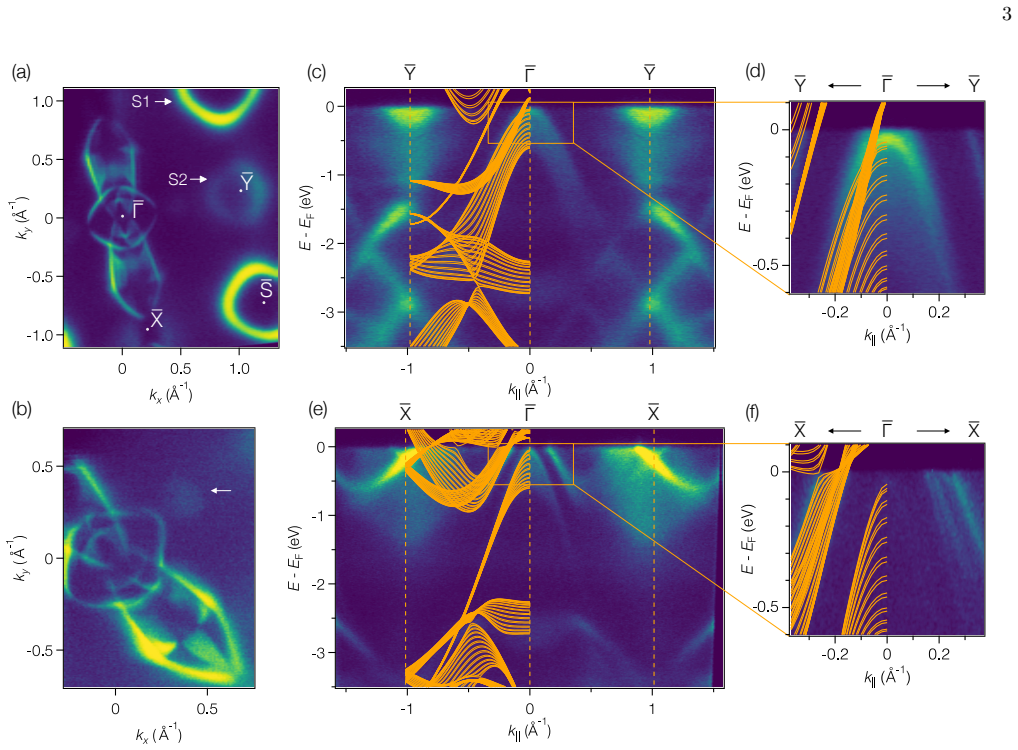
The central claim is that ARPES measurements detect surface states inside wide projected bulk band gaps around the Fermi level; these states exhibit symmetry-enforced crossings near the S-bar point that are required by the mirror-symmetry operations of the p2mm wallpaper group. One state derives mainly from Al dangling bonds and is rapidly suppressed by surface contamination, while a mainly Mo-derived state shows larger Rashba splitting. The calculations reproduce the observed bulk Fermi-level crossings and assign the orbital character that explains the differing sensitivities.
What carries the argument
The p2mm wallpaper group mirror symmetries that enforce band crossings in the surface states near the S-bar point.
If this is right
- Al-derived surface states are expected to be more easily quenched by adsorbates than Mo-derived states.
- The Mo-derived state should display a larger momentum-dependent spin splitting that survives moderate contamination.
- The enforced crossings remain at the same location regardless of small changes in surface potential, as long as the p2mm symmetry is preserved.
- Surface states inside the bulk gaps can be tuned by choosing terminations that select either Al or Mo character.
Where Pith is reading between the lines
- Similar mirror-protected crossings may appear at surfaces of other orthorhombic materials belonging to the same wallpaper group.
- The differing contamination responses suggest a route to selectively expose spin-split states by controlled surface dosing.
- Device interfaces that preserve the mirror planes could host robust one-dimensional conduction channels along the protected crossings.
Load-bearing premise
The detected states are purely surface-derived and the calculations correctly identify their elemental and orbital character without significant surface reconstruction.
What would settle it
If high-resolution ARPES after controlled surface preparation shows the crossings vanishing or shifting away from the S-bar point while the bulk bands remain unchanged, the symmetry-protection claim would be falsified.
Figures



read the original abstract
The bulk and surface electronic structure of MoAlB(010) is studied by a combination of angle-resolved photoemission spectroscopy and density functional calculations. The observed bulk Fermi-level crossings agree with the previously reported bulk Fermi surface of the material. Additionally, we find several surface states in the wide projected bulk band gaps around the Fermi energy. The surface states differ in their stability under residual-gas exposure in the vacuum system and in the magnitude of their Rashba-type spin-orbit splitting. We explain this in terms of their elemental and orbital character. A surface state arising from Al dangling bonds is sensitive to surface contamination, whereas a mainly Mo-derived surface state exhibits the stronger spin-orbit splitting. The surface states show symmetry-enforced crossings near the $\bar{\mathrm{S}}$ point of the surface Brillouin zone. These are protected by the mirror-symmetry elements of the p2mm wallpaper group.
Editorial analysis
A structured set of objections, weighed in public.
Referee Report
Summary. The manuscript reports a combined ARPES and DFT study of the bulk and surface electronic structure of MoAlB(010). Bulk Fermi-level crossings are shown to match prior reports. Several surface states are identified inside projected bulk gaps; their differing contamination sensitivity and Rashba splitting magnitudes are attributed to Al-dangling-bond versus Mo-derived orbital character. The central claim is that crossings near the surface Brillouin-zone S-bar point are symmetry-enforced by the mirror operations of the p2mm wallpaper group.
Significance. If the symmetry-protection claim is placed on a firmer footing, the work supplies a concrete, experimentally accessible illustration of wallpaper-group-enforced surface-state crossings in an intermetallic compound. The standard ARPES+DFT methodology is applied without obvious post-hoc fitting, and the orbital-character analysis usefully rationalizes the observed differences in surface-state robustness.
major comments (1)
- [Surface-states discussion near S-bar] The assertion that the crossings near S-bar are symmetry-protected by the mirror elements of p2mm (abstract and surface-states discussion) is load-bearing for the strongest claim yet rests only on orbital-character assignment. The manuscript does not extract or tabulate the mirror eigenvalues (or irrep labels) of the DFT wavefunctions at the crossing momentum. Without this explicit check, it remains possible that surface relaxation or termination breaks the effective mirror symmetry, converting an enforced crossing into an avoided one whose gap lies below experimental resolution.
minor comments (2)
- [Figure captions] Figure captions should explicitly state the photon energy, polarization, and temperature used for each ARPES map so that the surface versus bulk assignment can be independently assessed.
- [Computational methods] A brief statement on the slab thickness and surface termination chosen for the DFT surface calculations would clarify how the projected bulk gaps and surface-state dispersions were obtained.
Simulated Author's Rebuttal
We thank the referee for their careful reading of the manuscript and for the constructive comment on the symmetry-protection claim. We address this point below and will revise the manuscript to incorporate an explicit verification of the mirror eigenvalues.
read point-by-point responses
-
Referee: [Surface-states discussion near S-bar] The assertion that the crossings near S-bar are symmetry-protected by the mirror elements of p2mm (abstract and surface-states discussion) is load-bearing for the strongest claim yet rests only on orbital-character assignment. The manuscript does not extract or tabulate the mirror eigenvalues (or irrep labels) of the DFT wavefunctions at the crossing momentum. Without this explicit check, it remains possible that surface relaxation or termination breaks the effective mirror symmetry, converting an enforced crossing into an avoided one whose gap lies below experimental resolution.
Authors: We agree that an explicit tabulation of mirror eigenvalues (or irrep labels) from the DFT wavefunctions would place the symmetry-protection argument on firmer footing and directly address the possibility of a small avoided crossing. Our orbital-character analysis was performed on wavefunctions from a relaxed slab model that preserves the p2mm symmetries, and the observed crossings are consistent with this protection. However, we acknowledge that the manuscript does not report the eigenvalues themselves. In the revised version we will extract and present the mirror eigenvalues for the surface states at the crossing momentum near the surface Brillouin-zone S point, confirming that the states belong to distinct mirror irreps. We will also add a brief statement clarifying that the surface relaxation in our DFT slab calculations maintains the mirror symmetries of the p2mm wallpaper group with no detectable symmetry-breaking distortion. revision: yes
Circularity Check
No significant circularity detected
full rationale
The paper's central claims rest on independent ARPES measurements combined with standard DFT calculations whose inputs (crystal structure, exchange-correlation functional) are not derived from the ARPES data set itself. The symmetry-enforced crossing statement invokes the p2mm wallpaper group as an external group-theoretic fact; no equation or parameter is fitted to the observed crossings and then re-labeled as a prediction. No self-citation chain is load-bearing for the symmetry argument, and no ansatz or uniqueness theorem is smuggled in. The derivation chain therefore remains self-contained against external benchmarks.
Axiom & Free-Parameter Ledger
axioms (1)
- domain assumption Density functional theory in standard approximations accurately describes the bulk and surface electronic bands of MoAlB.
Reference graph
Works this paper leans on
-
[1]
S. Kota, M. Sokol, and M. W. Barsoum, International Materials Reviews65, 226 (2020)
work page 2020
- [2]
-
[3]
M. Ramezanzadeh, R. Ghamarpoor, A. Dashan, A. Fal- lah, S. Soleimani, and B. Ramezanzadeh, Advanced Composites and Hybrid Materials8(2025)
work page 2025
-
[4]
S. Kota, E. Zapata-Solvas, A. Ly, J. Lu, O. Elkassabany, A. Huon, W. E. Lee, L. Hultman, S. J. May, and M. W. Barsoum, Scientific Reports6(2016)
work page 2016
- [5]
-
[6]
X. Li, H. Cui, and R. Zhang, Scientific Reports6(2016)
work page 2016
-
[7]
M. A. Ali, M. A. Hadi, M. M. Hossain, S. H. Naqib, and A. K. M. A. Islam, physica status solidi (b)254(2017)
work page 2017
-
[8]
L. Ke, B. N. Harmon, and M. J. Kramer, Physical Review B95, 104427 (2017)
work page 2017
-
[9]
L. Zhao, L. Xu, L. Ding, H. Zuo, and Z. Zhu, Physical Review B102(2020)
work page 2020
-
[10]
P. Nie, H. Zuo, L. Zhao, and Z. Zhu, Chinese Physics Letters39, 057102 (2022)
work page 2022
-
[11]
J. J. Mortensen, A. H. Larsen, M. Kuisma, A. V. Ivanov, A. Taghizadeh, A. Peterson, A. Haldar, A. O. Dohn, C. Sch¨ afer, E.¨O. J´ onsson, et al., The Journal of Chemical Physics160(2024)
work page 2024
-
[12]
J. P. Perdew, K. Burke, and M. Ernzerhof, Physical Re- view Letters77, 3865 (1996)
work page 1996
-
[13]
A. H. Larsen, J. J. Mortensen, J. Blomqvist, I. E. Castelli, R. Christensen, M. Du lak, J. Friis, M. N. Groves, B. Hammer, C. Hargus, et al., Journal of Physics: Condensed Matter29, 273002 (2017). [14]See online supplementary material for core level spectra, for a bulk band structure calculations in the primitive bril- louin zone, for a bulk and (010)-sur...
work page 2017
-
[14]
E. W. Plummer and W. Eberhardt, Advances in Chemi- cal Physics49, 533 (1982)
work page 1982
-
[15]
P. Hofmann,Synchrotron-Radiation Studies of Topologi- cal Insulators(Springer International Publishing, 2013), pp. 211–238, ISBN 9783319030326
work page 2013
- [16]
-
[17]
S. LaShell, B. A. McDougall, and E. Jensen, Physical Review Letters77, 3419 (1996)
work page 1996
-
[18]
Y. M. Koroteev, G. Bihlmayer, J. E. Gayone, E. V. Chulkov, S. Bl¨ ugel, P. M. Echenique, and P. Hofmann, Physical Review Letters93, 046403 (2004)
work page 2004
-
[19]
J. Paul and F. M. Hoffmann, The Journal of Physical Chemistry90, 5321 (1986)
work page 1986
-
[20]
L. Yang, X. Lei, J. Feng, Y. Zhang, and M. Liu, Jour- nal of Theoretical and Computational Chemistry12, 1350035 (2013)
work page 2013
discussion (0)
Sign in with ORCID, Apple, or X to comment. Anyone can read and Pith papers without signing in.