Influence of random surface deformations on the resonance frequencies and quality factors of optical cavities and plasmonic nanoparticles
Pith reviewed 2026-05-09 23:08 UTC · model grok-4.3
The pith
First-order perturbation theory with shifting boundaries predicts the statistical distributions of resonance frequencies and quality factors caused by random surface deformations in optical cavities and plasmonic nanoparticles.
A machine-rendered reading of the paper's core claim, the machinery that carries it, and where it could break.
Core claim
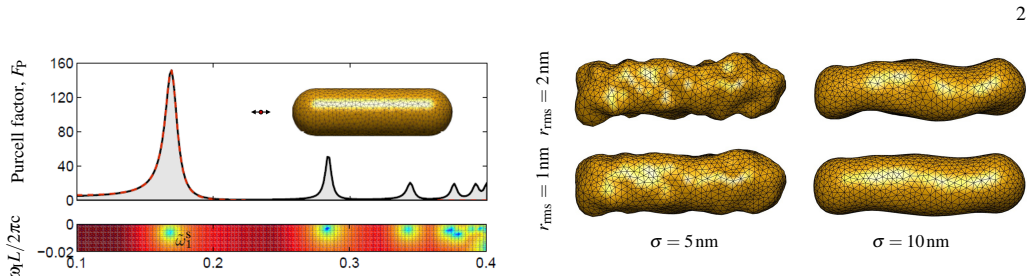
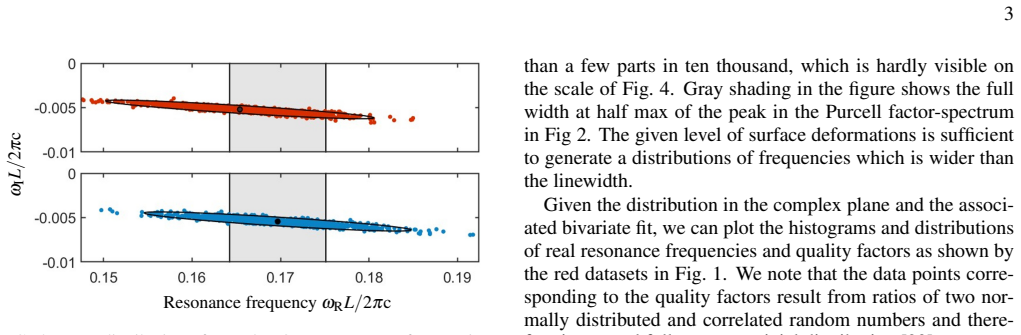
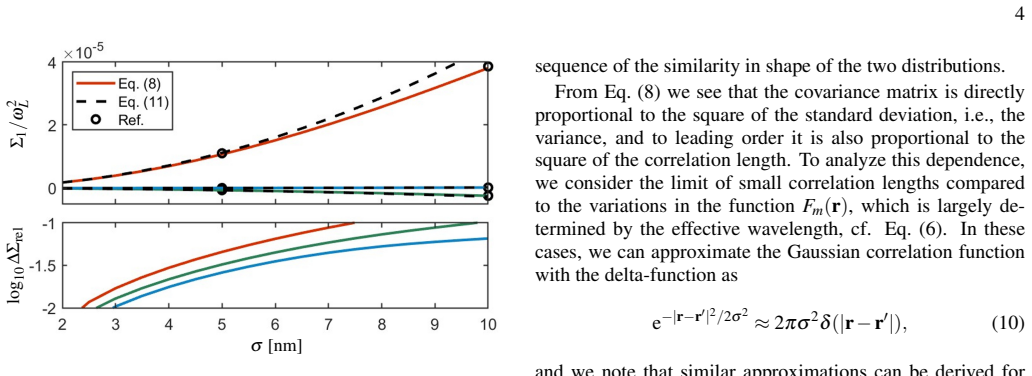
The central claim is that first-order perturbation theory with a shifting-boundary approximation provides a practical way to characterize the statistical distributions of resonance frequencies and quality factors arising from random surface deformations. In the example of a plasmonic nanowire, the method reproduces the bivariate frequency distribution obtained from direct numerical calculations over 1000 independent deformation realizations and supplies the mean values and covariance matrix to relatively high accuracy.
What carries the argument
first-order perturbation theory with shifting boundaries, which approximates the effect of surface deformations by applying small displacements to the boundary conditions of the unperturbed electromagnetic solution.
If this is right
- The same perturbation approach can be used to estimate quality-factor distributions in addition to frequencies for any given cavity shape.
- Covariance matrices obtained this way reveal correlations between different resonance modes induced by the same deformations.
- Statistical properties of ensembles of nanoparticles can be computed from a single unperturbed calculation plus the deformation statistics.
- The method offers a route to assess fabrication tolerance requirements without repeated full-wave simulations for each realization.
Where Pith is reading between the lines
- Designers could use the covariance information to identify which spatial modes of deformation most strongly affect target resonances and prioritize fabrication control accordingly.
- The framework might extend to predicting how deformation statistics influence other observables such as scattering cross-sections or Purcell factors in the same resonators.
- If the perturbation remains valid across a range of amplitudes, it could guide inverse design by optimizing nominal geometry to minimize sensitivity to expected surface roughness.
Load-bearing premise
First-order perturbation theory remains accurate for the considered random surface deformations, with the shifting-boundary approximation holding without higher-order corrections or geometry-specific breakdowns.
What would settle it
Numerical results from a much larger ensemble of deformed nanowire realizations, or direct experimental measurements of resonance frequencies on fabricated samples, that deviate substantially from the predicted average and covariance matrix.
Figures

read the original abstract
Surface deformations of optical cavities and plasmonic nanoparticles are inevitable in nanophotonics. The random morphology changes of different realizations modify the associated resonance frequencies and quality factors, which may be characterized by specified distributions instead of their nominal values. As an alternative to statistical analyses based on direct numerical calculations, we present an approximate method using first-order perturbation theory with shifting boundaries. For an example resonator in the form of a plasmonic nanowire, the approach explains the bivariate frequency distribution observed in direct numerical calculations involving 1000 realizations of random surface deformations and provides the average and the associated covariance matrix with relatively high accuracy.
Editorial analysis
A structured set of objections, weighed in public.
Referee Report
Summary. The manuscript proposes an approximate analytical method based on first-order perturbation theory with shifting boundaries to characterize the statistical effects of random surface deformations on resonance frequencies and quality factors of optical cavities and plasmonic nanoparticles. For a plasmonic nanowire example, the approach is shown to reproduce the bivariate frequency distribution observed across 1000 independent numerical realizations of random deformations and to recover the sample mean and associated covariance matrix with relatively high accuracy.
Significance. If the first-order approximation remains accurate, the method provides an efficient alternative to direct numerical sampling for statistical tolerance analysis in nanophotonics, where surface roughness is unavoidable. The validation against separate numerical calculations for one geometry is a positive feature, as is the absence of free parameters or fitted quantities. Broader applicability to other cavity geometries and deformation statistics would increase impact.
major comments (2)
- The central claim that first-order shifting-boundary perturbation theory explains the observed bivariate frequency distribution and recovers the mean plus covariance matrix rests on the linear approximation remaining accurate for the deformation amplitudes realized in the 1000 numerical runs. No explicit bound is given on deformation amplitude relative to skin depth or wavelength, nor is there a comparison against second-order terms, reduced-amplitude runs, or estimates of mode-profile distortion and additional radiation damping. This assumption is load-bearing for the general method and the nanowire validation.
- In the nanowire example, the reported agreement with the numerical covariance matrix should be accompanied by quantitative error metrics (e.g., relative Frobenius norm or element-wise discrepancies with uncertainties) rather than the qualitative statement of 'relatively high accuracy'.
minor comments (1)
- The abstract and introduction would benefit from a brief statement of the deformation amplitude range (rms height relative to wavelength or skin depth) for which the method is intended.
Simulated Author's Rebuttal
We thank the referee for the positive overall assessment and the constructive major comments. We address each point below and will revise the manuscript to strengthen the presentation of the approximation's validity range and to include quantitative error metrics.
read point-by-point responses
-
Referee: The central claim that first-order shifting-boundary perturbation theory explains the observed bivariate frequency distribution and recovers the mean plus covariance matrix rests on the linear approximation remaining accurate for the deformation amplitudes realized in the 1000 numerical runs. No explicit bound is given on deformation amplitude relative to skin depth or wavelength, nor is there a comparison against second-order terms, reduced-amplitude runs, or estimates of mode-profile distortion and additional radiation damping. This assumption is load-bearing for the general method and the nanowire validation.
Authors: We agree that an explicit discussion of the validity range would improve the manuscript. The deformation amplitudes used in the 1000 realizations are stated in the methods section and are small compared to both the wavelength and the skin depth of the plasmonic material; the close quantitative match to the full numerical distributions (including covariance) already indicates that higher-order contributions remain negligible for these amplitudes. In the revision we will add a dedicated paragraph providing the ratio of rms deformation amplitude to skin depth, a simple scaling estimate for the size of second-order corrections based on the perturbation framework, and a brief note that mode-profile distortion and extra radiation damping are captured to first order by the boundary-shift approach. We do not claim the approximation holds for arbitrarily large deformations, only for the regime validated by the numerical ensemble. revision: yes
-
Referee: In the nanowire example, the reported agreement with the numerical covariance matrix should be accompanied by quantitative error metrics (e.g., relative Frobenius norm or element-wise discrepancies with uncertainties) rather than the qualitative statement of 'relatively high accuracy'.
Authors: We accept this suggestion. In the revised manuscript we will replace the qualitative phrase with explicit quantitative measures: the relative Frobenius norm of the difference between the analytical and sample covariance matrices, together with the maximum element-wise relative discrepancy and its standard error across the ensemble. These numbers will be reported both in the text and in a new table or figure caption for the nanowire example. revision: yes
Circularity Check
No significant circularity; derivation is independent and externally validated
full rationale
The paper derives statistical predictions (bivariate frequency distribution, mean, covariance) for resonance shifts under random surface deformations by applying first-order perturbation theory with shifting boundaries. These predictions are then compared to independent direct numerical calculations over 1000 realizations. No load-bearing step reduces by construction to a fitted parameter, self-definition, or self-citation chain; the perturbation framework is presented as an approximate method whose accuracy is assessed against separate simulations rather than assumed or fitted. The central claim therefore retains independent content.
Axiom & Free-Parameter Ledger
axioms (1)
- domain assumption First-order perturbation theory with shifting boundaries is valid for the random surface deformations studied
Reference graph
Works this paper leans on
-
[1]
As a consequence, the QNM reso- nance frequencies become themselves random variables with specific distributions to be determined. We model the surface deformations using a normally dis- tributed random displacement∆h(r)of the local resonator sur- face with zero mean and standard deviationr rms given as the root mean square of the displacements. Moreover,...
-
[2]
K. J. Vahala, Optical microcavities, Nature424, 839 (2003)
work page 2003
-
[3]
L. Novotny and N. van Hulst, Antennas for light, Nature Pho- tonics5, 83 (201)
-
[4]
P. R. Dolan, G. M. Hughes, F. Grazioso, B. R. Patton, and J. M. Smith, Femtoliter tunable optical cavity arrays, Optics Letters 35, 3556 (2010)
work page 2010
-
[5]
J. Rodríguez-Fernández, A. M. Funston, J. Pérez-Juste, R. A. Álvarez Puebla, L. M. Liz-Marzán, and P. Mulvaney, The effect of surface roughness on the plasmonic response of individual sub-micron gold spheres, Phys. Chem. Chem. Phys.11, 5909 (2009)
work page 2009
-
[6]
A. Trügler, J.-C. Tinguely, J. R. Krenn, A. Hohenau, and U. Ho- henester, Influence of surface roughness on the optical proper- ties of plasmonic nanoparticles, Physical Review B83, 081412 (2011)
work page 2011
-
[7]
D. Marcuse, Mode conversion caused by surface imperfections of a slab waveguide, Bell Systems Technical Journal48, 3187 (1969)
work page 1969
-
[8]
J. P. R. Lacey and F. P. Payne, Radiation loss from planar waveguides with random wall imperfections, IEE Proceedings 137, 282 (1990)
work page 1990
-
[9]
M. Patterson, S. Hughes, S. Combrié, N.-V .-Q. Tran, A. De Rossi, R. Gabet, and Y . Jaouën, Disorder-induced coher- ent scattering in slow-light photonic crystal waveguides, Physi- cal Review Letters102, 253903 (2009)
work page 2009
-
[10]
M. Hammerschmidt, D. Lockau, S. Burger, F. Schmidt, C. Schwanke, S. Kirner, S. Calnan, B. Stannowski, and B. Rech, FEM-based optical modeling of silicon thin-film tandem solar cells with randomly textured interfaces in 3D, Proceedings of SPIE8620, 86201H (2013)
work page 2013
- [11]
-
[12]
E. S. C. Ching, P. T. Leung, A. Maassen van den Brink, W. M. Suen, S. S. Tong, and K. Young, Quasinormal-mode expansion for waves in open systems, Review of Modern Physics70, 1545 (1998)
work page 1998
-
[13]
P. T. Kristensen and S. Hughes, Modes and mode volumes of leaky optical cavities and plasmonic nanoresonators, ACS Pho- tonics1, 2 (2014)
work page 2014
-
[14]
P. Lalanne, W. Yan, K. Vynck, C. Sauvan, and J.-P. Hugo- nin, Light interaction with photonic and plasmonic resonances, Laser & Photonics Reviews12, 1700113 (2018)
work page 2018
-
[15]
P. T. Kristensen, K. Herrmann, F. Intravaia, and K. Busch, Mod- eling electromagnetic resonators using quasinormal modes, Ad- vances in Optics and Photonics12, 612 (2020)
work page 2020
-
[16]
E. A. Muljarov, W. Langbein, and R. Zimmermann, Brillouin- wigner perturbation theory in open electromagnetic systems, European Physics Letters92, 50010 (2010)
work page 2010
-
[17]
U. Hohenester and A. Trügler, Mnpbem — a matlab toolbox for the simulation of plasmonic nanoparticles, Computer Physics Communications183, 370 (2012)
work page 2012
-
[18]
F. Alpeggiani, S. D. Agostino, D. Sanvitto, and D. Gerace, Vis- ible quantum plasmonics from metallic nanodimers, Scientific Reports6, 34772 (2016)
work page 2016
- [19]
-
[20]
J. Wen, H. Wang, W. Wang, Z. Deng, C. Zhuang, Y . Zhang, F. Liu, J. She, J. Chen, H. Chen, S. Deng, and N. Xu, Room- temperature strong light–matter interaction with active con- trol in single plasmonic nanorod coupled with two-dimensional atomic crystals, Nano Letters17, 4689 (2017)
work page 2017
-
[21]
N. G. V . Kampen,Stochastic processes in physics and chem- istry, 3rd ed.(Elsevier, Amsterdam, 1992)
work page 1992
-
[22]
F. Loth, T. Kiel, K. Busch, and P. T. Kristensen, Surface rough- ness in finite-element meshes: application to plasmonic nanos- tructures, Journal of the Optical Society of America B40, B1 (2023)
work page 2023
-
[23]
C. Geuzaine and J.-F. Remacle, Gmsh: a three-dimensional finite element mesh generator with built-in pre- and post- processing facilities, International Journal for Numerical Meth- ods in Engineering79, 1309 (2009)
work page 2009
-
[24]
Marsaglia, Ratios of normal variables, Journal of Statistical Software16, 1–10 (2006)
G. Marsaglia, Ratios of normal variables, Journal of Statistical Software16, 1–10 (2006)
work page 2006
-
[25]
H. M. Lai, P. T. Leung, K. Young, P. W. Barber, and S. C. Hill, Time-independent perturbation for leaking electromag- netic modes in open systems with application to resonances in microdroplets, Physical Review A41, 5187 (1990)
work page 1990
-
[26]
S. G. Johnson, M. Ibanescu, M. A. Skorobogatiy, O. Weis- berg, J. D. Joannopoulos, and Y . Fink, Perturbation theory for maxwell’s equations with shifting material boundaries, Physi- cal Review E65, 066611 (2002)
work page 2002
-
[27]
Z. Sztranyovszky, W. Langbein, and E. A. Muljarov, First-order perturbation theory of eigenmodes for systems with interfaces, Physical Review Research5, 013209 (2023)
work page 2023
-
[28]
G. Kountouris, J. Mørk, E. V . Denning, and P. T. Kristensen, Modal properties of dielectric bowtie cavities with deep sub- wavelength confinement, Optics Express30, 40367 (2022)
work page 2022
-
[29]
N. Granchi, F. Intonti, M. Florescu, P. D. García, M. Gurioli, and G. Arregui, Q-factor optimization of modes in ordered and disordered photonic systems using non-hermitian perturbation theory, ACS Photonics10, 2808 (2023)
work page 2023
-
[30]
I. V . Lindell, Delta function expansions, complex delta func- tions and the steepest descent method, American Journal of Physics61, 438 (1993)
work page 1993
discussion (0)
Sign in with ORCID, Apple, or X to comment. Anyone can read and Pith papers without signing in.