Recognition: unknown
Modulation of Spin Angular Momentum of Emission in Symmetric 1D Plasmonic Crystals by Cathodoluminescence
Pith reviewed 2026-05-09 20:37 UTC · model grok-4.3
The pith
Symmetric 1D plasmonic crystals generate controllable circularly polarized light via electron-beam position.
A machine-rendered reading of the paper's core claim, the machinery that carries it, and where it could break.
Core claim
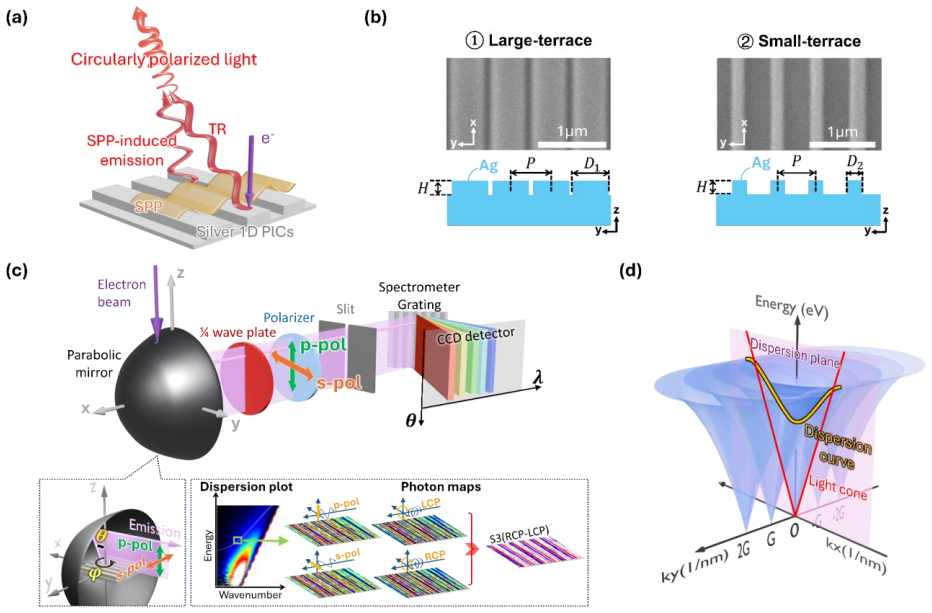
In symmetric one-dimensional plasmonic crystals, coherent interference between transition radiation and 1D PlC mode emissions produces energy- and momentum-resolved circularly polarized light. Scattering of surface plasmon polaritons at the structural boundaries further modulates the polarization efficiency when the electron-beam excitation position is shifted along the terrace, revealing both the dispersion and the spatial dependence at the nanoscale.
What carries the argument
Interference among transition radiation, 1D plasmonic crystal modes, and boundary-scattered surface plasmon polaritons that yields position-dependent circular polarization.
If this is right
- Circular polarization efficiency can be modulated simply by moving the excitation position along the terrace.
- Energy- and emission-angle-resolved maps of circular polarization directly reveal the dispersion of the plasmonic modes.
- Phase information extracted from the interference supplies concrete guidance for plasmonic device design.
- Controllable circularly polarized emission becomes feasible in symmetric structures that avoid the fabrication demands of chiral geometries.
Where Pith is reading between the lines
- Beam-position control could enable dynamic polarization switching in integrated plasmonic circuits without moving parts.
- The same interference principle may apply to other symmetric nanostructures, opening routes to chiral emission from achiral platforms.
- Replacing the electron beam with focused optical excitation might allow all-optical modulation of the same effect.
Load-bearing premise
The observed circular polarization arises from coherent interference between transition radiation, plasmonic modes, and boundary scattering rather than from sample imperfections or beam-induced asymmetries.
What would settle it
If shifting the electron-beam position along the terrace produces no measurable change in circular polarization efficiency, or if the polarization spectrum shows no dispersion matching the expected 1D plasmonic modes, the interference mechanism would be ruled out.
Figures
read the original abstract
The spin angular momentum (SAM) of light has become a cornerstone of numerous photonic applications, including optical communication and chiral photonics. Because SAM is inherently associated with circularly polarized light (CPL), the ability to modulate CPL in a controlled and efficient manner is essential not only for advancing fundamental studies of light-matter interactions but also for enabling next-generation photonic technologies. However, such modulation is commonly realized by structurally chiral systems, which inherently limits the feasibility of dynamic tuning. Here, we demonstrate that one-dimensional plasmonic crystals (1D PlCs), despite their structural symmetry, can serve as a platform for controllable CPL generation. By employing an electron beam in scanning transmission electron microscopy (STEM), we coherently excite transition radiation and emission from 1D PlC modes. Their interference produces energy- and momentum- (emission angle-) resolved CPL, which clearly reveals its dispersion and spatial dependence at the nanoscale, providing direct guidance for its manipulation and offering insights into the design of plasmonic devices including the phase information. Furthermore, interference with surface plasmon polariton scattering at the structural boundary enables the efficiency modulation of CPL generation via the excitation position along the terrace.
Editorial analysis
A structured set of objections, weighed in public.
Referee Report
Summary. The manuscript claims that symmetric one-dimensional plasmonic crystals can generate controllable circularly polarized light (CPL) via cathodoluminescence in STEM, where interference between transition radiation and 1D plasmonic crystal modes produces energy- and momentum-resolved spin angular momentum, with additional efficiency modulation achieved by varying the electron-beam excitation position along the terrace due to surface plasmon polariton scattering at structural boundaries.
Significance. If the interference mechanism is confirmed, the result would be significant for plasmonic and chiral photonics by showing that structural symmetry does not preclude tunable CPL generation, enabling nanoscale control of spin angular momentum through excitation position without requiring chiral geometries. This could inform device design for optical communication and provide direct access to phase information in plasmonic emissions at the nanoscale.
major comments (1)
- [Results] The central claim that position-dependent CPL arises specifically from coherent interference (transition radiation + 1D PlC modes + boundary SPP scattering) is load-bearing. The results section must demonstrate quantitative agreement between the measured Stokes-parameter variation and the expected interference phase (path-length difference to the boundary scaled by the SPP wavevector k_SPP); without such a model comparison or fit, alternative explanations such as local fabrication variations or beam-induced asymmetries cannot be excluded.
minor comments (2)
- [Abstract] The abstract states that the approach 'clearly reveals its dispersion and spatial dependence' but does not reference specific figures or quantitative metrics (e.g., visibility of interference fringes or error bars on polarization degree); add explicit cross-references.
- [Methods] Clarify the precise definition and normalization of the circular polarization degree (or Stokes S3 parameter) used in the energy-momentum maps to ensure reproducibility.
Simulated Author's Rebuttal
We thank the referee for their constructive and detailed review. The central concern regarding quantitative validation of the interference mechanism is well taken, and we have revised the manuscript to include the requested model comparison. Our point-by-point response follows.
read point-by-point responses
-
Referee: [Results] The central claim that position-dependent CPL arises specifically from coherent interference (transition radiation + 1D PlC modes + boundary SPP scattering) is load-bearing. The results section must demonstrate quantitative agreement between the measured Stokes-parameter variation and the expected interference phase (path-length difference to the boundary scaled by the SPP wavevector k_SPP); without such a model comparison or fit, alternative explanations such as local fabrication variations or beam-induced asymmetries cannot be excluded.
Authors: We agree that explicit quantitative agreement with the interference phase is necessary to strengthen the central claim and exclude alternatives. In the revised manuscript we have added a dedicated analysis in the Results section that extracts the position-dependent Stokes-parameter oscillation and directly compares it to the expected phase accumulation Δφ = k_SPP · Δx, where Δx is the measured distance from the electron-beam position to the terrace boundary. The observed spatial period of the CPL modulation matches the independently determined SPP wavelength (from EELS dispersion) within experimental uncertainty. We also include SEM images confirming structural uniformity and discuss why beam-induced asymmetries are inconsistent with the observed energy- and momentum-resolved behavior. These additions provide the requested model comparison while preserving the original data. revision: yes
Circularity Check
No circularity: experimental demonstration of position-dependent CPL via observed interference
full rationale
The manuscript is an experimental study employing cathodoluminescence in STEM to excite and measure energy/momentum-resolved circular polarization in symmetric 1D plasmonic crystals. Claims rest on direct observations of interference between transition radiation, 1D PlC modes, and boundary-scattered SPPs, with spatial modulation shown via excitation position. No mathematical derivation chain, fitted-parameter predictions, self-definitional equations, or load-bearing self-citations appear; the central results are self-contained empirical mappings of Stokes parameters versus position and energy, without reduction to inputs by construction.
Axiom & Free-Parameter Ledger
axioms (1)
- standard math Classical electromagnetic theory governs transition radiation, plasmon mode excitation, and their interference in nanostructures.
Reference graph
Works this paper leans on
-
[1]
Anti -Interference Circularly Polarized LiDAR for Ocean Detection
(1) Li, J.; Bao, D.; Shi, M.; Zeng, K.; Song, J.; Ma, Y.; Zhang, M.; Zhong, M.; Fang, Z.; Wang, K.; Li, Y.; Wang, X.; Chen, W.; Hu, D.; Tang, J.; Sun, W. Anti -Interference Circularly Polarized LiDAR for Ocean Detection. Commun. Phys. 2026, 9 (1),
2026
-
[2]
Processable, High -Performance Circularly Polarized Luminescence Architectures for Information Interaction
(2) Zhang, M.; Zhuang, T. Processable, High -Performance Circularly Polarized Luminescence Architectures for Information Interaction. Acc. Chem. Res. 2026, acs.accounts.5c00911. (3) Stachelek, P.; MacKenzie, L.; Parker, D.; Pal, R. Circularly Polarised Luminescence L aser Scanning Confocal Microscopy to Study Live Cell Chiral Molecular Interactions. Nat. ...
2026
-
[3]
I.; Di Stasio, F.; Mihi, A
(4) Mendoza-Carreño, J.; Bertucci, S.; Garbarino, M.; Cirignano, M.; Fiorito, S.; Lova, P.; Garriga, M.; Alonso, M. I.; Di Stasio, F.; Mihi, A. A Single Nanophotonic Platform for Producing Circularly Polarized White Light from Non-Chiral Emitters. Nat. Commun. 2024, 15 (1), 10443. (5) Chen, C.; Gao, L.; Gao, W.; Ge, C.; Du, X.; Li, Z.; Yang, Y.; Niu, G.; ...
2024
-
[4]
Circular Polarization-Resolved Ultraviolet Photonic Artificial Synapse Based on Chiral Perovskite
(6) Liu, Q.; Wei, Q.; Ren, H.; Zhou, L.; Zhou, Y.; Wang, P.; Wang, C.; Yin , J.; Li, M. Circular Polarization-Resolved Ultraviolet Photonic Artificial Synapse Based on Chiral Perovskite. Nat. Commun. 2023, 14 (1),
2023
-
[5]
H.; Han, G.; An, S.; Kim, S
(7) Lv, J.; Han, J. H.; Han, G.; An, S.; Kim, S. J.; Kim, R. M.; Ryu, J.; Oh, R.; Choi, H.; Ha, I. H.; Lee, Y. H.; Kim, M.; Park, G.-S.; Jang, H. W.; Doh, J.; Choi, J.; Nam, K. T. Spatiotemporally Modulated Full -Polarized Light Emission for Multiplexed Optical Encryption. Nat. Commun. 2024, 15 (1),
2024
-
[6]
Room -Temperature Circularly Polarized Single Photon Emission from Eu 3+ /Organic Complexes Coupled to Chiral Plasmonic Nanocavity
(8) Liang, K.; Li, Y.; Fan, S.; Ding, T. Room -Temperature Circularly Polarized Single Photon Emission from Eu 3+ /Organic Complexes Coupled to Chiral Plasmonic Nanocavity. Nano Lett. 2025, 25 (41), 14825–14831. (9) Mishra, S.; Bowes, E. G.; Majumder, S.; Hollingsworth, J. A.; Htoon, H.; Jones, A. C. Inducing Circularly Polarized Single-Photon Emission vi...
2025
-
[7]
(12) Kim, D.; Seo, M. -K. Experim ental Probing of Canonical Electromagnetic Spin Angular Momentum Distribution via Valley-Polarized Photoluminescence. Phys. Rev. Lett. 2021, 127 (22), 223601. (13) Rong, R.; Liu, Y.; Nie, X.; Zhang, W.; Zhang, Z.; Liu, Y.; Guo, W. The Interaction of 2D Materials With Circularly Polarized Light. Adv. Sci. 2023, 10 (10), 22...
2021
-
[8]
Broadband and Large-Area Optical Chirality Generated by an Achiral Metasurface under Achiral Excitation
(21) Jia, S.; Fu, T.; Peng, J.; Wang, S. Broadband and Large-Area Optical Chirality Generated by an Achiral Metasurface under Achiral Excitation. Phys. Rev. A 2023, 108 (5), 053504. (22) Oshikiri, T.; Sun, Q.; Yamada, H.; Zu, S.; Sasaki, K.; Misawa, H. Extrinsic Chirality by Interference between Two Plasmonic Modes on an Achiral Rectangular Nanostructure....
2023
-
[9]
J.; Yamamoto, N
(37) Sannomiya, T.; Konečná, A.; Matsukata, T.; Thollar, Z.; Okamoto, T.; García De Abajo, F. J.; Yamamoto, N. Cathodoluminescence Phase Extraction of the Coupling between Nanoparticles and Surface Plasmon Polaritons. Nano Lett. 2020, 20 (1), 592–598. (38) Matsukata, T.; Wadell, C.; Matthaiakakis, N.; Yamamoto, N.; Sannomiya, T. Selected Mode Mixing and I...
2020
discussion (0)
Sign in with ORCID, Apple, or X to comment. Anyone can read and Pith papers without signing in.