Radiation properties of a regular black hole embedded in a Dehnen-type dark matter halo with a thin accretion disk
Pith reviewed 2026-05-09 21:12 UTC · model grok-4.3
The pith
Larger values of the halo parameter enlarge the accretion disk's effective radiation area around this regular black hole and enhance the asymmetry and Doppler boosting of its images.
A machine-rendered reading of the paper's core claim, the machinery that carries it, and where it could break.
Core claim
The radiation properties of the thin accretion disk are computed for this spacetime. Larger values of the model parameter a enlarge the effective radiation area of the accretion disk and significantly enhance the asymmetry and Doppler boosting effects of the direct and secondary images at large viewing angles.
What carries the argument
The regular black hole metric derived from the Dehnen density profile and the Page-Thorne thin-disk approximation for calculating radiative flux and observed images.
If this is right
- The black hole shadow size and shape are determined by the same metric parameter a.
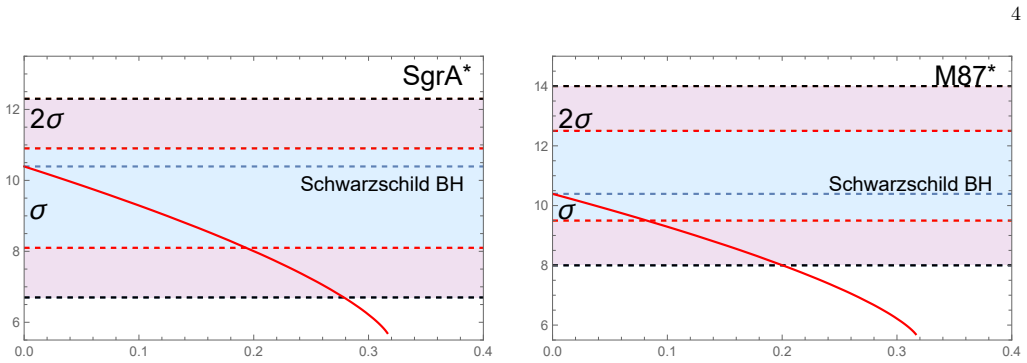
- Observational constraints on a are obtained at 1 sigma and 2 sigma confidence levels from M87* and Sgr A*.
- The redshift factor distribution and received radiation flux depend on both a and the observer viewing angle.
- Larger a produces a bigger effective radiation region and more pronounced image distortions.
Where Pith is reading between the lines
- This model offers a way to test dark matter halo effects on black hole accretion using high-resolution imaging.
- Similar analyses could be applied to other density profiles to see if the radiation enhancement is generic.
- Future observations with improved resolution may detect the predicted increase in asymmetry with a.
- The approach could be generalized to spinning black holes for more realistic comparisons with astrophysical data.
Load-bearing premise
The Dehnen-based metric solves Einstein's equations with the chosen matter distribution and the Page-Thorne thin disk model remains valid without modification in this regular spacetime.
What would settle it
Detection of accretion disk emission or image asymmetry in M87* or Sgr A* showing no increase or a decrease with larger halo parameter a would contradict the paper's central result.
Figures


read the original abstract
We investigate the shadow, timelike geodesic structure, radiation properties of thin accretion disks, and optical appearance of a static spherically symmetric regular black hole, constructed based on the Dehnen-type density profile. Using observational data from M87* and Sgr A*, we constrain the model parameter $a$ at both $1\sigma$ and $2\sigma$ confidence levels. Based on the Page--Thorne model, we calculate the local radiative flux, redshift factor distribution, and the radiation flux received by a distant observer, systematically examining the effects of the parameter $a$ and the viewing angle on the black hole image. The results show that larger $a$ will enlarge the effective radiation area of the accretion disk and significantly enhance the asymmetry and Doppler boosting effects of the direct and secondary images at large viewing angles.
Editorial analysis
A structured set of objections, weighed in public.
Referee Report
Summary. The manuscript constructs a static spherically symmetric regular black hole metric from a Dehnen-type dark matter halo density profile, constrains the free parameter a using EHT shadow data for M87* and Sgr A* at 1σ and 2σ, and then computes thin-disk radiation quantities (local flux, redshift factor g, and distant-observer intensity) via the Page-Thorne model. It reports that larger a enlarges the effective radiating area of the disk and strengthens asymmetry plus Doppler boosting in the direct and secondary images at high inclination.
Significance. If the metric is an exact Einstein solution with the Dehnen stress-energy and the Page-Thorne expressions remain valid without re-derivation, the work supplies a concrete, observationally anchored example of dark-matter-halo modifications to accretion-disk observables. The use of real shadow constraints to bound a and the systematic variation of viewing angle are positive features that could be useful for future EHT analyses.
major comments (2)
- [Radiation properties / Page-Thorne flux calculation] Radiation properties section (the calculations of local flux F(r), redshift g, and observed intensity): the paper applies the standard Page-Thorne formula F(r) = (Ṁ/4πr) (−Ω,r/(E−ΩL),r) directly to the new metric function f(r). However, the orbital frequency Ω(r), specific energy E(r), and angular momentum L(r) for circular timelike geodesics are not re-derived from the geodesic equation or effective potential in the Dehnen-embedded spacetime; the Schwarzschild expressions appear to be retained. Because these conserved quantities change with f(r), the claimed dependence of radiation area and Doppler boosting on a is not guaranteed to be physical.
- [Metric construction] Metric construction section: the spacetime is described as 'constructed based on' the Dehnen density profile, yet no explicit verification is given that the resulting f(r) satisfies the Einstein equations with the stress-energy tensor obtained from that density (plus any regularization term). This is load-bearing for the central claim because all subsequent geodesic and radiative results presuppose a valid solution of the field equations.
minor comments (2)
- [Abstract and §1] The abstract and introduction should state explicitly whether the Dehnen halo is treated as an exact solution or an approximate embedding; the current phrasing leaves the status of the matter content ambiguous.
- [Observational constraints and results] Error propagation from the 1σ/2σ bounds on a into the flux and image quantities is not detailed; adding a brief propagation or Monte-Carlo assessment would strengthen the quantitative claims.
Simulated Author's Rebuttal
We thank the referee for the careful and constructive report. We address each major comment below and will revise the manuscript accordingly to improve clarity and rigor.
read point-by-point responses
-
Referee: Radiation properties / Page-Thorne flux calculation: the paper applies the standard Page-Thorne formula F(r) = (Ṁ/4πr) (−Ω,r/(E−ΩL),r) directly to the new metric function f(r). However, the orbital frequency Ω(r), specific energy E(r), and angular momentum L(r) for circular timelike geodesics are not re-derived from the geodesic equation or effective potential in the Dehnen-embedded spacetime; the Schwarzschild expressions appear to be retained. Because these conserved quantities change with f(r), the claimed dependence of radiation area and Doppler boosting on a is not guaranteed to be physical.
Authors: We appreciate the referee highlighting this point. The expressions for Ω(r), E(r), and L(r) in the manuscript were obtained from the general geodesic equations and effective potential for the static spherically symmetric line element with the given f(r), following the standard procedure used for non-Schwarzschild metrics in the literature. These quantities are functions of f(r) and its derivatives and therefore incorporate the effects of the Dehnen halo parameter a. Nevertheless, to eliminate any possible ambiguity, we will add an explicit derivation of Ω, E, and L from the effective potential in the revised version, together with the resulting Page–Thorne flux formula expressed in terms of the model-specific f(r). revision: yes
-
Referee: Metric construction: the spacetime is described as 'constructed based on' the Dehnen density profile, yet no explicit verification is given that the resulting f(r) satisfies the Einstein equations with the stress-energy tensor obtained from that density (plus any regularization term). This is load-bearing for the central claim because all subsequent geodesic and radiative results presuppose a valid solution of the field equations.
Authors: We agree that an explicit verification strengthens the foundation of the work. The metric function f(r) was obtained by solving the Einstein equations with the Dehnen-type density as the matter source together with a regularization term that ensures regularity. In the revised manuscript we will include a short calculation (or appendix) that substitutes the derived f(r) back into the Einstein tensor and confirms consistency with the stress-energy tensor constructed from the given density profile. revision: yes
Circularity Check
No significant circularity in derivation chain
full rationale
The paper first constructs the regular black hole metric from the Dehnen density profile, then uses M87* and Sgr A* data to constrain the parameter a at 1σ/2σ levels, and finally computes local flux, redshift, and observed intensity via the Page-Thorne thin-disk expressions while varying a and viewing angle. The reported dependence of radiation area and Doppler boosting on larger a follows directly from these explicit calculations rather than reducing to the observational constraints by construction. No self-definitional loops, fitted inputs renamed as predictions, or load-bearing self-citations appear in the described steps; the central claims retain independent content from the geodesic and radiative transfer computations.
Axiom & Free-Parameter Ledger
free parameters (1)
- a
axioms (2)
- domain assumption Einstein's equations are solved by the constructed static spherically symmetric metric with Dehnen-type matter
- domain assumption Page-Thorne thin accretion disk model applies without modification
invented entities (1)
-
regular black hole embedded in Dehnen-type dark matter halo
no independent evidence
Reference graph
Works this paper leans on
-
[1]
Regular black holes: A short topic review,
C. Lan, H. Yang, Y. Guo, and Y.-G. Miao, “Regular black holes: A short topic review,”Int. J. Theor. Phys., vol. 62, p. 202, 2023
work page 2023
-
[2]
S. Ansoldi, “Spherical black holes with regular center: A Review of existing models including a recent realization with Gaussian sources,”arXiv e-prints, 2008. Invited review at Conference on Black Holes and Naked Singu- larities
work page 2008
-
[3]
Bambi, ed.,Regular Black Holes: Towards a New Paradigm of Gravitational Collapse
C. Bambi, ed.,Regular Black Holes: Towards a New Paradigm of Gravitational Collapse. Springer Series in Astrophysics and Cosmology, Springer, 2023
work page 2023
-
[4]
Regular Black Holes Sourced by Nonlinear Electrodynamics,
K. A. Bronnikov, “Regular Black Holes Sourced by Nonlinear Electrodynamics,” inRegular Black Holes: Towards a New Paradigm of Gravitational Collapse (C. Bambi, ed.), pp. 37–68, Springer, 2023
work page 2023
-
[5]
Regular black hole in general relativity coupled to nonlinear electrodynamics,
E. Ayon-Beato and A. Garcia, “Regular black hole in general relativity coupled to nonlinear electrodynamics,” Phys. Rev. Lett., vol. 80, pp. 5056–5059, 1998
work page 1998
-
[6]
Regular magnetic black holes and monopoles from nonlinear electrodynamics,
K. A. Bronnikov, “Regular magnetic black holes and monopoles from nonlinear electrodynamics,”Phys. Rev. D, vol. 63, p. 044005, 2001
work page 2001
-
[7]
I. Dymnikova, “Regular electrically charged vacuum structures with de Sitter centre in nonlinear electro- dynamics coupled to general relativity,”Class. Quant. Grav., vol. 21, pp. 4417–4428, 2004
work page 2004
-
[8]
Construction of regular black holes in general relativity,
Z.-Y. Fan and X. Wang, “Construction of regular black holes in general relativity,”Phys. Rev. D, vol. 94, p. 124027, 2016
work page 2016
-
[9]
E. Aydiner, E. Sucu, and ˙I. Sakallı, “Regular Magnet- ically Charged Black Holes from Nonlinear Electrody- namics: Thermodynamics, Light Deflection, and Orbital Dynamics,”Phys. Dark Univ., vol. 50, p. 102164, 2025
work page 2025
-
[10]
Z. Li, “Comment on ’Regular magnetically charged black holes from nonlinear electrodynamics: Thermodynamics, light deflection, and orbital dynamics’ by Aydiner, Sucu and Sakalli,”Phys. Dark Univ., 2026. to appear
work page 2026
-
[11]
Novel regular black holes: geometry, source and shadow,
A. Kar and S. Kar, “Novel regular black holes: geometry, source and shadow,”Gen. Rel. Grav., vol. 56, p. 56, 2024
work page 2024
-
[12]
L. Zhao, M. Tang, and Z. Xu, “Constraints on the scale parameter of regular black hole in asymptotically safe gravity from extreme mass ratio inspirals,”JCAP, vol. 10, p. 002, 2025
work page 2025
-
[13]
Testing Quantum- Corrected Black Hole Through Particle Dynamics and S2 Star Observations,
B. Saidov, B. Narzilloev, A. Abdujabbarov, I. Hussain, B. Ahmedov, C. Yuan, and C. Zhou, “Testing Quantum- Corrected Black Hole Through Particle Dynamics and S2 Star Observations,”J. High Energy Astrophys., 2025
work page 2025
-
[14]
C. Bambi and L. Modesto, “Rotating regular black holes,”Phys. Lett. B, vol. 721, pp. 329–334, 2013
work page 2013
-
[15]
B. Toshmatov and Z. Stuchl´ ık, “Rotating regular black holes,”Phys. Rev. D, vol. 95, p. 084037, 2017
work page 2017
-
[16]
Regular hairy black holes through gravitational decou- pling method,
Y. Hua, Z. Ban, T.-Y. Ren, J.-J. Yin, and R.-J. Yang, “Regular hairy black holes through gravitational decou- pling method,”Eur. Phys. J. C, vol. 86, no. 1, p. 44, 2026
work page 2026
-
[17]
Nonsingular hairy black holes by gravitational decoupling,
Y. Hua and R.-J. Yang, “Nonsingular hairy black holes by gravitational decoupling,” 12 2025
work page 2025
-
[18]
Stability of regular black holes,
M.-S. Ma and R. Zhao, “Stability of regular black holes,” Eur. Phys. J. C, vol. 83, p. 405, 2023
work page 2023
-
[19]
A Uni- versal density profile from hierarchical clustering,
J. F. Navarro, C. S. Frenk, and S. D. M. White, “A Uni- versal density profile from hierarchical clustering,”As- trophys. J., vol. 490, pp. 493–508, 1997
work page 1997
-
[20]
Particle dark mat- ter: Evidence, candidates and constraints,
G. Bertone, D. Hooper, and J. Silk, “Particle dark mat- ter: Evidence, candidates and constraints,”Phys. Rept., vol. 405, pp. 279–390, 2005
work page 2005
-
[21]
An Analytical Model for Spherical Galax- ies and Bulges,
L. Hernquist, “An Analytical Model for Spherical Galax- ies and Bulges,”Astrophys. J., vol. 356, p. 359, 1990
work page 1990
-
[22]
J. Einasto, “On the construction of a composite model of the Galaxy and the determination of the system of Galactic parameters,”Trudy Astrofizicheskogo Instituta Alma-Ata, vol. 5, pp. 87–100, 1965
work page 1965
-
[23]
Galactic models with massive corona I. Method,
U. Haud and J. Einasto, “Galactic models with massive corona I. Method,”Astron. Astrophys., vol. 223, pp. 89– 94, 1989
work page 1989
-
[24]
Metric of a Slow Rotat- ing Body with Quadrupole Moment from the Erez-Rosen Metric,
F. Frutos-Alfaro, E. Retana-Montenegro, I. Cordero- Garcia, and O. Ulloa-Esquivel, “Metric of a Slow Rotat- ing Body with Quadrupole Moment from the Erez-Rosen Metric,”Astron. Astrophys., vol. 3, no. 4, p. 40409, 2013
work page 2013
-
[25]
A Family of Potential-Density Pairs for Spherical Galaxies and Bulges,
W. Dehnen, “A Family of Potential-Density Pairs for Spherical Galaxies and Bulges,”Mon. Not. Roy. Astron. Soc., vol. 265, p. 250, 1993
work page 1993
-
[26]
Dark matter halo as a source of regular black-hole geometries,
R. A. Konoplya and A. Zhidenko, “Dark matter halo as a source of regular black-hole geometries,”Phys. Rev. D, vol. 113, no. 4, p. 043011, 2026
work page 2026
-
[27]
Black holes immersed in dark matter: En- ergy condition and sound speed,
S. Datta, “Black holes immersed in dark matter: En- ergy condition and sound speed,”Phys. Rev. D, vol. 109, no. 10, p. 104042, 2024
work page 2024
-
[28]
Solutions of the Ein- stein Equations for a Black Hole Surrounded by a Galac- tic Halo,
R. A. Konoplya and A. Zhidenko, “Solutions of the Ein- stein Equations for a Black Hole Surrounded by a Galac- tic Halo,”Astrophys. J., vol. 933, no. 2, p. 166, 2022
work page 2022
-
[29]
Quasinormal ringing and shadows of black holes and wormholes in dark matter-inspired Weyl gravity,
R. A. Konoplya, A. Khrabustovskyi, J. Kˇ r´ ıˇ z, and A. Zhi- denko, “Quasinormal ringing and shadows of black holes and wormholes in dark matter-inspired Weyl gravity,” JCAP, vol. 04, p. 062, 2025
work page 2025
-
[30]
Diverse regular spacetimes using a parametrised density profile,
A. Kar and S. Kar, “Diverse regular spacetimes using a parametrised density profile,”Eur. Phys. J. C, vol. 85, no. 7, p. 773, 2025
work page 2025
-
[31]
Circular orbits and thin accretion disk around a quantum corrected black hole,
Y.-H. Shu and J.-H. Huang, “Circular orbits and thin accretion disk around a quantum corrected black hole,” Phys. Lett. B, vol. 864, p. 139411, 2025
work page 2025
-
[32]
Possible signatures of higher dimension in thin accre- tion disk around brane world black hole,
A. Liu, T.-Y. He, M. Liu, Z.-W. Han, and R.-J. Yang, “Possible signatures of higher dimension in thin accre- tion disk around brane world black hole,”JCAP, vol. 07, p. 062, 2024
work page 2024
-
[33]
Thin accretion disks around a black hole in Einstein-Aether-scalar theory,
T.-Y. He, Z. Cai, and R.-J. Yang, “Thin accretion disks around a black hole in Einstein-Aether-scalar theory,” Eur. Phys. J. C, vol. 82, no. 11, p. 1067, 2022
work page 2022
-
[34]
Gravitational waveforms from periodic orbits around a quantum-corrected black hole,
S. Yang, Y.-P. Zhang, T. Zhu, L. Zhao, and Y.-X. Liu, “Gravitational waveforms from periodic orbits around a quantum-corrected black hole,”JCAP, vol. 01, p. 091, 2025
work page 2025
-
[35]
Optical images of the Kerr–Sen black hole and thin accretion disk,
P. Wang, S. Guo, L.-F. Li, Z.-F. Mai, B.-F. Wu, W.-H. Deng, and Q.-Q. Jiang, “Optical images of the Kerr–Sen black hole and thin accretion disk,”Eur. Phys. J. C, vol. 85, no. 7, p. 747, 2025
work page 2025
-
[36]
Thin ac- cretion disk and shadow of Kerr–Sen black hole in Einstein–Maxwell-dilaton–axion gravity,
H. Feng, R.-J. Yang, and W.-Q. Chen, “Thin ac- cretion disk and shadow of Kerr–Sen black hole in Einstein–Maxwell-dilaton–axion gravity,”Astropart. Phys., vol. 166, p. 103075, 2025
work page 2025
-
[37]
First M87 Event Horizon Telescope Results. I. The Shadow of the Supermassive Black Hole,
K. Akiyamaet al., “First M87 Event Horizon Telescope Results. I. The Shadow of the Supermassive Black Hole,” Astrophys. J. Lett., vol. 875, p. L1, 2019
work page 2019
-
[38]
First M87 Event Horizon Telescope 11 Results. II. Array and Instrumentation,
K. Akiyamaet al., “First M87 Event Horizon Telescope 11 Results. II. Array and Instrumentation,”Astrophys. J. Lett., vol. 875, no. 1, p. L2, 2019
work page 2019
-
[39]
First M87 Event Horizon Telescope Results. III. Data Processing and Calibration,
K. Akiyamaet al., “First M87 Event Horizon Telescope Results. III. Data Processing and Calibration,”Astro- phys. J. Lett., vol. 875, no. 1, p. L3, 2019
work page 2019
-
[40]
First M87 Event Horizon Telescope Results. IV. Imaging the Central Supermassive Black Hole,
K. Akiyamaet al., “First M87 Event Horizon Telescope Results. IV. Imaging the Central Supermassive Black Hole,”Astrophys. J. Lett., vol. 875, no. 1, p. L4, 2019
work page 2019
-
[41]
First M87 Event Horizon Telescope Results. V. Physical Origin of the Asymmetric Ring,
K. Akiyamaet al., “First M87 Event Horizon Telescope Results. V. Physical Origin of the Asymmetric Ring,” Astrophys. J. Lett., vol. 875, no. 1, p. L5, 2019
work page 2019
-
[42]
First M87 Event Horizon Telescope Results. VI. The Shadow and Mass of the Central Black Hole,
K. Akiyamaet al., “First M87 Event Horizon Telescope Results. VI. The Shadow and Mass of the Central Black Hole,”Astrophys. J. Lett., vol. 875, no. 1, p. L6, 2019
work page 2019
-
[43]
K. Akiyamaet al., “First Sagittarius A* Event Horizon Telescope Results. I. The Shadow of the Supermassive Black Hole in the Center of the Milky Way,”Astrophys. J. Lett., vol. 930, no. 2, p. L12, 2022
work page 2022
-
[44]
K. Akiyamaet al., “First Sagittarius A* Event Horizon Telescope Results. II. EHT and Multiwavelength Obser- vations, Data Processing, and Calibration,”Astrophys. J. Lett., vol. 930, no. 2, p. L13, 2022
work page 2022
-
[45]
K. Akiyamaet al., “First Sagittarius A* Event Horizon Telescope Results. III. Imaging of the Galactic Center Supermassive Black Hole,”Astrophys. J. Lett., vol. 930, no. 2, p. L14, 2022
work page 2022
-
[46]
K. Akiyamaet al., “First Sagittarius A* Event Hori- zon Telescope Results. IV. Variability, Morphology, and Black Hole Mass,”Astrophys. J. Lett., vol. 930, no. 2, p. L15, 2022
work page 2022
-
[47]
K. Akiyamaet al., “First Sagittarius A* Event Hori- zon Telescope Results. V. Testing Astrophysical Models of the Galactic Center Black Hole,”Astrophys. J. Lett., vol. 930, no. 2, p. L16, 2022
work page 2022
-
[48]
First Sagittarius A* Event Horizon Telescope Results. VI. Testing the Black Hole Metric,
K. Akiyamaet al., “First Sagittarius A* Event Horizon Telescope Results. VI. Testing the Black Hole Metric,” Astrophys. J. Lett., vol. 930, no. 2, p. L17, 2022
work page 2022
-
[49]
Disk-Accretion onto a Black Hole. Time-Averaged Structure of Accretion Disk,
D. N. Page and K. S. Thorne, “Disk-Accretion onto a Black Hole. Time-Averaged Structure of Accretion Disk,” Astrophys. J., vol. 191, pp. 499–506, 1974
work page 1974
-
[50]
Image of a spherical black hole with thin accretion disk,
J. P. Luminet, “Image of a spherical black hole with thin accretion disk,”Astron. Astrophys., vol. 75, pp. 228–235, 1979
work page 1979
-
[51]
Circular Orbit Structure and Thin Accretion Disks around Kerr Black Holes with Scalar Hair,
L. G. Collodel, D. D. Doneva, and S. S. Yazadjiev, “Circular Orbit Structure and Thin Accretion Disks around Kerr Black Holes with Scalar Hair,”Astrophys. J., vol. 910, no. 1, p. 52, 2021
work page 2021
-
[52]
Influence of accretion disk on the optical appearance of the Kazakov-Solodukhin black hole,
Y.-X. Huang, S. Guo, Y.-H. Cui, Q.-Q. Jiang, and K. Lin, “Influence of accretion disk on the optical appearance of the Kazakov-Solodukhin black hole,”Phys. Rev. D, vol. 107, no. 12, p. 123009, 2023
work page 2023
discussion (0)
Sign in with ORCID, Apple, or X to comment. Anyone can read and Pith papers without signing in.