Discontinuous transition in 2D Potts: II. Order-Order Interface convergence
Pith reviewed 2026-05-09 20:23 UTC · model grok-4.3
The pith
At the discontinuous transition of the 2D q-state Potts model for q>4, the boundaries of the disordered layer between two ordered phases converge to a pair of non-intersecting Brownian motions.
A machine-rendered reading of the paper's core claim, the machinery that carries it, and where it could break.
Core claim
At Tc(q) for q>4 the order-order interface consists of a disordered layer whose boundaries, when scaled diffusively, converge to a pair of Brownian motions conditioned not to intersect. This convergence is obtained by extending the single-interface renewal analysis of the companion paper to a pair of interacting order-disorder interfaces and constructing an explicit coupling to non-intersecting random walks via rigorous entropic repulsion.
What carries the argument
The coupling of the pair of order-order interfaces to a pair of random walks conditioned not to intersect, constructed via entropic repulsion derived from the renewal picture for the associated Ashkin-Teller random-cluster model.
If this is right
- The same interface convergence holds for the FK percolation model at its critical point pc(q) when q>4.
- The subcritical regime T<Tc(q) exhibits no such disordered layer, so the interface behavior changes discontinuously at Tc(q).
- Surface tension exists and is positive for all q>4, extending earlier results that required q sufficiently large.
- The pair of interfaces remains separated by a positive distance on the microscopic scale while their macroscopic positions are governed by the non-intersection constraint.
Where Pith is reading between the lines
- The same coupling technique may apply to interfaces in other planar models whose random-cluster representations admit an Ornstein-Zernike renewal structure.
- The non-intersection conditioning is expected to produce a specific repulsion exponent that could be tested by measuring the typical width of the disordered layer as a function of system size.
- The result supplies a microscopic justification for treating the order-order boundary as an effective two-particle system in the scaling limit.
Load-bearing premise
The entropic repulsion between the two interfaces and the resulting coupling to conditioned random walks both rest on the renewal structure and order-disorder analysis already established for a single interface in the companion paper.
What would settle it
Numerical sampling of the scaled height difference between the two interfaces at large system size that shows positive probability of intersection in the limit would falsify the claimed convergence to non-intersecting Brownian motions.
Figures




read the original abstract
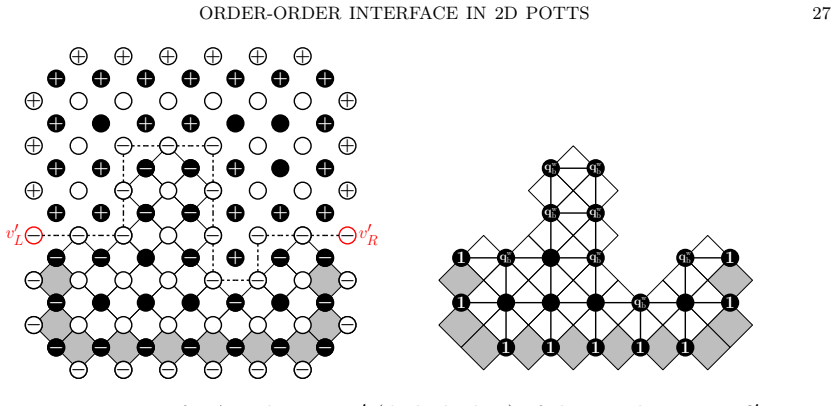
The $q$-state Potts model is an archetypical model for various types of phase transitions. We consider it on the square grid and focus on the regime where it undergoes a discontinuous transition, that is $q>4$. At the transition point $T_c(q)$, there are exactly $q+1$ extremal Gibbs measures (pure phases): $q$ ordered (monochromatic) and one disordered (free). This work establishes for the first time the wetting phenomenon in a precise geometric form and in the entire regime of discontinuity $q>4$: at $T_c(q)$, between two ordered phases a disordered layer emerges and, in the diffusive scaling, its boundaries converge to a pair of Brownian motions conditioned not to intersect. This is starkly different from the subcritical ($T<T_c(q)$) behaviour. At $T_c(q)$, previous results (Bricmont--Lebowitz '87, Messager--Miracle-Sole--Ruiz--Shlosman '91) were limited to the construction and properties of the surface tension for large enough $q$. In a companion work, arXiv:2502.04129, we provide a detailed study of the Potts model under order-disorder Dobrushin conditions. That work also develops a ``renewal picture'' \`a la Ornstein-Zernike for a suitable percolation model, which plays a central part in our study of the Potts interfaces. The latter is the random-cluster representation of an Ashkin--Teller model (ATRC), and is related to the Potts model via a chain of couplings going through the six-vertex model. In the current work, we extend the analysis to a pair of interacting order-disorder interfaces forming the separation between the two ordered phases, and couple them to a pair of well-behaved random walks conditioned not to intersect. The construction of the coupling is based on rigorously deriving entropic repulsion between the two interfaces. We also prove convergence of interfaces in the FK-percolation model at $p_c(q)$ when $q>4$.
Editorial analysis
A structured set of objections, weighed in public.
Referee Report
Summary. The paper proves that in the q-state Potts model on the square grid for q>4 at the critical temperature Tc(q), a disordered wetting layer emerges between two ordered phases. Under diffusive scaling, the boundaries of this layer converge in law to a pair of non-intersecting Brownian motions. The argument proceeds by constructing a coupling between the pair of order-disorder interfaces (under Dobrushin boundary conditions) and a pair of conditioned random walks, obtained by rigorously deriving entropic repulsion between the interfaces. The construction extends the renewal picture and Ornstein-Zernike estimates developed for the single-interface case in the companion paper arXiv:2502.04129; the same framework is also used to obtain interface convergence in the associated FK-percolation model at pc(q).
Significance. If the central coupling and scaling-limit statements hold, the result supplies the first precise geometric characterization of the wetting transition at criticality throughout the entire discontinuous regime q>4. It distinguishes the critical interface behavior from the subcritical regime and goes substantially beyond the earlier surface-tension constructions available only for large q. The rigorous derivation of entropic repulsion for the interacting pair, together with the explicit coupling to conditioned non-intersecting walks, constitutes a technical advance that may serve as a template for other multi-interface problems in planar statistical mechanics.
major comments (2)
- [§4] §4 (Entropic repulsion and coupling construction): The derivation that the single-interface renewal controls and tail bounds from the companion paper continue to hold uniformly under the additional non-intersection conditioning is not supplied in sufficient detail. Because the central claim reduces to this coupling, an explicit verification that the decoupling lemmas and Ornstein-Zernike error estimates remain valid (with constants independent of the repulsion) is required; without it the passage from the single-interface renewal picture to the pair case remains a potential gap.
- [Theorem 1.2] Theorem 1.2 (main scaling-limit statement): The statement that the rescaled interfaces converge to Brownian motions conditioned not to intersect relies on the entropic-repulsion estimates of §4. If those estimates contain q-dependent or distance-dependent error terms that are not controlled uniformly, the identification of the limiting law may fail for finite q>4; a quantitative bound on the total-variation distance to the conditioned random-walk pair should be stated explicitly.
minor comments (2)
- [Introduction] The notation for the pair of interfaces (e.g., the distinction between the upper and lower boundaries of the disordered layer) is introduced only informally in the introduction and should be fixed with a precise definition before the statement of the main theorems.
- Several references to results from the companion paper arXiv:2502.04129 are given without page or theorem numbers; adding explicit citations would improve readability.
Simulated Author's Rebuttal
We thank the referee for the detailed and constructive report. The two major comments both concern the uniformity and explicitness of the entropic-repulsion estimates in §4 and their consequences for the scaling limit in Theorem 1.2. We address each point below and will revise the manuscript accordingly.
read point-by-point responses
-
Referee: [§4] §4 (Entropic repulsion and coupling construction): The derivation that the single-interface renewal controls and tail bounds from the companion paper continue to hold uniformly under the additional non-intersection conditioning is not supplied in sufficient detail. Because the central claim reduces to this coupling, an explicit verification that the decoupling lemmas and Ornstein-Zernike error estimates remain valid (with constants independent of the repulsion) is required; without it the passage from the single-interface renewal picture to the pair case remains a potential gap.
Authors: We agree that the passage from the single-interface renewal picture to the interacting pair requires an explicit uniformity statement. In the current draft the argument proceeds by first establishing exponential decay of the intersection probability (via the surface-tension lower bound and the renewal decomposition of the companion paper), then conditioning on non-intersection and verifying that the resulting measure still satisfies the same Ornstein-Zernike tail estimates. The constants are independent of the repulsion distance because the error terms in the decoupling lemmas depend only on the macroscopic separation, which is guaranteed once the entropic-repulsion bound is in force. Nevertheless, the verification is currently condensed into a single paragraph. We will expand §4 with a dedicated subsection that isolates the application of each decoupling lemma under the conditioned measure and states the resulting uniform bounds explicitly. revision: yes
-
Referee: [Theorem 1.2] Theorem 1.2 (main scaling-limit statement): The statement that the rescaled interfaces converge to Brownian motions conditioned not to intersect relies on the entropic-repulsion estimates of §4. If those estimates contain q-dependent or distance-dependent error terms that are not controlled uniformly, the identification of the limiting law may fail for finite q>4; a quantitative bound on the total-variation distance to the conditioned random-walk pair should be stated explicitly.
Authors: The proof of Theorem 1.2 obtains the scaling limit by coupling the pair of interfaces to a pair of conditioned random walks on an event whose probability tends to 1 under diffusive scaling; the coupling error is controlled by the same uniform tail bounds derived in §4. Because the error terms are polynomial in the inverse scaling parameter and the constants are independent of q (for q>4 fixed), the total-variation distance to the limiting conditioned random-walk law vanishes. We will add an explicit statement of this quantitative bound (including the dependence on the scaling parameter) immediately after the statement of Theorem 1.2, together with a short derivation from the estimates of §4. revision: yes
Circularity Check
No circularity: central convergence claim rests on explicit extension and new derivation of entropic repulsion, not reduction to companion inputs by construction
full rationale
The paper cites its companion arXiv:2502.04129 for the single-interface renewal picture and order-disorder analysis under Dobrushin conditions, but states that the present work extends this framework to the interacting pair by deriving entropic repulsion and constructing the coupling to conditioned non-intersecting random walks. No equation or claim in the abstract or described derivation reduces the wetting convergence result to a self-definition, fitted parameter, or unverified self-citation chain; the new repulsion estimates and interface convergence are presented as independent content. The companion is treated as prior input rather than the sole justification for the pair case, satisfying the criteria for a self-contained derivation chain.
Axiom & Free-Parameter Ledger
axioms (2)
- domain assumption The q-state Potts model on the square grid possesses exactly q+1 extremal Gibbs measures at T_c(q) for q>4 (q ordered monochromatic phases and one disordered phase).
- standard math The random-cluster representation and associated percolation tools admit couplings to random walks under diffusive scaling.
Reference graph
Works this paper leans on
-
[1]
Yacine Aoun, Moritz Dober, and Alexander Glazman, Phase diagram of the A shkin-- T eller model , Communications in Mathematical Physics 405 (2024), no. 2, 37
2024
-
[2]
Y. Aoun, S. Ott, and Y. Velenik, Ornstein-- Z ernike behavior for I sing models with infinite-range interactions , Annales de l'Institut Henri Poincare (B) Probabilites et statistiques 60 (2024), no. 1, 167--207
2024
-
[3]
Ashkin and E
J. Ashkin and E. Teller, Statistics of two-dimensional lattices with four components, Physical Review 64 (1943), no. 5-6, 178--184
1943
-
[4]
Beffara and H
V. Beffara and H. Duminil-Copin , Smirnov's fermionic observable away from criticality, Ann. Probab. 40 (2012), no. 6, 2667--2689. 3050513
2012
-
[5]
u rg Fr \
Jean Bricmont, A El Mellouki, and J \"u rg Fr \"o hlich, Random surfaces in statistical mechanics: R oughening, rounding, wetting,... , Journal of statistical physics 42 (1986), no. 5, 743--798
1986
-
[6]
3, 397--406
R J Baxter, S B Kelland, and F Y Wu, Equivalence of the P otts model or W hitney polynomial with an ice-type model , Journal of Physics A: Mathematical and General 9 (1976), no. 3, 397--406
1976
-
[7]
Bricmont and J
J. Bricmont and J. L. Lebowitz, Wetting in P otts and B lume- C apel models , J. Statist. Phys. 46 (1987), no. 5-6, 1015--1029. 893130
1987
-
[8]
Massimo Campanino, Dmitry Ioffe, and Yvan Velenik, Fluctuation theory of connectivities for subcritical random cluster models, Ann. Probab. 36 (2008), no. 4, 1287--1321. 2435850 (2009m:60228)
2008
-
[9]
Lucas D Alimonte, Entropic repulsion and scaling limit for a finite number of non-intersecting subcritical FK interfaces , Electronic Journal of Probability 29 (2024), 1--53
2024
-
[10]
Hugo Duminil-Copin, Lectures on the I sing and P otts models on the hypercubic lattice , PIMS-CRM Summer School in Probability, Springer, 2017, pp. 35--161
2017
-
[11]
1, 45--60
Jo \"e l De Coninck, Alain Messager, Salvador Miracle-Sole, and Jean Ruiz, A study of perfect wetting for P otts and B lume- C apel models with correlation inequalities , Journal of statistical physics 52 (1988), no. 1, 45--60
1988
-
[12]
54, SOC Mathematique France, 2021, pp
Hugo Duminil-Copin , Maxime Gagnebin, Matan Harel, Ioan Manolescu, and Vincent Tassion, Discontinuity of the phase transition for the planar random-cluster and P otts models with q>4 , Annales Scientifiques de l'Ecole Normale Sup \'e rieure, vol. 54, SOC Mathematique France, 2021, pp. 1363--1413
2021
-
[13]
Discontinuous transition in 2D Potts: I. Order-Disorder Interface convergence
M. Dober, A. Glazman, and S. Ott, Discontinuous transition in 2D P otts: I. O rder- D isorder I nterface convergence , arXiv preprint arXiv:2502.04129 (2025)
work page internal anchor Pith review Pith/arXiv arXiv 2025
-
[14]
13, 9204
S Dietrich and A Latz, Classification of interfacial wetting behavior in binary liquid mixtures, Physical Review B 40 (1989), no. 13, 9204
1989
-
[15]
Bernard Derrida and M Schick, Interfacial wetting in the q-state P otts model , Journal of physics A: mathematical and general 19 (1986), no. 8, 1439
1986
-
[16]
Hugo Duminil-Copin , Vladas Sidoravicius, and Vincent Tassion, Continuity of the phase transition for planar random-cluster and P otts models with 1 q 4 , Comm. Math. Phys. 349 (2017), no. 1, 47--107
2017
-
[17]
3, 992--1044
Denis Denisov and Vitali Wachtel, Random walks in cones, Annals of probability 43 (2015), no. 3, 992--1044
2015
-
[18]
7, 3920--3942
Jetlir Duraj and Vitali Wachtel, Invariance principles for random walks in cones, Stochastic processes and their applications 130 (2020), no. 7, 3920--3942
2020
-
[19]
Edwards and Alan D
Robert G. Edwards and Alan D. Sokal, Generalization of the F ortuin- K asteleyn- S wendsen- W ang representation and M onte C arlo algorithm , Phys. Rev. D (3) 38 (1988), no. 6, 2009--2012. 965465
1988
-
[20]
Fan, On critical properties of the A shkin- T eller model , Physics Letters A 39 (1972), no
C. Fan, On critical properties of the A shkin- T eller model , Physics Letters A 39 (1972), no. 2, 136
1972
-
[21]
Chungpeng Fan, Remarks on the eight-vertex model and the ashkin-teller model of lattice statistics, Phys. Rev. Lett. 29 (1972), 158--160
1972
-
[22]
2, John Wiley & Sons, 1991
William Feller, An introduction to probability theory and its applications, volume 2, vol. 2, John Wiley & Sons, 1991
1991
-
[23]
C. M. Fortuin and P. W. Kasteleyn, On the random-cluster model. I . I ntroduction and relation to other models , Physica 57 (1972), 536--564
1972
- [24]
-
[25]
2, 209--256
Alexander Glazman and Ioan Manolescu, Structure of G ibbs measures for planar FK -percolation and P otts models , Probability and Mathematical Physics 4 (2023), no. 2, 209--256
2023
-
[26]
Alexander Glazman and Ron Peled, On the transition between the disordered and antiferroelectric phases of the 6-vertex model, Electronic Journal of Probability 28 (2023), 1--53
2023
-
[27]
Grimmett, The random-cluster model, Grundlehren der Mathematischen Wissenschaften [Fundamental Principles of Mathematical Sciences], vol
G. Grimmett, The random-cluster model, Grundlehren der Mathematischen Wissenschaften [Fundamental Principles of Mathematical Sciences], vol. 333, Springer-Verlag, Berlin, 2006
2006
-
[28]
3-4, 431--476
Ostap Hryniv and Roman Koteck \`y , Surface tension and the O rnstein-- Z ernike behaviour for the 2 D B lume-- C apel model , Journal of statistical physics 106 (2002), no. 3-4, 431--476
2002
-
[29]
Richard Holley, Remarks on the FKG inequalities , Comm. Math. Phys. 36 (1974), 227--231. 0341552 (49 \#6300)
1974
-
[30]
Dmitry Ioffe, S \'e bastien Ott, Yvan Velenik, and Vitali Wachtel, Invariance principle for a potts interface along a wall, Journal of Statistical Physics 180 (2020), 832--861
2020
-
[31]
Dmitry Ioffe, Senya Shlosman, and Fabio Lucio Toninelli, Interaction versus entropic repulsion for low temperature I sing polymers , J. Stat. Phys. 158 (2015), no. 5, 1007--1050. 3313616
2015
-
[32]
Leo P. Kadanoff and Franz J. Wegner, Some critical properties of the eight-vertex model, Phys. Rev. B 4 (1971), 3989--3993, 10.1103/PhysRevB.4.3989 https://link.aps.org/doi/10.1103/PhysRevB.4.3989
-
[33]
Marcin Lis, Spins, percolation and height functions, Electronic Journal of Probability 27 (2022), 1--21
2022
-
[34]
Lahoussine Laanait, Alain Messager, Salvador Miracle-Sol\' e , Jean Ruiz, and Senya Shlosman, Interfaces in the P otts model. I . P irogov- S inai theory of the F ortuin- K asteleyn representation , Comm. Math. Phys. 140 (1991), no. 1, 81--91. 1124260
1991
-
[35]
Alain Messager, Salvador Miracle-Sol\' e , Jean Ruiz, and Senya Shlosman, Interfaces in the P otts model. II . A ntonov's rule and rigidity of the order disorder interface , Comm. Math. Phys. 140 (1991), no. 2, 275--290. 1124270
1991
-
[36]
Sebastien Ott, A new perspective on the equivalence between W eak and S trong S pacial M ixing in two dimensions , 2025
2025
-
[37]
1, 309--340
S \'e bastien Ott and Yvan Velenik, Asymptotics of even--even correlations in the I sing model , Probability Theory and Related Fields 175 (2019), no. 1, 309--340
2019
- [38]
-
[39]
12, 2680--2684
Linus Pauling, The structure and entropy of ice and of other crystals with some randomness of atomic arrangement, Journal of the American Chemical Society 57 (1935), no. 12, 2680--2684
1935
-
[40]
48(2), Cambridge Univ Press, 1952, pp
Renfrey Burnard Potts, Some generalized order-disorder transformations, Proceedings of the Cambridge Philosophical Society, vol. 48(2), Cambridge Univ Press, 1952, pp. 106--109
1952
-
[41]
Pfister and Y
C.-E. Pfister and Y. Velenik, Random-cluster representation of the A shkin- T eller model , J. Statist. Phys. 88 (1997), no. 5-6, 1295--1331. 1478070
1997
-
[42]
3, 1977--1988
Gourab Ray and Yinon Spinka, A short proof of the discontinuity of phase transition in the planar random-cluster model with q>4 , Communications in Mathematical Physics 378 (2020), no. 3, 1977--1988
2020
-
[43]
36, Birkhauser Verlag AG Viadukstrasse 40-44, PO Box 133, CH-4010 Basel, Switzerland, 1963, p
Franz Rys, \"U ber ein zweidimensionales klassisches K onfigurationsmodell , Helvetica Physica Acta, vol. 36, Birkhauser Verlag AG Viadukstrasse 40-44, PO Box 133, CH-4010 Basel, Switzerland, 1963, p. 537
1963
-
[44]
Yvan Velenik, Localization and delocalization of random interfaces
-
[45]
Wegner, D uality relation between the A shkin- T eller and the eight-vertex model , Journal of physics
F. Wegner, D uality relation between the A shkin- T eller and the eight-vertex model , Journal of physics. C, Solid state physics 5 (1972), no. 11, L131–L132
1972
-
[46]
Wu, Ising model with four-spin interactions, Phys
F.W. Wu, Ising model with four-spin interactions, Phys. Rev. B 4 (1971), 2312--2314
1971
discussion (0)
Sign in with ORCID, Apple, or X to comment. Anyone can read and Pith papers without signing in.