Recognition: unknown
MINDS: Intertwined evolution of dust and gas in large planet-forming disks. A diversity driven by halted pebble drift?
Pith reviewed 2026-05-08 13:33 UTC · model grok-4.3
The pith
Large planet-forming disks show high acetylene-to-water ratios and silica dust when halted pebble drift traps most icy grains outside, setting inner-disk C/O near unity.
A machine-rendered reading of the paper's core claim, the machinery that carries it, and where it could break.
Core claim
High C2H2/H2O flux ratios arise in pebble-rich large disks only when approximately 95 percent of icy grains are blocked in the outer disk, the outer disk is chemically evolved, and outer gas has reached the inner disk, yielding a volatile C/O ratio close to unity; the same conditions produce silica dust by reformation at the sublimation front in gas with super-solar but sub-unity C/O, making silica a promising diagnostic of that ratio. This origin differs from the fast O-rich pebble drift invoked for very-low-mass stars, and no direct correspondence exists between outer-disk C2H/C18O and inner-disk C2H2/H2O ratios.
What carries the argument
Toy model of halted pebble drift that blocks ~95 percent of icy grains in the outer disk, allowing chemically evolved gas with near-unity C/O to reach the inner disk where it drives silica dust reformation at the silicate sublimation front.
Load-bearing premise
The model requires that roughly 95 percent of icy grains remain blocked in the outer disk, the outer disk reaches chemical equilibrium, and its gas migrates inward on the available timescale.
What would settle it
Observation of a high C2H2/H2O flux ratio in a disk lacking any silica dust feature, or a direct inner-disk C/O measurement far from unity in one of the high-ratio sources.
Figures



read the original abstract
(Abridged) We aim to investigate the inner regions of large and massive disks orbiting T Tauri stars, thought to be progenitors of systems with wide-orbit planets and possible cases of halted pebble drift. We analyze the MIRI spectra of three disks from the MINDS program: V1094 Sco, DL Tau, and IM Lup. The spectra reveal a striking diversity. V1094 Sco and DL Tau exhibit the highest C$_2$H$_2$/H$_2$O flux ratio in the MINDS sample of T Tauri disks. In V1094 Sco, even cold C$_4$H$_2$ is seen. In contrast, the IM Lup spectrum is dominated by O-bearing species. No one-to-one correspondence is found between the gas in the outer disk, as traced by the C$_2$H/C$^{18}$O flux ratio, and that of the inner disk as traced by the C$_2$H$_2$/H$_2$O flux ratio. To explain these results, we propose a scenario based on a toy model of halted pebble drift. We show that a volatile C/O ratio close to unity and low C and O abundances in inner disks arise only if: (1) ~95$\%$ of the icy grains are blocked in the outer disk, (2) the outer disk is chemically evolved, and (3) the gas in the outer disk has had time to reach the inner disk. DL Tau and perhaps V1094 Sco would be the rare examples for which all these conditions are met. Therefore, a high C$_2$H$_2$/H$_2$O flux ratio in pebble-rich disks would have a different origin than proposed for very-low mass stars, for which fast drift of O-rich pebbles would eventually leave a C-rich inner disk. We also show for the first time that the disks with high C$_2$H$_2$/H$_2$O flux ratio exhibit a prominent silica dust component, a result found in four disks published so far (V1094 Sco, DL Tau, CY Tau, DoAr 33). We propose that the reformation of dust at the sublimation front of silicates in a gas with super-solar (but below unity) C/O ratio leads to a silica stoichiometry (SiO$_2$). In turn, silica is a promising diagnostic of the C/O ratio in the inner disks.
Editorial analysis
A structured set of objections, weighed in public.
Referee Report
Summary. The manuscript analyzes MIRI spectra of three large T Tauri disks (V1094 Sco, DL Tau, IM Lup) from the MINDS program, documenting striking diversity in inner-disk molecular emission: V1094 Sco and DL Tau show the highest C₂H₂/H₂O flux ratios in the sample (with cold C₄H₂ also detected in V1094 Sco), while IM Lup is O-dominated. No one-to-one link is found between outer-disk (C₂H/C¹⁸O) and inner-disk tracers. The authors advance a toy model of halted pebble drift requiring ~95% blocking of icy grains, chemically evolved outer-disk gas with C/O near unity, and sufficient migration time; only DL Tau (and possibly V1094 Sco) satisfy all three. They further report prominent silica dust features in the high-ratio disks and propose silica as a diagnostic of inner-disk C/O.
Significance. The observational results clearly establish spectral diversity among large, massive disks and identify silica as a recurring feature in high C₂H₂/H₂O sources (now four disks total). If the halted-drift scenario can be placed on independent observational footing, it would offer a distinct pathway for producing carbon-rich inner disks in pebble-rich systems, separate from the fast-drift mechanism invoked for very-low-mass stars, with direct implications for the initial conditions of wide-orbit planet formation. The work also supplies a falsifiable prediction that only a small subset of large disks should exhibit the observed combination of high C₂H₂/H₂O and silica.
major comments (3)
- [§5] §5 (halted pebble drift toy model): The requirement that ~95% of icy grains must be blocked is introduced as a necessary condition for producing the observed high C₂H₂/H₂O ratios and low absolute abundances, yet the value is selected to reproduce the MIRI flux ratios rather than being fixed a priori by the ALMA dust radial profiles, total dust mass, or depletion timescales reported for these disks.
- [§5] §5, paragraph on condition satisfaction: The assertion that 'DL Tau and perhaps V1094 Sco would be the rare examples for which all these conditions are met' is reached by matching the three model requirements (95% blocking, evolved outer chemistry, migration time) to the same inner-disk flux ratios being explained; no independent probability calculation or Monte Carlo sampling over plausible ranges of blocking fraction and migration timescale is provided.
- [Discussion] Discussion of silica (final paragraph): The claim that silica (SiO₂) forms via dust reformation at the silicate sublimation front in gas with super-solar but sub-unity C/O is presented without a quantitative chemical network or reference to prior calculations that would predict the resulting stoichiometry under the stated C/O conditions.
minor comments (2)
- [Abstract] The abstract states that silica is seen in 'four disks published so far'; the main text should explicitly list which four (including literature sources) and confirm whether all exhibit the same high C₂H₂/H₂O ratio.
- [Figures] Figure captions for the MIRI spectra should include the exact wavelength ranges and line identifications used to measure the C₂H₂/H₂O flux ratios.
Simulated Author's Rebuttal
We thank the referee for the constructive comments on our manuscript. We address each major point below and have revised the text to improve clarity on the toy model parameters, avoid any implication of circular reasoning, and strengthen the silica discussion with additional references.
read point-by-point responses
-
Referee: [§5] §5 (halted pebble drift toy model): The requirement that ~95% of icy grains must be blocked is introduced as a necessary condition for producing the observed high C₂H₂/H₂O ratios and low absolute abundances, yet the value is selected to reproduce the MIRI flux ratios rather than being fixed a priori by the ALMA dust radial profiles, total dust mass, or depletion timescales reported for these disks.
Authors: The 95% blocking fraction is the minimum value required in the toy model to achieve C/O near unity and the observed depletion levels given the outer-disk dust masses and radial profiles from ALMA. We have revised §5 to state explicitly that this is a model-derived threshold, not a free parameter, and to compare it directly against the observed dust trapping signatures (rings and cavities) and depletion timescales in V1094 Sco and DL Tau. revision: yes
-
Referee: [§5] §5, paragraph on condition satisfaction: The assertion that 'DL Tau and perhaps V1094 Sco would be the rare examples for which all these conditions are met' is reached by matching the three model requirements (95% blocking, evolved outer chemistry, migration time) to the same inner-disk flux ratios being explained; no independent probability calculation or Monte Carlo sampling over plausible ranges of blocking fraction and migration timescale is provided.
Authors: The classification relies on independent ALMA constraints on outer-disk structure and chemistry rather than the inner MIRI ratios alone. We agree the statement is qualitative; we have revised the paragraph to present it as a hypothesis for these specific sources and added an explicit caveat that a full statistical assessment (e.g., population synthesis) would be needed to quantify rarity. revision: yes
-
Referee: [Discussion] Discussion of silica (final paragraph): The claim that silica (SiO₂) forms via dust reformation at the silicate sublimation front in gas with super-solar but sub-unity C/O is presented without a quantitative chemical network or reference to prior calculations that would predict the resulting stoichiometry under the stated C/O conditions.
Authors: The silica interpretation is observational and correlative. We have added references to prior dust-condensation calculations in disks with varying C/O and clarified that the SiO₂ stoichiometry is a proposed diagnostic rather than a fully modeled prediction. A quantitative network lies beyond the scope of this paper. revision: partial
Circularity Check
Toy model parameters (~95% pebble blocking, evolved outer chemistry, migration time) fitted to reproduce observed C₂H₂/H₂O ratios, making the 'arise only if' claim and disk identification a post-hoc fit
specific steps
-
fitted input called prediction
[Abstract]
"We show that a volatile C/O ratio close to unity and low C and O abundances in inner disks arise only if: (1) ~95% of the icy grains are blocked in the outer disk, (2) the outer disk is chemically evolved, and (3) the gas in the outer disk has had time to reach the inner disk. DL Tau and perhaps V1094 Sco would be the rare examples for which all these conditions are met."
The specific parameter values (95% blocking, chemical evolution state, and migration timescale) are introduced to make the toy model reproduce the high C₂H₂/H₂O flux ratios and low abundances seen in the MIRI spectra of V1094 Sco and DL Tau. The subsequent statement that only these two disks meet all three conditions is therefore a restatement of the fitted inputs rather than an independent derivation or prediction from external constraints.
full rationale
The paper proposes a toy model of halted pebble drift to explain the high C₂H₂/H₂O in V1094 Sco and DL Tau. The three conditions are presented as necessary for the model to yield the observed inner-disk chemistry, but their numerical values are selected to match the MIRI flux ratios rather than constrained by independent outer-disk data (ALMA dust profiles or C₂H/C¹⁸O). This reduces the central claim to a fitted scenario whose 'prediction' of which disks satisfy the conditions is equivalent to the input assumptions by construction. No self-citation chains, uniqueness theorems, or ansatz smuggling are present; the circularity is limited to the toy-model fitting step.
Axiom & Free-Parameter Ledger
free parameters (1)
- fraction of icy grains blocked
axioms (2)
- domain assumption Outer disk is chemically evolved before gas migrates inward
- domain assumption Gas from outer disk reaches inner disk on relevant timescales
Reference graph
Works this paper leans on
-
[1]
Alata, I., Cruz-Diaz, G. A., Muñoz Caro, G. M., & Dartois, E. 2014, A&A, 569, A119 Anderson, D. E., Blake, G. A., Cleeves, L. I., et al. 2021, ApJ, 909, 55 Ansdell, M., Williams, J. P., van der Marel, N., et al. 2016, ApJ, 828, 46 Antonellini, S., Kamp, I., & Waters, L. B. F. M. 2023, A&A, 672, A92 Arabhavi, A. M., Kamp, I., Henning, T., et al. 2024, Scie...
-
[2]
2017; Kalyaan et al
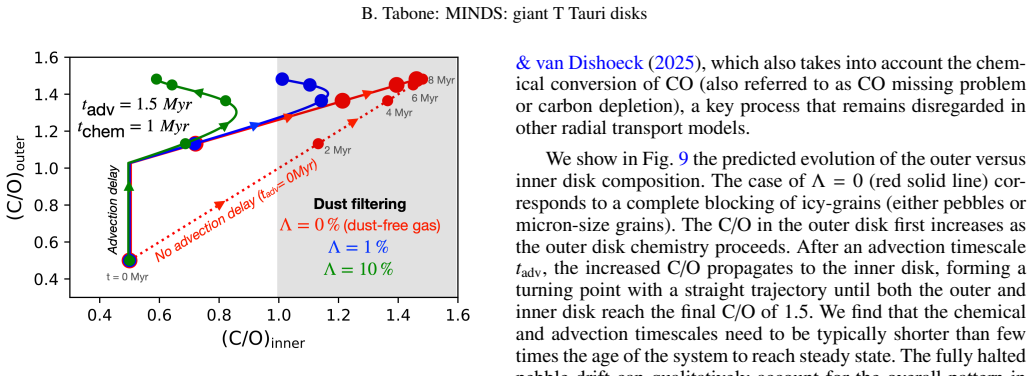
Appendix C: A toy model for radial transport in halted pebble drift 1-D models which consider the advection of gas and pebbles and include basic adsorption and desorption physics along with chemistry have been intensively developed over the past years (Booth et al. 2017; Kalyaan et al. 2021; Bosman et al. 2018a). However, they tend to neglect the CO chemi...
2017
-
[3]
and chemi- cal models (Furuya et al. 2022). We note thatt chem is only an effective chemical timescale tided to the adopted anzat of Eq (C.2) and captures the result of several processes (sublimation and desorption, vertical transport, CO chemical conversion). The (O/H) converges to (O/H)gas outer,∞ =3×10 −6, in line with the weak H2O and CO lines measure...
2022
-
[4]
Italic values correspond to optically thin emission where column density and emitting area are degenerate; uncertainties are therefore not provided
for DL Tau. Italic values correspond to optically thin emission where column density and emitting area are degenerate; uncertainties are therefore not provided. Fig. A.1: Result of the slab model fit on the 12.5-19µm region. For each source, the observed JWST spectrum is compared to the total model (red). The total emission model is further split into the...
2017
-
[5]
C.2 the (C/O) adv ratio of the advected material for various amount of icy grains assuming a gas with high C/O and various values of O/H
The O and C abundances of the advected material are then (O/H)adv =(O/H) gas outer + µO −(O/H) gas outer Λ (C/H)adv =(C/H) gas outer + µC −(C/H) gas outer Λ,(C.3) which gives a C/O ratio of of the advected material of (C/O)adv =(C/O) gas outer 1+ µC/(C/H)outergas −1 Λ 1+(µ O/(O/H)gas outer −1)Λ .(C.4) We plot in Fig. C.2 the (C/O) adv ratio of the advecte...
2019
-
[6]
C 2H(3-2) flux Ref
Source C18O(2-1) flux Ref. C 2H(3-2) flux Ref. mJy km/s mJy km/s IM Lup 1,225±120 (a) 2,448±214 (a) Sz 98 <180 (e) 1,540±51 (b) CY Tau 220±10 (c) 1,850±120 (d) DL Tau 80±10 (c) 780±50 (d) DN Tau 90±10 (c) 1,380±40 (d) IQ Tau 70±10 (c) 2,300±110 (d) CI Tau 840±30 (c) 1,890±130 (d) DR Tau 622±10 (f) 24±5 (g) (a) Miotello et al. (2019) (b) Bergner et al. (20...
2019
discussion (0)
Sign in with ORCID, Apple, or X to comment. Anyone can read and Pith papers without signing in.