Recognition: unknown
Carrier scattering considerations and thermoelectric power factors of half-Heuslers
Pith reviewed 2026-05-09 20:58 UTC · model grok-4.3
The pith
Polar optical phonon and ionized impurity scattering together set the thermoelectric power factor of half-Heusler alloys by about 65 percent on average.
A machine-rendered reading of the paper's core claim, the machinery that carries it, and where it could break.
Core claim
Using ab initio parameters for scattering rates in the relaxation-time Boltzmann transport framework applied to 13 half-Heusler compounds, the combination of polar optical phonon and ionized impurity scattering determines the thermoelectric power factor on average by about 65 percent, with non-polar phonon interactions contributing far less.
What carries the argument
The relaxation-time Boltzmann transport equation with ab initio scattering times for polar optical phonons, ionized impurities, and non-polar phonons applied to the electronic band structures of the half-Heuslers.
Load-bearing premise
The ab initio scattering parameters for polar optical phonon and ionized impurity processes accurately capture the dominant mechanisms and the relaxation-time Boltzmann transport framework remains valid across the doping and temperature ranges examined.
What would settle it
An experimental measurement of the power factor in any of the 13 alloys at room temperature that deviates strongly from the value obtained when only polar optical phonon and ionized impurity scattering are included.
Figures


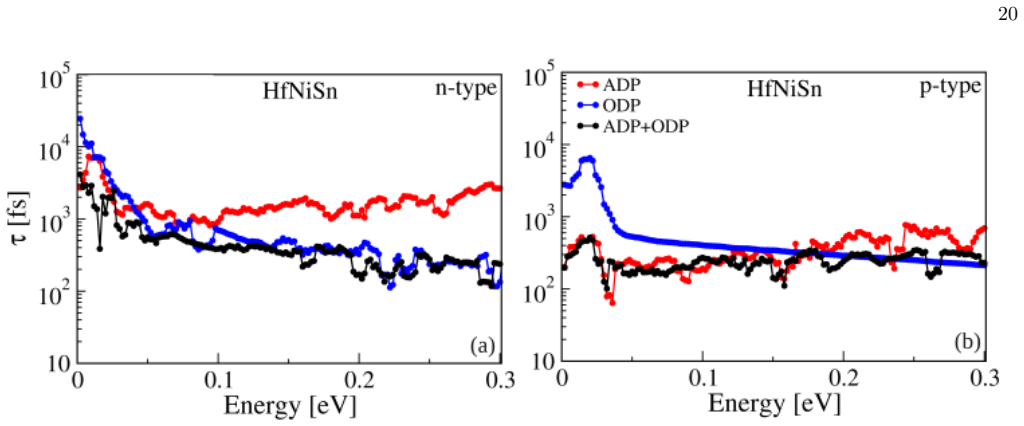


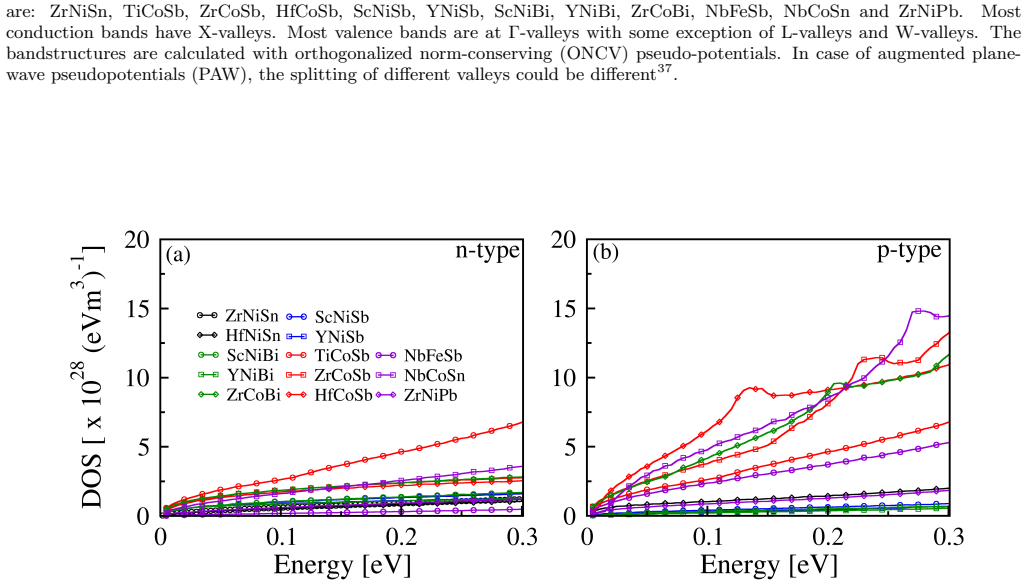


read the original abstract
The electronic and thermoelectric (TE) transport properties of 13 n-type and p-type half-Heusler alloys are computationally examined using Boltzmann transport. The electronic scattering times resulting from all relevant phonon interactions and ionized impurity scattering (IIS) are fully accounted for using ab initio extracted parameters. We find that at room temperature the average peak TE power factors (PF) of all materials we examine reside between 5 and 10 mW/mK$^2$. We also find that IIS in combination with the long range polar optical phonon (POP) scattering are more influential in determining the electronic transport and PF over all other non-polar phonon interactions (acoustic and optical phonon transport). In fact, the combination of POP and IIS determines the thermoelectric power factor of the half-Heuslers examined on average by about 65\%. The results highlight the crucial impact of Coulombic scattering process (POP and IIS) on the TE properties of half-Heusler alloys and provide profound insight for understanding transport, which can be applied widely in other complex bandstructure materials. In terms of computation expense, the computationally cheaper POP and IIS provide an acceptable first-order estimate of the power factor of these materials, while the non-polar contributions, which require more expensive ab initio calculations, could be of secondary importance.
Editorial analysis
A structured set of objections, weighed in public.
Referee Report
Summary. The manuscript computationally examines the electronic and thermoelectric transport properties of 13 n-type and p-type half-Heusler alloys using Boltzmann transport theory. Scattering times from all relevant phonon interactions and ionized impurity scattering (IIS) are incorporated via ab initio extracted parameters. The authors report that average peak power factors at room temperature lie between 5 and 10 mW/mK² and that the combination of polar optical phonon (POP) scattering and IIS determines the power factor on average by about 65%, with the remaining contribution from non-polar acoustic and optical phonons; they conclude that the computationally cheaper POP+IIS processes provide an acceptable first-order estimate.
Significance. If the central quantitative attribution holds, the work provides concrete evidence that long-range Coulombic scattering mechanisms dominate thermoelectric power factors in half-Heuslers, offering a practical route to reduce computational cost in screening complex-bandstructure materials while highlighting the limited role of short-range phonon scattering.
major comments (2)
- [Results / Computational Methods] The 65% attribution (abstract and results section) is obtained by comparing power factors computed with the full set of ab initio scattering rates versus the POP+IIS subset, all within the relaxation-time approximation. Because POP scattering is inelastic and the half-Heusler bands are multi-valley and non-parabolic, the RTA does not solve the linearized Boltzmann transport equation exactly; the resulting error in the transport integrals could be comparable in magnitude to the 35% attributed to non-polar phonons, undermining both the numerical claim and the statement that POP+IIS furnish an “acceptable first-order estimate.”
- [Results] No error bars, sensitivity analysis with respect to doping level or temperature, or direct comparison to experimental power-factor data are provided for the reported 5–10 mW/mK² range or the 65% figure, making it impossible to assess whether the quantitative conclusions are robust within the examined parameter space.
minor comments (2)
- [Abstract] The abstract states that “the average peak TE power factors … reside between 5 and 10 mW/mK²” without specifying the precise definition of “peak” (maximum versus value at a fixed carrier concentration) or the temperature at which the average is taken.
- [Methods] Notation for the scattering rates (e.g., symbols for POP, IIS, and non-polar contributions) should be introduced once in the methods section and used consistently in all figures and tables.
Simulated Author's Rebuttal
We thank the referee for the detailed and constructive review of our manuscript. We address the major comments point by point below and outline the revisions we plan to make.
read point-by-point responses
-
Referee: [Results / Computational Methods] The 65% attribution (abstract and results section) is obtained by comparing power factors computed with the full set of ab initio scattering rates versus the POP+IIS subset, all within the relaxation-time approximation. Because POP scattering is inelastic and the half-Heusler bands are multi-valley and non-parabolic, the RTA does not solve the linearized Boltzmann transport equation exactly; the resulting error in the transport integrals could be comparable in magnitude to the 35% attributed to non-polar phonons, undermining both the numerical claim and the statement that POP+IIS furnish an “acceptable first-order estimate.”
Authors: We appreciate this important observation regarding the limitations of the relaxation-time approximation (RTA). It is true that for inelastic scattering mechanisms such as polar optical phonon (POP) scattering, the RTA provides an approximate solution to the Boltzmann transport equation, and the multi-valley, non-parabolic nature of the bands in half-Heuslers can introduce additional complexities. However, since both the full scattering model and the reduced POP+IIS model are evaluated using the identical RTA implementation, the relative 65% contribution is a consistent measure of the impact of those specific scattering channels within the same methodological framework. We do not claim that RTA is exact, but rather that it is a practical and commonly employed approach for such comparative studies. To address the concern, we will revise the manuscript to include a more explicit discussion of the RTA limitations and note that the percentage is within this approximation. We believe this does not undermine the practical utility for first-order estimates, as the computational savings remain significant. revision: partial
-
Referee: [Results] No error bars, sensitivity analysis with respect to doping level or temperature, or direct comparison to experimental power-factor data are provided for the reported 5–10 mW/mK² range or the 65% figure, making it impossible to assess whether the quantitative conclusions are robust within the examined parameter space.
Authors: We agree that additional analyses would help demonstrate the robustness of our findings. In the revised manuscript, we will include sensitivity analyses showing how the power factor and the relative contribution of POP+IIS vary with carrier concentration (doping level) and temperature for selected representative materials from our set of 13 alloys. This will provide a better assessment of the stability of the 65% figure and the 5-10 mW/mK² range. Regarding direct comparison to experimental data, while our primary focus is on computational trends and the role of scattering mechanisms across multiple compounds, we will add a discussion section comparing our computed power factors to available experimental values reported in the literature for a subset of well-characterized half-Heusler materials (e.g., NbFeSb, ZrNiSn). This will help contextualize the results, although we note that experimental samples often include additional scattering from defects and grain boundaries not fully captured in our ideal crystal calculations. revision: yes
Circularity Check
No circularity: 65% PF attribution is direct output of ab initio BTE comparison
full rationale
The paper extracts scattering parameters ab initio for all mechanisms, computes power factors via Boltzmann transport under the full set versus the POP+IIS subset, and reports the average ratio as ~65%. This comparison is a post-processing step on independently computed rates; no parameter is fitted to the target PF value, no self-citation supplies the uniqueness or the numerical result, and no ansatz is imported. The derivation chain therefore remains self-contained against external benchmarks and does not reduce to its own inputs by construction.
Axiom & Free-Parameter Ledger
axioms (1)
- domain assumption The relaxation-time approximation to the Boltzmann transport equation is sufficient to describe thermoelectric transport in these half-Heusler alloys.
Reference graph
Works this paper leans on
-
[1]
Thermoelectrics: From history, a window to the future , journal =. 2019 , issn =. doi:https://doi.org/10.1016/j.mser.2018.09.001 , author =
-
[2]
2009 , issn =
Cooling, heating, generating power, and recovering waste heat with thermoelectric systems , journal =. 2009 , issn =
2009
-
[3]
Nature materials , volume=
Complex thermoelectric materials , author=. Nature materials , volume=. 2008 , publisher=
2008
-
[4]
, journal =
Recent trends and future perspectives of thermoelectric materials and their applications. , journal =. 2024 , issn =
2024
-
[5]
Physical Review B , volume=
Band alignment and scattering considerations for enhancing the thermoelectric power factor of complex materials: The case of Co-based half-Heusler alloys , author=. Physical Review B , volume=. 2019 , publisher=
2019
-
[6]
Half-Heusler topological insulators: A first-principles study with the Tran-Blaha modified Becke-Johnson density functional , author=. Phys. Rev. B , volume=. 2010 , publisher=
2010
-
[7]
Low-dimensional transport and large thermoelectric power factors in bulk semiconductors by band engineering of highly directional electronic states , author=. Phs. Rev. Lett. , volume=. 2015 , publisher=
2015
-
[8]
Cristina Artini et. al. , title =. Nanotechnology , year =
-
[9]
Advanced Functional Materials , volume =
Xiong, Qihong and Han, Guang and Wang, Guoyu and Lu, Xu and Zhou, Xiaoyuan , title =. Advanced Functional Materials , volume =. doi:https://doi.org/10.1002/adfm.202411304 , url =
-
[10]
Advanced Energy Materials , volume =
Zhu, Tiejun and Fu, Chenguang and Xie, Hanhui and Liu, Yintu and Zhao, Xinbing , title =. Advanced Energy Materials , volume =. doi:https://doi.org/10.1002/aenm.201500588 , url =
-
[11]
Kukreti, Sumit and Ramawat, Surbhi and Dixit, Ambesh , journal =. Band anisotropy and quartic anharmonicity cooperate to drive p -type thermoelectricity in the ternary diamondlike semiconductor. 2024 , month =. doi:10.1103/PhysRevB.110.245202 , url =
-
[12]
Ultralow Thermal Conductivity in Full Heusler Semiconductors , author =. Phys. Rev. Lett. , volume =. 2016 , month =. doi:10.1103/PhysRevLett.117.046602 , url =
-
[13]
Effect of boundary scattering on the thermal conductivity of TiNiSn-based half-Heusler alloys , author =. Phys. Rev. B , volume =. 2008 , month =. doi:10.1103/PhysRevB.77.184203 , url =
-
[14]
and Liu, Weishu and Opeil, Cyril P
Chen, Shuo and Lukas, Kevin C. and Liu, Weishu and Opeil, Cyril P. and Chen, Gang and Ren, Zhifeng , title =. Advanced Energy Materials , volume =. doi:https://doi.org/10.1002/aenm.201300336 , url =
-
[15]
Advanced Energy Materials , volume =
Yan, Xiao and Liu, Weishu and Chen, Shuo and Wang, Hui and Zhang, Qian and Chen, Gang and Ren, Zhifeng , title =. Advanced Energy Materials , volume =. doi:https://doi.org/10.1002/aenm.201200973 , url =
-
[16]
Jeffrey and Zhang, Wenqing , title =
Xi, Lili and Pan, Shanshan and Li, Xin and Xu, Yonglin and Ni, Jianyue and Sun, Xin and Yang, Jiong and Luo, Jun and Xi, Jinyang and Zhu, Wenhao and Li, Xinran and Jiang, Di and Dronskowski, Richard and Shi, Xun and Snyder, G. Jeffrey and Zhang, Wenqing , title =. Journal of American Chemical Society , volume =
-
[17]
Vikram and Sahni, Bhawna and Barman, C. K. and Alam, Aftab , title =. The Journal of Physical Chemistry C , volume =. 2019 , doi =
2019
-
[18]
Journal of Materials Chemistry C , volume=
A novel p-type half-Heusler from high-throughput transport and defect calculations , author=. Journal of Materials Chemistry C , volume=. 2016 , publisher=
2016
-
[19]
Nature communications , volume=
Discovery of TaFeSb-based half-Heuslers with high thermoelectric performance , author=. Nature communications , volume=. 2019 , publisher=
2019
-
[20]
ElecTra code: Full-band electronic transport properties of materials , journal =
Patrizio Graziosi and Zhen Li and Neophytos Neophytou , keywords =. ElecTra code: Full-band electronic transport properties of materials , journal =. 2023 , issue =. doi:https://doi.org/10.1016/j.cpc.2023.108670 , url =
-
[21]
Physical Review , author=
Scattering by Ionized Impurities in Semiconductors , volume=. Physical Review , author=. 1951 , pages=
1951
-
[22]
Insights into low thermal conductivity in inorganic materials for thermoelectrics , author=. J. Am. Chem. Soc , volume=. 2022 , publisher=
2022
-
[23]
sd Coupling-Induced Dynamic Off-Centering of Cu Drives High Thermoelectric Performance in TlCuS , author=. J. Am. Chem. Soc. , volume =. 2025 , publisher=
2025
-
[24]
Nature , volume=
Identification of cathode materials for lithium batteries guided by first-principles calculations , author=. Nature , volume=. 1998 , publisher=
1998
-
[25]
MRS bulletin , volume=
Toward computational materials design: the impact of density functional theory on materials research , author=. MRS bulletin , volume=. 2006 , publisher=
2006
-
[26]
Journal of Materials Science , volume=
From the computer to the laboratory: materials discovery and design using first-principles calculations , author=. Journal of Materials Science , volume=. 2012 , publisher=
2012
-
[27]
Nature Reviews Materials , volume=
Computational predictions of energy materials using density functional theory , author=. Nature Reviews Materials , volume=. 2016 , publisher=
2016
-
[28]
A code for calculating band-structure dependent quantities , author=
BoltzTraP. A code for calculating band-structure dependent quantities , author=. Computer Physics Communications , volume=. 2006 , publisher=
2006
-
[29]
Computer Physics Communications , volume=
BoltzTraP2, a program for interpolating band structures and calculating semi-classical transport coefficients , author=. Computer Physics Communications , volume=. 2018 , publisher=
2018
-
[30]
ACS Applied Energy Materials , volume=
Material descriptors for the discovery of efficient thermoelectrics , author=. ACS Applied Energy Materials , volume=. 2020 , publisher=
2020
-
[31]
Journal of Applied Physics , volume=
Impact of the scattering physics on the power factor of complex thermoelectric materials , author=. Journal of Applied Physics , volume=. 2019 , publisher=
2019
-
[32]
Physical review , volume=
Deformation potentials and mobilities in non-polar crystals , author=. Physical review , volume=. 1950 , publisher=
1950
-
[33]
Journal of Applied Physics , volume=
Band structure, deformation potentials, and carrier mobility in strained Si, Ge, and SiGe alloys , author=. Journal of Applied Physics , volume=. 1996 , publisher=
1996
-
[34]
Scientific reports , volume=
Full-scale computation for all the thermoelectric property parameters of half-Heusler compounds , author=. Scientific reports , volume=. 2016 , publisher=
2016
-
[35]
Nature communications , volume=
Efficient calculation of carrier scattering rates from first principles , author=. Nature communications , volume=. 2021 , publisher=
2021
-
[36]
Reviews of modern Physics , volume=
Phonons and related crystal properties from density-functional perturbation theory , author=. Reviews of modern Physics , volume=. 2001 , publisher=
2001
-
[37]
Physical Review B—Condensed Matter and Materials Physics , volume=
Superconductivity and electron-phonon coupling in lithium at high pressures , author=. Physical Review B—Condensed Matter and Materials Physics , volume=. 2010 , publisher=
2010
-
[38]
Computer Physics Communications , volume=
EPW: Electron--phonon coupling, transport and superconducting properties using maximally localized Wannier functions , author=. Computer Physics Communications , volume=. 2016 , publisher=
2016
-
[39]
Computer Physics Communications , volume=
Perturbo: A software package for ab initio electron--phonon interactions, charge transport and ultrafast dynamics , author=. Computer Physics Communications , volume=. 2021 , publisher=
2021
-
[40]
Advanced Energy Materials , volume=
Accelerated screening of thermoelectric materials by first-principles computations of electron--phonon scattering , author=. Advanced Energy Materials , volume=. 2018 , publisher=
2018
-
[41]
npj Computational Materials , volume=
EPIC STAR: a reliable and efficient approach for phonon-and impurity-limited charge transport calculations , author=. npj Computational Materials , volume=. 2020 , publisher=
2020
-
[42]
ACS Applied Energy Materials , volume =
Conditions for Thermoelectric Power Factor Improvements upon Band Alignment in Complex Bandstructure Materials , author=. ACS Applied Energy Materials , volume =. 2025 , publisher=
2025
-
[43]
Computer Physics Communications , volume=
ElecTra code: Full-band electronic transport properties of materials , author=. Computer Physics Communications , volume=. 2023 , publisher=
2023
-
[44]
Advanced Energy Materials , volume=
High efficiency half-Heusler thermoelectric materials for energy harvesting , author=. Advanced Energy Materials , volume=. 2015 , publisher=
2015
-
[45]
Journal of Electronic Materials , volume=
Thermoelectric and Structural Properties of Zr-/Hf-Based Half-Heusler Compounds Produced at a Large Scale , author=. Journal of Electronic Materials , volume=. 2018 , publisher=
2018
-
[46]
Proceedings of the National Academy of Sciences , volume=
Achieving high power factor and output power density in p-type half-Heuslers Nb1-xTixFeSb , author=. Proceedings of the National Academy of Sciences , volume=. 2016 , publisher=
2016
-
[47]
Materials Advances , volume=
Advances in half-Heusler alloys for thermoelectric power generation , author=. Materials Advances , volume=. 2021 , publisher=
2021
-
[48]
Chemical reviews , volume=
Rationally designing high-performance bulk thermoelectric materials , author=. Chemical reviews , volume=. 2016 , publisher=
2016
-
[49]
Advanced Energy Materials , volume=
High band degeneracy contributes to high thermoelectric performance in p-type half-Heusler compounds , author=. Advanced Energy Materials , volume=. 2014 , publisher=
2014
-
[50]
Advanced Energy Materials , volume=
Unique role of refractory Ta alloying in enhancing the figure of merit of NbFeSb thermoelectric materials , author=. Advanced Energy Materials , volume=. 2018 , publisher=
2018
-
[51]
Advanced Science , volume=
Enhancing the figure of merit of heavy-band thermoelectric materials through hierarchical phonon scattering , author=. Advanced Science , volume=. 2016 , publisher=
2016
-
[52]
Ultrahigh power factor in thermoelectric system Nb0. 95M0. 05FeSb (M= Hf, Zr, and Ti) , author=. Advanced Science , volume=. 2018 , publisher=
2018
-
[53]
Energy & Environmental Science , volume=
NbFeSb-based p-type half-Heuslers for power generation applications , author=. Energy & Environmental Science , volume=. 2014 , publisher=
2014
-
[54]
Energy & Environmental Science , volume=
Band engineering of high performance p-type FeNbSb based half-Heusler thermoelectric materials for figure of merit zT> 1 , author=. Energy & Environmental Science , volume=. 2015 , publisher=
2015
-
[55]
Journal of Alloys and Compounds , volume=
Optimized electronic performance in half-Heusler Ti-doped NbFeSb materials by stoichiometric tuning at the Fe and Sb sites , author=. Journal of Alloys and Compounds , volume=. 2022 , publisher=
2022
-
[56]
Nature communications , volume=
Realizing high figure of merit in heavy-band p-type half-Heusler thermoelectric materials , author=. Nature communications , volume=. 2015 , publisher=
2015
-
[57]
Journal of Materials Chemistry A , volume=
Synergistic defect engineering for improving n-type NbFeSb thermoelectric performance through high-throughput computations , author=. Journal of Materials Chemistry A , volume=. 2022 , publisher=
2022
-
[58]
Materials Today Physics , volume=
Enhanced thermoelectric performance in the n-type NbFeSb half-Heusler compound with heavy element Ir doping , author=. Materials Today Physics , volume=. 2019 , publisher=
2019
-
[59]
Inorganic chemistry , volume=
Structural, chemical, electrical, and thermal properties of n-type NbFeSb , author=. Inorganic chemistry , volume=. 2019 , publisher=
2019
-
[60]
Nature Communications , volume=
Large thermoelectric power factor from crystal symmetry-protected non-bonding orbital in half-Heuslers , author=. Nature Communications , volume=. 2018 , publisher=
2018
-
[61]
RSC advances , volume=
Electronic structure and thermoelectric properties of p-type half-Heusler compound NbFeSb: a first-principles study , author=. RSC advances , volume=. 2016 , publisher=
2016
-
[62]
arXiv preprint arXiv:1912.10924 , year=
Effective masses in complex band structures, a code to extract them , author=. arXiv preprint arXiv:1912.10924 , year=
-
[63]
Nano letters , volume=
Large enhancement in hole velocity and mobility in p-type [110] and [111] silicon nanowires by cross section scaling: an atomistic analysis , author=. Nano letters , volume=. 2010 , publisher=
2010
-
[64]
Physical review letters , volume=
Linear-response calculations of electron-phonon interactions , author=. Physical review letters , volume=. 1994 , publisher=
1994
-
[65]
Physical Review B , volume=
Linear-response calculation of electron-phonon coupling parameters , author=. Physical Review B , volume=. 1996 , publisher=
1996
-
[66]
Deformation potentials and electron-phonon scattering: Two new theorems , author =. Phys. Rev. B , volume =. 1984 , month =. doi:10.1103/PhysRevB.29.3341 , url =
-
[67]
Measurement Science and Technology , volume=
Fundamentals of carrier transport, 2nd edn , author=. Measurement Science and Technology , volume=
-
[68]
1996 , publisher=
Dynamical theory of crystal lattices , author=. 1996 , publisher=
1996
-
[69]
Advances in Physics , volume=
Electrons in lattice fields , author=. Advances in Physics , volume=. 1954 , publisher=
1954
-
[70]
Physical Review B , volume=
Long-range quadrupole electron-phonon interaction from first principles , author=. Physical Review B , volume=. 2020 , publisher=
2020
-
[71]
Verdi, Carla and Giustino, Feliciano , journal=. Fr. 2015 , publisher=
2015
-
[72]
npj Computational Materials , volume=
Efficient first-principles electronic transport approach to complex band structure materials: the case of n-type Mg3Sb2 , author=. npj Computational Materials , volume=. 2024 , publisher=
2024
-
[73]
Physical Review B , volume=
Deformation potential extraction and computationally efficient mobility calculations in silicon from first principles , author=. Physical Review B , volume=. 2021 , publisher=
2021
-
[74]
The Journal of Physical Chemistry C , volume=
Ultra-high thermoelectric power factors in narrow gap materials with asymmetric bands , author=. The Journal of Physical Chemistry C , volume=. 2020 , publisher=
2020
-
[75]
The Journal of Physical Chemistry Letters , volume=
Reliable prediction of new quantum materials for topological and renewable-energy applications: a high-throughput screening , author=. The Journal of Physical Chemistry Letters , volume=. 2020 , publisher=
2020
-
[76]
The Journal of Physical Chemistry C , volume=
Accelerated discovery of new 8-electron half-Heusler compounds as promising energy and topological quantum materials , author=. The Journal of Physical Chemistry C , volume=. 2019 , publisher=
2019
-
[77]
Applied Physics Letters , volume=
Bipolar conduction asymmetries lead to ultra-high thermoelectric power factor , author=. Applied Physics Letters , volume=. 2022 , publisher=
2022
-
[78]
Nature communications , volume=
When band convergence is not beneficial for thermoelectrics , author=. Nature communications , volume=. 2021 , publisher=
2021
-
[79]
npj Computational Materials , volume=
Electron--phonon physics from first principles using the EPW code , author=. npj Computational Materials , volume=. 2023 , publisher=
2023
-
[80]
Physical Review B , volume=
Towards predictive many-body calculations of phonon-limited carrier mobilities in semiconductors , author=. Physical Review B , volume=. 2018 , publisher=
2018
discussion (0)
Sign in with ORCID, Apple, or X to comment. Anyone can read and Pith papers without signing in.