Recognition: unknown
CCAT: Silicon-Platelet Feedhorns for Submillimeter Wavelengths
Pith reviewed 2026-05-08 13:39 UTC · model grok-4.3
The pith
Silicon-platelet feedhorns operate at submillimeter wavelengths up to 850 GHz and match both simulations and traditional metal feedhorns.
A machine-rendered reading of the paper's core claim, the machinery that carries it, and where it could break.
Core claim
The paper demonstrates silicon-platelet feedhorns at submillimeter wavelengths for the first time, including in the 850 GHz band that represents a threefold frequency increase over prior devices. Fabrication metrology, room-temperature beammaps, and cryogenic optical efficiency measurements with prototype detectors show that performance matches simulation and compares directly to traditional direct-machined metal feedhorns.
What carries the argument
Silicon-platelet feedhorn arrays formed by stacking and bonding photolithographically etched silicon plates to create precise horn apertures and tapers.
Load-bearing premise
Room-temperature and cryogenic laboratory measurements with prototype detectors accurately represent the on-sky performance and long-term stability of the feedhorns at submillimeter wavelengths in the actual telescope environment.
What would settle it
On-sky beam maps or optical efficiency measurements from the completed Prime-Cam instrument that deviate significantly from the reported laboratory results and simulations.
Figures
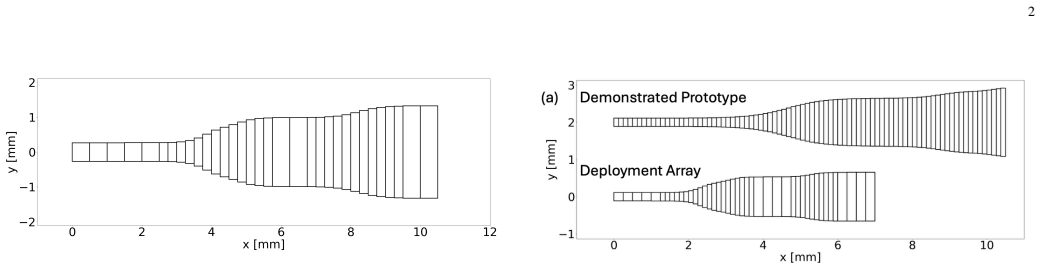


read the original abstract
Silicon-platelet feedhorn arrays are an established technology at millimeter wavelengths that, for some applications, can provide significant advantages over traditional direct-machined metal feedhorns. The Prime-Cam focal planes operating in the 350 GHz ($\sim$860 $\mathrm{\mu}$m) and 850 GHz ($\sim$350 $\mathrm{\mu}$m) bands are anticipated to carry the first silicon-platelet feedhorn arrays to operate fully at submillimeter wavelengths, representing a significant step forward in the application of this technology. In particular, the feedhorns designed for operation in the 850 GHz band represent a 3x increase in frequency compared to previously demonstrated and deployed devices of this type. Here we present a demonstration of silicon-platelet feedhorns at these submillimeter wavelengths, including in-lab performance characterization. We present fabrication metrology, room-temperature beammaps, and cryogenic optical efficiency measurements where the feedhorns are coupled to prototype CCAT Prime-Cam detectors. We show that feedhorn performance measurements are well matched to simulation and compare that performance directly to traditional, direct-machined metal feedhorns.
Editorial analysis
A structured set of objections, weighed in public.
Referee Report
Summary. The manuscript presents a laboratory demonstration of silicon-platelet feedhorn arrays for submillimeter wavelengths, specifically for the 350 GHz and 850 GHz bands of the CCAT Prime-Cam instrument. It details the fabrication process with metrology, room-temperature beam mapping, and cryogenic optical efficiency tests using prototype detectors. The key result is that the measured performance agrees well with electromagnetic simulations and is directly comparable to that of traditional direct-machined metal feedhorns.
Significance. This demonstration extends silicon-platelet technology to submillimeter frequencies, representing a threefold increase in operating frequency over prior work. Successful validation in the lab supports its potential use in large focal plane arrays for submillimeter astronomy, offering possible benefits in manufacturing scalability and performance consistency for instruments like Prime-Cam.
major comments (2)
- [Cryogenic measurements and abstract] Cryogenic optical efficiency measurements: The abstract and results claim that performance measurements are 'well matched to simulation' and allow direct comparison to metal feedhorns, but the presented data lack error bars, quantitative agreement metrics (e.g., RMS residuals or percentage differences), and details on the number of devices tested or exclusion criteria. This directly affects the verifiability of the central experimental claim.
- [Room-temperature beammaps] Room-temperature beammaps: The beammap results are stated to match simulations, yet the figures and text provide no statistical comparison or full dataset summary, making it difficult to assess the strength and reproducibility of the agreement that underpins the technology demonstration.
minor comments (2)
- [Abstract] The abstract would benefit from specifying the number of feedhorns and detectors characterized to contextualize the sample size for the reported matches.
- [Fabrication metrology] Fabrication metrology section: A summary table of measured vs. designed dimensions with tolerances would improve clarity and allow readers to evaluate fabrication precision at these small scales.
Simulated Author's Rebuttal
We thank the referee for their detailed and constructive comments on our manuscript. We have carefully considered each point and revised the paper to enhance the presentation of our experimental results.
read point-by-point responses
-
Referee: [Cryogenic measurements and abstract] Cryogenic optical efficiency measurements: The abstract and results claim that performance measurements are 'well matched to simulation' and allow direct comparison to metal feedhorns, but the presented data lack error bars, quantitative agreement metrics (e.g., RMS residuals or percentage differences), and details on the number of devices tested or exclusion criteria. This directly affects the verifiability of the central experimental claim.
Authors: We agree that including error bars, quantitative agreement metrics, and details on the number of devices tested would improve the verifiability of our central claims. In the revised manuscript, we have added error bars to the cryogenic optical efficiency data in the figures and text. We have also included quantitative metrics such as RMS residuals and percentage differences between measured and simulated efficiencies. We now specify the number of devices tested and note that no devices were excluded from the analysis. These additions allow readers to better assess the agreement with simulations and the comparison to metal feedhorns. revision: yes
-
Referee: [Room-temperature beammaps] Room-temperature beammaps: The beammap results are stated to match simulations, yet the figures and text provide no statistical comparison or full dataset summary, making it difficult to assess the strength and reproducibility of the agreement that underpins the technology demonstration.
Authors: We agree that a statistical comparison and full dataset summary would help assess the strength of the beammap agreement. In the revised manuscript, we have added a statistical comparison of the beammap results, including RMS differences between measured and simulated patterns. We have also provided a summary of the full dataset, including key parameters for all measured devices. This revision supports the reproducibility and agreement with simulations. revision: yes
Circularity Check
No significant circularity; pure experimental validation
full rationale
The paper presents fabrication metrology, room-temperature beam maps, and cryogenic optical-efficiency measurements of silicon-platelet feedhorns at submillimeter wavelengths, showing these data match independent electromagnetic simulations and allow direct comparison to separately fabricated metal feedhorns. No derivation chain, fitted parameters renamed as predictions, self-definitional equations, or load-bearing self-citations appear in the reported results. The central claims are empirical demonstrations against external benchmarks (simulations and metal-horn controls), with no reduction of outputs to inputs by construction. This is the expected outcome for a technology-demonstration manuscript.
Axiom & Free-Parameter Ledger
axioms (1)
- domain assumption Electromagnetic simulations accurately predict real-device performance at 350-850 GHz
Reference graph
Works this paper leans on
-
[1]
Corrugated silicon platelet feed horn array for CMB polarimetry at 150 GHz,
J. W. Britton, J. P. Nibarger, K. W. Yoon, J. A. Beall, D. Becker, H.-M. Cho, G. C. Hilton, J. Hubmayr, M. D. Niemack, and K. D. Irwin, “Corrugated silicon platelet feed horn array for CMB polarimetry at 150 GHz,” inSociety of Photo-Optical Instrumentation Engineers (SPIE) Conference Series, ser. Society of Photo-Optical Instrumentation Engineers (SPIE) C...
2010
-
[2]
An 84 pixel all-silicon corrugated feedhorn for cmb measurements,
J. P. Nibarger, J. A. Beall, D. Becker, J. Britton, H.-M. Cho, A. Fox, G. C. Hilton, J. Hubmayr, D. Li, J. McMahonet al., “An 84 pixel all-silicon corrugated feedhorn for cmb measurements,”Journal of Low Temperature Physics, vol. 167, no. 3-4, pp. 522–527, 2012
2012
-
[3]
The design and characterization of wideband spline-profiled feedhorns for advanced actpol,
S. M. Simon, J. Austermann, J. A. Beall, S. K. Choi, K. P. Coughlin, S. M. Duff, P. A. Gallardo, S. W. Henderson, F. B. Hills, S.-P. P. Ho et al., “The design and characterization of wideband spline-profiled feedhorns for advanced actpol,” inMillimeter, Submillimeter, and Far- Infrared Detectors and Instrumentation for Astronomy VIII, vol. 9914. SPIE, 201...
2016
-
[4]
Feedhorn development and scalability for simons observatory and beyond,
S. M. Simon, J. E. Golec, A. Ali, J. Austermann, J. A. Beall, S. M. M. Bruno, S. K. Choi, K. T. Crowley, S. Dicker, B. Doberet al., “Feedhorn development and scalability for simons observatory and beyond,” inMil- limeter, Submillimeter, and Far-Infrared Detectors and Instrumentation for Astronomy IX, vol. 10708. SPIE, 2018, pp. 1145–1156
2018
-
[5]
The Atacama Cosmology Telescope: CMB polarization at 200-l-9000,
S. Naess, M. Hasselfield, J. McMahon, M. D. Niemack, G. E. Addison, P. A. R. Ade, R. Allison, M. Amiri, N. Battaglia, J. A. Beall, F. de Bernardis, J. R. Bond, J. Britton, E. Calabrese, H.-m. Cho, K. Coughlin, D. Crichton, S. Das, R. Datta, M. J. Devlin, S. R. Dicker, J. Dunkley, R. D ¨unner, J. W. Fowler, A. E. Fox, P. Gallardo, E. Grace, M. Gralla, A. H...
2014
-
[6]
Measurements of Sub-degree B-mode 9 Polarization in the Cosmic Microwave Background from 100 Square Degrees of SPTpol Data,
R. Keisler, S. Hoover, N. Harrington, J. W. Henning, P. A. R. Ade, K. A. Aird, J. E. Austermann, J. A. Beall, A. N. Bender, B. A. Benson, L. E. Bleem, J. E. Carlstrom, C. L. Chang, H. C. Chiang, H.-M. Cho, R. Citron, T. M. Crawford, A. T. Crites, T. de Haan, M. A. Dobbs, W. Everett, J. Gallicchio, J. Gao, E. M. George, A. Gilbert, N. W. Halverson, D. Hans...
2015
-
[7]
Readout of two-kilopixel transition-edge sensor arrays for Advanced ACTPol,
S. W. Henderson, J. R. Stevens, M. Amiri, J. Austermann, J. A. Beall, S. Chaudhuri, H.-M. Cho, S. K. Choi, N. F. Cothard, K. T. Crowley, S. M. Duff, C. P. Fitzgerald, P. A. Gallardo, M. Halpern, M. Hasselfield, G. Hilton, S.-P. P. Ho, J. Hubmayr, K. D. Irwin, B. J. Koopman, D. Li, Y . Li, J. McMahon, F. Nati, M. Niemack, C. D. Reintsema, M. Salatino, A. S...
2016
-
[8]
The optical design of the litebird middle and high frequency telescope,
L. Lamagna, J. E. Gudmundsson, H. Imada, P. Hargrave, C. Franceschet, M. De Petris, J. Austermann, S. Bounissou, F. Columbro, P. de Bernardis et al., “The optical design of the litebird middle and high frequency telescope,” inSpace Telescopes and Instrumentation 2020: Optical, Infrared, and Millimeter Wave, vol. 11443. SPIE, 2020, pp. 1129– 1145
2020
-
[9]
Design of 280 ghz feedhorn-coupled tes arrays for the balloon- borne polarimeter spider,
J. Hubmayr, J. E. Austermann, J. A. Beall, D. T. Becker, S. J. Benton, A. S. Bergman, J. R. Bond, S. Bryan, S. M. Duff, A. J. Duivenvoorden et al., “Design of 280 ghz feedhorn-coupled tes arrays for the balloon- borne polarimeter spider,”arXiv preprint arXiv:1606.09396, 2016
-
[10]
Millimeter-wave polarimeters using kinetic inductance detectors for TolTEC and beyond,
J. E. Austermann, J. A. Beall, S. A. Bryan, B. Dober, J. Gao, G. Hilton, J. Hubmayr, P. Mauskopf, C. M. McKenney, S. M. Simonet al., “Millimeter-wave polarimeters using kinetic inductance detectors for TolTEC and beyond,”Journal of Low Temperature Physics, vol. 193, no. 3, pp. 120–127, 2018
2018
-
[11]
Ccat: Comparisons of 280 ghz TiN and Al kinetic inductance detector arrays,
C. J. Duell, J. Austermann, J. Beall, J. R. Burgoyne, S. C. Chapman, S. K. Choi, R. G. Freundt, J. Gao, C. Groppi, A. I. Huberet al., “Ccat: Comparisons of 280 ghz TiN and Al kinetic inductance detector arrays,” arXiv preprint arXiv:2406.06828, 2024
-
[12]
Feedhorn-coupled tes polarimeter camera modules at 150 ghz for cmb polarization mea- surements with sptpol,
J. Henning, P. Ade, K. Aird, J. Austermann, J. Beall, D. Becker, B. Benson, L. Bleem, J. Britton, J. Carlstromet al., “Feedhorn-coupled tes polarimeter camera modules at 150 ghz for cmb polarization mea- surements with sptpol,” inMillimeter, Submillimeter, and Far-Infrared Detectors and Instrumentation for Astronomy VI, vol. 8452. SPIE, 2012, pp. 986–1000
2012
-
[13]
The atacama cosmology telescope: The polarization-sensitive actpol instrument,
R. J. Thornton, P. A. R. Ade, S. Aiola, F. E. Angile, M. Amiri, J. A. Beall, D. T. Becker, H. M. Cho, S. K. Choi, P. Corlieset al., “The atacama cosmology telescope: The polarization-sensitive actpol instrument,”The Astrophysical Journal Supplement Series, vol. 227, no. 2, p. 21, 2016
2016
-
[14]
Prime-Cam: A first-light instrument for the CCAT-prime telescope,
E. M. Vavagiakis, Z. Ahmed, A. Ali, K. Basu, N. Battaglia, F. Bertoldi, R. Bond, R. Bustos, S. C. Chapman, D. Chunget al., “Prime-Cam: A first-light instrument for the CCAT-prime telescope,” inMillimeter, Submillimeter, and Far-Infrared Detectors and Instrumentation for As- tronomy IX, vol. 10708. International Society for Optics and Photonics, 2018, p. 107081U
2018
-
[15]
Ccat-prime: the fred young submillimeter telescope (fyst) final design and fabrication,
S. C. Parshley, S. Gramke, R. Higgins, J. Kronshage, K. Steeger, and K. Willmeroth, “Ccat-prime: the fred young submillimeter telescope (fyst) final design and fabrication,” inGround-based and Airborne Telescopes IX, vol. 12182. SPIE, 2022, pp. 543–550
2022
-
[16]
Characterization of high-frequency tes detectors and silicon platelet feedhorns for litebird,
S. Stevensonet al., “Characterization of high-frequency tes detectors and silicon platelet feedhorns for litebird,” inIn Prep - These Proceedings. LTD, 2025
2025
-
[17]
Conceptual design of the modular detector and readout system for the cmb-s4 survey experiment,
D. R. Barron, Z. Ahmed, J. Aguilar, A. Anderson, C. Baker, P. Barry, J. Beall, A. N. Bender, B. Benson, R. Besuneret al., “Conceptual design of the modular detector and readout system for the cmb-s4 survey experiment,”arXiv preprint arXiv:2208.02284, 2022
-
[18]
280-GHz aluminum MKID arrays for the Fred Young Submillimeter Telescope,
A. K. Vaskuri, J. D. Wheeler, J. E. Austermann, M. R. Vissers, J. A. Beall, J. Burgoyne, V . Butler, S. Chapman, S. K. Choi, A. Crites, C. J. Duell, R. Freundt, A. Huber, Z. B. Huber, J. Hubmayr, J. Imrek, B. Keller, L. Lin, A. Middleton, M. D. Niemack, T. Nikola, D. Scott, A. Sinclair, E. Smith, G. Stacey, J. Ullom, J. van Lanen, E. M. Vavagiakis, S. Wal...
-
[19]
Actpol: on-sky performance and characterization,
E. Grace, J. Beall, J. Bond, H. Cho, R. Datta, M. Devlin, R. D ¨unner, A. Fox, P. Gallardo, M. Hasselfieldet al., “Actpol: on-sky performance and characterization,” inMillimeter, Submillimeter, and Far-Infrared Detectors and Instrumentation for Astronomy VII, vol. 9153. SPIE, 2014, pp. 298–310
2014
-
[20]
Advanced ACTpol cryogenic detector arrays and readout,
S. Henderson, R. Allison, J. Austermann, T. Baildon, N. Battaglia, J. Beall, D. Becker, F. De Bernardis, J. Bond, E. Calabreseet al., “Advanced ACTpol cryogenic detector arrays and readout,”Journal of Low Temperature Physics, vol. 184, no. 3-4, pp. 772–779, 2016
2016
-
[21]
The TolTEC camera: an overview of the instrument and in-lab testing results,
G. W. Wilson, S. Abi-Saad, P. Ade, I. Aretxaga, J. Austermann, Y . Ban, J. Bardin, J. Beall, M. Berthoud, S. Bryanet al., “The TolTEC camera: an overview of the instrument and in-lab testing results,” inMillimeter, Submillimeter, and Far-Infrared Detectors and Instrumentation for As- tronomy X, vol. 11453. International Society for Optics and Photonics, 2...
2020
-
[22]
280 GHz focal plane unit design and characterization for the SPIDER-2 suborbital polarimeter,
A. Bergman, P. Ade, S. Akers, M. Amiri, J. Austermann, J. Beall, D. Becker, S. Benton, J. Bock, J. Bondet al., “280 GHz focal plane unit design and characterization for the SPIDER-2 suborbital polarimeter,” Journal of Low Temperature Physics, vol. 193, no. 5, pp. 1075–1084, 2018
2018
-
[23]
SPTpol: an instrument for CMB polarization measurements with the South Pole Telescope,
J. E. Austermann, K. A. Aird, J. A. Beall, D. Becker, A. Bender, B. A. Benson, L. E. Bleem, J. Britton, J. E. Carlstrom, C. L. Changet al., “SPTpol: an instrument for CMB polarization measurements with the South Pole Telescope,” inMillimeter, Submillimeter, and Far-Infrared Detectors and Instrumentation for Astronomy VI, vol. 8452. SPIE, 2012, pp. 393–410
2012
-
[24]
A review of metal mesh filters,
P. A. R. Ade, G. Pisano, C. Tucker, and S. Weaver, “A review of metal mesh filters,” vol. 6275, 2006, pp. 62 750U–62 750U–15. [Online]. Available: http://dx.doi.org/10.1117/12.673162
-
[25]
CCAT-prime: The 850 GHz camera for Prime-Cam on FYST,
S. Chapman, “CCAT-prime: The 850 GHz camera for Prime-Cam on FYST,” inAmerican Astronomical Society Meeting Abstracts, ser. American Astronomical Society Meeting Abstracts, vol. 55, Jan. 2023, p. 346.03
2023
-
[26]
Development of silicon micromachined waveguide filter-banks for on-chip spectrometers,
M. A. Koc, J. Austermann, J. Beall, J. Hubmayr, J. N. Ullom, M. Vissers, and J. Wheeler, “Development of silicon micromachined waveguide filter-banks for on-chip spectrometers,”IEEE Transactions on Applied Superconductivity, 2026
2026
-
[27]
The surface impedance of superconductors and normal met- als at high frequencies ii. the anomalous skin effect in normal metals,
A. Pippard, “The surface impedance of superconductors and normal met- als at high frequencies ii. the anomalous skin effect in normal metals,” Proceedings of the Royal Society of London. Series A. Mathematical and Physical Sciences, vol. 191, no. 1026, pp. 385–399, 1947
1947
-
[28]
Development of a submillimeter double-ridged waveguide ortho- mode transducer (omt) for the 385–500 ghz band,
M. Kamikura, M. Naruse, S. Asayama, N. Satou, W. Shan, and Y . Seki- moto, “Development of a submillimeter double-ridged waveguide ortho- mode transducer (omt) for the 385–500 ghz band,”Journal of Infrared, Millimeter, and Terahertz Waves, vol. 31, no. 6, pp. 697–707, 2010
2010
-
[29]
The blast observatory: A sensitivity study for far-ir balloon-borne polarimeters,
G. Coppi, S. Dicker, J. E. Aguirre, J. E. Austermann, J. A. Beall, S. E. Clark, E. G. Cox, M. J. Devlin, L. M. Fissel, N. Galitzkiet al., “The blast observatory: A sensitivity study for far-ir balloon-borne polarimeters,” Publications of the Astronomical Society of the Pacific, vol. 136, no. 3, p. 035003, 2024
2024
discussion (0)
Sign in with ORCID, Apple, or X to comment. Anyone can read and Pith papers without signing in.