Enhancing a gamified tool for UML modeling education
Pith reviewed 2026-05-08 11:16 UTC · model grok-4.3
The pith
Refactoring UMLegend to a modular architecture adds use case diagram support and eases future expansions.
A machine-rendered reading of the paper's core claim, the machinery that carries it, and where it could break.
Core claim
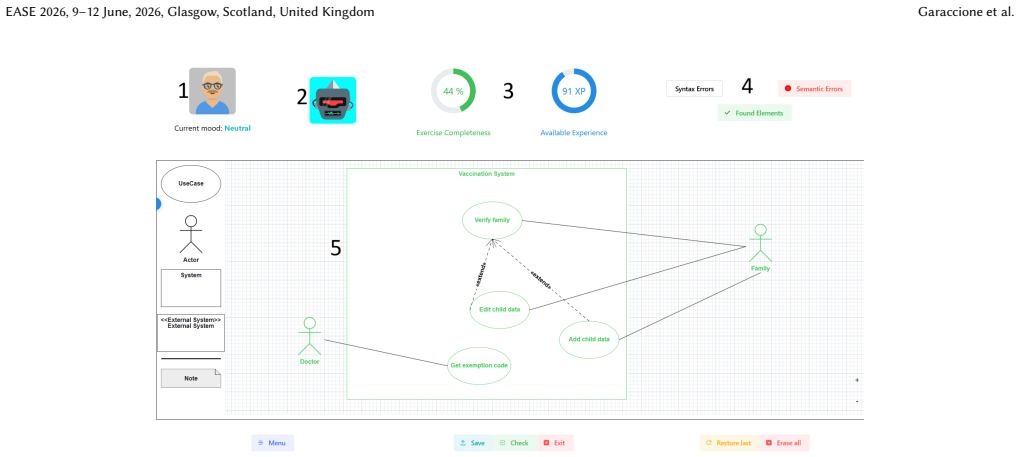
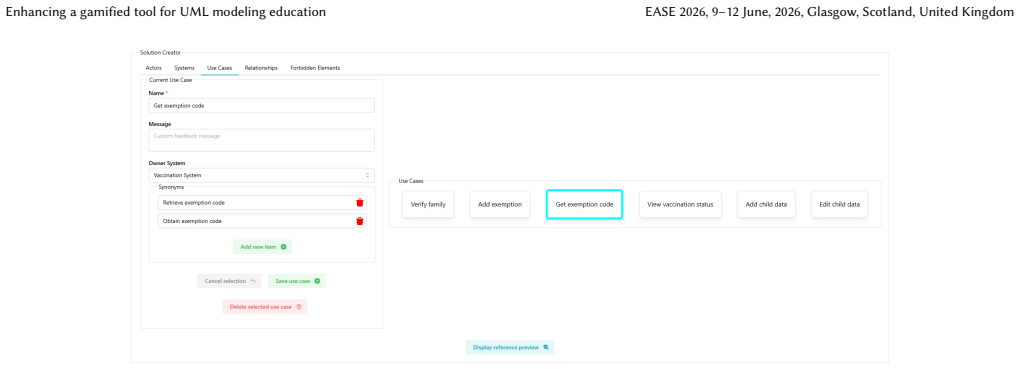
Following results from a prior experiment, UMLegend was updated by adopting a modular architecture that separates concerns across different modeling notations, enabling the addition of use case diagram exercises while retaining gamified elements such as dynamic feedback and long-term mechanics to support software engineering education.
What carries the argument
The modular architecture of the refactored UMLegend tool, which isolates components for individual notations to support easy extension to additional diagram types and topics.
If this is right
- The tool now supports exercises on both class diagrams and use case diagrams in one gamified environment.
- Future additions of modeling notations will require less development effort due to the modular separation.
- Long-term student use of the gamified mechanics is expected to produce improved performance in UML modeling tasks.
- The same architecture can be extended to cover other software engineering education topics beyond UML.
Where Pith is reading between the lines
- The modular design could lower barriers for educators to create similar gamified systems in adjacent areas like requirements gathering or software design patterns.
- A successful 2026 study might support integrating the tool into standard curricula where students practice multiple diagram types together.
- Students could develop better cross-notation understanding if the single environment encourages comparing use case and class diagram elements.
Load-bearing premise
The modular refactoring will allow addition of further notations and topics without introducing hidden complexity or maintenance issues.
What would settle it
A failed attempt to add a new notation such as sequence diagrams that requires substantial extra refactoring effort beyond the modular structure, or 2026 study results showing no measurable performance gains in students using the tool long-term.
Figures
read the original abstract
Unified Modeling Language (UML) Use Case and Class Diagrams are fundamental modeling notations in Software Engineering (SE) education due to their importance for requirements and model-based engineering, yet their relevance is underestimated by students, who tend to dismiss the topic as secondary. Gamification has been adopted to make modeling education more appealing, but existing tools focus almost exclusively on class diagrams, leaving support for use cases and other notations unexplored. In 2025, we designed UMLegend, a gamified tool for class diagrams that offered dynamic feedback to help students learn correct modeling practices and multiple long-term mechanics to increase engagement, and performed a study with the tool. With this paper, we describe how we enhanced UMLegend following the results of the experiment so that it can support more modeling languages, with use case diagrams being added to the type of available exercises in the tool. The revised version has been refactored to have a modular architecture, to make it easier to add other software engineering topics and additional modeling notations. We also describe the potential impact we expect the new version to have, and outline a longitudinal study we intend to perform in 2026 where we will assess whether long-term UML gamification leads to improved student performance.
Editorial analysis
A structured set of objections, weighed in public.
Referee Report
Summary. The manuscript is an experience report describing the enhancement of the UMLegend gamified tool for UML modeling education. Building on a 2025 study with class diagrams, the authors report refactoring the tool to a modular architecture that now supports use case diagrams as well, with the goal of facilitating addition of further software engineering topics and modeling notations; they also outline plans for a 2026 longitudinal study to evaluate long-term effects on student performance.
Significance. If the modular refactoring achieves its stated goal of simplifying extensions to new notations and topics, the work could contribute to more flexible gamified tools in software engineering education. The explicit plan for a longitudinal study is a strength, as it aims to move beyond short-term engagement metrics toward measurable performance outcomes. However, the manuscript provides only a high-level description of the changes with no technical details, examples, or validation, so any significance is prospective and contingent on the future study.
major comments (1)
- [Abstract and enhancement/refactoring description] The central claim that the tool 'has been refactored to have a modular architecture, to make it easier to add other software engineering topics and additional modeling notations' (abstract and the enhancement description section) is presented without any concrete details on the module boundaries, extension interfaces, or a worked example of adding a new notation. This detail is load-bearing for the paper's contribution as a report on the enhancement.
Simulated Author's Rebuttal
We thank the referee for the constructive feedback on our experience report. We appreciate the acknowledgment of the potential contribution of the modular refactoring and the planned longitudinal study. Below we address the major comment directly and describe the revisions we will make to strengthen the manuscript.
read point-by-point responses
-
Referee: [Abstract and enhancement/refactoring description] The central claim that the tool 'has been refactored to have a modular architecture, to make it easier to add other software engineering topics and additional modeling notations' (abstract and the enhancement description section) is presented without any concrete details on the module boundaries, extension interfaces, or a worked example of adding a new notation. This detail is load-bearing for the paper's contribution as a report on the enhancement.
Authors: We agree that the current high-level description leaves the central claim insufficiently substantiated. In the revised manuscript we will expand the enhancement section with concrete details on the module boundaries (core gamification engine, shared feedback and persistence layers, and notation-specific adapters for parsing/validation/rendering), the extension interfaces (e.g., a simple plugin contract for new diagram types), and a brief worked example showing the steps taken to integrate use-case-diagram support. These additions will remain within the scope of an experience report while directly addressing the load-bearing claim. revision: yes
Circularity Check
No circularity; purely descriptive experience report
full rationale
The manuscript is a factual account of refactoring an existing tool (UMLegend) to add use-case diagram support and a modular architecture, plus plans for a 2026 study. It contains no equations, fitted parameters, predictions, uniqueness theorems, or ansatzes. The only self-reference is a brief mention of the authors' own prior 2025 design and experiment, which serves as background rather than a load-bearing justification for any derived claim. All central statements reduce directly to the authors' reported actions and intentions, with no reduction by construction or self-citation loop.
Axiom & Free-Parameter Ledger
Reference graph
Works this paper leans on
-
[1]
Bilal Akpolat and Wolfgang Slany. 2014. Enhancing software engineering stu- dent team engagement in a high-intensity extreme programming course using gamification. 149–153. https://doi.org/10.1109/CSEET.2014.6816792
-
[2]
Manal M. Alhammad and Ana M. Moreno. 2018. Gamification in software engineering education: A systematic mapping.Journal of Systems and Software 141 (2018), 131–150. https://doi.org/10.1016/j.jss.2018.03.065
-
[3]
Antonio Bucchiarone, Maxime Savary-Leblanc, Xavier Le Pallec, Antonio Ci- cchetti, Sébastien Gérard, Simone Bassanelli, Federica Gini, and Annapaola Marconi. 2023. Gamifying model-based engineering: the PapyGame experi- ence.Software and Systems Modeling22, 4 (01 Aug 2023), 1369–1389. https: //doi.org/10.1007/s10270-023-01091-8
-
[4]
Felix Cammaerts and Monique Snoeck. 2023. ModelDefenders: A novel gamified mutation testing game for model-driven engineering. InPoEM Companion. https: //api.semanticscholar.org/CorpusID:268946614
work page 2023
-
[5]
Sergio Galvan Cruz, Mirna Muñoz, Jezreel Mejía, Adriana Peña, and David Bonilla Carranza. 2025. Experimental Evaluation of Using Gamification in Software Engineering Education in Software Requirements.CLEI Electronic Journal28, 2 (2025), 3–1
work page 2025
-
[6]
Sebastian Deterding, Dan Dixon, Rilla Khaled, and Lennart Nacke. 2011. From Game Design Elements to Gamefulness: Defining "Gamification". InProceedings of the 15th International Academic MindTrek Conference. https://doi.org/10.1145/ 2181037.2181040
-
[7]
Gordon Fraser, Alessio Gambi, Marvin Kreis, and José Miguel Rojas. 2019. Gami- fying a Software Testing Course with Code Defenders. InProceedings of the 50th ACM Technical Symposium on Computer Science Education(Minneapolis, MN, USA)(SIGCSE ’19). Association for Computing Machinery, New York, NY, USA, 571–577. https://doi.org/10.1145/3287324.3287471
-
[8]
Giacomo Garaccione, Riccardo Coppola, Luca Ardito, and Marco Torchiano. 2026. Gamification of conceptual modeling education with UML class diagrams: an experimental analysis.Software and Systems Modeling25, 1 (01 Feb 2026), 239–270. https://doi.org/10.1007/s10270-025-01282-5
-
[9]
Juho Hamari, Jonna Koivisto, and Harri Sarsa. 2014. Does Gamification Work? – A Literature Review of Empirical Studies on Gamification. InProceedings of the 47th Hawaii International Conference on System Sciences. https://doi.org/10.1109/ HICSS.2014.377
work page 2014
-
[10]
María-Blanca Ibáñez, Ángela Di-Serio, and Carlos Delgado-Kloos. 2014. Gam- ification for engaging computer science students in learning activities: A case study.IEEE Transactions on Learning Technologies7, 3 (2014), 291–301. https: //doi.org/10.1109/TLT.2014.2329293
-
[11]
Ed Júnior and Kleinner Farias. 2021. ModelGame: A Quality Model for Gamified Software Modeling Learning. InProceedings of the 15th Brazilian Symposium on Software Components, Architectures, and Reuse(Joinville, Brazil)(SBCARS ’21). Association for Computing Machinery, New York, NY, USA, 100–109. https: //doi.org/10.1145/3483899.3483910
-
[12]
Mantas Jurgelaitis. 2018. Using Gamification for Teaching UML in Information System Design Course. https://api.semanticscholar.org/CorpusID:54041007
work page 2018
-
[13]
Mantas Jurgelaitis, Lina Čeponien ˙e, Jonas Čeponis, and Vaidotas Drungi- las. 2019. Implementing gamification in a university-level UML mod- eling course: A case study.Computer Applications in Engineering Education27, 2 (2019), 332–343. https://doi.org/10.1002/cae.22077 arXiv:https://onlinelibrary.wiley.com/doi/pdf/10.1002/cae.22077
-
[14]
Frez, José Cruz-Lemus, and Marcela Genero
Beatriz Marín, J. Frez, José Cruz-Lemus, and Marcela Genero. 2018. An Empirical Investigation on the Benefits of Gamification in Programming Courses.ACM Transactions on Computing Education19 (11 2018), 1–22. https://doi.org/10.1145/ 3231709
work page 2018
-
[15]
Beatriz Marín, Felipe Larenas, and Giovanni Giachetti. 2018. Learning Conceptual Modeling Design Through the Classutopia Serious Game.International Journal of Software Engineering and Knowledge Engineering28 (11 2018), 1679–1699. https://doi.org/10.1142/S0218194018400235
-
[16]
Katie Seaborn and Deborah I. Fels. 2015. Gamification in theory and action: A survey.International Journal of Human-Computer Studies74 (2015), 14–31. https://doi.org/10.1016/j.ijhcs.2014.09.006
-
[17]
Philipp Straubinger and Gordon Fraser. 2024. Improving Testing Behavior by Gamifying IntelliJ. InProceedings of the IEEE/ACM 46th International Conference on Software Engineering(Lisbon, Portugal)(ICSE ’24). Association for Computing Machinery, New York, NY, USA, Article 49, 13 pages. https://doi.org/10.1145/ 3597503.3623339
-
[18]
Enes Yigitbas, Maximilian Schmidt, Antonio Bucchiarone, Sebastian Gottschalk, and Gregor Engels. 2024. GaMoVR: Gamification-based UML learning environ- ment in virtual reality.Science of Computer Programming231 (2024), 103029. https://doi.org/10.1016/j.scico.2023.103029
discussion (0)
Sign in with ORCID, Apple, or X to comment. Anyone can read and Pith papers without signing in.