Horizontal SCA Attacks on Binary kP Algorithms using Chevallier-Mames Atomic Blocks
Pith reviewed 2026-05-08 11:36 UTC · model grok-4.3
The pith
Binary scalar multiplication with Chevallier-Mames atomic blocks remains vulnerable to single-trace side-channel attacks
A machine-rendered reading of the paper's core claim, the machinery that carries it, and where it could break.
Core claim
The authors demonstrate through software and hardware implementations that binary right-to-left and left-to-right kP algorithms, when implemented with Chevallier-Mames atomic block patterns, are still vulnerable to single-trace SCA attacks. The vulnerability remains true for the left-to-right kP algorithm with projective coordinate randomization.
What carries the argument
Chevallier-Mames atomic block patterns, which replace variable point operations in binary kP algorithms with fixed sequences of field multiplications, additions, and inversions intended to produce indistinguishable power traces.
If this is right
- Single-trace horizontal attacks recover the scalar from both right-to-left and left-to-right versions protected by these atomic blocks.
- Projective coordinate randomization does not remove the leakage for the left-to-right algorithm.
- Both software and hardware realizations of the protected algorithms exhibit the vulnerability.
- Implementations relying solely on Chevallier-Mames atomicity require additional countermeasures.
Where Pith is reading between the lines
- Other proposed atomic patterns for elliptic-curve operations may need similar horizontal-attack testing.
- Combined use of atomic blocks with constant-time field arithmetic or masking could be checked for residual leakage.
- The attack method could be applied to scalar multiplication on other curve models or with different coordinate systems.
Load-bearing premise
The authors' software and hardware implementations correctly follow the Chevallier-Mames atomic block specification and the observed leakage generalizes beyond their specific test setups.
What would settle it
Power traces collected from a new, independent implementation of the randomized left-to-right algorithm in which the horizontal analysis method used in the paper produces no usable correlation with the scalar bits.
Figures


read the original abstract
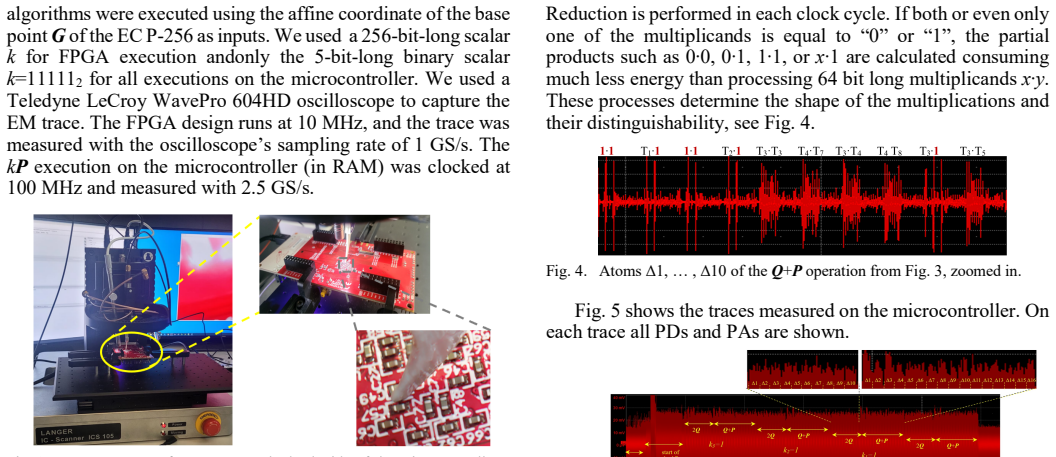
Scalar multiplication kP is the operation most frequently targeted in Elliptic Curve (EC) cryptosystems. To protect against single-trace Side-Channel Analysis (SCA) attacks, the atomicity principle and various atomic block patterns have been proposed in the past. In this work we use our software and hardware implementations to demonstrate that binary right-to left and left-to-right kP algorithms, when implemented with Chevallier-Mames atomic block patterns, are still vulnerable to single-trace SCA attacks. The vulnerability remains true for the left-to-right kP algorithm with projective coordinate randomization.
Editorial analysis
A structured set of objections, weighed in public.
Referee Report
Summary. The paper claims that binary right-to-left and left-to-right kP (scalar multiplication) algorithms on elliptic curves remain vulnerable to single-trace horizontal SCA attacks even when implemented with Chevallier-Mames atomic block patterns. The authors support this via software and hardware implementations and further assert that the vulnerability holds for the left-to-right variant under projective coordinate randomization.
Significance. If the experimental evidence is made reproducible and quantitatively robust, the result would be significant for elliptic-curve cryptography: it would demonstrate that a well-known atomicity countermeasure fails to protect standard binary kP algorithms against horizontal single-trace attacks, thereby affecting the design of secure implementations in both software and hardware.
major comments (1)
- [Abstract and experimental description] The abstract states that software and hardware implementations were used to demonstrate the attacks, but the manuscript supplies no information on trace acquisition (platforms, sampling rates, number of traces collected), the precise statistical or correlation technique applied for the single-trace horizontal attack, or any success-rate metrics. Because the central claim is an empirical demonstration rather than a derivation, these missing details are load-bearing for assessing validity and reproducibility.
minor comments (1)
- Define all acronyms (SCA, kP, EC) on first use and ensure consistent notation for atomic blocks throughout.
Simulated Author's Rebuttal
We thank the referee for the detailed review and constructive feedback. We agree that the experimental description requires substantial expansion to support reproducibility and will revise the manuscript accordingly.
read point-by-point responses
-
Referee: [Abstract and experimental description] The abstract states that software and hardware implementations were used to demonstrate the attacks, but the manuscript supplies no information on trace acquisition (platforms, sampling rates, number of traces collected), the precise statistical or correlation technique applied for the single-trace horizontal attack, or any success-rate metrics. Because the central claim is an empirical demonstration rather than a derivation, these missing details are load-bearing for assessing validity and reproducibility.
Authors: We agree that the current manuscript does not supply the requested experimental details. In the revised version we will add a dedicated experimental section that specifies: the hardware and software platforms used for trace collection, sampling rates and acquisition equipment, the total number of traces recorded per experiment, the exact statistical or correlation method applied to perform the single-trace horizontal attack (including any preprocessing steps), and quantitative success-rate figures (e.g., key-recovery rates over multiple scalar multiplications). These additions will directly address the reproducibility concern raised. revision: yes
Circularity Check
No significant circularity; experimental demonstration only
full rationale
The paper reports an empirical attack demonstration on binary kP algorithms using Chevallier-Mames atomic blocks, based on the authors' own software and hardware implementations. No derivation chain, equations, fitted parameters presented as predictions, or load-bearing self-citations appear in the provided material. The central claim rests on observed leakage traces rather than any reduction to inputs by construction, making the work self-contained as an experimental test.
Axiom & Free-Parameter Ledger
axioms (1)
- domain assumption Atomic block patterns can be implemented to enforce identical power profiles for different field operations.
Reference graph
Works this paper leans on
-
[1]
Low -cost solutions for preventing simple side -channel analysis: side- channel atomicity,
B. Chevallier -Mames, M. Ciet, and M. Joye, ‘Low -cost solutions for preventing simple side-channel analysis: side-channel atomicity’, IEEE Trans.Comput. ,vol.53, no.6, pp.760–768,Jun.2004,doi: 10.1109/TC.2004.13
-
[2]
C. H. Gebotys, ‘Security -driven exploration of cryptography in DSP cores’, in Proceedings of the 15th international symposium on System Synthesis, in ISSS ’02. New York, NY, USA: Association for Computing Machinery, Oct. 2002, pp. 80–85. doi: 10.1145/581199.581218
-
[3]
A. Bauer, et al ‘Horizontal Collision Correlation Attack on Elliptic Curves’, in Selected Areas in Cryptography -- SAC 2013, vol. 8282, T. Lange, K. Lauter, and P. Lisoněk, Eds., in L NCS, vol. 8282, Springer 2014, pp. 553–570. doi: 10.1007/978-3-662-43414-7_28
-
[4]
I. Kabin, et al. , ‘Atomicity and Regularity Principles Do Not Ensure Full Resistance of ECC Designs against Single-Trace Attacks’, Sensors, vol. 22, no. 8, Art. no. 8, Jan. 2022, doi: 10.3390/s22083083
-
[5]
A . A. Sigourou, Z. Dyka, P. Langendoerfer, and I. Kabin, ‘Atomic Patterns: Field Operation Distinguishability on Cryptographic ASICs’, in 2025 IEEE CSR, Chania, Crete, Greece: IEEE, Aug. 2025, pp. 990–995. doi: 10.1109/CSR64739.2025.11130154. [ 6] F. Rondepierre, ‘Revisiting Atomic Patterns for Scalar Multiplications on Elliptic Curves’, in Smart Card Re...
-
[6]
P. Lo nga, ‘Accelerating the Scalar Multiplication on Elliptic Curve Cryptosystems Over Prime Fields’, 2007
work page 2007
-
[7]
G. Schrock, et al. , ‘Distinguishability of EC Point Doublings and Additions in Binary kP Implementations using Chevallier -Mames Atomic Blocks’, in 2025 IEEE EWDTS, Tbilisi, Georgia: IEEE, Dec. 2025, pp. 1–6. doi: 10.1109/EWDTS67441.2025.11303708
-
[8]
Available: https://www.ti.com/tool/LAUNCHXL-F28379D
‘LAUNCHXL-F28379D Development kit | TI.com’. Available: https://www.ti.com/tool/LAUNCHXL-F28379D
-
[9]
Flecc in C. (Sep. 07, 2022). Scilab. Institute of Information Security. [ Online]. Available: https://github.com/isec-tugraz/flecc_in_c
work page 2022
-
[10]
‘Digital Signature Standard (DSS)’, National Institute of Standards and Technology (U.S.), Washington, D.C., NIST FIPS 186-5, Feb. 2023. doi: 10.6028/NIST.FIPS.186-5
-
[11]
Coron, ‘Resistance Against Differential Power Analysis For Elliptic Curve Cryptosystems’, in CHES, Ç
J.-S. Coron, ‘Resistance Against Differential Power Analysis For Elliptic Curve Cryptosystems’, in CHES, Ç. K. Koç and C. Paar, Eds., Berlin, Heidelberg: Springer,1999,pp.292–302.doi: 10.1007/3-540-48059-5_25
-
[12]
Available: https://digilent.com/shop/arty-z7-zynq-7000-soc-development-board/
‘Arty Z7: Zynq -7000 SoC Development Board’, Digilent. Available: https://digilent.com/shop/arty-z7-zynq-7000-soc-development-board/
-
[13]
‘Langer EMV - MFA-R 0.2-75, Near-Field Micro Probe 1 MHz up to 1 GHz’. Available: https://www.langer-emv.de/en/product/mfa-active-1mhz- up-to-6-ghz/32/mfa-r-0-2-75-near-field-micro-probe-1-mhz-up-to-1-ghz/854 [ 15] ‘Langer EMV - ICS 105 set, IC Scanner 4- Axis Positioning System’. Available: https://www.langer -emv.com/en/product/langer-scanner/41/ics- 10...
-
[14]
I. Kabi n, et al. , ‘Unified field multiplier for ECC: Inherent resistance against horizontal SCA attacks’, in 2018 13th DTIS, Taormina: IEEE, Apr. 2018, pp. 1–4. doi: 10.1109/DTIS.2018.8368560
-
[15]
P. L. Montgomery, ‘Speeding the Pollard and elliptic curve methods of factorization’, Math. Comput., vol. 48, no. 177, pp. 243–264, 1987, doi: 10.1090/S0025-5718-1987-0866113-7
-
[16]
J. Fan, et al., ‘State-of-the-art of secure ECC implementations: a survey on known side -channel attacks and countermeasures’, in 201 0 HOST, Anaheim, CA, USA: IEEE, Jun. 2010, pp. 76 –87. doi: 10.1109/HST.2010.5513110
-
[17]
M. Azouaoui, et al. , ‘Fast Side -Channel Security Evaluation of ECC Implementations: Shortcut Formulas for Horizontal Side -Channel Attacks Against ECSM with the Montgo mery Ladder’, in Constructive Side-Channel Analysis and Secure Design, vol. 11421, I. Polian and M. Stöttinger, Eds., in L NCS, vol. 11421. , Cham: Springer International Publishing, 2019...
-
[18]
J. Samotyja and K. Lemke-Rust, ‘Practical Results of ECC Side Channel Countermeasures on an ARM Cortex M3 Processor’, in Proceedings of the 2016 ACM Workshop on Theory of Implementation Security, Vienna Austria: ACM, Oct. 2016, pp. 27–35. doi: 10.1145/2996366.2996371
-
[19]
M. Joye and S.-M. Yen, ‘The Montgomery Powering Ladder’, in CHES 2002, B. S. Kaliski, çetin K. Koç, and C. Paar, Eds., Berlin, Heidelberg: Springer, 2003, pp. 291–302. doi: 10.1007/3-5 40-36400-5_22
work page doi:10.1007/3-5 2002
-
[20]
K. Itoh, T. Izu, and M. Takenaka, ‘Address -Bit Diff erential Power Analysis of Cryptographic Schemes OK -ECDH and OK -ECDSA’, in CHES 2002, vol. 2523, B. S. Kaliski, çetin K. Koç, and C. Paar, Eds., in LNCS, vol. 2523. , Springer Berlin Heidelberg, 2003, pp. 129–143. doi: 10.1007/3-540-36400-5_11
-
[21]
I. Kabin, Z. Dyka, D. Kreiser, and P. Langendoerfer, ‘Horizontal address- bit DPA against montgomery kP implementation’, in 2017 ReConFig, Cancun:IEEE, Dec.2017, pp.1–8.doi: 10.1109/RECONFIG.2017.8279800
-
[22]
A. A. Sigourou, I. Kabin, P. Langendörfer, N. Sklavos, and Z. Dyka , ‘ Successful Simple Side Channel Analysis: Vulnerability of an atomic pattern kP algorithm implemented with a constant time crypto library to simple electromagnetic analysis attacks’, in 2023 MECO, Jun. 2023, pp. 1–6. doi: 10.1109/MECO58584.2023.10154940
-
[23]
K. Itoh, T. Izu, and M. Takenaka, ‘A Practical Countermeasure against Address-Bit Differential Power Analysis’, in CHES 2003, C. D. Walter, Ç. K. Koç, and C. Paar, Eds., Berlin, Heidelberg: Springer, 2003, pp. 382–396. doi: 10.1007/978-3-540-45238-6_30
-
[24]
M. Izumi, et al., ‘Improved countermeasure against Address-bit DPA for ECC scalar multiplication’, inDATE 2010, Dresden: IEEE, Mar. 2010, pp. 981–984. doi: 10.1109/DATE.2010.5456907
-
[25]
L. Batina, et al., ‘Side-channel evaluation of FPGA implementations of binary Edwards curves’, in 2010 17th IEEE I CECS, Athens, Greece: IEEE, Dec. 2010, pp. 1248–
work page 2010
-
[26]
doi: 10.1109/ICECS.2010.5724745
-
[27]
N. Pirotte, J. Vliegen, L. Batina, and N. Mentens, ‘Design of a Fully Balanced ASIC Coprocess or Implementing Complete Addition Formulas on Weierstrass Elliptic Curves’, in DSD 2018, Prague: IEEE , A ug. 2018, pp. 545–552. doi: 10.1109/DSD.2018.00095
-
[28]
Randomized Addressing Countermeasures are Inefficient Against Address -Bit SCA,
I. Kabin, Z. Dyka, and P. Langendoerfer, ‘Randomized Addressing Countermeasures are Inefficient Against Address -Bit SCA’, in IEEE CSR 2023 , Venice, Italy: IEEE, Jul. 2023, pp. 580 –585. doi: 10.1109/CSR57506.2023.10224968
-
[29]
I. Kabin, et al. , ‘Breaking a fully Balanced ASIC Coprocessor Implementing Complete Addition Formulas on Weierstrass Ellipt ic Curves’, in DSD 2020, Kranj, Slovenia: IEEE, Aug. 2020, pp. 270–276. doi: 10.1109/DSD51259.2020.00051
-
[30]
I. Kabin, ‘Horizontal address -bit SCA attacks against ECC and appropriate countermeasures’, BTU Cottbus - Senftenberg, 2023. doi: 10.26127/BTUOpen-6397
-
[31]
Sze Hei Li, ‘Distinguishability investigation on Longa’s atomic patterns when used as a basis for implementing elliptic curve scalar multiplication algorithms, Master’s Thesis’, BTU Cottbus - Senftenberg, 2024. doi: 10.26127/BTUOpen-6836
-
[32]
P. L. Doku, Investigation of the Distinguishability of Giraud -Verneuil Atomic Blocks, Master’s thesis. BTU Cottbus-Senftenberg, 2025. doi: https://opus4.kobv.de/opus4-btu/frontdoor/index/index/docId/7140
work page 2025
-
[33]
Atomicity Improvement for Elliptic Curve Scalar Multiplication,
C. Giraud and V. Verneuil, ‘Atomicity Improvement for Elliptic Curv e S calar Multiplication’, in Smart Card Research and Advanced Application, vol. 6035, D. Gollmann, J.-L. Lanet, and J. Iguchi-Cartigny, E ds., in LNCS, vol. 6035. Springer Berlin Heidelberg, 2010, pp. 80–101. doi: 10.1007/978-3-642-12510-2_7
-
[34]
P. Longa and A. Miri, ‘Fast and Flexible Elliptic Curve Point Arithmetic over Prime Fields’, IEEE Trans. Comput., vol. 57, no. 3, pp. 289 –302, Mar. 2008, doi: 10.1109/TC.2007.70815
discussion (0)
Sign in with ORCID, Apple, or X to comment. Anyone can read and Pith papers without signing in.