Emergence of dual axion response in condensed matter
Pith reviewed 2026-05-08 07:39 UTC · model grok-4.3
The pith
Antiferromagnetically coupled spins produce an emergent dual axion field in their electromagnetic response.
A machine-rendered reading of the paper's core claim, the machinery that carries it, and where it could break.
Core claim
A condensed matter system of spins coupled by antiferromagnetic exchange interaction gives rise to an emergent dual axion field in addition to the conventional axion response; this dual field is captured by electrodynamics with magnetic charge.
What carries the argument
The effective electromagnetic properties obtained by coarse-graining the microscopic antiferromagnetic spin model, which encode both axion and dual axion magneto-electric responses.
If this is right
- The system exhibits nonreciprocal magneto-electric effects in two distinct forms, one conventional and one dual.
- Numerical simulations of the spin model confirm the presence of the dual axion field.
- Specific candidate materials are identified where the dual axion response should be observable.
- The dual axion response can be accessed through the magneto-electric properties of antiferromagnetic multilayers.
Where Pith is reading between the lines
- Realizing the response in a laboratory material would give a controllable platform for testing dual electrodynamics.
- The same spin model might be extended to include other interactions that couple to the dual axion field.
- If the dual response survives in real samples, it could be combined with topological or photonic effects in the same metamaterial.
Load-bearing premise
The effective electromagnetic properties derived from the microscopic antiferromagnetic spin model accurately capture the dual axion response without missing higher-order corrections or additional magneto-electric channels.
What would settle it
A numerical simulation or direct measurement on a candidate antiferromagnetic multilayer that shows the magneto-electric coupling lacks the nonreciprocal signature predicted for the dual axion response.
Figures


read the original abstract
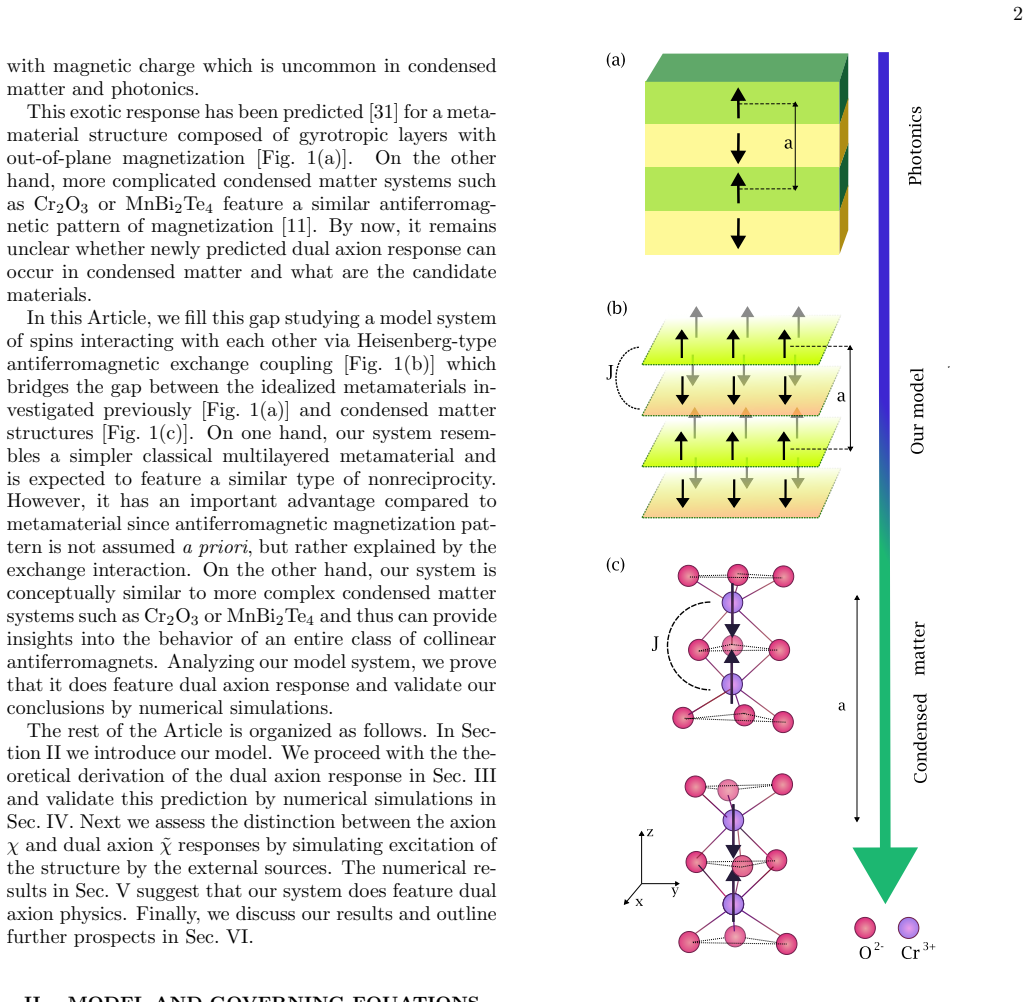
Recently, it was predicted that nonreciprocal magneto-electric effect in antiferromagnetic multilayered metamaterials occurs in two distinct versions. One is the conventional axion response, while another one is dual axion response captured by electrodynamics with magnetic charge. Here we investigate a model condensed matter system of spins coupled through antiferromagnetic exchange interaction and derive its effective electromagnetic properties. We predict that this system gives rise to the emergent dual axion field, support our conclusion by numerical simulations and put forward candidate materials.
Editorial analysis
A structured set of objections, weighed in public.
Referee Report
Summary. The manuscript claims that a condensed matter system of spins coupled through antiferromagnetic exchange interaction gives rise to an emergent dual axion field in its effective electromagnetic properties. This is obtained by deriving the long-wavelength response from the microscopic Heisenberg spin model, with the conclusion supported by numerical simulations; candidate materials are also proposed. The work positions this as a distinct version of the nonreciprocal magneto-electric effect, separate from the conventional axion response previously predicted in antiferromagnetic multilayered metamaterials.
Significance. If the derivation is sound and the numerical evidence robust against competing channels, the result would be significant for establishing a microscopic condensed-matter route to dual axion electrodynamics, moving beyond engineered metamaterials and potentially enabling new platforms for magneto-electric phenomena. The numerical confirmation and material suggestions are positive elements that strengthen the claim's testability.
major comments (2)
- [Abstract] Abstract: The abstract asserts a derivation of effective electromagnetic properties from the microscopic antiferromagnetic spin model plus numerical confirmation, but supplies no equations, no details of the effective-medium procedure, and no error analysis. Without these elements the support for the central claim that the response maps cleanly onto dual axion electrodynamics cannot be evaluated.
- [Derivation of effective EM properties] Derivation of effective EM properties: The central claim requires that the long-wavelength response maps onto dual axion constitutive relations with the dual axion term dominant and no stronger conventional axion or bianisotropic contributions. The manuscript must specify the expansion order, cutoff scale, and explicit comparison to other magnetoelectric invariants that generically appear in spin systems with broken symmetries; absent this, the identification of a pure dual axion response does not follow.
minor comments (1)
- [Introduction] The distinction between conventional axion and dual axion responses would benefit from a short explicit statement of the respective constitutive relations early in the text.
Simulated Author's Rebuttal
We thank the referee for the thoughtful and constructive report. The comments highlight areas where additional clarity on the abstract and the technical details of the long-wavelength derivation would strengthen the presentation. We address each point below and indicate the revisions we will make.
read point-by-point responses
-
Referee: [Abstract] Abstract: The abstract asserts a derivation of effective electromagnetic properties from the microscopic antiferromagnetic spin model plus numerical confirmation, but supplies no equations, no details of the effective-medium procedure, and no error analysis. Without these elements the support for the central claim that the response maps cleanly onto dual axion electrodynamics cannot be evaluated.
Authors: We agree that the abstract, being a concise summary, omits explicit equations and procedural details. The full derivation, effective-medium procedure, and numerical error analysis appear in Sections 2 and 3 of the manuscript. To improve accessibility, we will revise the abstract to include one sentence referencing the derived constitutive relation that isolates the dual axion term, while remaining within length limits. revision: yes
-
Referee: [Derivation of effective EM properties] Derivation of effective EM properties: The central claim requires that the long-wavelength response maps onto dual axion constitutive relations with the dual axion term dominant and no stronger conventional axion or bianisotropic contributions. The manuscript must specify the expansion order, cutoff scale, and explicit comparison to other magnetoelectric invariants that generically appear in spin systems with broken symmetries; absent this, the identification of a pure dual axion response does not follow.
Authors: We accept that the manuscript would benefit from an explicit statement of the expansion order and cutoff. In the revised version we will add a dedicated paragraph in the derivation section specifying the long-wavelength expansion to first order in wave vector (with lattice constant as the ultraviolet cutoff) and will include a symmetry-based comparison demonstrating that the conventional axion and other bianisotropic invariants are forbidden or subdominant by the antiferromagnetic Heisenberg symmetry. This comparison will be supported by the same microscopic calculation already used to obtain the dual axion coefficient. revision: yes
Circularity Check
Derivation from standard antiferromagnetic Heisenberg model to dual axion response is independent
full rationale
The paper starts from a conventional microscopic antiferromagnetic spin Hamiltonian (Heisenberg exchange) whose parameters are chosen independently of the target electromagnetic constitutive relations. Effective long-wavelength EM properties are then derived and checked via numerics. No step reduces the claimed dual axion term to a fit, redefinition, or self-citation chain by the paper's own equations. The mapping is not tautological; the input model does not encode the output response by construction. This is the most common honest non-finding for effective-theory papers.
Axiom & Free-Parameter Ledger
free parameters (1)
- antiferromagnetic exchange strength
axioms (1)
- domain assumption The collective electromagnetic response of the spin system can be captured by an effective linear constitutive relation containing axion and dual-axion terms.
invented entities (1)
-
emergent dual axion field
no independent evidence
Reference graph
Works this paper leans on
-
[1]
L. Landau and E. Lifshitz,Electrodynamics of Continu- ous Media(Pergamon Press, Oxford, 1984)
work page 1984
- [2]
-
[3]
V. S. Asadchy, M. S. Mirmoosa, A. D´ ıaz-Rubio, S. Fan, and S. A. Tretyakov, Tutorial on Electromagnetic Nonre- ciprocity and its Origins, Proceedings of the IEEE108, 1684 (2020)
work page 2020
-
[4]
L. ˇSmejkal, J. Sinova, and T. Jungwirth, Emerging Re- search Landscape of Altermagnetism, Physical Review X 12, 040501 (2022)
work page 2022
-
[5]
L. ˇSmejkal, J. Sinova, and T. Jungwirth, Beyond Con- ventional Ferromagnetism and Antiferromagnetism: A Phase with Nonrelativistic Spin and Crystal Rotation Symmetry, Physical Review X12, 031042 (2022)
work page 2022
-
[6]
T. Jungwirth, J. Sinova, R. M. Fernandes, Q. Liu, H. Watanabe, S. Murakami, S. Nakatsuji, and L.ˇSmejkal, Symmetry, microscopy and spectroscopy signatures of al- termagnetism, Nature649, 837 (2026)
work page 2026
-
[7]
I. E. Dzyaloshinskii, On the Magneto-Electrical Effect in Antiferromagnets, Sov. Phys. JETP10, 628 (1960)
work page 1960
-
[8]
Astrov, The Magnetoelectric Effect in Antiferromag- netics, Sov
D. Astrov, The Magnetoelectric Effect in Antiferromag- netics, Sov. Phys. JETP11, 708 (1960)
work page 1960
-
[9]
B. B. Krichevtsov, V. V. Pavlov, R. V. Pisarev, and V. N. Gridnev, Spontaneous non-reciprocal reflection of light from antiferromagnetic Cr 2O3, Journal of Physics: Con- densed Matter5, 8233 (1993)
work page 1993
-
[10]
V. R. Bilyk, R. M. Dubrovin, A. K. Zvezdin, A. I. Kiri- lyuk, and A. V. Kimel, Control of spins in collinear an- tiferromagnet Cr2O3 by terahertz electric fields, Newton 1, 100132 (2025)
work page 2025
-
[11]
D. M. Nenno, C. A. C. Garcia, J. Gooth, C. Felser, and P. Narang, Axion physics in condensed-matter systems, Nature Reviews Physics2, 682 (2020)
work page 2020
-
[12]
A. Sekine and K. Nomura, Axion electrodynamics in topological materials, Journal of Applied Physics129, 141101 (2021)
work page 2021
-
[13]
Wilczek, Two Applications of Axion Electrodynamics, Physical Review Letters58, 1799 (1987)
F. Wilczek, Two Applications of Axion Electrodynamics, Physical Review Letters58, 1799 (1987)
work page 1987
-
[14]
A. M. Essin, J. E. Moore, and D. Vanderbilt, Mag- netoelectric Polarizability and Axion Electrodynamics in Crystalline Insulators, Physical Review Letters102, 146805 (2009)
work page 2009
-
[15]
M. M. Vazifeh and M. Franz, Quantization and 2πperi- odicity of the axion action in topological insulators, Phys- ical Review B82, 233103 (2010)
work page 2010
-
[16]
L. Wu, M. Salehi, N. Koirala, J. Moon, S. Oh, and N. P. Armitage, Quantized Faraday and Kerr rotation and ax- ion electrodynamics of a 3D topological insulator, Science 354, 1124 (2016)
work page 2016
- [17]
-
[18]
B. A. Bernevig, C. Felser, and H. Beidenkopf, Progress and prospects in magnetic topological materials, Nature 603, 41 (2022)
work page 2022
-
[19]
S. Li, T. Liu, C. Liu, Y. Wang, H.-Z. Lu, and X. C. Xie, Progress on the antiferromagnetic topological insulator MnBi2Te4, National Science Review11, nwac296 (2023)
work page 2023
-
[20]
J.-X. Qiu, C. Tzschaschel, J. Ahn, A. Gao, H. Li, X.- Y. Zhang, B. Ghosh, C. Hu, Y.-X. Wang, Y.-F. Liu, D. B´ erub´ e, T. Dinh, Z. Gong, S.-W. Lien, S.-C. Ho, B. Singh, K. Watanabe, T. Taniguchi, D. C. Bell, H.-Z. Lu, A. Bansil, H. Lin, T.-R. Chang, B. B. Zhou, Q. Ma, A. Vishwanath, N. Ni, and S.-Y. Xu, Axion optical in- duction of antiferromagnetic order...
work page 2023
-
[21]
J.-X. Qiu, B. Ghosh, J. Sch¨ utte-Engel, T. Qian, M. Smith, Y.-T. Yao, J. Ahn, Y.-F. Liu, A. Gao, C. Tzschaschel, H. Li, I. Petrides, D. B´ erub´ e, T. Dinh, T. Huang, O. Liebman, E. M. Been, J. M. Blawat, K. Watanabe, T. Taniguchi, K. C. Fong, H. Lin, P. P. Orth, P. Narang, C. Felser, T.-R. Chang, R. McDonald, R. J. McQueeney, A. Bansil, I. Martin, N. Ni...
work page 2025
-
[23]
S. Safaei Jazi, I. Faniayeu, R. Cichelero, D. C. Tzarouchis, M. M. Asgari, A. Dmitriev, S. Fan, and V. Asadchy, Optical Tellegen metamaterial with sponta- neous magnetization, Nature Communications15, 1293 (2024)
work page 2024
-
[24]
Q. Yang, X. Wen, Z. Li, O. You, and S. Zhang, Gigantic Tellegen responses in metamaterials, Nature Communi- cations16, 151 (2025)
work page 2025
-
[25]
S. Safaei Jazi, I. Faniayeu, R. Cichelero, N. Kuznetsov, S. van Dijken, S. Fan, A. Dmitriev, and V. Asadchy, Re- alization of the Tellegen effect in resonant optical meta- surfaces, eLight6, 8 (2026)
work page 2026
-
[26]
S. A. Tretyakov, S. I. Maslovski, I. S. Nefedov, A. J. Vi- itanen, P. A. Belov, and A. Sanmartin, Artificial Tellegen Particle, Electromagnetics23, 665 (2003)
work page 2003
-
[27]
S. Filipini, M. Cambiaso, A. Mart´ ın-Ruiz, and L. F. Ur- rutia, Exact modes, hybridization, and polarization rota- tion of electromagnetic fields propagating in a topological insulating slab, Physical Review A112, 063504 (2025)
work page 2025
-
[28]
E. G. Ozaktas, C. Guo, and S. Fan, Reciprocity-based compound symmetries in inhomogeneous chiral and Tel- legen media, Optical Materials Express16, 899 (2026)
work page 2026
-
[29]
G.-G. Liu, S. Mandal, X. Xi, Q. Wang, C. Devescovi, A. Morales-P´ erez, Z. Wang, L. Yang, R. Banerjee, Y. Long, Y. Meng, P. Zhou, Z. Gao, Y. Chong, A. Garc´ ıa- Etxarri, M. G. Vergniory, and B. Zhang, Photonic axion insulator, Science387, 162 (2025)
work page 2025
- [30]
-
[31]
T. Z. Seidov, E. Barredo-Alamilla, D. A. Bobylev, L. Sha- poshnikov, M. Mazanov, and M. A. Gorlach, Dual origin of effective axion response, Nature Communications16, 5942 (2025)
work page 2025
-
[32]
Y. Shiratsuchi, K. Toyoki, and R. Nakatani, Magne- toelectric control of antiferromagnetic domain state in Cr2O3 thin film, Journal of Physics: Condensed Matter 33, 243001 (2021)
work page 2021
-
[33]
See Supplementary Materials at [url will be inserted by publisher] for the analysis of dipole-dipole interactions and derivation of the lattice interaction constant; calcula- tion of reflection and transmission coefficients for the slab possessing either axion or dual axion response; derivation of electromagnetic field produced by the thin layer of ex- te...
-
[34]
V. Agranovich and V. Ginzburg,Crystal Optics with Spa- tial Dispersion and Excitons(Springer, Berlin, 1984)
work page 1984
-
[35]
M. G. Silveirinha, Metamaterial homogenization ap- proach with application to the characterization of microstructured composites with negative parameters, Physical Review B75, 115104 (2007)
work page 2007
-
[36]
A. Al` u, First-principles homogenization theory for pe- riodic metamaterials, Physical Review B84, 075153 (2011)
work page 2011
-
[37]
M. A. Gorlach and M. Lapine, Boundary conditions for the effective-medium description of subwavelength multilayered structures, Physical Review B101, 075127 (2020)
work page 2020
-
[38]
J.-Q. Yan, Q. Zhang, T. Heitmann, Z. Huang, K. Y. Chen, J.-G. Cheng, W. Wu, D. Vaknin, B. C. Sales, and R. J. McQueeney, Crystal growth and magnetic structure of MnBi2Te4, Phys. Rev. Mater.3, 064202 (2019)
work page 2019
-
[39]
M. A. Gorlach, S. B. Glybovski, A. A. Hurshkainen, and P. A. Belov, Giant spatial-dispersion-induced birefrin- gence in metamaterials, Physical Review B93, 201115 (2016)
work page 2016
-
[40]
S. V. Ovsyannikov and L. S. Dubrovinsky, High-pressure high-temperature synthesis of Cr 2O3 and Ga 2O3, High Pressure Research31, 23 (2011)
work page 2011
-
[41]
L. Hong, C. Xu, and H. Xiang, Evaluating Gilbert damp- ing in magnetic insulators from first-principles, Phys. Rev. B109, 094429 (2024)
work page 2024
-
[42]
E. M. Purcell and C. R. Pennypacker, Scattering and Absorption of Light by Nonspherical Dielectric Grains, The Astrophysical Journal186, 705 (1973)
work page 1973
-
[43]
B. T. Draine, The discrete-dipole approximation and its application to interstellar graphite grains, The Astro- physical Journal333, 848 (1988)
work page 1988
-
[44]
M. Yurkin and A. Hoekstra, The discrete dipole approx- imation: An overview and recent developments, Jour- nal of Quantitative Spectroscopy and Radiative Transfer 106, 558 (2007)
work page 2007
-
[45]
R. A. Shore and A. D. Yaghjian, Traveling waves on two- and three-dimensional periodic arrays of lossless scatter- ers, Radio Science42, RS6S21 (2007)
work page 2007
-
[46]
P. A. Belov, Homogonization of electromagnetic crystals formed by uniaxial resonant scatters, Physical Review E 72, 026615 (2005)
work page 2005
-
[47]
M. A. Gorlach and P. A. Belov, Effect of spatial dis- persion on the topological transition in metamaterials, Physical Review B90, 115136 (2014)
work page 2014
-
[48]
A. V. Chebykin, M. A. Gorlach, and P. A. Belov, Spatial- dispersion-induced birefringence in metamaterials with cubic symmetry, Physical Review B92, 045127 (2015)
work page 2015
- [49]
-
[50]
I. Zucker and M. Robertson, Exact values of some two- dimensional lattice sums, Journal of Physics A: Mathe- matical, Nuclear and General8, 874 (1975)
work page 1975
-
[51]
Hardy, On some definite integral considered by Mellin, Mess
G. Hardy, On some definite integral considered by Mellin, Mess. Math49, 86 (1920). Supplemental Materials: Emergence of dual axion response in condensed matter Elina Kokurina, 1 Dmitry Vagin,1 Eduardo Barredo-Alamilla, 1 and Maxim A. Gorlach 1,∗ 1School of Physics and Engineering, ITMO University, Saint Petersburg 197101, Russia CONTENTS S1. Dipole-dipole...
work page 1920
-
[52]
= 4π c j. (S29) This provides the connection between the vectors in a circular basis: E3+ H3+ E3− H3− = E′ 3+ H ′ 3+ E′ 3− H ′ 3− + 0 4π c j+ 0 − 4π c j− (S30) which is recast as V3 =V 3 ′ + 4πi c 0 j+ 0 −j− =V3 ′ + 2πi c j0 0 1 0 −1 .(S31) HereV 3 andV ′ 3 are the fields inside the slab from both sides ...
-
[53]
Hardy, On some definite integral considered by Mellin, Mess
G. Hardy, On some definite integral considered by Mellin, Mess. Math49, 86 (1920)
work page 1920
-
[54]
I. Zucker and M. Robertson, Exact values of some two-dimensional lattice sums, Journal of Physics A: Mathematical, Nuclear and General8, 874 (1975)
work page 1975
-
[55]
L. Shaposhnikov, M. Mazanov, D. A. Bobylev, F. Wilczek, and M. A. Gorlach, Emergent axion response in multilayered metamaterials, Physical Review B108, 115101 (2023)
work page 2023
-
[56]
T. Z. Seidov, E. Barredo-Alamilla, D. A. Bobylev, L. Shaposhnikov, M. Mazanov, and M. A. Gorlach, Dual origin of effective axion response, Nature Communications16, 5942 (2025)
work page 2025
discussion (0)
Sign in with ORCID, Apple, or X to comment. Anyone can read and Pith papers without signing in.