gateau: an observation simulator for ground-based submillimeter astronomy with integral field units and kinetic inductance detectors
Pith reviewed 2026-05-08 06:59 UTC · model grok-4.3
The pith
A new open-source simulator accurately reproduces real submillimeter observations with kinetic inductance detectors.
A machine-rendered reading of the paper's core claim, the machinery that carries it, and where it could break.
Core claim
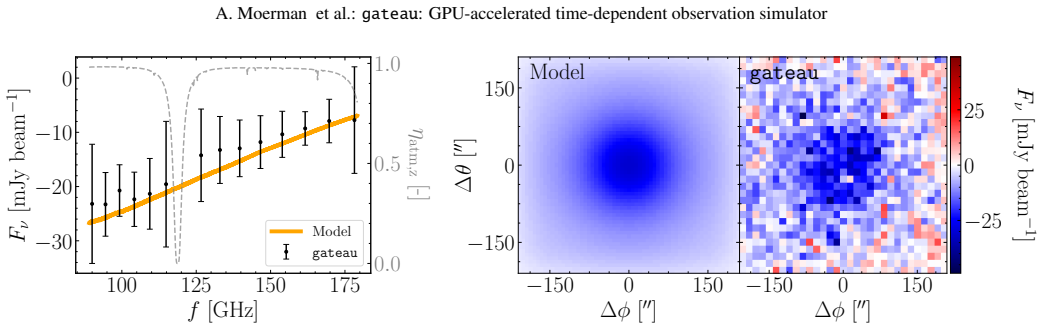
The paper claims that gateau provides a complete, GPU-accelerated simulation chain for submm IFU observations that incorporates realistic propagation of source signals through the atmosphere and instrument, adds photon noise and pink detector noise, and produces time-ordered data whose statistical properties match those measured in real observations with DESHIMA 2.0 of both atmospheric emission and the planet Uranus.
What carries the argument
The gateau simulator itself, which propagates an input source through user-specified atmospheric screens and telescope parameters to the detector array before overlaying white photon noise and temporally correlated pink noise to create realistic time-ordered datasets.
If this is right
- Observation strategies and scan patterns can be optimized in simulation before telescope time is allocated.
- Data-reduction pipelines can be developed and tested on large volumes of realistic synthetic data.
- Instrument parameters can be adjusted iteratively to predict performance on faint extended sources such as galaxies.
- Long-duration surveys become feasible to model in minutes rather than days, allowing rapid iteration on experimental design.
Where Pith is reading between the lines
- The same framework could be extended to forecast sensitivity for detecting weak spectral lines in high-redshift galaxies.
- Simulated datasets might help quantify how scan strategy choices reduce residual atmospheric contamination after data processing.
- Community users could adapt the modular code to other submillimeter instruments or wavelengths without starting from scratch.
Load-bearing premise
The chosen photon-noise model plus the addition of pink noise fully captures the actual noise behavior of kinetic inductance detectors and the atmosphere during real submillimeter observations.
What would settle it
Systematic differences between the simulated and measured power spectra or signal-to-noise ratios in new, independent observations from a similar kinetic-inductance-detector instrument would show that the noise model does not match reality.
Figures


read the original abstract
Submillimeter (submm) integral field units (IFUs) utilising kinetic inductance detectors (KIDs) are a promising instrument architecture for the study of galaxies, galaxy clusters, and the large-scale structure of the Universe. In order to design successful experiments targeting these science cases, several aspects such as instrument design, observation and calibration strategies, and data reduction pipelines must be collectively developed, tested, and optimised. This can be achieved through end-to-end simulations of the experiment, allowing for quantitative assessment of the aforementioned aspects. To this end, we have developed gateau, a modular, flexible, and efficient simulator for submm IFU observations of astronomical sources. The simulator consists of a Python interface, powered by a C/C++ backend that uses CUDA for GPU-acceleration, and is publicly available and fully open-source. gateau simulates observations by taking user input such as an astronomical source, a set of atmospheric screens, a scan pattern, and telescope and instrument parameters. It then propagates the source signal to the detectors. A physically motivated photon-noise model is used to add a white noise component to the received power. Detector noise is added as temporally correlated pink noise. The output is stored in the form of time-ordered datasets. We validated gateau against observations with DESHIMA 2.0, a superconducting, ultra-wideband spectrometer utilising KIDs and on-chip filterbank technology. We show that we can reproduce real observations of the atmosphere and Uranus with gateau simulations. Lastly, we present a use case to show how gateau can simulate long observations in timespans orders of magnitude smaller than the observation time itself, highlighting its applicability and efficiency.
Editorial analysis
A structured set of objections, weighed in public.
Referee Report
Summary. The paper presents gateau, a modular, open-source simulator for ground-based submillimeter IFU observations with KIDs. It features a Python interface with a CUDA-accelerated C/C++ backend that propagates user-specified astronomical sources, atmospheric screens, scan patterns, and instrument parameters to produce time-ordered detector data. A physically motivated photon-noise model adds white noise, while temporally correlated pink noise models detector behavior. The central claim is that gateau reproduces real DESHIMA 2.0 observations of the atmosphere and Uranus, with an additional demonstration of its efficiency for simulating long observations in short wall-clock times.
Significance. If the noise models hold under broader conditions, gateau would provide a valuable, reproducible tool for end-to-end testing of instrument designs, calibration strategies, and data-reduction pipelines ahead of observations targeting galaxies, clusters, and large-scale structure. The public availability of the code, GPU acceleration, and modular architecture are explicit strengths that support community adoption and further development.
major comments (1)
- [Validation section] Validation section: the reproduction of DESHIMA 2.0 data is shown only for the atmosphere and Uranus (high signal-to-noise cases). No quantitative metrics—such as residual maps, noise power spectra, or measured 1/f knee frequencies—are reported for low-flux targets where source power is comparable to or below the detector noise floor. This directly affects the load-bearing claim that the photon-noise plus pink-noise model accurately captures real KID and atmospheric behavior for the intended faint-source science cases.
minor comments (2)
- [Abstract] The abstract states that 'we can reproduce real observations' but does not specify the quantitative comparison metrics or goodness-of-fit measures used; adding these would improve clarity.
- Figure captions in the validation and use-case sections should explicitly list the simulation parameters (e.g., atmospheric screen properties, scan speed, integration time) that correspond to the plotted data.
Simulated Author's Rebuttal
We thank the referee for their thoughtful review and positive assessment of the significance of our work. We address the major comment regarding the validation section below.
read point-by-point responses
-
Referee: Validation section: the reproduction of DESHIMA 2.0 data is shown only for the atmosphere and Uranus (high signal-to-noise cases). No quantitative metrics—such as residual maps, noise power spectra, or measured 1/f knee frequencies—are reported for low-flux targets where source power is comparable to or below the detector noise floor. This directly affects the load-bearing claim that the photon-noise plus pink-noise model accurately captures real KID and atmospheric behavior for the intended faint-source science cases.
Authors: We agree that the current validation is limited to high signal-to-noise cases and that quantitative metrics for low-flux regimes would provide stronger support for the intended faint-source applications. The photon-noise and pink-noise models are physically motivated and derived from first principles, which in principle extend to lower fluxes, but we acknowledge that explicit demonstration is needed. In the revised manuscript we will add a new subsection to the validation section that includes end-to-end simulations of faint sources (source power comparable to or below the noise floor). These will report residual maps after source subtraction, noise power spectra, and measured 1/f knee frequencies, allowing direct quantitative comparison to the model expectations. This addition will be accompanied by a brief discussion of the limitations of available real low-flux DESHIMA 2.0 data. revision: yes
Circularity Check
Forward simulator validated on independent external observations; no derivation chain or fitting loop
full rationale
The manuscript describes gateau as a forward-modeling tool that ingests independent user inputs (astronomical source maps, atmospheric screens, scan patterns, telescope/instrument parameters) and propagates them through a photon-noise model plus temporally correlated pink noise to generate time-ordered data. Validation is performed by direct comparison of these outputs to separate real DESHIMA 2.0 observations of the atmosphere and Uranus. No equations, parameters, or uniqueness claims are fitted to the validation data and then re-used as predictions; the noise model is stated as physically motivated rather than tuned on the target dataset. Consequently the claimed reproduction of observations rests on external data rather than any self-referential reduction.
Axiom & Free-Parameter Ledger
axioms (1)
- domain assumption A physically motivated photon-noise model plus temporally correlated pink noise sufficiently represents real detector and atmospheric noise for the purpose of simulation validation.
Reference graph
Works this paper leans on
-
[1]
2020, A&A, 642, A60
Ade, P., Aravena, M., Barria, E., et al. 2020, A&A, 642, A60
2020
-
[2]
N., Jenness, T., Holland, W
Archibald, E. N., Jenness, T., Holland, W. S., et al. 2002, MNRAS, 336, 1–13
2002
-
[3]
2007, PASJ, 59, 397–418
Asaki, Y ., Sudou, H., Kono, Y ., et al. 2007, PASJ, 59, 397–418
2007
-
[4]
Baselmans, J. J. A., Bueno, J., Yates, S. J. C., et al. 2017, A&A, 601, A89
2017
-
[5]
Baselmans, J. J. A., Facchin, F., Pascual Laguna, A., et al. 2022, A&A, 665, A17
2022
-
[6]
2001, A&A, 365, 285–293
Bensch, F., Stutzki, J., & Heithausen, A. 2001, A&A, 365, 285–293
2001
-
[7]
1999, Phys
Birkinshaw, M. 1999, Phys. Rep., 310, 97 Blanco Rodríguez, J., del Toro Iniesta, J. C., Orozco Suárez, D., et al. 2018, The Astrophysical Journal Supplement Series, 237, 35
1999
-
[8]
2021, Master’s thesis, Delft University of Technology
Bosma, S. 2021, Master’s thesis, Delft University of Technology
2021
-
[9]
Buscher, D. F. 2016, Optics Express, 24, 23566
2016
-
[10]
2016, Journal of Low Temperature Physics, 184, 816–823
Calvo, M., Benoît, A., Catalano, A., et al. 2016, Journal of Low Temperature Physics, 184, 816–823
2016
-
[11]
& Fusco-Femiano, R
Cavaliere, A. & Fusco-Femiano, R. 1978, A&A, 70, 677
1978
-
[12]
2014, Professional CUDA C Pro- gramming (10475 Crosspoint Boulevard, Indianapolis, IN 46256: John Wiley & Sons, Inc.) Cortés, F., Cortés, K., Reeves, R., Bustos, R., & Radford, S
Cheng, J., Grossman, M., & McKercher, T. 2014, Professional CUDA C Pro- gramming (10475 Crosspoint Boulevard, Indianapolis, IN 46256: John Wiley & Sons, Inc.) Cortés, F., Cortés, K., Reeves, R., Bustos, R., & Radford, S. 2020, A&A, 640, A126
2014
-
[13]
O., Mavropoulou, A., Endo, A., et al
Dabironezare, S. O., Mavropoulou, A., Endo, A., et al. 2026, IEEE Transactions on Antennas and Propagation, 1–1
2026
-
[14]
K., LeDuc, H
Day, P. K., LeDuc, H. G., Mazin, B. A., Vayonakis, A., & Zmuidzinas, J. 2003, Nature, 425, 817–821 de Graaf, S. E., Faoro, L., Burnett, J., et al. 2018, Nature Communications, 9 de Pater, I., Fletcher, L. N., Luszcz-Cook, S., et al. 2014, Icarus, 237, 211–238 de Pater, I., Molter, E. M., & Moeckel, C. M. 2023, Remote Sensing, 15, 1313 de Pater, I., Sault,...
2003
-
[15]
W., de Gasperin, F., & Rafferty, D
Edler, H. W., de Gasperin, F., & Rafferty, D. 2021, A&A, 652, A37
2021
-
[16]
2019, Nature Astronomy, 3, 989–996
Endo, A., Karatsu, K., Tamura, Y ., et al. 2019, Nature Astronomy, 3, 989–996
2019
-
[17]
2004, in Proc
Ezawa, H., Kawabe, R., Kohno, K., & Yamamoto, S. 2004, in Proc. SPIE, ed. J. Jacobus M. Oschmann (SPIE)
2004
-
[18]
Fixsen, D. J. 2009, The Astrophysical Journal, 707, 916–920
2009
-
[19]
A., LeDuc, H
Gao, J., Zmuidzinas, J., Mazin, B. A., LeDuc, H. G., & Day, P. K. 2007, Applied Physics Letters, 90
2007
-
[20]
1996, Bulletin of the American Astronomical Society, 28, 1158
Giorgini, J., Yeomans, D., Chamberlin, A., et al. 1996, Bulletin of the American Astronomical Society, 28, 1158
1996
-
[21]
U., et al
Guan, X., Stutzki, J., Graf, U. U., et al. 2012, Astron. Astrophys., 542, L4
2012
-
[22]
J., & Withington, S
Guruswamy, T., Goldie, D. J., & Withington, S. 2014, Superconductor Science and Technology, 27, 055012 Güsten, R., Nyman, L. Å., Schilke, P., et al. 2006, A&A, 454, L13–L16
2014
-
[23]
& Rubens, H
Hagen, E. & Rubens, H. 1903, Annalen der Physik, 316, 873–901
1903
-
[24]
Hofmann, V . B. & O’Brien, K. 2023, RAS Techniques and Instruments, 2, 278–292
2023
-
[25]
2024, A&A, 689, A20
Hu, W., Beelen, A., Lagache, G., et al. 2024, A&A, 689, A20
2024
-
[26]
Hughes, J. P. & Birkinshaw, M. 1998, The Astrophysical Journal, 501, 1–14
1998
-
[27]
A., et al
Huijten, E., Roelvink, Y ., Brackenhoff, S. A., et al. 2022, J. Astron. Telesc. In- strum. Syst., 8 Article number, page 11 of 13 A&A proofs:manuscript no. aanda
2022
-
[28]
2008, in Millimeter and Submillimeter Detectors and Instrumentation for Astronomy IV , ed
Inami, H., Bradford, M., Aguirre, J., et al. 2008, in Millimeter and Submillimeter Detectors and Instrumentation for Astronomy IV , ed. W. D. Duncan, W. S
2008
-
[29]
1998, The Astrophysical Journal, 502, 7–15
Itoh, N., Kohyama, Y ., & Nozawa, S. 1998, The Astrophysical Journal, 502, 7–15
1998
-
[30]
Janssen, R. M. J., Baselmans, J. J. A., Endo, A., et al. 2013, Appl. Phys. Lett., 103, 203503
2013
-
[31]
2015, Monthly Notices of the Royal Astronomical Society, 447, 3467–3474
Jia, P., Cai, D., Wang, D., & Basden, A. 2015, Monthly Notices of the Royal Astronomical Society, 447, 3467–3474
2015
-
[32]
2023, Journal of Physics: Photonics, 5, 042501
Jovanovic, N., Gatkine, P., Anugu, N., et al. 2023, Journal of Physics: Photonics, 5, 042501
2023
-
[33]
2026, DESHIMA 2.0: A 200-400 GHz Ultra-wideband Integrated Superconducting Spectrometer
Karatsu, K., Endo, A., Moerman, A., et al. 2026, DESHIMA 2.0: A 200-400 GHz Ultra-wideband Integrated Superconducting Spectrometer
2026
-
[34]
S., Bailey, J
Kim, C. S., Bailey, J. I., López, R. A., Clay, W. H., & Mazin, B. A. 2025, The Astronomical Journal, 169, 176
2025
-
[35]
Kirk, D. B. & Hwu, W. W. 2017, Programming massively parallel processors, third edition (North Charleston, SC: Createspace Independent Publishing Platform)
2017
-
[36]
2021, hpc4cmb/toast: Update Pybind11
Kisner, T., Keskitalo, R., Zonca, A., et al. 2021, hpc4cmb/toast: Update Pybind11
2021
-
[37]
2016, Publications of the Astronom- ical Society of Japan, 68
Kitayama, T., Ueda, S., Takakuwa, S., et al. 2016, Publications of the Astronom- ical Society of Japan, 68
2016
-
[38]
D., Geers, V
Klaassen, P. D., Geers, V . C., Beard, S. M., et al. 2020, Monthly Notices of the Royal Astronomical Society, 500, 2813–2821
2020
-
[39]
2024, Physical Review Applied, 21
Kouwenhoven, K., van Doorn, G., Buijtendorp, B., et al. 2024, Physical Review Applied, 21
2024
-
[40]
Lay, O. P. 1997, Astronomy and Astrophysics Supplement Series, 122, 535–545
1997
-
[41]
H., Karatsu, K., Endo, A., Baselmans, J
Marting, L. H., Karatsu, K., Endo, A., Baselmans, J. J. A., & Pascual Laguna, A. 2024, Journal of Low Temperature Physics, 216, 144–153
2024
-
[42]
H., Karatsu, K., Scholtenhuis, L
Marting, L. H., Karatsu, K., Scholtenhuis, L. G. G. O., et al. 2026, A High Effi- ciency Superconducting On-chip Filterbank with Directional Filters for Inte- gral Field Units in the Sub-millimeter Regime
2026
-
[43]
2024, MockSZ: a Python interface for fast and accurate mock SZ map generation
Moerman, A. 2024, MockSZ: a Python interface for fast and accurate mock SZ map generation
2024
-
[44]
H., Karatsu, K., & Endo, A
Moerman, A., Gafaji, M. H., Karatsu, K., & Endo, A. 2023, J. Open Source Softw., 8, 5478
2023
-
[45]
Moerman, A., Karatsu, K., Baselmans, J. J. A., et al. 2025, Journal of Astronom- ical Telescopes, Instruments, and Systems, 11
2025
-
[46]
Moerman, A., Karatsu, K., Yates, S. J. C., et al. 2024, A&A, 684, A161
2024
-
[47]
M., de Pater, I., Luszcz-Cook, S., et al
Molter, E. M., de Pater, I., Luszcz-Cook, S., et al. 2021, The Planetary Science Journal, 2, 3
2021
-
[48]
W., Bustos, R., Calabrese, E., et al
Morris, T. W., Bustos, R., Calabrese, E., et al. 2022, Physical Review D, 105
2022
-
[49]
1998, ApJ, 508, 17–24
Nozawa, S., Itoh, N., & Kohyama, Y . 1998, ApJ, 508, 17–24
1998
-
[50]
1928, Physical Review, 32, 110–113 Olde Scholtenhuis, L
Nyquist, H. 1928, Physical Review, 32, 110–113 Olde Scholtenhuis, L. G. G., Capelo, D. P., Karatsu, K., et al. 2026, Advances in the Fabrication of On-chip Superconducting Integral Field Units for CMB and Line-Intensity Astronomy O’Brien, K. 2020, Journal of Low Temperature Physics, 199, 537–546
1928
-
[51]
2001, IEEE Trans
Pardo, J., Cernicharo, J., & Serabyn, E. 2001, IEEE Trans. Antennas Propag., 49, 1683–1694 Pascual Laguna, A., Karatsu, K., Thoen, D., et al. 2021, IEEE Transactions on Terahertz Science and Technology, 11, 635–646
2001
-
[52]
& Braun, R
Popping, A. & Braun, R. 2007, A&A, 479, 903–913
2007
-
[53]
2009, Journal of the Optical Society of America A, 26, 833
Poyneer, L., van Dam, M., & Véran, J.-P. 2009, Journal of the Optical Society of America A, 26, 833
2009
-
[54]
Reyes, N., Weiss, A., Yates, S. J. C., et al. 2026, Astronomy & Astrophysics, 707, A294
2026
-
[55]
1966, Proc
Ruze, J. 1966, Proc. IEEE, 54, 633
1966
-
[56]
& van Engelen, A
Scott, D. & van Engelen, A. 2005, SCAN Mode Strategies for SCUBA-2, Tech. rep
2005
-
[57]
V ., Inatani, J., Shan, W., et al
Shitov, S. V ., Inatani, J., Shan, W., et al. 2008, 19th International Symposium on Space Terahertz Technology, 263
2008
-
[58]
Silveira, F. E. M. & Kurcbart, S. M. 2010, EPL (Europhysics Letters), 90, 44004
2010
-
[59]
& Weintraub, S
Smith, E. & Weintraub, S. 1953, Proceedings of the IRE, 41, 1035–1037
1953
-
[60]
2022, Progress of Theoretical and Ex- perimental Physics, 2022
Sueno, Y ., Honda, S., Kutsuma, H., et al. 2022, Progress of Theoretical and Ex- perimental Physics, 2022
2022
-
[61]
Sunyaev, R. A. & Zeldovich, Y . B. 1970, Astrophysics and Space Science, 7, 3–19
1970
-
[62]
Sunyaev, R. A. & Zeldovich, Y . B. 1980, MNRAS, 190, 413–420
1980
-
[63]
2026, Silicon-based vacuum window for millimeter and submillimeter-wave astrophysics
Takaku, R., Cray, S., Aizawa, K., et al. 2026, Silicon-based vacuum window for millimeter and submillimeter-wave astrophysics
2026
-
[64]
Takekoshi, T., Karatsu, K., Suzuki, J., et al. 2020, J. Low Temp. Phys., 199, 231–239
2020
-
[65]
Taniguchi, A., Bakx, T. J. L. C., Baselmans, J. J. A., et al. 2022, J. Low Temp. Phys., 209, 278 The HDF Group. 2025, Hierarchical Data Format, version 5
2022
-
[66]
& König, M
Timmer, J. & König, M. 1995, A&A, 300, 707
1995
-
[67]
Ulich, B. L. & Haas, R. W. 1976, ApJS, 30, 247 van Marrewijk, J., Morris, T. W., Mroczkowski, T., et al. 2024, The Open Journal of Astrophysics, 7 van Rantwijk, J., Grim, M., van Loon, D., et al. 2016, IEEE Transactions on Microwave Theory and Techniques, 64, 1876–1883 von Hoerner, S. & Wong, W.-Y . 1975, IEEE Trans. Antennas Propag., 23, 689
1976
-
[68]
1967, IEEE Transactions on Audio and Electroacoustics, 15, 70–73
Welch, P. 1967, IEEE Transactions on Audio and Electroacoustics, 15, 70–73
1967
-
[69]
Worrall, D. M. & Birkinshaw, M. 2003, Monthly Notices of the Royal Astro- nomical Society, 340, 1261–1268
2003
-
[70]
Yates, S. J. C., Baselmans, J. J. A., Endo, A., et al. 2011, Applied Physics Letters, 99, 073505 Article number, page 12 of 13 A. Moerman et al.:gateau: GPU-accelerated time-dependent observation simulator 10□1 100 101 102 fxx [Hz] 10□1 100 101 ˆP obs xx / ˆP sim xx median 250 300 350 f[GHz] Fig. A.1.Ratios of ˆPxx for the good weather scenario. The avera...
2011
discussion (0)
Sign in with ORCID, Apple, or X to comment. Anyone can read and Pith papers without signing in.