H-SemiS: Hierarchical Fusion of Semi and Self-Supervised Learning for Knee Osteoarthritis Severity Grading
Pith reviewed 2026-05-08 08:42 UTC · model grok-4.3
The pith
A hierarchical decomposition of knee osteoarthritis grading into binary steps inside a semi-supervised teacher-student model with self-supervised reconstruction improves accuracy on limited labeled X-ray data.
A machine-rendered reading of the paper's core claim, the machinery that carries it, and where it could break.
Core claim
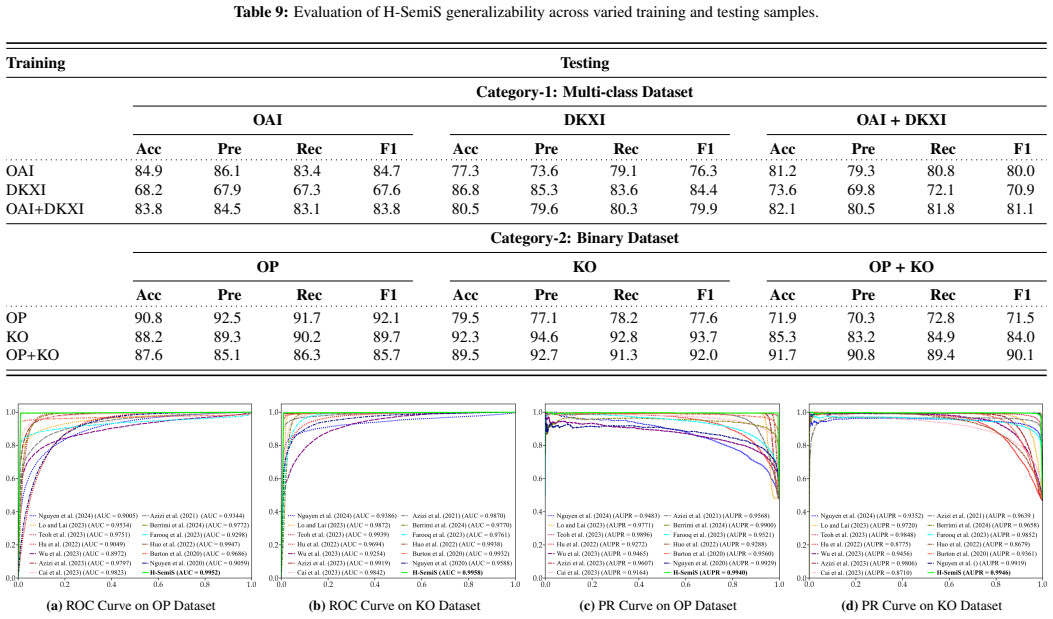
The authors claim that their H-SemiS framework, which fuses semi-supervised learning with self-supervision by decomposing severity grading into ordered binary sub-tasks, training an adversarial reconstruction module on unlabeled data, and applying quantum-inspired feature mixing inside the teacher-student loop, delivers higher performance than competing methods across accuracy, sensitivity, and other metrics on two multi-class knee X-ray datasets and generalizes to binary tasks.
What carries the argument
Hierarchical binary task decomposition inside a teacher-student semi-supervised architecture, combined with adversarial self-supervised reconstruction and quantum-inspired feature mixing to stabilize learning under class imbalance and noisy pseudo-labels.
Load-bearing premise
That the specific combination of binary decomposition, adversarial reconstruction, and quantum-inspired mixing will reliably lessen the damage from class imbalance and noisy labels without introducing its own biases on new clinical data.
What would settle it
Training and testing the full H-SemiS pipeline against a standard supervised baseline and a non-hierarchical semi-supervised version on a fresh, independent multi-center knee X-ray collection; if the proposed method no longer leads on the primary metrics, the central claim would not hold.
Figures




read the original abstract
Knee osteoarthritis (KOA) is a degenerative joint disease that can lead to chronic pain, reduced mobility, and long-term disability. Automated severity grading from knee radiographs can support early assessment, but current methods heavily depend on large labeled datasets and remain sensitive to class imbalance, noisy samples, and variability in clinical annotations. To alleviate these limitations, we propose a Hierarchical fusion of Semi-Supervised framework with Self-Supervision (H-SemiS) for KOA severity grading in knee X-ray samples using limited annotated data. Rather than treating severity grading as a flat multi-class problem, H-SemiS decomposes the task into a sequence of binary sub-tasks within a semi-supervised teacher-student architecture, directly mitigating the impact of class imbalance. To further enhance feature learning from unlabeled data, the framework integrates an adversarial self-supervised reconstruction module that encourages the network to capture robust anatomical structures. In parallel, a teacher-student design with quantum-inspired feature mixing improves discrimination boundaries between adjacent grades when pseudo-labels are noisy. We comprehensively evaluate H-SemiS on two challenging multi-class datasets and assess its generalizability on two binary-class datasets. Our experimental results demonstrate the superiority of the proposed H-SemiS framework across multiple evaluation metrics, consistently outperforming several competing baselines and state-of-the-art methods. The code is publicly available at https://github.com/chandravardhan-singh-raghaw/H-SemiS.
Editorial analysis
A structured set of objections, weighed in public.
Referee Report
Summary. The manuscript proposes H-SemiS, a hierarchical fusion of semi-supervised and self-supervised learning for knee osteoarthritis (KOA) severity grading from radiographs with limited labeled data. It decomposes the multi-class problem into sequential binary sub-tasks inside a teacher-student framework to mitigate class imbalance, adds an adversarial reconstruction module for robust feature learning from unlabeled samples, and introduces quantum-inspired feature mixing to sharpen boundaries between adjacent grades under noisy pseudo-labels. The method is evaluated on two multi-class KOA datasets and two binary datasets, with the central claim that it consistently outperforms competing baselines and state-of-the-art methods across multiple metrics.
Significance. If the empirical superiority holds after proper validation, the work could advance semi-supervised medical imaging by offering a structured decomposition that directly targets class imbalance and label noise in ordinal grading tasks like KOA. The public code release supports reproducibility, which is a positive factor for adoption in the field.
major comments (3)
- [§3.3] §3.3: The quantum-inspired feature mixing is described as improving discrimination under noisy pseudo-labels, yet no ablation is provided that isolates this operator from the hierarchical binary decomposition and teacher-student setup; without it, the load-bearing claim that the full framework mitigates imbalance and noise cannot be evaluated.
- [Experimental results section] Experimental results section (referenced in abstract and §4.2): The manuscript asserts consistent outperformance but supplies no statistical significance tests, confidence intervals, or error analysis on the metric gains; this directly weakens the central empirical claim.
- [§4.2] §4.2: No cross-dataset transfer experiments or analysis of decision boundaries between adjacent KL grades (e.g., KL-2 vs. KL-3) are reported, leaving open whether the reported gains generalize beyond the two specific KOA datasets or simply reflect dataset-specific tuning of the mixing weights.
minor comments (3)
- [Abstract] The abstract and introduction should explicitly name the two multi-class datasets and report their sizes and class distributions to allow immediate assessment of the experimental scope.
- [§3.3] Notation for the quantum-inspired mixing weights and the adversarial reconstruction loss weight should be introduced with explicit equations rather than descriptive text only.
- [Figure 1] Figure captions for the overall architecture should clarify the flow of labeled versus unlabeled data through the teacher-student and reconstruction modules.
Simulated Author's Rebuttal
We thank the referee for the detailed and constructive feedback on our manuscript. We address each of the major comments point by point below, providing clarifications and committing to revisions where they will strengthen the work.
read point-by-point responses
-
Referee: [§3.3] §3.3: The quantum-inspired feature mixing is described as improving discrimination under noisy pseudo-labels, yet no ablation is provided that isolates this operator from the hierarchical binary decomposition and teacher-student setup; without it, the load-bearing claim that the full framework mitigates imbalance and noise cannot be evaluated.
Authors: We agree with the referee that isolating the contribution of the quantum-inspired feature mixing is important for validating its role in the framework. In the revised manuscript, we will add a dedicated ablation study that compares the full H-SemiS model against a variant without the quantum-inspired mixing, while keeping the hierarchical binary decomposition and teacher-student setup intact. This will allow readers to directly evaluate the impact of this component on handling noisy pseudo-labels and class imbalance. revision: yes
-
Referee: [Experimental results section] Experimental results section (referenced in abstract and §4.2): The manuscript asserts consistent outperformance but supplies no statistical significance tests, confidence intervals, or error analysis on the metric gains; this directly weakens the central empirical claim.
Authors: We acknowledge that the absence of statistical significance testing limits the strength of our empirical claims. We will revise the experimental results section to include appropriate statistical tests (such as paired t-tests across multiple runs) and report confidence intervals or standard deviations for the key metrics. This will provide a more robust quantification of the performance improvements over baselines. revision: yes
-
Referee: [§4.2] §4.2: No cross-dataset transfer experiments or analysis of decision boundaries between adjacent KL grades (e.g., KL-2 vs. KL-3) are reported, leaving open whether the reported gains generalize beyond the two specific KOA datasets or simply reflect dataset-specific tuning of the mixing weights.
Authors: Our current evaluation demonstrates consistent superiority across two multi-class KOA datasets with different characteristics and two binary datasets, which supports generalizability beyond a single dataset. However, we agree that explicit cross-dataset transfer experiments and focused analysis of decision boundaries between adjacent grades would further strengthen the claims. In the revision, we will include visualizations and quantitative analysis of decision boundaries (e.g., via confusion matrices or feature space projections for KL-2 vs. KL-3). We will also discuss the potential for cross-dataset transfer based on our multi-dataset results, though conducting full transfer experiments may be limited by dataset availability and will be noted as future work if not feasible within the revision timeline. revision: partial
Circularity Check
No circularity: purely empirical framework proposal with no derivations or self-referential predictions.
full rationale
The paper introduces the H-SemiS architecture (hierarchical binary decomposition in a teacher-student setup plus quantum-inspired feature mixing and adversarial self-supervised reconstruction) and reports its empirical superiority on two multi-class KOA datasets plus two binary datasets. No equations, first-principles derivations, fitted-parameter predictions, or uniqueness theorems appear in the provided text. Central claims rest on direct performance comparisons against external baselines rather than any reduction to inputs by construction. Self-citations, if present, are not load-bearing for any tautological step because no derivation chain exists to be circular.
Axiom & Free-Parameter Ledger
free parameters (2)
- hyperparameters of teacher-student training
- adversarial reconstruction loss weight
axioms (2)
- domain assumption Decomposing severity grading into sequential binary sub-tasks directly mitigates class imbalance
- domain assumption Adversarial self-supervised reconstruction encourages capture of robust anatomical structures from unlabeled data
invented entities (1)
-
quantum-inspired feature mixing
no independent evidence
Reference graph
Works this paper leans on
-
[1]
author Azizi, S. , author Culp, L. , author Freyberg, J. , author Mustafa, B. , author Baur, S. , author Kornblith, S. , author Chen, T. , author Tomasev, N. , author Mitrović, J. , author Strachan, P. , author Mahdavi, S.S. , author Wulczyn, E. , author Babenko, B. , author Walker, M. , author Loh, A. , author Chen, P.H.C. , author Liu, Y. , author Bavis...
-
[2]
In: 2021 IEEE/CVF International Conference on Computer Vision (ICCV)
author Azizi, S. , author Mustafa, B. , author Ryan, F. , author Beaver, Z. , author Freyberg, J. , author Deaton, J. , author Loh, A. , author Karthikesalingam, A. , author Kornblith, S. , author Chen, T. , author Natarajan, V. , author Norouzi, M. , year 2021 . title Big self-supervised models advance medical image classification , in: booktitle 2021 IE...
-
[3]
author Benedetti, M. , author Lloyd, E. , author Sack, S. , author Fiorentini, M. , year 2019 . title Parameterized quantum circuits as machine learning models . journal Quantum Science and Technology volume 4 , pages 043001 . :10.1088/2058-9565/ab4eb5
-
[4]
author Berrimi, M. , author Hans, D. , author Jennane, R. , year 2024 . title A semi-supervised multiview-mri network for the detection of knee osteoarthritis . journal Computerized Medical Imaging and Graphics volume 114 , pages 102371 . :10.1016/j.compmedimag.2024.102371
-
[5]
author Burton, W. , author Myers, C. , author Rullkoetter, P. , year 2020 . title Semi-supervised learning for automatic segmentation of the knee from mri with convolutional neural networks . journal Computer Methods and Programs in Biomedicine volume 189 , pages 105328 . :10.1016/j.cmpb.2020.105328
-
[6]
author Cai, Y. , author Chen, H. , author Yang, X. , author Zhou, Y. , author Cheng, K.T. , year 2023 . title Dual-distribution discrepancy with self-supervised refinement for anomaly detection in medical images . journal Medical Image Analysis volume 86 , pages 102794 . :10.1016/j.media.2023.102794
-
[7]
author Chattopadhay, A. , author Sarkar, A. , author Howlader, P. , author Balasubramanian, V.N. , year 2018 . title Grad-cam++: Generalized gradient-based visual explanations for deep convolutional networks , in: booktitle 2018 IEEE Winter Conference on Applications of Computer Vision (WACV) , publisher IEEE . pp. pages 839--847 . :10.1109/wacv.2018.00097
-
[8]
author Chen, P. , year 2018 . title Knee osteoarthritis severity grading dataset . :0.17632/56rmx5bjcr.1
work page 2018
-
[9]
author Chen, T. , author Kornblith, S. , author Norouzi, M. , author Hinton, G. , year 2020 . title A simple framework for contrastive learning of visual representations , in: booktitle 37th International Conference on Machine Learning, ICML 2020 , pp. pages 1597--1607 . https://proceedings.mlr.press/v119/chen20j/chen20j.pdf. note accessed 8 March 2025
work page 2020
-
[10]
author Cubuk, E.D. , author Zoph, B. , author Shlens, J. , author Le, Q.V. , year 2020 . title Randaugment: Practical automated data augmentation with a reduced search space , in: booktitle 2020 IEEE/CVF Conference on Computer Vision and Pattern Recognition Workshops (CVPRW) , publisher IEEE . pp. pages 702--703 . :10.1109/cvprw50498.2020.00359
-
[11]
author Dosovitskiy, A. , author Beyer, L. , author Kolesnikov, A. , author Weissenborn, D. , author Zhai, X. , author Unterthiner, T. , author Dehghani, M. , author Minderer, M. , author Heigold, G. , author Gelly, S. , author Uszkoreit, J. , author Houlsby, N. , year 2021 . title An image is worth 16x16 words: Transformers for image recognition at scale ...
work page 2021
-
[12]
author Du, Y. , author Almajalid, R. , author Shan, J. , author Zhang, M. , year 2018 . title A novel method to predict knee osteoarthritis progression on mri using machine learning methods . journal IEEE Transactions on NanoBioscience volume 17 , pages 228–236 . :10.1109/tnb.2018.2840082
-
[13]
author Farooq, M.U. , author Ullah, Z. , author Khan, A. , author Gwak, J. , year 2023 . title Dc-aae: Dual channel adversarial autoencoder with multitask learning for kl-grade classification in knee radiographs . journal Computers in Biology and Medicine volume 167 , pages 107570 . :10.1016/j.compbiomed.2023.107570
-
[14]
In: 2023 IEEE/CVF Conference on Com- puter Vision and Pattern Recognition (CVPR), pp
author Fei, Z. , author Fan, M. , author Zhu, L. , author Huang, J. , author Wei, X. , author Wei, X. , year 2023 . title Masked auto-encoders meet generative adversarial networks and beyond , in: booktitle 2023 IEEE/CVF Conference on Computer Vision and Pattern Recognition (CVPR) , publisher IEEE . p. pages 24449–24459 . :10.1109/cvpr52729.2023.02342
-
[15]
author Ghosh, S. , author Kumar, S. , author Kumar, A. , author Verma, J. , year 2024 . title A closer look at consistency regularization for semi-supervised learning , in: booktitle Proceedings of the 7th Joint International Conference on Data Science; Management of Data (11th ACM IKDD CODS and 29th COMAD) , publisher ACM . p. pages 10–17 . :10.1145/3632...
-
[16]
[HBP23] Aamal Abbas Hussain, Francesco Belardinelli, and G eorgios Piliouras
author Goodfellow, I. , author Pouget-Abadie, J. , author Mirza, M. , author Xu, B. , author Warde-Farley, D. , author Ozair, S. , author Courville, A. , author Bengio, Y. , year 2020 . title Generative adversarial networks . journal Communications of the ACM volume 63 , pages 139–144 . :10.1145/3422622
-
[17]
author Gornale, S. , author Patravali, P. , year 2020 . title Digital knee x-ray images . :10.17632/T9NDX37V5H.1
-
[18]
author Guo, J. , author Han, K. , author Wu, H. , author Tang, Y. , author Chen, X. , author Wang, Y. , author Xu, C. , year 2022 . title Cmt: Convolutional neural networks meet vision transformers , in: booktitle 2022 IEEE/CVF Conference on Computer Vision and Pattern Recognition (CVPR) , publisher IEEE . p. pages 12165–12175 . :10.1109/cvpr52688.2022.01186
-
[19]
author He, K. , author Chen, X. , author Xie, S. , author Li, Y. , author Dollar, P. , author Girshick, R. , year 2022 . title Masked autoencoders are scalable vision learners , in: booktitle 2022 IEEE/CVF Conference on Computer Vision and Pattern Recognition (CVPR) , publisher IEEE . pp. pages 16000--16009 . :10.1109/cvpr52688.2022.01553
-
[20]
Deep residual learning for image recognition,
author He, K. , author Zhang, X. , author Ren, S. , author Sun, J. , year 2016 . title Deep residual learning for image recognition , in: booktitle 2016 IEEE Conference on Computer Vision and Pattern Recognition (CVPR) , publisher IEEE . pp. pages 770--778 . :10.1109/cvpr.2016.90
-
[21]
author Hu, K. , author Wu, W. , author Li, W. , author Simic, M. , author Zomaya, A. , author Wang, Z. , year 2022 . title Adversarial evolving neural network for longitudinal knee osteoarthritis prediction . journal IEEE Transactions on Medical Imaging volume 41 , pages 3207–3217 . :10.1109/tmi.2022.3181060
-
[22]
Densely connected convolutional networks,
author Huang, G. , author Liu, Z. , author Van Der Maaten, L. , author Weinberger, K.Q. , year 2017 . title Densely connected convolutional networks , in: booktitle 2017 IEEE Conference on Computer Vision and Pattern Recognition (CVPR) , publisher IEEE . pp. pages 4700--4708 . :10.1109/cvpr.2017.243
-
[23]
Medicine6, 74, DOI: 10.1038/s41746-023-00811-0 (2023)
author Huang, S.C. , author Pareek, A. , author Jensen, M. , author Lungren, M.P. , author Yeung, S. , author Chaudhari, A.S. , year 2023 . title Self-supervised learning for medical image classification: a systematic review and implementation guidelines . journal npj Digital Medicine volume 6 . :10.1038/s41746-023-00811-0
-
[24]
author Huang, Z. , author Jin, X. , author Lu, C. , author Hou, Q. , author Cheng, M.M. , author Fu, D. , author Shen, X. , author Feng, J. , year 2024 . title Contrastive masked autoencoders are stronger vision learners . journal IEEE Transactions on Pattern Analysis and Machine Intelligence volume 46 , pages 2506–2517 . :10.1109/tpami.2023.3336525
-
[25]
author Huo, J. , author Ouyang, X. , author Si, L. , author Xuan, K. , author Wang, S. , author Yao, W. , author Liu, Y. , author Xu, J. , author Qian, D. , author Xue, Z. , author Wang, Q. , author Shen, D. , author Zhang, L. , year 2022 . title Automatic grading assessments for knee mri cartilage defects via self-ensembling semi-supervised learning with...
-
[26]
author Kellgren, J. , author Lawrence, J. , year 1957 . title Radiological assessment of osteo-arthrosis . journal Annals of the Rheumatic Diseases volume 16 , pages 494–502 . :10.1136/ard.16.4.494
-
[27]
author Laine, S. , author Aila, T. , year 2017 . title Temporal ensembling for semi-supervised learning , in: booktitle 5th International Conference on Learning Representations, ICLR 2017 - Conference Track Proceedings , pp. pages 1--17 . https://openreview.net/forum?id=BJ6oOfqge. note accessed 8 March 2025
work page 2017
-
[28]
author Lindner, C. , author Thiagarajah, S. , author Wilkinson, J. , author Consortium, T. , author Wallis, G. , author Cootes, T. , year 2013 . title Fully automatic segmentation of the proximal femur using random forest regression voting . journal IEEE Transactions on Medical Imaging volume 32 , pages 1462–1472 . :10.1109/tmi.2013.2258030
-
[29]
author Lo, C.M. , author Lai, K.L. , year 2023 . title Deep learning-based assessment of knee septic arthritis using transformer features in sonographic modalities . journal Computer Methods and Programs in Biomedicine :10.1016/j.cmpb.2023.107575
-
[30]
author van der Maaten, L. , author Hinton, G. , year 2008 . title Visualizing data using t-sne . journal Journal of Machine Learning Research volume 9 . https://jmlr.org/papers/volume9/vandermaaten08a/vandermaaten08a.pdf. note accessed 8 March 2025
work page 2008
-
[31]
author Manzari, O.N. , author Ahmadabadi, H. , author Kashiani, H. , author Shokouhi, S.B. , author Ayatollahi, A. , year 2023 . title Medvit: A robust vision transformer for generalized medical image classification . journal Computers in Biology and Medicine volume 157 , pages 106791 . :10.1016/j.compbiomed.2023.106791
-
[32]
author Mari, A. , author Bromley, T.R. , author Izaac, J. , author Schuld, M. , author Killoran, N. , year 2020 . title Transfer learning in hybrid classical-quantum neural networks . journal Quantum volume 4 , pages 340 . :10.22331/q-2020-10-09-340
-
[33]
author Nguyen, H.H. , author Blaschko, M.B. , author Saarakkala, S. , author Tiulpin, A. , year 2024 . title Clinically-inspired multi-agent transformers for disease trajectory forecasting from multimodal data . journal IEEE Transactions on Medical Imaging volume 43 , pages 529–541 . :10.1109/tmi.2023.3312524
-
[34]
author Nguyen, H.H. , author Saarakkala, S. , author Blaschko, M.B. , author Tiulpin, A. , year 2020 . title Semixup: In- and out-of-manifold regularization for deep semi-supervised knee osteoarthritis severity grading from plain radiographs . journal IEEE Transactions on Medical Imaging volume 39 , pages 4346–4356 . :10.1109/tmi.2020.3017007
-
[35]
author Ning, Z. , author Jiang, Z. , author Zhang, D. , year 2025 . title To combat multiclass imbalanced problems by aggregating evolutionary hierarchical classifiers . journal IEEE Transactions on Neural Networks and Learning Systems volume 36 , pages 5258–5272 . :10.1109/tnnls.2024.3383672
-
[36]
author Ovalle-Magallanes, E. , author Avina-Cervantes, J.G. , author Cruz-Aceves, I. , author Ruiz-Pinales, J. , year 2022 . title Hybrid classical–quantum convolutional neural network for stenosis detection in x-ray coronary angiography . journal Expert Systems with Applications volume 189 , pages 116112 . :10.1016/j.eswa.2021.116112
-
[37]
author Pan, J. , author Wu, Y. , author Tang, Z. , author Sun, K. , author Li, M. , author Sun, J. , author Liu, J. , author Tian, J. , author Shen, B. , year 2024 . title Automatic knee osteoarthritis severity grading based on x-ray images using a hierarchical classification method . journal Arthritis Research & Therapy volume 26 . :10.1186/s13075-024-03416-4
-
[38]
author Poppi, S. , author Cornia, M. , author Baraldi, L. , author Cucchiara, R. , year 2021 . title Revisiting the evaluation of class activation mapping for explainability: A novel metric and experimental analysis , in: booktitle 2021 IEEE/CVF Conference on Computer Vision and Pattern Recognition Workshops (CVPRW) , publisher IEEE . pp. pages 2299--2304...
-
[39]
author Prabhakar, C. , author Li, H. , author Yang, J. , author Shit, S. , author Wiestler, B. , author Menze, B. , year 2024 . title Vit-ae++: improving vision transformer autoencoder for self-supervised medical image representations , in: booktitle Medical Imaging with Deep Learning , organization PMLR . pp. pages 666--679 . https://proceedings.mlr.pres...
work page 2024
-
[40]
author Raghaw, C.S. , author Bhore, P.S. , author Rehman, M.Z.U. , author Kumar, N. , year 2024 . title An explainable contrastive-based dilated convolutional network with transformer for pediatric pneumonia detection . journal Applied Soft Computing volume 167 , pages 112258 . :10.1016/j.asoc.2024.112258
-
[41]
YOLO9000: Better, Faster, Stronger
author Redmon, J. , author Farhadi, A. , year 2017 . title Yolo9000: Better, faster, stronger , in: booktitle 2017 IEEE Conference on Computer Vision and Pattern Recognition (CVPR) , publisher IEEE . p. pages 6517–6525 . :10.1109/cvpr.2017.690
-
[42]
author Sam Chandra Bose, A. , author Srinivasan, C. , author Immaculate Joy, S. , year 2024 . title Optimized feature selection for enhanced accuracy in knee osteoarthritis detection and severity classification with machine learning . journal Biomedical Signal Processing and Control volume 97 , pages 106670 . :10.1016/j.bspc.2024.106670
-
[43]
doi:10.1007/s11263-019-01228-7
author Selvaraju, R.R. , author Cogswell, M. , author Das, A. , author Vedantam, R. , author Parikh, D. , author Batra, D. , year 2019 . title Grad-cam: Visual explanations from deep networks via gradient-based localization . journal International Journal of Computer Vision volume 128 , pages 336–359 . :10.1007/s11263-019-01228-7
-
[44]
author Shaw, D. , year 2024 . title Osteoarthritis . :10.21227/mszn-gr21
-
[45]
author Sohail, M. , author Azad, M.M. , author Kim, H.S. , year 2025 . title Knee osteoarthritis severity detection using deep inception transfer learning . journal Computers in Biology and Medicine volume 186 , pages 109641 . :10.1016/j.compbiomed.2024.109641
-
[46]
author Song, Z. , author Du, P. , author Yan, J. , author Li, K. , author Shou, J. , author Lai, M. , author Fan, Y. , author Xu, Y. , year 2024 . title Nucleus-aware self-supervised pretraining using unpaired image-to-image translation for histopathology images . journal IEEE Transactions on Medical Imaging volume 43 , pages 459–472 . :10.1109/tmi.2023.3309971
-
[47]
author Tao, M. , year 2023 . title Osteoarthritis prediction . :10.21227/EWX7-B315
-
[48]
author Tarvainen, A. , author Valpola, H. , year 2017 . title Mean teachers are better role models: Weight-averaged consistency targets improve semi-supervised deep learning results , in: booktitle Proceedings of the 31st International Conference on Neural Information Processing Systems , p. pages 1195–1204
work page 2017
-
[49]
author Teoh, Y.X. , author Othmani, A. , author Lai, K.W. , author Goh, S.L. , author Usman, J. , year 2023 . title Stratifying knee osteoarthritis features through multitask deep hybrid learning: Data from the osteoarthritis initiative . journal Computer Methods and Programs in Biomedicine volume 242 , pages 107807 . :10.1016/j.cmpb.2023.107807
-
[50]
author Wang, F. , author Cao, Y. , author Lu, H. , author Pan, Y. , author Tao, Y. , author Huang, S. , author Wang, J. , author Huo, L. , author Wu, J. , year 2025 . title Osteoarthritis incidence trends globally, regionally, and nationally, 1990–2019: An age‐period‐cohort analysis . journal Musculoskeletal Care volume 23 . :10.1002/msc.70045
-
[51]
author Wang, H. , author Wang, Z. , author Du, M. , author Yang, F. , author Zhang, Z. , author Ding, S. , author Mardziel, P. , author Hu, X. , year 2020 . title Score-cam: Score-weighted visual explanations for convolutional neural networks , in: booktitle 2020 IEEE/CVF Conference on Computer Vision and Pattern Recognition Workshops (CVPRW) , publisher ...
-
[52]
author Wang, Y. , author Song, D. , author Wang, W. , author Rao, S. , author Wang, X. , author Wang, M. , year 2022 . title Self-supervised learning and semi-supervised learning for multi-sequence medical image classification . journal Neurocomputing volume 513 , pages 383–394 . :10.1016/j.neucom.2022.09.097
-
[53]
author Wu, W. , author Hu, K. , author Yue, W. , author Li, W. , author Simic, M. , author Li, C. , author Xiang, W. , author Wang, Z. , year 2023 . title Self-supervised multimodal fusion network for knee osteoarthritis severity grading , in: booktitle 2023 International Conference on Digital Image Computing: Techniques and Applications (DICTA) , publish...
-
[54]
author Zagoruyko, S. , author Komodakis, N. , year 2016 . title Wide residual networks , in: booktitle Procedings of the British Machine Vision Conference 2016 , publisher British Machine Vision Association . pp. pages 87.1--87.12 . :10.5244/c.30.87
-
[55]
author Zhuang, Z. , author Si, L. , author Wang, S. , author Xuan, K. , author Ouyang, X. , author Zhan, Y. , author Xue, Z. , author Zhang, L. , author Shen, D. , author Yao, W. , author Wang, Q. , year 2023 . title Knee cartilage defect assessment by graph representation and surface convolution . journal IEEE Transactions on Medical Imaging volume 42 , ...
discussion (0)
Sign in with ORCID, Apple, or X to comment. Anyone can read and Pith papers without signing in.