ARIstoteles -- Dissecting Apple's Baseband Interface
Pith reviewed 2026-05-08 07:47 UTC · model grok-4.3
The pith
Reverse engineering of Apple's undocumented ARI baseband interface reveals insufficient internal testing.
A machine-rendered reading of the paper's core claim, the machinery that carries it, and where it could break.
Core claim
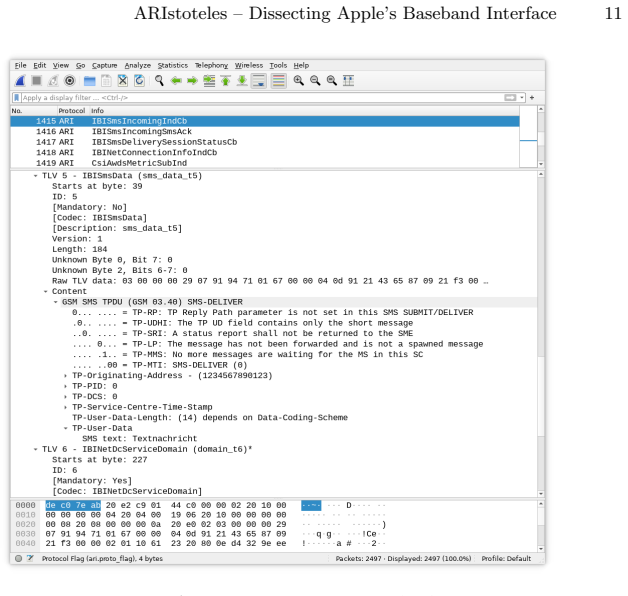
We are the first to reverse-engineer and fuzz-test the ARI interface on iOS. Our Ghidra scripts automatically generate a Wireshark dissector, called ARIstoteles, by parsing closed-source iOS libraries for this undocumented protocol. We compare the quality of the dissector to fully-automated approaches based on static trace analysis. Finally, we fuzz the ARI interface based on our reverse-engineering results. The fuzzing results indicate that ARI does not only lack public security research but also has not been well-tested by Apple.
What carries the argument
ARIstoteles, the Wireshark dissector automatically produced by Ghidra scripts that parse closed-source iOS libraries to decode the ARI protocol messages exchanged with CommCenter.
If this is right
- The ARI protocol presents a remote code execution attack surface because it interacts directly with CommCenter and multiple user-space daemons.
- Releasing ARIstoteles open source enables other researchers to inspect and extend baseband protocol analysis on Apple devices.
- The fuzzing campaign supplies concrete evidence that Apple has not performed sufficient internal testing of the ARI interface.
- The Ghidra-script method for building dissectors can be applied to other undocumented protocols inside iOS libraries.
Where Pith is reading between the lines
- The same reverse-engineering pipeline could be rerun on newer iOS versions to track whether ARI attack surface changes over time.
- Crashes found during fuzzing could be turned into targeted exploits once their root causes are analyzed.
- Closing the research gap between Android and iOS baseband interfaces may reveal common design patterns that affect wireless security across platforms.
Load-bearing premise
The behavior extracted from the closed-source libraries accurately represents how ARI actually runs on real iPhones.
What would settle it
Capturing live ARI traffic from a running iPhone and finding that the generated ARIstoteles dissector cannot parse it correctly, or running the fuzzer for an extended period and observing no unexpected crashes or anomalies.
Figures




read the original abstract
Wireless chips and interfaces expose a substantial remote attack surface. As of today, most cellular baseband security research is performed on the Android ecosystem, leaving a huge gap on Apple devices. With iOS jailbreaks, last-generation wireless chips become fairly accessible for performance and security research. Yet, iPhones were never intended to be used as a research platform, and chips and interfaces are undocumented. One protocol to interface with such chips is Apple Remote Invocation (ARI), which interacts with the central phone component CommCenter and multiple user-space daemons, thereby posing a Remote Code Execution (RCE) attack surface. We are the first to reverse-engineer and fuzz-test the ARI interface on iOS. Our Ghidra scripts automatically generate a Wireshark dissector, called ARIstoteles, by parsing closed-source iOS libraries for this undocumented protocol. Moreover, we compare the quality of the dissector to fully-automated approaches based on static trace analysis. Finally, we fuzz the ARI interface based on our reverse-engineering results. The fuzzing results indicate that ARI does not only lack public security research but also has not been well-tested by Apple. By releasing ARIstoteles open-source, we also aim to facilitate similar research in the future.
Editorial analysis
A structured set of objections, weighed in public.
Referee Report
Summary. The manuscript presents ARIstoteles, a toolset of Ghidra scripts that reverse-engineers the undocumented Apple Remote Invocation (ARI) protocol from closed-source iOS libraries (CommCenter and related daemons) to automatically generate a Wireshark dissector. It compares the quality of this static-analysis approach against fully-automated trace-based methods, performs fuzz testing of the ARI interface, and concludes that ARI lacks public security research and has not been well-tested by Apple. The work includes an open-source release of the tool to facilitate future research.
Significance. If the reverse-engineering accurately recovers the protocol grammar and the fuzzing results are representative, the paper addresses a notable gap in public analysis of iOS baseband interfaces, where Android has received far more attention. The automated dissector generation, direct comparison to trace methods, and open-source release of the scripts constitute concrete, reusable contributions that lower the barrier for subsequent security work on Apple cellular stacks.
major comments (2)
- [Section 3] Section 3 (Reverse Engineering): The central claims rest on Ghidra scripts correctly extracting the full ARI message grammar, field layouts, and command semantics from binary libraries. The manuscript provides no independent validation (e.g., differential testing against live device traffic or manual annotation of a sample of messages) that the extracted model matches runtime behavior. Any incompleteness directly invalidates the generated dissector, the comparison in Section 4, and the fuzzing results used to conclude insufficient Apple testing.
- [Section 5] Section 5 (Fuzzing Results): The claim that ARI 'has not been well-tested by Apple' is supported only by the fuzzing outcomes, yet the paper reports no coverage metrics, error bars, specific crash data, or details on the number of messages, mutation strategies, or observed anomalies. Without these, the representativeness of the results cannot be assessed and the conclusion about Apple's internal testing remains unsupported.
minor comments (1)
- [Abstract] The abstract and introduction could more explicitly separate the engineering contribution (dissector generation) from the security conclusion (insufficient testing), to avoid conflating the two.
Simulated Author's Rebuttal
We thank the referee for the constructive feedback on our manuscript. We address each major comment below with clarifications and planned revisions to improve the rigor of the presentation.
read point-by-point responses
-
Referee: [Section 3] Section 3 (Reverse Engineering): The central claims rest on Ghidra scripts correctly extracting the full ARI message grammar, field layouts, and command semantics from binary libraries. The manuscript provides no independent validation (e.g., differential testing against live device traffic or manual annotation of a sample of messages) that the extracted model matches runtime behavior. Any incompleteness directly invalidates the generated dissector, the comparison in Section 4, and the fuzzing results used to conclude insufficient Apple testing.
Authors: We acknowledge that explicit independent validation would strengthen the central claims. The comparison in Section 4 to trace-based methods already provides a form of differential assessment by quantifying differences in recovered messages and coverage. To further address the concern, we will revise Section 3 to include a description of manual annotation and verification performed on a sample of extracted messages, cross-referenced against observed runtime behaviors from our fuzzing experiments where possible. We will also add a discussion of the inherent limitations of purely static analysis for protocol recovery. revision: yes
-
Referee: [Section 5] Section 5 (Fuzzing Results): The claim that ARI 'has not been well-tested by Apple' is supported only by the fuzzing outcomes, yet the paper reports no coverage metrics, error bars, specific crash data, or details on the number of messages, mutation strategies, or observed anomalies. Without these, the representativeness of the results cannot be assessed and the conclusion about Apple's internal testing remains unsupported.
Authors: We agree that expanded details on the fuzzing campaign are needed for readers to evaluate the results and the strength of the conclusion. In the revised manuscript we will expand Section 5 with specifics on the number of messages tested, the mutation strategies applied, descriptions of observed anomalies, and any coverage metrics collected. The statement regarding Apple's internal testing will be qualified to reflect that the anomalies discovered indicate gaps relative to our testing scope, while acknowledging that our campaign cannot comprehensively represent all possible inputs or Apple's full test suite. revision: yes
Circularity Check
No circularity: empirical reverse-engineering and fuzzing with no derivations or self-referential claims
full rationale
The paper's contribution consists of static analysis of closed-source iOS libraries via Ghidra scripts to extract ARI protocol details, generation of a Wireshark dissector, comparison to trace-based methods, and fuzzing. No equations, fitted parameters, predictions, or mathematical derivations appear in the abstract or described content. Claims rest on the empirical outputs of the tools and experiments rather than any self-definition, imported uniqueness theorems, or renamings of prior results. No self-citations are invoked as load-bearing justification for core premises. The work is self-contained as tool-building and analysis.
Axiom & Free-Parameter Ledger
Reference graph
Works this paper leans on
-
[1]
Afek, J.: Simplifying iOS Research: Booting the iOS Kernel to an Interactive Bash Shell on QEMU.https://www.offensivecon.org/speakers/2020/jonathan-afe k.html(Feb 2020)
work page 2020
-
[2]
Android Open Source Project: RIL Refactoring.https://source.android.com/ devices/tech/connect/ril(May 2021)
work page 2021
-
[3]
Apple: Profiles and Logs - Bug Reporting - Apple Developer.https://develope r.apple.com/bug-reporting/profiles-and-logs/(May 2021)
work page 2021
- [4]
-
[5]
Golde, N.: There’s Life in the Old Dog Yet: Tearing New Holes into Intel/iPhone Cellular Modems.https://comsecuris.com/blog/posts/theres_life_in_the_ old_dog_yet_tearing_new_holes_into_inteliphone_cellular_modems/(Apr 2018)
work page 2018
-
[6]
Guy: Burned in Ashes: Baseband Fairy Tale Stories.https://cfp.recon.cx/re conmtl2019/talk/7A7TBA/(Jun 2019)
work page 2019
-
[7]
Heinze, D.: fpicker.https://github.com/ttdennis/fpicker(May 2021)
work page 2021
-
[8]
In: 14th USENIX Workshop on Offensive Technologies (WOOT 20)
Heinze, D., Classen, J., Hollick, M.: ToothPicker: Apple Picking in the iOS Blue- tooth Stack. In: 14th USENIX Workshop on Offensive Technologies (WOOT 20). USENIX Association (Aug 2020),https://www.usenix.org/conference/woot20 /presentation/heinze
work page 2020
-
[9]
Hernandez, G., Muench, M.: Emulating Samsung’s Baseband for Security Testing. BlackHat USA 2020 (Aug 2020)
work page 2020
-
[10]
In: IEEE INFOCOM 2020 - IEEE Conference on Computer Communications
Kleber, S., van der Heijden, R.W., Kargl, F.: Message Type Identification of Binary Network Protocols using Continuous Segment Similarity. In: IEEE INFOCOM 2020 - IEEE Conference on Computer Communications. pp. 2243–2252 (2020). https://doi.org/10.1109/INFOCOM41043.2020.9155275
-
[11]
In: 12th USENIX Workshop on Offensive Technologies (WOOT 18)
Kleber, S., Kopp, H., Kargl, F.: NEMESYS: Network Message Syntax Reverse Engineering by Analysis of the Intrinsic Structure of Individual Messages. In: 12th USENIX Workshop on Offensive Technologies (WOOT 18). USENIX Association, Baltimore, MD (Aug 2018)
work page 2018
-
[12]
libqmi Developers: QMI modem protocol helper library.https://github.com/fr eedesktop/libqmi(May 2021)
work page 2021
-
[13]
In: 29th USENIX Security Symposium (USENIX Security 20)
Liu, B., Zhang, C., Gong, G., Zeng, Y., Ruan, H., Zhuge, J.: FANS: Fuzzing An- droid Native System Services via Automated Interface Analysis. In: 29th USENIX Security Symposium (USENIX Security 20). pp. 307–323. USENIX Association (Aug 2020),https://www.usenix.org/conference/usenixsecurity20/present ation/liu ARIstoteles – Dissecting Apple’s Baseband Interface 19
work page 2020
-
[14]
Maier, D., Seidel, L., Park, S.: BaseSAFE: Baseband SAnitized Fuzzing through Emulation. The 13th ACM Conference on Security and Privacy in Wireless and Mobile Networks (WiSec ’20) (Jul 2020)
work page 2020
-
[15]
Mantz, D., Classen, J., Schulz, M., Hollick, M.: InternalBlue - Bluetooth Binary Patching and Experimentation Framework. In: The 17th Annual International Conference on Mobile Systems, Applications, and Services (MobiSys ’19) (Jun 2019). https://doi.org/10.1145/3307334.3326089
-
[16]
In: 25th Annual Network and Distributed System Security Symposium (NDSS 2018)
Muench, M., Stijohann, J., Kargl, F., Francillon, A., Balzarotti, D.: What you corrupt is not what you crash: Challenges in fuzzing embedded devices. In: 25th Annual Network and Distributed System Security Symposium (NDSS 2018). The Internet Society (2018)
work page 2018
-
[17]
Mulliner, C.: Fuzzing the Phone in your Phone.https://media.ccc.de/v/26c3- 3507-de-fuzzing_the_phone_in_your_phone
-
[18]
Mulliner, C., Miller, C.: Fuzzing the Phone in your Phone.https: //www.blackhat.com/presentations/bh-usa-09/MILLER/BHUSA09-Miller- FuzzingPhone-PAPER.pdf
-
[19]
National Security Agency: Ghidra.https://ghidra-sre.org/(May 2021)
work page 2021
-
[20]
Ravn˚ as, O.A.V.: Frida - a world-class dynamic instrumentation framework.https: //frida.re/(2020)
work page 2020
-
[21]
Ravn˚ as, O.A.V.: Frida - stalker.https://frida.re/docs/stalker/(2021)
work page 2021
-
[22]
In: 29th USENIX Security Symposium (USENIX Security 19)
Ruge, J., Classen, J., Gringoli, F., Hollick, M.: Frankenstein: Advanced Wireless Fuzzing to Exploit New Bluetooth Escalation Targets. In: 29th USENIX Security Symposium (USENIX Security 19). USENIX Association (Aug 2020)
work page 2020
-
[23]
Schulz, M., Wegemer, D., Hollick, M.: Nexmon: The C-based Firmware Patching Framework.https://nexmon.org(2017)
work page 2017
-
[24]
https://scikit-learn.org/stable/modules/generated/sklearn.manifold
scikit-learn Developers: sklearn.mainfold.MDS – scikit-learn 0.24.2 documentation. https://scikit-learn.org/stable/modules/generated/sklearn.manifold. MDS.html(May 2021)
work page 2021
-
[25]
Silvanovich, N.: iOS Messaging Tools.https://github.com/googleprojectzero/ iOS-messaging-tools(Aug 2019)
work page 2019
-
[26]
Stone, M.: Bad Binder: Android In-The-Wild Exploit.https://googleprojectze ro.blogspot.com/2019/11/bad-binder-android-in-wild-exploit.html(Nov 2019)
work page 2019
-
[27]
In: 28th USENIX Security Symposium (USENIX Security 19)
Stute, M., Narain, S., Mariotto, A., Heinrich, A., Kreitschmann, D., Noubir, G., Hollick, M.: A Billion Open Interfaces for Eve and Mallory: MitM, DoS, and Track- ing Attacks on iOS and macOS Through Apple Wireless Direct Link. In: 28th USENIX Security Symposium (USENIX Security 19). pp. 37–54. USENIX Asso- ciation, Santa Clara, CA (Aug 2019)
work page 2019
-
[28]
Wireshark Foundation: Wireshark.https://www.wireshark.org/(May 2021)
work page 2021
discussion (0)
Sign in with ORCID, Apple, or X to comment. Anyone can read and Pith papers without signing in.