Reparameterization through Coverings and Topological Weight Priors
Pith reviewed 2026-05-08 06:21 UTC · model grok-4.3
The pith
Covering maps let the reparameterization trick work on latent spaces whose topology is not a Lie group, such as the Klein bottle, while keeping the KL term in the VAE objective tractable.
A machine-rendered reading of the paper's core claim, the machinery that carries it, and where it could break.
Core claim
We generalise the reparameterization trick applied in variational autoencoders (VAEs) letting these have latent spaces of non-trivial topology - i.e. that of base manifolds covered with other ones, on which some technique for RT is available. That is possible since covering maps are measurable - moreover, in case of particular measure preservation property holding for the covering, one can establish an inequality on KL-divergence between pushforward (PF) densities on the base latent manifold, making the KL-term of VAE's ELBO analytically tractable, despite the topological non-triviality of the supporting latent manifold. We demonstrate the working of our approach by constructing a VAE with a
What carries the argument
A covering map equipped with a measure-preservation property that produces a usable inequality on the KL divergence of the push-forward densities on the base manifold.
If this is right
- VAEs become constructible on base manifolds whose topology is covered by spaces that already admit reparameterization, including manifolds that are not Lie groups.
- The evidence lower bound remains analytically tractable for such non-trivial topologies once the measure-preservation condition is met.
- A working Klein-bottle latent-space VAE can be trained on artificial data and used as a generative model.
- The same construction supplies topology-aware weight priors for Bayesian learning, with possible relevance to convolutional networks.
Where Pith is reading between the lines
- The same covering technique may be applied to other manifolds whose topology is known to appear in data or parameter spaces, even when no global Lie-group structure exists.
- It could be tested whether the resulting priors yield better-calibrated uncertainty or improved generalization than isotropic Gaussian priors in vision tasks.
- The inequality derived from measure preservation might be tightened or replaced by an equality under additional symmetry assumptions on the covering.
Load-bearing premise
The covering map must satisfy a specific measure-preservation property that lets the KL divergence of the pushed-forward densities be bounded from above.
What would settle it
An explicit covering map for which the claimed KL inequality between push-forward densities fails to hold, or a KleinVAE whose ELBO cannot be evaluated or optimized because the inequality does not deliver a tractable upper bound.
Figures
read the original abstract
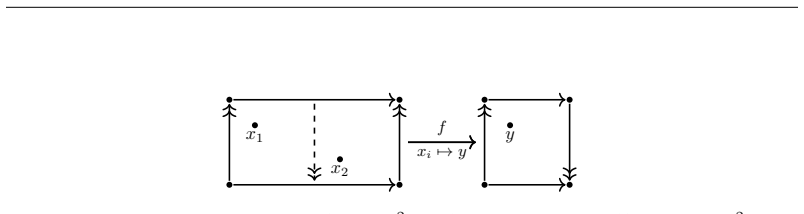
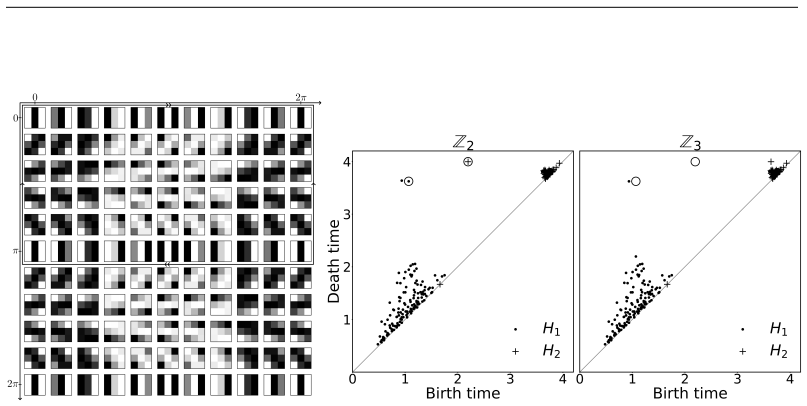
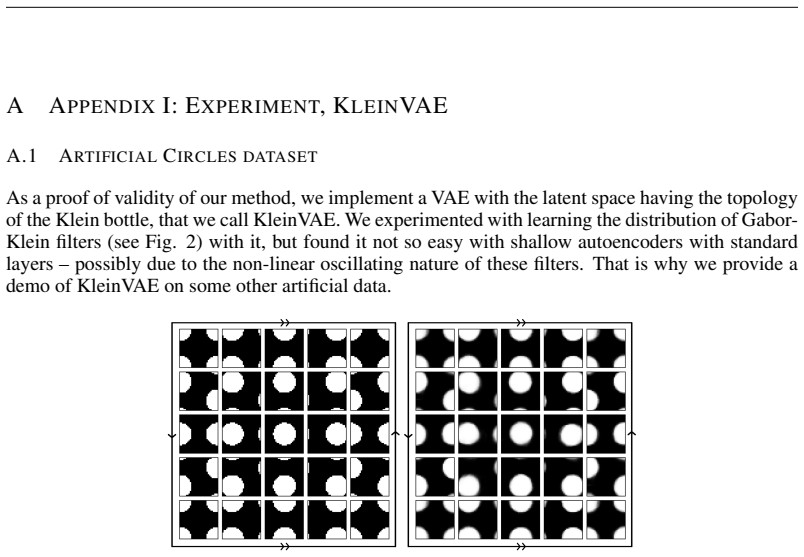
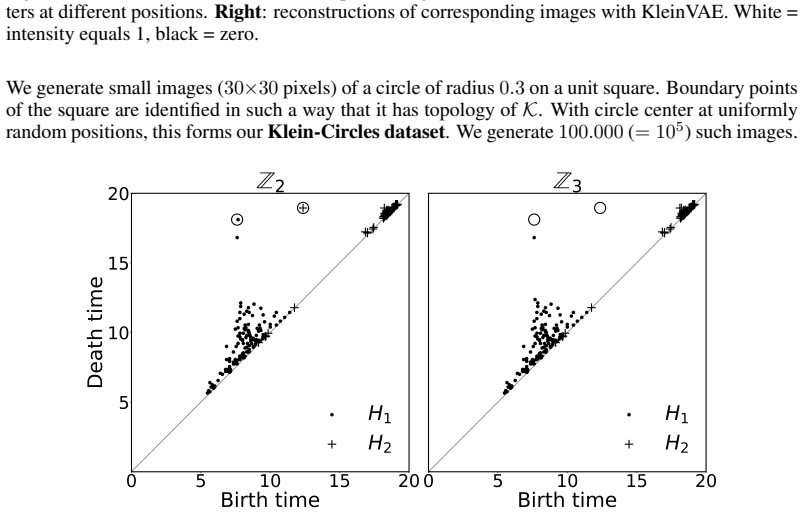
We generalise the reparameterization trick applied in variational autoencoders (VAEs) letting these have latent spaces of non-trivial topology - i.e. that of base manifolds covered with other ones, on which some technique for RT is available. That is possible since covering maps are measurable - moreover, in case of particular measure preservation property holding for the covering, one can establish an inequality on KL-divergence between pushforward (PF) densities on the base latent manifold, making the KL-term of VAE's ELBO analytically tractable, despite the topological non-triviality of the supporting latent manifold. Our development follows a route close but somewhat alternative to reparameterization on Lie groups, the latest proposal for which is to reparameterize PFs of normal densities from the Lie algebra - "through" the exponential map, seen by us as sometimes a particular case of what we propose to call reparameterization through a covering. Covering maps need not be global diffeomorphisms (although Lie-exp maps, in general, need not either, but, to date only smooth ones were considered in this context, to the best of our knowledge), which makes many non-trivial topologies tamable to our proposed technique, that we detail on a particular such example. We demonstrate the working of our approach by constructing a VAE with the latent space of Klein bottle (not a Lie group) topology, which we call KleinVAE, successfully learning an appropriate artificial dataset. We discuss potential applicability of such topology-informed generative models as weight priors in Bayesian learning, particularly for convolutional vision models, where said manifold was peculiarly shown to have some relevance.
Editorial analysis
A structured set of objections, weighed in public.
Referee Report
Summary. The paper proposes generalizing the reparameterization trick for VAEs to latent spaces with non-trivial topology (e.g., Klein bottle) via covering maps from manifolds where reparameterization is available. Under a specific (unnamed) measure-preservation property of the covering, an inequality relating KL divergences of pushforward densities is claimed to make the KL term in the VAE ELBO analytically tractable. The method is illustrated by constructing KleinVAE, which is shown to learn an artificial dataset, and potential use as topological weight priors for Bayesian learning (e.g., in convolutional models) is discussed.
Significance. If the measure-preservation condition can be rigorously stated, verified for standard coverings such as that of the Klein bottle, and the KL inequality derived without circularity, the approach would offer a route to VAEs on manifolds outside Lie groups, extending reparameterization techniques and enabling topology-informed priors. The synthetic demonstration provides initial evidence of feasibility but does not yet establish broader utility.
major comments (3)
- [Abstract / KL-inequality section] Abstract and the section introducing the KL inequality: the central tractability claim rests on an inequality for KL divergences between pushforward densities that holds only under a 'particular measure preservation property' of the covering map. This property is neither explicitly defined nor shown to hold for the identification map used to construct the Klein bottle (e.g., from R^2 or the torus), so the reduction of the ELBO KL term to a tractable form remains unverified.
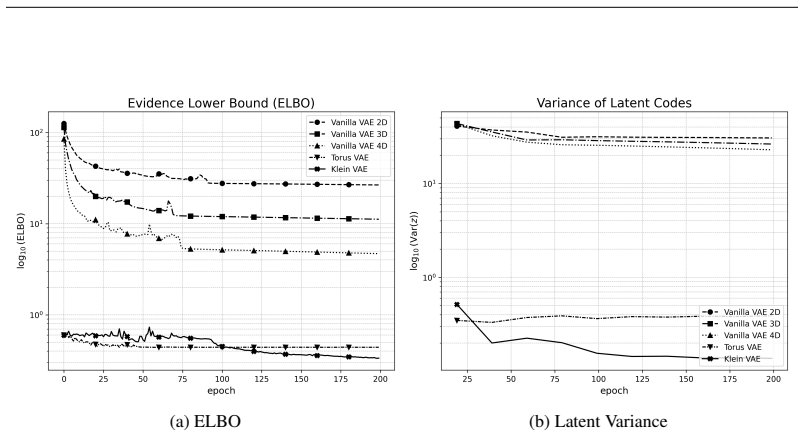
- [KleinVAE experiments] Experimental demonstration (KleinVAE section): only qualitative success on an artificial dataset is reported. No quantitative metrics (e.g., ELBO values, reconstruction error, or comparison against a standard VAE), no ablation on the covering map, and no direct check that the asserted measure-preservation property is satisfied in the implemented model, leaving the practical tractability of the KL term unconfirmed.
- [Relation to Lie groups] § on relation to Lie-group reparameterization: the claim that the exponential map is 'sometimes a particular case' of reparameterization through a covering is asserted without a precise statement of when the covering map coincides with the exp map or when the measure-preservation condition reduces to the usual Lie-algebra case, weakening the positioning relative to prior work.
minor comments (2)
- [Method] Notation for pushforward densities and covering maps should be introduced with explicit definitions and a small diagram of the Klein-bottle covering to aid readability.
- [Abstract] The abstract states the construction but supplies neither the explicit inequality derivation nor quantitative experimental results; moving a concise derivation or pseudocode to the main text would strengthen the presentation.
Simulated Author's Rebuttal
Thank you for the referee's constructive and detailed comments on our manuscript. We address each major point below with the strongest honest defense possible, indicating where revisions will be made to improve clarity, rigor, and validation without misrepresenting the original claims.
read point-by-point responses
-
Referee: [Abstract / KL-inequality section] Abstract and the section introducing the KL inequality: the central tractability claim rests on an inequality for KL divergences between pushforward densities that holds only under a 'particular measure preservation property' of the covering map. This property is neither explicitly defined nor shown to hold for the identification map used to construct the Klein bottle (e.g., from R^2 or the torus), so the reduction of the ELBO KL term to a tractable form remains unverified.
Authors: We acknowledge that while the abstract and relevant section introduce the measure preservation property as a sufficient condition for the KL inequality to hold, a fully explicit definition and verification for the Klein bottle covering were not provided. In the revised manuscript we will add a precise definition: the covering map φ: M → N preserves measures in the sense that for suitable test functions f the integral equality ∫_M (f ∘ φ) dμ = ∫_N f dν holds, where μ and ν are the reference measures on the covering and base manifolds respectively. We will then prove that this property is satisfied by the standard identification map from the torus (or R^2 with periodic identifications) to the Klein bottle via direct computation of the pushforward densities and Jacobian factors. This will rigorously establish the applicability of the KL inequality and confirm tractability of the ELBO term. revision: yes
-
Referee: [KleinVAE experiments] Experimental demonstration (KleinVAE section): only qualitative success on an artificial dataset is reported. No quantitative metrics (e.g., ELBO values, reconstruction error, or comparison against a standard VAE), no ablation on the covering map, and no direct check that the asserted measure-preservation property is satisfied in the implemented model, leaving the practical tractability of the KL term unconfirmed.
Authors: We agree that the current experimental presentation is limited to qualitative visualization. In the revision we will augment the KleinVAE section with quantitative results: reported ELBO values and mean reconstruction errors on the artificial dataset, direct numerical comparison against a standard Euclidean VAE baseline trained on identical data, and an ablation varying the covering construction (e.g., different identification periods). We will also include an explicit numerical check of the measure-preservation property by Monte-Carlo approximation of the relevant integrals over the latent space in the implemented model, thereby confirming practical tractability of the KL term. revision: yes
-
Referee: [Relation to Lie groups] § on relation to Lie-group reparameterization: the claim that the exponential map is 'sometimes a particular case' of reparameterization through a covering is asserted without a precise statement of when the covering map coincides with the exp map or when the measure-preservation condition reduces to the usual Lie-algebra case, weakening the positioning relative to prior work.
Authors: We will strengthen the related-work discussion by adding a precise characterization: the exponential map coincides with a covering map precisely when it is a global covering (which occurs for certain compact Lie groups), and in those cases the measure-preservation property holds with equality, recovering the standard KL computation on the Lie algebra. For non-global cases the inequality version of our result still applies. This explicit reduction clarifies how our framework generalizes the Lie-group approach while encompassing additional topologies such as the Klein bottle. revision: yes
Circularity Check
No circularity: derivation rests on external properties of covering maps and standard VAE ELBO without reduction to fitted inputs or self-referential definitions
full rationale
The paper generalizes the reparameterization trick by invoking that covering maps are measurable and that, conditional on a particular measure preservation property, an inequality relating KL divergences of pushforward densities holds, thereby keeping the VAE ELBO's KL term tractable on non-trivial manifolds such as the Klein bottle. This step is presented as following from the assumed property of the covering rather than being internally derived or fitted; the KleinVAE construction and synthetic-data demonstration serve as an application and empirical check, not a statistical fit renamed as prediction. No self-citations appear load-bearing, no uniqueness theorems are imported from the authors' prior work, and no ansatz is smuggled via citation. The chain therefore remains self-contained against external facts about measurable coverings and the standard variational objective.
Axiom & Free-Parameter Ledger
axioms (2)
- standard math Covering maps are measurable
- domain assumption A particular measure preservation property holds for the covering
Reference graph
Works this paper leans on
-
[1]
" write newline "" before.all 'output.state := FUNCTION n.dashify 't := "" t empty not t #1 #1 substring "-" = t #1 #2 substring "--" = not "--" * t #2 global.max substring 't := t #1 #1 substring "-" = "-" * t #2 global.max substring 't := while if t #1 #1 substring * t #2 global.max substring 't := if while FUNCTION format.date year duplicate empty "emp...
-
[2]
\@ifxundefined[1] #1\@undefined \@firstoftwo \@secondoftwo \@ifnum[1] #1 \@firstoftwo \@secondoftwo \@ifx[1] #1 \@firstoftwo \@secondoftwo [2] @ #1 \@temptokena #2 #1 @ \@temptokena \@ifclassloaded agu2001 natbib The agu2001 class already includes natbib coding, so you should not add it explicitly Type <Return> for now, but then later remove the command n...
-
[3]
\@lbibitem[] @bibitem@first@sw\@secondoftwo \@lbibitem[#1]#2 \@extra@b@citeb \@ifundefined br@#2\@extra@b@citeb \@namedef br@#2 \@nameuse br@#2\@extra@b@citeb \@ifundefined b@#2\@extra@b@citeb @num @parse #2 @tmp #1 NAT@b@open@#2 NAT@b@shut@#2 \@ifnum @merge>\@ne @bibitem@first@sw \@firstoftwo \@ifundefined NAT@b*@#2 \@firstoftwo @num @NAT@ctr \@secondoft...
-
[4]
@open @close @open @close and [1] URL: #1 \@ifundefined chapter * \@mkboth \@ifxundefined @sectionbib * \@mkboth * \@mkboth\@gobbletwo \@ifclassloaded amsart * \@ifclassloaded amsbook * \@ifxundefined @heading @heading NAT@ctr thebibliography [1] @ \@biblabel @NAT@ctr \@bibsetup #1 @NAT@ctr @ @openbib .11em \@plus.33em \@minus.07em 4000 4000 `\.\@m @bibit...
discussion (0)
Sign in with ORCID, Apple, or X to comment. Anyone can read and Pith papers without signing in.