Recognition: unknown
Event-based SLAM Benchmark for High-Speed Maneuvers
Pith reviewed 2026-05-08 02:57 UTC · model grok-4.3
The pith
Event-based state estimation under arbitrary aggressive maneuvers remains unsolved because existing methods require persistent map visibility or assume pure rotations.
A machine-rendered reading of the paper's core claim, the machinery that carries it, and where it could break.
Core claim
Current event-based visual odometry and visual-inertial odometry methods do not fully demonstrate that event-based state estimation under arbitrary aggressive maneuvers is a solved problem. They either require persistent local map visibility within the field of view or assume pure rotations, failing to generalize to six-degree-of-freedom motions where both linear and angular velocities may be large. The EvSLAM framework provides a thorough benchmark with sufficient variation in data collection platforms, diverse extreme lighting scenarios, and a wide scope of challenging motion patterns under a clear definition of high-speed maneuvers for mobile robots, along with a novel evaluation metric,,
What carries the argument
EvSLAM, a benchmarking framework that supplies datasets with varied platforms, extreme lighting, and defined high-speed motion patterns plus a novel metric to assess the operational limits of event-based VO and VIO methods.
If this is right
- State-of-the-art event-based VO and VIO methods exhibit clear shortcomings when evaluated on the EvSLAM high-speed maneuver sequences.
- Insights emerge into which architectural choices perform better under the tested conditions of fast translation and rotation.
- Persistent challenges remain in maintaining map consistency during arbitrary aggressive six-degree-of-freedom motion.
- Existing public datasets are insufficient to demonstrate that event-based state estimation works for general high-speed maneuvers.
Where Pith is reading between the lines
- Methods that dynamically rebuild or select map features during fast translation may be required to move beyond the identified visibility requirement.
- The benchmark could be extended with longer trajectories or additional sensor modalities to expose further failure modes.
- Practical robotic navigation at high speed will likely need event-based techniques that do not presuppose either constant structure visibility or rotation-only motion.
Load-bearing premise
The selected data collection platforms, lighting scenarios, and motion patterns under the defined high-speed maneuvers sufficiently cover real-world aggressive six-degree-of-freedom scenarios without selection bias or platform-specific artifacts.
What would settle it
An event-based method that maintains accurate tracking across every EvSLAM scenario without requiring persistent local map visibility or restricting itself to pure rotations would show that the problem is closer to solved.
Figures




read the original abstract
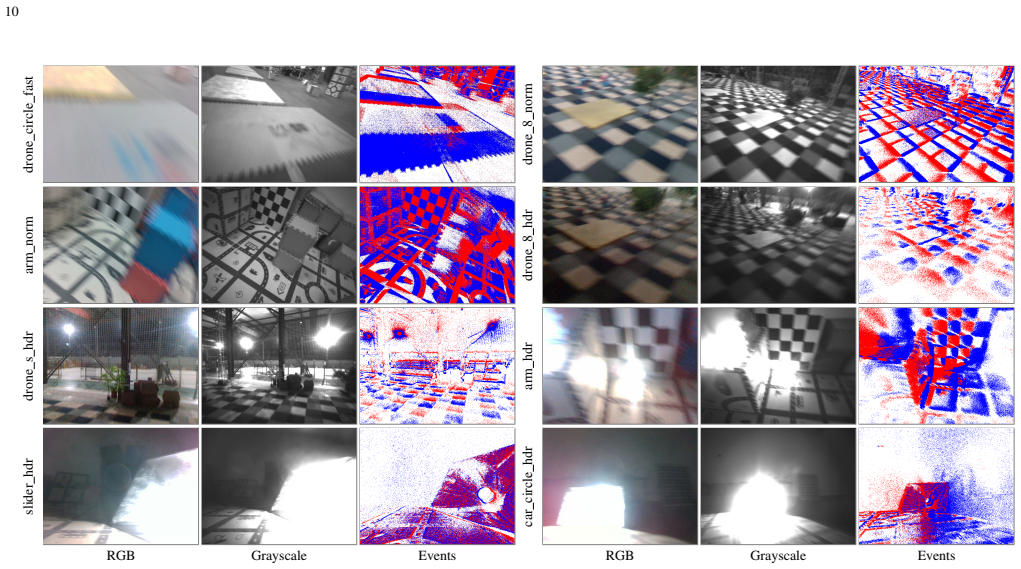
Event-based cameras are bio-inspired sensors with pixels that independently and asynchronously respond to brightness changes at microsecond resolution, offering the potential to handle visual tasks in high-speed maneuvering scenarios. Existing event-based approaches, although successful in mitigating motion blur caused by high-speed maneuvers, suffer from many limitations. Some of them highlight a success of pose tracking for a fronto-parallel fast shaking camera closed to the structure, while others assume pure (optionally aggressive) three-degree-of-freedom rotations. The former requires persistent local map visibility within the field of view (FOV), whereas the latter fails to generalize to six-degree-of-freedom (6-DoF) motions where both linear and angular velocities may be large. Consequently, current successes do not fully demonstrate that event-based state estimation under arbitrary aggressive maneuvers is a fully solved problem. To quantitatively assess the extent to which the potential of event cameras has been unlocked, we conduct a thorough analysis of state-of-the-art (SOTA) event-based visual odometry (VO)/visual-inertial odometry (VIO) methods and report shortcomings in current public datasets. Furthermore, we introduce a benchmarking framework for event-based state estimation, called EvSLAM, characterized by sufficient variation in data collection platforms, diverse extreme lighting scenarios, and a wide scope of challenging motion patterns under a clear and rigorous definition of high-speed maneuvers for mobile robots, along with a novel evaluation metric designed to fairly assess the operational limits of event-based solutions. This framework benchmarks state-of-the-art methods, yielding insights into optimal architectures and persistent challenges.
Editorial analysis
A structured set of objections, weighed in public.
Referee Report
Summary. The manuscript introduces EvSLAM, a benchmarking framework for event-based visual odometry (VO) and visual-inertial odometry (VIO) under high-speed maneuvers. It argues that existing SOTA methods are limited because they either require persistent local map visibility within the FOV or assume pure (optionally aggressive) 3-DoF rotations, and therefore do not demonstrate that event-based state estimation for arbitrary aggressive 6-DoF motions is solved. The work reports shortcomings in current public datasets, provides a new dataset with variation across platforms, extreme lighting, and challenging motion patterns under a claimed rigorous definition of high-speed maneuvers, and introduces a novel evaluation metric to assess operational limits of event-based solutions.
Significance. If the benchmark dataset demonstrably covers representative arbitrary aggressive 6-DoF trajectories with large simultaneous linear and angular velocities, diverse lighting, and multiple platforms without selection bias, and if the new metric fairly penalizes tracking failures, the work would be significant for the event-based robotics community by providing a standardized testbed that exposes persistent architectural limitations and guides future method development.
major comments (2)
- [Abstract] Abstract: the claim of a 'clear and rigorous definition' of high-speed maneuvers together with 'sufficient variation' in platforms, lighting, and motion patterns is load-bearing for the central assertion that observed failures in SOTA methods are attributable to the cited limitations (persistent map visibility or pure-rotation assumptions) rather than dataset-specific artifacts; however, no quantitative thresholds (velocity bounds, trajectory statistics, FOV coverage metrics, or explicit bias checks) are supplied to substantiate coverage of arbitrary 6-DoF aggressive maneuvers.
- [Abstract] The novel evaluation metric is presented as designed to 'fairly assess the operational limits' of event-based solutions, yet the manuscript provides no explicit formulation, comparison to standard ATE/RPE metrics, or ablation showing how it penalizes failures differently from existing protocols; this directly affects the reliability of the reported shortcomings in SOTA methods.
minor comments (1)
- [Abstract] Abstract: the phrasing 'closed to the structure' appears to be a typographical error for 'close to the structure' and should be corrected for clarity.
Simulated Author's Rebuttal
We thank the referee for the constructive and detailed review. The comments identify opportunities to strengthen the abstract's substantiation of key claims. We address each major comment below and will revise the manuscript accordingly.
read point-by-point responses
-
Referee: [Abstract] Abstract: the claim of a 'clear and rigorous definition' of high-speed maneuvers together with 'sufficient variation' in platforms, lighting, and motion patterns is load-bearing for the central assertion that observed failures in SOTA methods are attributable to the cited limitations (persistent map visibility or pure-rotation assumptions) rather than dataset-specific artifacts; however, no quantitative thresholds (velocity bounds, trajectory statistics, FOV coverage metrics, or explicit bias checks) are supplied to substantiate coverage of arbitrary 6-DoF aggressive maneuvers.
Authors: We agree that the abstract would be strengthened by explicitly summarizing the quantitative thresholds and checks that support the definition and variation claims. The full manuscript provides a rigorous definition of high-speed maneuvers in Section 3, including velocity bounds, trajectory statistics, FOV coverage metrics, and verification of platform/lighting/motion diversity to rule out selection bias. We will revise the abstract to include a concise summary of these elements, thereby clarifying that the reported shortcomings in SOTA methods stem from the cited architectural limitations rather than dataset artifacts. revision: yes
-
Referee: [Abstract] The novel evaluation metric is presented as designed to 'fairly assess the operational limits' of event-based solutions, yet the manuscript provides no explicit formulation, comparison to standard ATE/RPE metrics, or ablation showing how it penalizes failures differently from existing protocols; this directly affects the reliability of the reported shortcomings in SOTA methods.
Authors: We appreciate the referee's emphasis on transparency for the evaluation metric. The manuscript details the novel metric's formulation, its comparison to standard ATE/RPE, and supporting ablations in the methods and experiments sections, where it is shown to penalize early tracking failures more directly than conventional protocols. We acknowledge that the abstract does not convey this explicitly. We will revise the abstract to briefly outline the metric's design and its differentiation from existing metrics, reinforcing the reliability of the benchmark results. revision: yes
Circularity Check
No circularity: benchmark evaluates external SOTA methods on newly collected data without self-referential derivations
full rationale
The paper is a benchmarking study that introduces EvSLAM with new data collection platforms, lighting scenarios, and motion patterns under a defined high-speed maneuver criterion. It evaluates existing event-based VO/VIO methods from the literature on this data and reports observed shortcomings. No equations, predictions, or central claims reduce by construction to parameters fitted from the introduced dataset itself. Self-citations (if present) are not load-bearing for any derivation, as the work contains no first-principles derivations or uniqueness theorems. The analysis of limitations in prior methods rests on empirical performance gaps rather than re-deriving those methods' results from the new data. This is the standard non-circular structure for a dataset/benchmark paper.
Axiom & Free-Parameter Ledger
Reference graph
Works this paper leans on
-
[1]
Past, present, and future of simultaneous localization and mapping: Toward the robust-perception age,
C. Cadena, L. Carlone, H. Carrillo, Y . Latif, D. Scaramuzza, J. Neira, I. D. Reid, and J. J. Leonard, “Past, present, and future of simultaneous localization and mapping: Toward the robust-perception age,”IEEE Trans. Robot., vol. 32, no. 6, pp. 1309–1332, 2016
2016
-
[2]
A comprehensive survey of visual SLAM algorithms,
A. Macario Barros, M. Michel, Y . Moline, G. Corre, and F. Carrel, “A comprehensive survey of visual SLAM algorithms,”Robotics, vol. 11, no. 1, p. 24, 2022
2022
-
[3]
Event-based vision: A survey,
G. Gallego, T. Delbruck, G. Orchard, C. Bartolozzi, B. Taba, A. Censi, S. Leutenegger, A. Davison, J. Conradt, K. Daniilidis, and D. Scara- muzza, “Event-based vision: A survey,”IEEE Trans. Pattern Anal. Mach. Intell., vol. 44, no. 1, pp. 154–180, 2022
2022
-
[4]
Retinomorphic event-based vision sensors: Bioinspired cameras with spiking output,
C. Posch, T. Serrano-Gotarredona, B. Linares-Barranco, and T. Del- bruck, “Retinomorphic event-based vision sensors: Bioinspired cameras with spiking output,”Proc. IEEE, vol. 102, no. 10, pp. 1470–1484, Oct. 2014
2014
-
[5]
A 128×128 120 dB 15µs latency asynchronous temporal contrast vision sensor,
P. Lichtsteiner, C. Posch, and T. Delbruck, “A 128×128 120 dB 15µs latency asynchronous temporal contrast vision sensor,”IEEE J. Solid- State Circuits, vol. 43, no. 2, pp. 566–576, 2008
2008
-
[6]
Event-based SLAM,
G. Gallego, J. Hidalgo-Carri ´o, and D. Scaramuzza, “Event-based SLAM,” inSLAM Handbook. From Localization and Mapping to Spatial Intelligence, L. Carlone, A. Kim, F. Dellaert, T. Barfoot, and D. Cremers, Eds. Cambridge University Press, 2026, pp. 282–302
2026
-
[7]
EMVS: Event-based multi-view stereo—3D reconstruction with an event camera in real-time,
H. Rebecq, G. Gallego, E. Mueggler, and D. Scaramuzza, “EMVS: Event-based multi-view stereo—3D reconstruction with an event camera in real-time,”Int. J. Comput. Vis., vol. 126, no. 12, pp. 1394–1414, Dec. 2018
2018
-
[8]
EVO: A geometric approach to event-based 6-DOF parallel tracking and mapping in real-time,
H. Rebecq, T. Horstsch ¨afer, G. Gallego, and D. Scaramuzza, “EVO: A geometric approach to event-based 6-DOF parallel tracking and mapping in real-time,”IEEE Robot. Autom. Lett., vol. 2, no. 2, pp. 593–600, 2017
2017
-
[9]
Ultimate SLAM? combining events, images, and IMU for robust visual SLAM in HDR and high speed scenarios,
A. Rosinol Vidal, H. Rebecq, T. Horstschaefer, and D. Scaramuzza, “Ultimate SLAM? combining events, images, and IMU for robust visual SLAM in HDR and high speed scenarios,”IEEE Robot. Autom. Lett., vol. 3, no. 2, pp. 994–1001, Apr. 2018
2018
-
[10]
CMax-SLAM: Event-based rotational-motion bundle adjustment and SLAM system using contrast maximization,
S. Guo and G. Gallego, “CMax-SLAM: Event-based rotational-motion bundle adjustment and SLAM system using contrast maximization,” IEEE Trans. Robot., vol. 40, pp. 2442–2461, 2024
2024
-
[11]
VECtor: A versatile event-centric benchmark for multi-sensor SLAM,
L. Gao, Y . Liang, J. Yang, S. Wu, C. Wang, J. Chen, and L. Kneip, “VECtor: A versatile event-centric benchmark for multi-sensor SLAM,” IEEE Robot. Autom. Lett., vol. 7, no. 3, pp. 8217–8224, 2022
2022
-
[12]
TUM-VIE: The TUM stereo visual-inertial event dataset,
S. Klenk, J. Chui, N. Demmel, and D. Cremers, “TUM-VIE: The TUM stereo visual-inertial event dataset,” inIEEE/RSJ Int. Conf. Intell. Robot. Syst. (IROS), 2021, pp. 8601–8608
2021
-
[13]
M3ED: Multi-robot, multi- sensor, multi-environment event dataset,
K. Chaney, F. Cladera, Z. Wang, A. Bisulco, M. A. Hsieh, C. Korpela, V . Kumar, C. J. Taylor, and K. Daniilidis, “M3ED: Multi-robot, multi- sensor, multi-environment event dataset,” inIEEE Conf. Comput. Vis. Pattern Recog. Workshops (CVPRW), 2023, pp. 4016–4023
2023
-
[14]
Event-based simultaneous localization and mapping: A comprehensive survey,
K. Huang, S. Zhang, J. Zhang, and D. Tao, “Event-based simultaneous localization and mapping: A comprehensive survey,”arXiv e-prints, 2024
2024
-
[15]
Application of event cameras and neuromorphic computing to VSLAM: A survey,
S. Tenzin, A. Rassau, and D. Chai, “Application of event cameras and neuromorphic computing to VSLAM: A survey,”Biomimetics, vol. 9, no. 7, p. 444, Jul. 2024
2024
-
[16]
Event-based stereo depth estimation: A survey,
S. Ghosh and G. Gallego, “Event-based stereo depth estimation: A survey,”IEEE Trans. Pattern Anal. Mach. Intell., vol. 47, no. 10, pp. 9130–9149, 2025
2025
-
[17]
Event-based stereo visual odometry,
Y . Zhou, G. Gallego, and S. Shen, “Event-based stereo visual odometry,” IEEE Trans. Robot., vol. 37, no. 5, pp. 1433–1450, 2021
2021
-
[18]
Event-aided direct sparse odometry,
J. Hidalgo-Carri ´o, G. Gallego, and D. Scaramuzza, “Event-aided direct sparse odometry,” inIEEE Conf. Comput. Vis. Pattern Recog. (CVPR), Jun. 2022, pp. 5781–5790
2022
-
[19]
Event-based stereo visual odometry with native temporal resolution via continuous-time Gaussian process regression,
J. Wang and J. D. Gammell, “Event-based stereo visual odometry with native temporal resolution via continuous-time Gaussian process regression,”IEEE Robot. Autom. Lett., vol. 8, no. 10, pp. 6707–6714, 2023
2023
-
[20]
ESVIO: Event-based stereo visual inertial odometry,
P. Chen, W. Guan, and P. Lu, “ESVIO: Event-based stereo visual inertial odometry,”IEEE Robot. Autom. Lett., vol. 8, no. 6, pp. 3661–3668, 2023
2023
-
[21]
IMU-aided event-based stereo visual odometry,
J. Niu, S. Zhong, and Y . Zhou, “IMU-aided event-based stereo visual odometry,” inIEEE Int. Conf. Robot. Autom. (ICRA), 2024, pp. 11 977– 11 983
2024
-
[22]
PL-EVIO: Robust monocular event-based visual inertial odometry with point and line features,
W. Guan, P. Chen, Y . Xie, and P. Lu, “PL-EVIO: Robust monocular event-based visual inertial odometry with point and line features,”IEEE Trans. Autom. Sci. Eng., vol. 21, no. 4, pp. 6277–6293, 2024
2024
-
[23]
Deep event visual odometry,
S. Klenk, M. Motzet, L. Koestler, and D. Cremers, “Deep event visual odometry,” inInt. Conf. 3D Vision (3DV), 2024, pp. 739–749
2024
-
[24]
ES-PTAM: Event-based stereo parallel tracking and mapping,
S. Ghosh, V . Cavinato, and G. Gallego, “ES-PTAM: Event-based stereo parallel tracking and mapping,” inEur. Conf. Comput. Vis. Workshops (ECCVW), 2024, pp. 70–87
2024
-
[25]
ESVO2: Direct visual-inertial odometry with stereo event cameras,
J. Niu, S. Zhong, X. Lu, S. Shen, G. Gallego, and Y . Zhou, “ESVO2: Direct visual-inertial odometry with stereo event cameras,”IEEE Trans. Robot., vol. 41, pp. 2164–2183, 2025
2025
-
[26]
DEIO: Deep event inertial odometry,
W. Guan, F. Lin, P. Chen, and P. Lu, “DEIO: Deep event inertial odometry,” inInt. Conf. Comput. Vis. Workshops (ICCVW), 2025
2025
-
[27]
Event-based visual- inertial state estimation for high-speed maneuvers,
X. Lu, Y . Zhou, J. Mai, K. Dai, Y . Xu, and S. Shen, “Event-based visual- inertial state estimation for high-speed maneuvers,”IEEE Trans. Robot., vol. 41, pp. 4439–4458, 2025
2025
-
[28]
SuperEvent: Cross- modal learning of event-based keypoint detection for SLAM,
Y . Burkhardt, S. Schaefer, and S. Leutenegger, “SuperEvent: Cross- modal learning of event-based keypoint detection for SLAM,” inInt. Conf. Comput. Vis. (ICCV), Oct. 2025, pp. 8918–8928
2025
-
[29]
Deep visual odometry for stereo event cameras,
S. Zhong, J. Niu, and Y . Zhou, “Deep visual odometry for stereo event cameras,”IEEE Robot. Autom. Lett., vol. 10, no. 11, pp. 11 078––11 085, Nov. 2025
2025
-
[30]
AsynEIO: Asyn- chronous monocular event-inertial odometry using Gaussian process regression,
Z. Wang, X. Li, Y . Zhang, F. Zhang, and P. Huang, “AsynEIO: Asyn- chronous monocular event-inertial odometry using Gaussian process regression,”IEEE Trans. Robot., 2025
2025
-
[31]
Semi-dense 3D reconstruction with a stereo event camera,
Y . Zhou, G. Gallego, H. Rebecq, L. Kneip, H. Li, and D. Scaramuzza, “Semi-dense 3D reconstruction with a stereo event camera,” inEur. Conf. Comput. Vis. (ECCV), 2018, pp. 242–258
2018
-
[32]
Asynchronous corner detection and tracking for event cameras in real time,
I. Alzugaray and M. Chli, “Asynchronous corner detection and tracking for event cameras in real time,”IEEE Robot. Autom. Lett., vol. 3, no. 4, pp. 3177–3184, Oct. 2018
2018
-
[33]
FA-Harris: A fast and asynchronous corner detector for event cameras,
R. Li, D. Shi, Y . Zhang, K. Li, and R. Li, “FA-Harris: A fast and asynchronous corner detector for event cameras,” inIEEE/RSJ Int. Conf. Intell. Robot. Syst. (IROS), 2019
2019
-
[34]
Feature- based event stereo visual odometry,
A. Hadviger, I. Cvi ˇsi´c, I. Markovi´c, S. Vraˇzi´c, and I. Petrovi ´c, “Feature- based event stereo visual odometry,” inEur. Conf. Mobile Robots (ECMR), 2021, pp. 1–6
2021
-
[35]
A combined corner and edge detector,
C. Harris and M. Stephens, “A combined corner and edge detector,” in Proc. Fourth Alvey Vision Conf., vol. 15, 1988, pp. 147–151
1988
-
[36]
Machine learning for high-speed corner detection,
E. Rosten and T. Drummond, “Machine learning for high-speed corner detection,” inEur. Conf. Comput. Vis. (ECCV), 2006, pp. 430–443
2006
-
[37]
VINS-Mono: A robust and versatile monocular visual-inertial state estimator,
T. Qin, P. Li, and S. Shen, “VINS-Mono: A robust and versatile monocular visual-inertial state estimator,”IEEE Trans. Robot., vol. 34, no. 4, pp. 1004–1020, 2018
2018
-
[38]
An iterative image registration technique with an application to stereo vision,
B. D. Lucas and T. Kanade, “An iterative image registration technique with an application to stereo vision,” inInt. Joint Conf. Artificial Intell. (IJCAI), 1981, pp. 674–679
1981
-
[39]
HASTE: multi-hypothesis asynchronous speeded-up tracking of events,
I. Alzugaray and M. Chli, “HASTE: multi-hypothesis asynchronous speeded-up tracking of events,” inBritish Mach. Vis. Conf. (BMVC), 2020
2020
-
[40]
RATE: Real-time asynchronous feature tracking with event cameras,
M. Ikura, C. Le Gentil, M. G. M ¨uller, F. Schuler, A. Yamashita, and W. St¨urzl, “RATE: Real-time asynchronous feature tracking with event cameras,” inIEEE/RSJ Int. Conf. Intell. Robot. Syst. (IROS), 2024, pp. 11 662–11 669
2024
-
[41]
Good features to track,
J. Shi and C. Tomasi, “Good features to track,” inIEEE Conf. Comput. Vis. Pattern Recog. (CVPR), 1994, pp. 593–600
1994
-
[42]
Unsupervised event- based learning of optical flow, depth, and egomotion,
A. Z. Zhu, L. Yuan, K. Chaney, and K. Daniilidis, “Unsupervised event- based learning of optical flow, depth, and egomotion,” inIEEE Conf. Comput. Vis. Pattern Recog. (CVPR), 2019, pp. 989–997. 15
2019
-
[43]
Unsupervised learning of dense optical flow, depth and egomotion with event-based sensors,
C. Ye, A. Mitrokhin, C. Parameshwara, C. Ferm ¨uller, J. A. Yorke, and Y . Aloimonos, “Unsupervised learning of dense optical flow, depth and egomotion with event-based sensors,” inIEEE/RSJ Int. Conf. Intell. Robot. Syst. (IROS), 2020, pp. 5831–5838
2020
-
[44]
Deep patch visual odometry,
Z. Teed, L. Lipson, and J. Deng, “Deep patch visual odometry,” inAdv. Neural Inf. Process. Syst. (NeurIPS), 2023
2023
-
[45]
A 240x180 130dB 3µs latency global shutter spatiotemporal vision sensor,
C. Brandli, R. Berner, M. Yang, S.-C. Liu, and T. Delbruck, “A 240x180 130dB 3µs latency global shutter spatiotemporal vision sensor,”IEEE J. Solid-State Circuits, vol. 49, no. 10, pp. 2333–2341, 2014
2014
-
[46]
SuperPoint: Self- supervised interest point detection and description,
D. DeTone, T. Malisiewicz, and A. Rabinovich, “SuperPoint: Self- supervised interest point detection and description,” inIEEE Conf. Comput. Vis. Pattern Recog. Workshops (CVPRW), 2018, pp. 224–236
2018
-
[47]
SuperGlue: Learning feature matching with graph neural networks,
P.-E. Sarlin, D. DeTone, T. Malisiewicz, and A. Rabinovich, “SuperGlue: Learning feature matching with graph neural networks,”IEEE Conf. Comput. Vis. Pattern Recog. (CVPR), pp. 4938–4947, 2020
2020
-
[48]
The event-camera dataset and simulator: Event-based data for pose estimation, visual odometry, and SLAM,
E. Mueggler, H. Rebecq, G. Gallego, T. Delbruck, and D. Scaramuzza, “The event-camera dataset and simulator: Event-based data for pose estimation, visual odometry, and SLAM,”Int. J. Robot. Research, vol. 36, no. 2, pp. 142–149, 2017
2017
-
[49]
Are we ready for autonomous drone racing? The UZH-FPV drone racing dataset,
J. Delmerico, T. Cieslewski, H. Rebecq, M. Faessler, and D. Scaramuzza, “Are we ready for autonomous drone racing? The UZH-FPV drone racing dataset,” inIEEE Int. Conf. Robot. Autom. (ICRA), 2019, pp. 6713–6719
2019
-
[50]
The multivehicle stereo event camera dataset: An event camera dataset for 3D perception,
A. Z. Zhu, D. Thakur, T. Ozaslan, B. Pfrommer, V . Kumar, and K. Daniilidis, “The multivehicle stereo event camera dataset: An event camera dataset for 3D perception,”IEEE Robot. Autom. Lett., vol. 3, no. 3, pp. 2032–2039, Jul. 2018
2032
-
[51]
DSEC: A stereo event camera dataset for driving scenarios,
M. Gehrig, W. Aarents, D. Gehrig, and D. Scaramuzza, “DSEC: A stereo event camera dataset for driving scenarios,”IEEE Robot. Autom. Lett., vol. 6, no. 3, pp. 4947–4954, 2021
2021
-
[52]
M2DGR: A multi-sensor and multi-scenario SLAM dataset for ground robots,
J. Yin, A. Li, T. Li, W. Yu, and D. Zou, “M2DGR: A multi-sensor and multi-scenario SLAM dataset for ground robots,”IEEE Robot. Autom. Lett., vol. 7, no. 2, pp. 2266–2273, 2022
2022
-
[53]
FusionPortable: A multi- sensor campus-scene dataset for evaluation of localization and mapping accuracy on diverse platforms,
J. Jiao, H. Wei, T. Hu, X. Hu, Y . Zhu, Z. He, J. Wu, J. Yu, X. Xie, H. Huang, R. Geng, L. Wang, and M. Liu, “FusionPortable: A multi- sensor campus-scene dataset for evaluation of localization and mapping accuracy on diverse platforms,” inIEEE/RSJ Int. Conf. Intell. Robot. Syst. (IROS), 2022, pp. 3851–3856
2022
-
[54]
ECMD: An event-centric multisensory driving dataset for SLAM,
P. Chen, W. Guan, F. Huang, Y . Zhong, W. Wen, L.-T. Hsu, and P. Lu, “ECMD: An event-centric multisensory driving dataset for SLAM,” IEEE Trans. Intell. Vehicles, vol. 9, no. 1, pp. 407–416, 2024
2024
-
[55]
FusionportableV2: A unified multi-sensor dataset for generalized SLAM across diverse platforms and scalable environments,
H. Wei, J. Jiao, X. Hu, J. Yu, X. Xie, J. Wu, Y . Zhu, Y . Liu, L. Wang, and M. Liu, “FusionportableV2: A unified multi-sensor dataset for generalized SLAM across diverse platforms and scalable environments,” Int. J. Robot. Research, vol. 44, no. 7, pp. 1093–1116, 2025
2025
-
[56]
CoSEC: A coaxial stereo event camera dataset for autonomous driving,
S. Peng, H. Zhou, H. Dong, Z. Shi, H. Liu, Y . Duan, Y . Chang, and L. Yan, “CoSEC: A coaxial stereo event camera dataset for autonomous driving,”arXiv e-prints, 2024
2024
-
[57]
Event- based 3D SLAM with a depth-augmented dynamic vision sensor,
D. Weikersdorfer, D. B. Adrian, D. Cremers, and J. Conradt, “Event- based 3D SLAM with a depth-augmented dynamic vision sensor,” in IEEE Int. Conf. Robot. Autom. (ICRA), 2014, pp. 359–364
2014
-
[58]
Real-time loop closure in 2D LIDAR SLAM,
W. Hess, D. Kohler, H. Rapp, and D. Andor, “Real-time loop closure in 2D LIDAR SLAM,” inIEEE Int. Conf. Robot. Autom. (ICRA), 2016, pp. 1271–1278
2016
-
[59]
EKLT: Asyn- chronous photometric feature tracking using events and frames,
D. Gehrig, H. Rebecq, G. Gallego, and D. Scaramuzza, “EKLT: Asyn- chronous photometric feature tracking using events and frames,”Int. J. Comput. Vis., vol. 128, pp. 601–618, 2020
2020
-
[60]
HOTS: A hierarchy of event-based time-surfaces for pattern recog- nition,
X. Lagorce, G. Orchard, F. Gallupi, B. E. Shi, and R. Benosman, “HOTS: A hierarchy of event-based time-surfaces for pattern recog- nition,”IEEE Trans. Pattern Anal. Mach. Intell., vol. 39, no. 7, pp. 1346–1359, Jul. 2017
2017
-
[61]
Focusing,
E. Krotkov, “Focusing,”Int. J. Comput. Vis., vol. 1, no. 3, pp. 223–237, 1988
1988
-
[62]
J ¨ahne,Digital image processing
B. J ¨ahne,Digital image processing. Springer, 2005
2005
-
[63]
Autofocus for event cameras,
S. Lin, Y . Zhang, L. Yu, B. Zhou, X. Luo, and J. Pan, “Autofocus for event cameras,” inIEEE Conf. Comput. Vis. Pattern Recog. (CVPR), Jun. 2022, pp. 16 344–16 353
2022
-
[64]
Event-based, 6-DOF camera tracking from photometric depth maps,
G. Gallego, J. E. A. Lund, E. Mueggler, H. Rebecq, T. Delbruck, and D. Scaramuzza, “Event-based, 6-DOF camera tracking from photometric depth maps,”IEEE Trans. Pattern Anal. Mach. Intell., vol. 40, no. 10, pp. 2402–2412, Oct. 2018
2018
-
[65]
Event vision sensor: A review,
X. Qin, J. Zhang, W. Bao, C. Lin, and H. Chen, “Event vision sensor: A review,”arXiv preprint 2502.06116, 2025
-
[66]
Multi-event-camera depth estimation and outlier rejection by refocused events fusion,
S. Ghosh and G. Gallego, “Multi-event-camera depth estimation and outlier rejection by refocused events fusion,”Adv. Intell. Syst., vol. 4, no. 12, p. 2200221, 2022
2022
-
[67]
Efficient and distinct large scale bags of words,
T. P ¨onitz, J. St ¨ottinger, R. Donner, and A. Hanbury, “Efficient and distinct large scale bags of words,” in34th Annual Workshop of the Austrian Association for Pattern Recognition (AAPR) and the WG Visual Computing of the Austrian Computer Society, 2010, pp. 139—-146
2010
-
[68]
Are high-resolution event cameras really needed?
D. Gehrig and D. Scaramuzza, “Are high-resolution event cameras really needed?”arXiv preprint 2203.14672, 2022
-
[69]
OpenCalib: A multi-sensor calibration toolbox for autonomous driving,
G. Yan, Z. Liu, C. Wang, C. Shi, P. Wei, X. Cai, T. Ma, Z. Liu, Z. Zhong, Y . Liuet al., “OpenCalib: A multi-sensor calibration toolbox for autonomous driving,”Software Impacts, vol. 14, p. 100393, 2022
2022
-
[70]
simple image recon,
B. Pfrommer, “simple image recon,” 2024. [Online]. Available: https://github.com/berndpfrommer/simple image recon
2024
-
[71]
A robust O(n) solution to the perspective-n- point problem,
S. Li, C. Xu, and M. Xie, “A robust O(n) solution to the perspective-n- point problem,”IEEE Trans. Pattern Anal. Mach. Intell., vol. 34, no. 7, pp. 1444–1450, 2012
2012
-
[72]
Hand-eye calibration using dual quaternions,
K. Daniilidis, “Hand-eye calibration using dual quaternions,”Int. J. Robot. Research, vol. 18, no. 3, pp. 286–298, 1999
1999
-
[73]
A benchmark for the evaluation of RGB-D SLAM systems,
J. Sturm, N. Engelhard, F. Endres, W. Burgard, and D. Cremers, “A benchmark for the evaluation of RGB-D SLAM systems,” inIEEE/RSJ Int. Conf. Intell. Robot. Syst. (IROS), Oct. 2012, pp. 573–580
2012
-
[74]
Event-based Visual Inertial Velometer,
X. Lu, Y . Zhou, J. Niu, S. Zhong, and S. Shen, “Event-based Visual Inertial Velometer,” inRobotics: Science and Systems (RSS), Jul. 2024
2024
-
[75]
REMODE: Probabilistic, monocular dense reconstruction in real time,
M. Pizzoli, C. Forster, and D. Scaramuzza, “REMODE: Probabilistic, monocular dense reconstruction in real time,” inIEEE Int. Conf. Robot. Autom. (ICRA), 2014, pp. 2609–2616
2014
-
[76]
Tracking any point with frame-event fusion network at high frame rate,
J. Liu, B. Wang, Z. Tan, J. Zhang, H. Shen, and D. Hu, “Tracking any point with frame-event fusion network at high frame rate,” inIEEE/RSJ Int. Conf. Intell. Robot. Syst. (IROS), 2025, pp. 18 834–18 840
2025
-
[77]
Yao and CPNTLAB, “REFIO,” inTeam at Sun Yat-sen University, IROS Workshop on Event-based Vision, Oct
H. Yao and CPNTLAB, “REFIO,” inTeam at Sun Yat-sen University, IROS Workshop on Event-based Vision, Oct. 2025
2025
-
[78]
OKVIS2: Realtime scalable visual-inertial SLAM with loop closure,
S. Leutenegger, “OKVIS2: Realtime scalable visual-inertial SLAM with loop closure,”arXiv preprint 2202.09199, 2022
-
[79]
BRISK: Binary robust invariant scalable keypoints,
S. Leutenegger, M. Chli, and R. Siegwart, “BRISK: Binary robust invariant scalable keypoints,” inInt. Conf. Comput. Vis. (ICCV), 2011, pp. 2548–2555
2011
-
[80]
A general optimisation-based framework for global pose estimation with multiple sensors,
T. Qin, S. Cao, J. Pan, and S. Shen, “A general optimisation-based framework for global pose estimation with multiple sensors,”IET Cyber- Systems and Robotics, vol. 7, no. 1, p. e70023, 2025
2025
discussion (0)
Sign in with ORCID, Apple, or X to comment. Anyone can read and Pith papers without signing in.