Recognition: unknown
Characterizing Fill Factor Limitations in Perovskite-Silicon Tandem Solar Cells
Pith reviewed 2026-05-08 03:09 UTC · model grok-4.3
The pith
Photoshunt from moderate transport-layer mobility reduces apparent parallel resistance in perovskite top cells and can be masked by over-illuminating the silicon bottom cell.
A machine-rendered reading of the paper's core claim, the machinery that carries it, and where it could break.
Core claim
The fill factor of perovskite-silicon monolithic tandems is limited by a photoshunt in the top cell that appears as reduced parallel resistance under illumination owing to moderate charge-transport-layer mobility; this photoshunt is concealed when the silicon bottom cell is over-illuminated, explaining why high-performance devices are typically bottom-cell current-limited. Series-resistance contributions can be isolated via electroluminescence, and the silicon two-diode characteristic further modulates tandem fill factor.
What carries the argument
Photoshunt, the apparent drop in parallel resistance under illumination caused by moderate charge transport layer mobility in the perovskite sub-cell.
If this is right
- Raising mobility in the perovskite charge-transport layers directly lowers the photoshunt contribution to fill-factor loss.
- High-efficiency tandems remain bottom-cell limited because over-illumination of the silicon cell conceals the photoshunt.
- Series-resistance losses in the tandem can be quantified separately using electroluminescence imaging.
- The two-diode recombination behavior of the silicon bottom cell adds an additional fill-factor term that must be modeled in tandem design.
- Overcoming the photoshunt moves the perovskite top cell closer to the low fill-factor losses already achieved in single-junction silicon cells.
Where Pith is reading between the lines
- Current-matching strategies that deliberately over-illuminate the bottom cell may remain advantageous even after transport-layer mobility is improved, because residual photoshunt could still be present.
- Similar apparent-resistance reduction under light may appear in other thin-film top cells paired with crystalline-silicon bottoms whenever transport-layer mobility is limited.
- Spectral tuning of the incident light during tandem characterization could be used to map the exact illumination threshold at which photoshunt becomes visible.
Load-bearing premise
The observed drop in apparent parallel resistance under light is produced by moderate mobility in the perovskite charge-transport layers rather than by some other unaccounted mechanism.
What would settle it
Fabricate a perovskite sub-cell with transport layers of demonstrably higher mobility, measure its illuminated current-voltage curve in a tandem stack, and check whether the apparent parallel resistance still falls under illumination to the same degree.
Figures

read the original abstract
Perovskite-silicon tandem technology has exceeded the single junction theoretical efficiency limit. However, there is still distance to the thermodynamic limit mainly caused by the fill factor. This work presents a methodology to illustrate the mechanisms of FF loss in perovskite-Si monolithic tandem solar cells. Apart from the series resistance related loss characterized by electroluminescence, another loss factor is from the photoshunt, a phenomenon in which the parallel resistance apparently reduces under illumination in perovskite solar cells due to the moderate charge transport layer mobility. In addoition, the two-diode property of the Si cell can also influence the FF of tandem devices. The photoshunt can be hidden when the bottom cell is over illuminated, which explains highly efficient tandem solar cells are usually bottom cell limited. This work outlines strategies that overcoming the photoshunt issue can move the perovskite top cell closer to low FF losses in tandem solar cells.
Editorial analysis
A structured set of objections, weighed in public.
Referee Report
Summary. The paper claims to present a methodology for illustrating the mechanisms of fill factor (FF) loss in perovskite-silicon monolithic tandem solar cells. Key loss factors identified are series resistance (characterized by electroluminescence), photoshunt (apparent reduction in parallel resistance under illumination due to moderate charge transport layer mobility in the perovskite sub-cell), and the two-diode property of the Si cell. It further claims that the photoshunt can be hidden when the bottom cell is over-illuminated, explaining why highly efficient tandem solar cells are usually bottom cell limited, and outlines strategies to overcome the photoshunt issue.
Significance. If the results hold, this work could be significant for the field by providing an explanation for the observed bottom-cell limitation in high-efficiency perovskite-silicon tandems and offering pathways to reduce FF losses in the perovskite top cell. The concept of photoshunt hiding under specific illumination conditions is novel and could influence device optimization strategies. However, the assessment is tempered by the need for stronger validation of the underlying mechanism.
major comments (2)
- [Abstract and methodology description] Abstract and methodology description: The central claim that the photoshunt arises specifically from moderate charge transport layer mobility is not accompanied by direct evidence, such as mobility values extracted independently or experiments ruling out other light-dependent shunt mechanisms like ion migration or trap-filling. This attribution is load-bearing for the explanation of the hiding effect and the recommendation for strategies.
- [Results section] Results section: The manuscript does not appear to include quantitative data, error bars, or model fits demonstrating the reduction in apparent parallel resistance or the hiding of the photoshunt under over-illumination of the bottom cell, which undermines the ability to evaluate the strength of the conclusions.
minor comments (1)
- [Abstract] Typo in 'In addoition' which should read 'In addition'.
Simulated Author's Rebuttal
We thank the referee for their insightful comments on our manuscript. We have addressed the concerns about the evidence supporting the photoshunt mechanism and the presentation of quantitative data. Our point-by-point responses are provided below, and we have made revisions to strengthen the manuscript accordingly.
read point-by-point responses
-
Referee: [Abstract and methodology description] Abstract and methodology description: The central claim that the photoshunt arises specifically from moderate charge transport layer mobility is not accompanied by direct evidence, such as mobility values extracted independently or experiments ruling out other light-dependent shunt mechanisms like ion migration or trap-filling. This attribution is load-bearing for the explanation of the hiding effect and the recommendation for strategies.
Authors: We appreciate the referee pointing out the need for stronger evidence on the origin of the photoshunt. Our attribution is based on detailed drift-diffusion modeling using mobility values typical for perovskite charge transport layers as reported in the literature. While independent mobility extraction (e.g., via Hall effect or time-of-flight) was not performed in this study, we have added a discussion in the revised manuscript explaining why other mechanisms like ion migration or trap-filling are inconsistent with the observed illumination-dependent behavior and the absence of significant hysteresis in our devices. We have also included sensitivity analysis showing how moderate mobility leads to the apparent shunt. This revision clarifies the load-bearing aspects of our claims. revision: yes
-
Referee: [Results section] Results section: The manuscript does not appear to include quantitative data, error bars, or model fits demonstrating the reduction in apparent parallel resistance or the hiding of the photoshunt under over-illumination of the bottom cell, which undermines the ability to evaluate the strength of the conclusions.
Authors: We agree that the original presentation lacked explicit quantitative support. The reduction in apparent parallel resistance is evident from the J-V characteristics, but we have now added quantitative analysis in the revised results section. Specifically, we include extracted values of apparent Rp from dark and light measurements with error bars representing standard deviation across multiple devices. Furthermore, we have incorporated model fits using the two-diode model for the silicon cell and the photoshunt model for the perovskite cell, demonstrating the hiding effect when the bottom cell is over-illuminated. These additions, including a supplementary figure with the fits, allow for better evaluation of the conclusions. revision: yes
Circularity Check
No significant circularity; claims rest on independent experimental characterization and physical modeling.
full rationale
The paper outlines a methodology for FF loss mechanisms in tandems, describing photoshunt as an apparent parallel resistance drop under illumination attributed to moderate CTL mobility, and notes its hiding under bottom-cell over-illumination. No equations, fitted parameters, self-citations, or self-definitional reductions are present in the provided text that would make the central claims equivalent to their inputs by construction. The attribution and explanatory power for bottom-limited tandems are presented as derived from characterization rather than tautological redefinition or load-bearing self-reference.
Axiom & Free-Parameter Ledger
axioms (1)
- domain assumption Standard two-terminal tandem equivalent-circuit models (series and shunt resistances plus diode terms) adequately capture the observed fill-factor behavior.
invented entities (1)
-
photoshunt
no independent evidence
Reference graph
Works this paper leans on
-
[1]
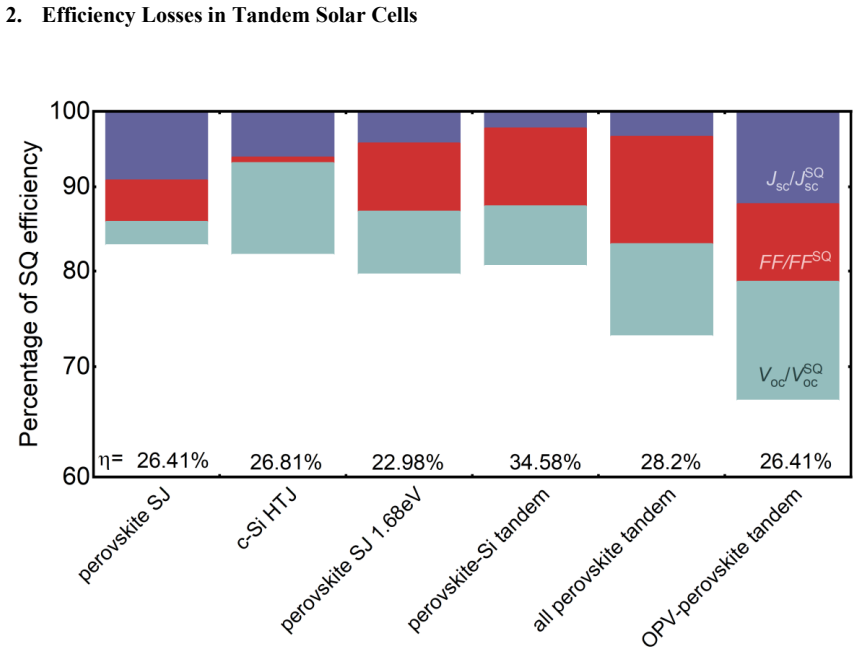
Figure 2 shows the theoretical efficiency limit of monolithic perovskite-Si tandem solar cells for the AM1.5G spectrum at 300 K
Electroluminescence and Pseudo-JV Curves of Single-Junction and Tandem Solar Cells Currently, the most widely applied solar photovoltaic technology is based on crystalline silicon (c- Si).36 Potential partner sub -cells for c-Si in tandem photovoltaic are hybrid organic inorganic metal halide perovskite solar cells .37, 38 The most suitable bandgap of per...
-
[2]
Effect of the Photoshunt on Single-Junction and Tandem Solar Cell Fill Factors Halide perovskite solar cells typically have very high shunt resistances , Rp, in the dark that do not have a strong effect on the fill factor of these devices which is described in the J-V curves in Figure S7b. However, as is the case for most thin -film solar cells, 41, 49, 5...
-
[3]
This feature is referred to as photoshunt, which indicates poor carrier extraction at low voltages and short circuit
Effect of Si bottom cell on the tandem cell fill factor The shifted illuminated J-V curve (yellow in Figure 8c) exhibits a moderate slope in the low-voltage region. This feature is referred to as photoshunt, which indicates poor carrier extraction at low voltages and short circuit . The dark J-V curve of the tandem solar cell (blue in Figure 8c) does not ...
-
[4]
The intensity of the 2 LEDs can be adjusted individually thus the tandem cell can be measured at different current not matching conditions
Effect of Hysteresis and Bias Light on Charge Collection To study how the current mismatch of individual sub-cells influences the tandem cell, we measured the perovskite-Si tandem solar cell under a sun simulator containing a white LED and an infrared LED. The intensity of the 2 LEDs can be adjusted individually thus the tandem cell can be measured at dif...
-
[5]
Conclusions In summary, this article introduce s advanced methods for understanding the fill factor loss mechanisms of monolithic perovskite-Si tandem solar cell by simulation. By comparing the efficiency losses relative to the Shockley-Queisser model of different solar cell technologies , we observe that in perovskite-Si tandem devices, the FF is the dom...
-
[6]
Detailed Balance Limit of Efficiency of p ‐n Junction Solar Cells
Shockley W, Queisser HJ. Detailed Balance Limit of Efficiency of p ‐n Junction Solar Cells. Journal of Applied Physics 1961, 32(3): 510-519
1961
-
[7]
Guide for the perplexed to the Shockley – Queisser model for solar cells
Guillemoles J -F, Kirchartz T, Cahen D, Rau U. Guide for the perplexed to the Shockley – Queisser model for solar cells. Nature Photonics 2019, 13(8): 501-505
2019
-
[8]
Interface engineering for high-performance, triple-halide perovskite–silicon tandem solar cells
Mariotti S, Köhnen E, Scheler F, Sveinbjörnsson K, Zimmermann L, Piot M , et al. Interface engineering for high-performance, triple-halide perovskite–silicon tandem solar cells. Science 2023, 381(6653): 63-69
2023
-
[9]
Enhanced cation interaction in perovskites for efficient tandem solar cells with silicon
Ugur E, Said AA, Dally P, Zhang S, Petoukhoff CE, Rosas -Villalva D, et al. Enhanced cation interaction in perovskites for efficient tandem solar cells with silicon. Science 2024, 385(6708): 533-538
2024
-
[10]
Perovskite/silicon tandem solar cells with bilayer interface passivation Nature 2024, 635(8039): 596-603
Liu J, He Y, Ding L, Zhang H, Li Q, Jia L , et al. Perovskite/silicon tandem solar cells with bilayer interface passivation Nature 2024, 635(8039): 596-603
2024
-
[11]
Efficient perovskite/silicon tandem with asymmetric self-assembly molecule
Jia L, Xia S, Li J, Qin Y, Pei B, Ding L , et al. Efficient perovskite/silicon tandem with asymmetric self-assembly molecule. Nature 2025, 644(8078): 912-919
2025
-
[12]
Third generation photovoltaics: solar cells for 2020 and beyond
Green MA. Third generation photovoltaics: solar cells for 2020 and beyond. Physica E-Low- Dimensional Systems & Nanostructures 2002, 14(1-2): 65-70
2020
-
[13]
Third generation photovoltaics: Ultra -high conversion efficiency at low cost
Green MA. Third generation photovoltaics: Ultra -high conversion efficiency at low cost. Progress in Photovoltaics 2001, 9(2): 123-135
2001
-
[14]
Interface passivation for 31.25%-efficient perovskite/silicon tandem solar cells
Chin XY, Turkay D, Steele JA, Tabean S, Eswara S, Mensi M , et al. Interface passivation for 31.25%-efficient perovskite/silicon tandem solar cells. Science 2023, 381(6653): 59-63
2023
-
[15]
Guide for the perplexed to the Shockley-Queisser model for solar cells
Guillemoles JF, Kirchartz T, Cahen D, Rau U. Guide for the perplexed to the Shockley-Queisser model for solar cells. Nat Photonics 2019, 13(8): 501-505
2019
-
[16]
How to Report Record Open -Circuit Voltages in Lead -Halide Perovskite Solar Cells
Krückemeier L, Rau U, Stolterfoht M, Kirchartz T. How to Report Record Open -Circuit Voltages in Lead -Halide Perovskite Solar Cells. Advanced Energy Materials 2020, 10(1): 1902573
2020
-
[17]
High-efficiency and thermally stable FACsPbI3 perovskite photovoltaics
Li S, Jiang Y, Xu J, Wang D, Ding Z, Zhu T , et al. High-efficiency and thermally stable FACsPbI3 perovskite photovoltaics. Nature 2024, 635(8037): 82-88
2024
-
[18]
Suppressing Halide Segregation via Pyridine-Derivative Isomers Enables Efficient 1.68 eV Bandgap Perovskite Solar Cells
Yang L, Fang Z, Jin Y, Feng H, Deng B, Zheng L , et al. Suppressing Halide Segregation via Pyridine-Derivative Isomers Enables Efficient 1.68 eV Bandgap Perovskite Solar Cells. Advanced Materials 2024, 36(21): 2311923
2024
-
[19]
Silicon heterojunction solar cells with up to 26.81% efficiency achieved by electrically optimized nanocrystalline -silicon hole contact layers
Lin H, Yang M, Ru X, Wang G, Yin S, Peng F, et al. Silicon heterojunction solar cells with up to 26.81% efficiency achieved by electrically optimized nanocrystalline -silicon hole contact layers. Nature Energy 2023, 8(8): 789-799
2023
-
[20]
Homogenized contact in all - perovskite tandems using tailored 2D perovskite
Wang Y, Lin R, Liu C, Wang X, Chosy C, Haruta Y , et al. Homogenized contact in all - perovskite tandems using tailored 2D perovskite. Nature 2024, 635(8040): 867-873
2024
-
[21]
Efficient near -infrared harvesting in perovskite–organic tandem solar cells
Jia Z, Guo X, Yin X, Sun M, Qiao J, Jiang X , et al. Efficient near -infrared harvesting in perovskite–organic tandem solar cells. Nature 2025, 643(8070): 104-110
2025
-
[22]
Hole Transporting Bilayers for Efficient Micrometer-Thick Perovskite Solar Cells
Wang Y, Akel S, Klingebiel B, Kirchartz T. Hole Transporting Bilayers for Efficient Micrometer-Thick Perovskite Solar Cells. Advanced Energy Materials 2024, 14(5): 2302614
2024
-
[23]
Design Criteria for Silicon Solar Cells with Fill Factors Approaching the Auger Limit
Razzaq A, Allen TG, De Wolf S. Design Criteria for Silicon Solar Cells with Fill Factors Approaching the Auger Limit. ACS Energy Letters 2023, 8(10): 4438-4440
2023
-
[24]
Highly efficient monolithic perovskite silicon tandem solar cells: analyzing the influence of current mismatch on device performance
Köhnen E, Jošt M, Morales -Vilches AB, Tockhorn P, Al -Ashouri A, Macco B , et al. Highly efficient monolithic perovskite silicon tandem solar cells: analyzing the influence of current mismatch on device performance. Sustainable Energy & Fuels 2019, 3(8): 1995-2005
2019
-
[25]
Limiting efficiencies of ideal single and multiple energy gap terrestrial solar cells
Henry CH. Limiting efficiencies of ideal single and multiple energy gap terrestrial solar cells. Journal of Applied Physics 1980, 51(8): 4494-4500
1980
-
[26]
Detailed balance limit of the efficiency of tandem solar cells
Vos AD. Detailed balance limit of the efficiency of tandem solar cells. Journal of Physics D: Applied Physics 1980, 13(5): 839
1980
-
[27]
Improving solar cell efficiencies by down-conversion of high- energy photons
Trupke T, Green MA, Würfel P. Improving solar cell efficiencies by down-conversion of high- energy photons. Journal of Applied Physics 2002, 92(3): 1668-1674
2002
-
[28]
Improving solar cell efficiencies by up-conversion of sub-band- gap light
Trupke T, Green MA, Würfel P. Improving solar cell efficiencies by up-conversion of sub-band- gap light. Journal of Applied Physics 2002, 92(7): 4117-4122
2002
-
[29]
Novel optimization principles and efficiency limits for semiconductor solar cells
Werner JH, Kolodinski S, Queisser HJ. Novel optimization principles and efficiency limits for semiconductor solar cells. Physical Review Letters 1994, 72(24): 3851-3854
1994
-
[30]
Third generation photovoltaics: Ultra -high conversion efficiency at low cost
Green MA. Third generation photovoltaics: Ultra -high conversion efficiency at low cost. Progress in Photovoltaics: Research and Applications 2001, 9(2): 123-135
2001
-
[31]
Monolithic Perovskite Tandem Solar Cells: A Review of the Present Status and Advanced Characterization Methods Toward 30% Efficiency
Jošt M, Kegelmann L, Korte L, Albrecht S. Monolithic Perovskite Tandem Solar Cells: A Review of the Present Status and Advanced Characterization Methods Toward 30% Efficiency. Advanced Energy Materials 2020, 10(26): 1904102
2020
-
[32]
A roadmap for tandem photovoltaics
Alberi K, Berry JJ, Cordell JJ, Friedman DJ, Geisz JF, Kirmani AR, et al. A roadmap for tandem photovoltaics. Joule 2024, 8(3): 658-692
2024
-
[33]
Perovskite Tandem Solar Cells: From Fundamentals to Commercial Deployment
Li H, Zhang W. Perovskite Tandem Solar Cells: From Fundamentals to Commercial Deployment. Chemical Reviews 2020, 120(18): 9835-9950
2020
-
[34]
Wide -bandgap, low-bandgap, and tandem perovskite solar cells
Song Z, Chen C, Li C, Awni RA, Zhao D, Yan Y. Wide -bandgap, low-bandgap, and tandem perovskite solar cells. Semiconductor Science and Technology 2019, 34(9): 093001
2019
-
[35]
Monolithic perovskite/silicon tandem solar cell with >29% efficiency by enhanced hole extraction
Al-Ashouri A, Köhnen E, Li B, Magomedov A, Hempel H, Caprioglio P , et al. Monolithic perovskite/silicon tandem solar cell with >29% efficiency by enhanced hole extraction. Science 2020, 370(6522): 1300-1309
2020
-
[36]
Enhanced optoelectronic coupling for perovskite/silicon tandem solar cells
Aydin E, Ugur E, Yildirim BK, Allen TG, Dally P, Razzaq A , et al. Enhanced optoelectronic coupling for perovskite/silicon tandem solar cells. Nature 2023, 623(7988): 732-738
2023
-
[37]
Efficient tandem solar cells with solution -processed perovskite on textured crystalline silicon
Hou Y, Aydin E, De Bastiani M, Xiao C, Isikgor FH, Xue D -J, et al. Efficient tandem solar cells with solution -processed perovskite on textured crystalline silicon. Science 2020, 367(6482): 1135-1140
2020
-
[38]
Designs from single junctions, heterojunctions to multijunctions for high -performance perovskite solar cells
Wu X, Li B, Zhu Z, Chueh C -C, Jen AKY. Designs from single junctions, heterojunctions to multijunctions for high -performance perovskite solar cells. Chemical Society Reviews 2021, 50(23): 13090-13128
2021
-
[39]
Recombination junctions for efficient monolithic perovskite -based tandem solar cells: physical principles, properties, processing and prospects
De Bastiani M, Subbiah AS, Aydin E, Isikgor FH, Allen TG, De Wolf S. Recombination junctions for efficient monolithic perovskite -based tandem solar cells: physical principles, properties, processing and prospects. Materials Horizons 2020, 7(11): 2791-2809
2020
-
[40]
The state of the art in photovoltaic materials and device research
Kirchartz T, Yan G, Yuan Y, Patel BK, Cahen D, Nayak PK. The state of the art in photovoltaic materials and device research. Nature Reviews Materials 2025, 10(5): 335-354
2025
-
[41]
Status and perspectives of crystalline silicon photovoltaics in research and industry
Ballif C, Haug F -J, Boccard M, Verlinden PJ, Hahn G. Status and perspectives of crystalline silicon photovoltaics in research and industry. Nature Reviews Materials 2022, 7(8): 597-616
2022
-
[42]
Perovskite/Silicon Tandem Solar Cells: Insights and Outlooks
Shi Y, Berry JJ, Zhang F. Perovskite/Silicon Tandem Solar Cells: Insights and Outlooks. ACS Energy Letters 2024, 9(3): 1305-1330
2024
-
[43]
Prospects and challenges for perovskite -organic tandem solar cells
Wu S, Liu M, Jen AKY. Prospects and challenges for perovskite -organic tandem solar cells. Joule 2023, 7(3): 484-502
2023
-
[44]
Transport Resistance Dominates the Fill Factor Losses in Record Organic Solar Cells
Wang C, MacKenzie RCI, Würfel U, Neher D, Kirchartz T, Deibel C , et al. Transport Resistance Dominates the Fill Factor Losses in Record Organic Solar Cells. Advanced Energy Materials, n/a(n/a): 2405889
-
[45]
Revealing charge carrier transport and selectivity losses in perovskite silicon tandem solar cells
Fischer O, Bett AJ, Zhu Y, Messmer C, Bui AD, Schygulla P , et al. Revealing charge carrier transport and selectivity losses in perovskite silicon tandem solar cells. Matter
-
[46]
Fill Factor Losses and Deviations from the Superposition Principle in Lead Halide Perovskite Solar Cells
Grabowski D, Liu Z, Schöpe G, Rau U, Kirchartz T. Fill Factor Losses and Deviations from the Superposition Principle in Lead Halide Perovskite Solar Cells. Solar RRL 2022, 6(11): 2200507
2022
-
[47]
Internal voltages in GaInP∕ GaInAs ∕ Ge multijunction solar cells determined by electroluminescence measurements
Kirchartz T, Rau U, Hermle M, Bett AW, Helbig A, Werner JH. Internal voltages in GaInP∕ GaInAs ∕ Ge multijunction solar cells determined by electroluminescence measurements. Applied Physics Letters 2008, 92(12)
2008
-
[48]
Subcell I -V characteristic analysis of GaInP/GaInAs/Ge solar cells using electroluminescence measurements
Roensch S, Hoheisel R, Dimroth F, Bett AW. Subcell I -V characteristic analysis of GaInP/GaInAs/Ge solar cells using electroluminescence measurements. Applied Physics Letters 2011, 98(25)
2011
-
[49]
Temperature -dependent electroluminescence and voltages of multi -junction solar cells
Karcher C, Helmers H, Schachtner M, Dimroth F, Bett AW. Temperature -dependent electroluminescence and voltages of multi -junction solar cells. Progress in Photovoltaics: Research and Applications 2014, 22(7): 757-763
2014
-
[50]
Performance Mapping of Multijunction Solar Cells Based on Electroluminescence
Zimmermann CG. Performance Mapping of Multijunction Solar Cells Based on Electroluminescence. IEEE Electron Device Letters 2009, 30(8): 825-827
2009
-
[51]
The chemical potential of radiation
Wurfel P. The chemical potential of radiation. Journal of Physics C: Solid State Physics 1982, 15(18): 3967
1982
-
[52]
Reciprocity relation between photovoltaic quantum efficiency and electroluminescent emission of solar cells
Rau U. Reciprocity relation between photovoltaic quantum efficiency and electroluminescent emission of solar cells. Physical Review B 2007, 76(8): 085303
2007
-
[53]
Loss Analysis of Halide ‐ Perovskite Solar Cells Deposited on Textured Substrates
Wang Y, Hüpkes J, Ravish ankar S, Klingebiel B, Kirchartz T. Loss Analysis of Halide ‐ Perovskite Solar Cells Deposited on Textured Substrates. Solar RRL 2025: 202400829
2025
-
[54]
Characterizing the Influence of Charge Extraction Layers on the Performance of Triple -Cation Perovskite Solar Cells
Siekmann J, Kulkarni A, Akel S, Klingebiel B, Saliba M, Rau U , et al. Characterizing the Influence of Charge Extraction Layers on the Performance of Triple -Cation Perovskite Solar Cells. Advanced Energy Materials 2023, 13(32): 2300448
2023
-
[55]
Understanding the Thickness and Light - Intensity Dependent Performance of Green -Solvent Processed Organic Solar Cells
Lübke D, Hartnagel P, Hülsbeck M, Kirchartz T. Understanding the Thickness and Light - Intensity Dependent Performance of Green -Solvent Processed Organic Solar Cells. ACS Materials Au 2023, 3(3): 215-230
2023
-
[56]
Quantifying Charge Extraction and Recombination Using the Rise and Decay of the Transient Photovoltage of Perovskite Solar Cells
Krückemeier L, Liu Z, Kirchartz T, Rau U. Quantifying Charge Extraction and Recombination Using the Rise and Decay of the Transient Photovoltage of Perovskite Solar Cells. Advanced Materials 2023: 2300872
2023
-
[57]
Charge Carrier Collection Losses in Lead-Halide Perovskite Solar Cells
Akel S, Wang Y, Yan G, Rau U, Kirchartz T. Charge Carrier Collection Losses in Lead-Halide Perovskite Solar Cells. Advanced Energy Materials 2024, 14(47): 2401800
2024
-
[58]
Quantifying Charge Extraction and Recombination Using the Rise and Decay of the Transient Photovoltage of Perovskite Solar Cells
Krückemeier L, Liu Z, Kirchartz T, Rau U. Quantifying Charge Extraction and Recombination Using the Rise and Decay of the Transient Photovoltage of Perovskite Solar Cells. Advanced Materials 2023, 35(35): 2300872
2023
-
[59]
Relevance of Long Diffusion Lengths for Efficient Halide Perovskite Solar Cells
Akel S, Kulkarni A, Rau U, Kirchartz T. Relevance of Long Diffusion Lengths for Efficient Halide Perovskite Solar Cells. PRX Energy 2023, 2(1): 013004
2023
-
[60]
Correlating the Photoshunt with Charge -Collection Losses in Organic Solar Cells
Kim E, Christen L, Kirchartz T. Correlating the Photoshunt with Charge -Collection Losses in Organic Solar Cells. Advanced Energy Materials, 16, no. 3 (2026): 2403129
2026
-
[61]
Accurate explicit equations for the fill factor of real solar cells - Applications to thin -film solar cells
Taretto K, Soldera M, Troviano M. Accurate explicit equations for the fill factor of real solar cells - Applications to thin -film solar cells. Progress in Photovoltaics: Research and Applications: John Wiley & Sons, Ltd; 2013. pp. 1489-1498
2013
-
[62]
A review and comparison of different methods to determine the series resistance of solar cells
Pysch D, Mette A, Glunz SW. A review and comparison of different methods to determine the series resistance of solar cells. Solar Energy Materials and Solar Cells 2007, 91(18): 1698- 1706
2007
-
[63]
Series resistance effects on solar cell measurements
Wolf M, Rauschenbach H. Series resistance effects on solar cell measurements. Advanced Energy Conversion 1963, 3(2): 455-479
1963
-
[64]
A new method for accurate measurements of the lumped series resistance of solar cells
Aberle AG, Wenham SR, Green MA. A new method for accurate measurements of the lumped series resistance of solar cells. Conference Record of the Twenty Third IEEE Photovoltaic Specialists Conference - 1993 (Cat. No.93CH3283-9); 1993 10-14 May 1993; 1993. p. 133-139
1993
-
[65]
Explanation of commonly observed shunt currents in c -Si solar cells by means of recombination statistics beyond the Shockley -Read-Hall approximation
Steingrube S, Breitenstein O, Ramspeck K, Glunz S, Schenk A, Altermatt PP. Explanation of commonly observed shunt currents in c -Si solar cells by means of recombination statistics beyond the Shockley -Read-Hall approximation. Journal of Applied Physics 2011, 110(1): 014515
2011
-
[66]
Statistical analysis and engineering fit models for two-diode model parameters of large area silicon solar cells
Khanna V, Das BK, Vandana, Singh PK, Sharma P, Jain SK. Statistical analysis and engineering fit models for two-diode model parameters of large area silicon solar cells. Solar Energy 2016, 136: 401-411
2016
-
[67]
Explanation of commonly observed shunt currents in c -Si solar cells by means of recombination statistics beyond the Shockley-Read-Hall approximation
Steingrube S, Breitenstein O, Ramspeck K, Glunz S, Schenk A, Altermatt PP. Explanation of commonly observed shunt currents in c -Si solar cells by means of recombination statistics beyond the Shockley-Read-Hall approximation. Journal of Applied Physics 2011, 110(1)
2011
-
[68]
Revealing Fundamental Efficiency Limits of Monolithic Perovskite/Silicon Tandem Photovoltaics through Subcell Characterization
Lang F, Köhnen E, Warby J, Xu K, Grischek M, Wagner P , et al. Revealing Fundamental Efficiency Limits of Monolithic Perovskite/Silicon Tandem Photovoltaics through Subcell Characterization. ACS Energy Letters 2021, 6(11): 3982-3991. Supplementary Materials for Characterizing Fill Factor Limitations in Perovskite -Silicon Tandem Solar Cells Yueming Wang*1...
2021
-
[69]
The illuminated JV curves of tandem cells are merged from top cell JV and bottom cell JV by MATLAB and plotted (a) linearly and (b) semi-log
The J01 and J02 are obtained by fitting with the dark JV of a real Si solar cell with the method in Figure S10. The illuminated JV curves of tandem cells are merged from top cell JV and bottom cell JV by MATLAB and plotted (a) linearly and (b) semi-log. Table S1. The currents driven the LED light sources and the corresponding current density of perovskite...
discussion (0)
Sign in with ORCID, Apple, or X to comment. Anyone can read and Pith papers without signing in.