Recognition: unknown
Psychologically-Grounded Graph Modeling for Interpretable Depression Detection
Pith reviewed 2026-05-08 03:36 UTC · model grok-4.3
The pith
PsyGAT models conversations as dynamic graphs with Psychological Expression Units to detect depression more accurately and with clinical interpretability.
A machine-rendered reading of the paper's core claim, the machinery that carries it, and where it could break.
Core claim
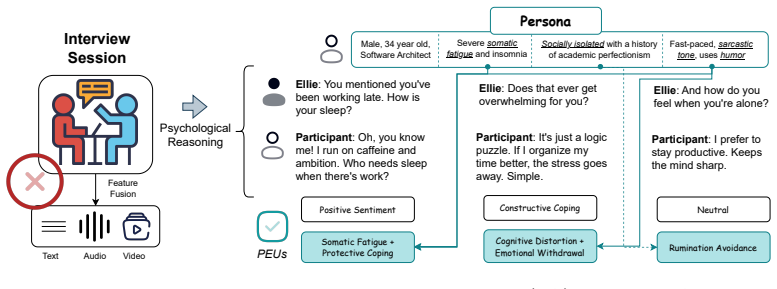
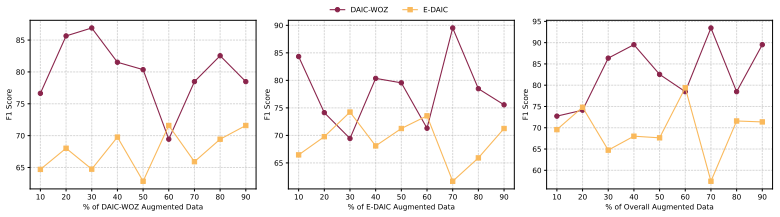
PsyGAT structures conversational sessions as dynamic temporal graphs in which Psychological Expression Units serve as nodes that explicitly encode utterance-level clinical evidence. Graph edges represent transitions between psychological states rather than semantic similarity alone. Session-level personality context is integrated directly into the structure to disentangle trait-based behavior from acute depressive symptoms. Clinically approved persona-based data augmentation addresses class imbalance. The resulting model reaches 89.99 Macro F1 on DAIC-WoZ and 71.37 on E-DAIC, outperforming strong graph baselines and closed-source LLMs such as GPT-5. An attached interpretability module, Causl
What carries the argument
Psychological Expression Units (PEUs), which encode utterance-level clinical evidence to structure temporal graphs that capture transitions in psychological states rather than semantic links.
Load-bearing premise
The newly defined Psychological Expression Units and the persona-based augmentation faithfully encode clinical evidence without introducing dataset-specific biases that inflate the reported performance metrics.
What would settle it
Evaluating the trained PsyGAT model on a fresh, independent set of depression-related conversational recordings drawn from a different clinical source or population to check whether the Macro F1 scores and MRR gains hold without retraining or further augmentation.
Figures


read the original abstract
Automatic depression detection from conversational interactions holds significant promise for scalable screening but remains hindered by severe data scarcity and a lack of clinical interpretability. Existing approaches typically rely on black-box deep learning architectures that struggle to model the subtle, temporal evolution of depressive symptoms or account for participant-specific heterogeneity. In this work, we propose PsyGAT (Psychological Graph Attention Network), a psychologically grounded framework that models conversational sessions as dynamic temporal graphs. We introduce Psychological Expression Units (PEUs) to explicitly encode utterance-level clinical evidence, structuring the session graph to capture transitions in psychological states rather than mere semantic dependencies. To address the critical class imbalance in depression datasets, we employ clinically approved persona-based data augmentation, enable robust model learning. Additionally, we integrate session-level personality context directly into the graph structure to disentangle trait-based behavior from acute depressive symptoms. PsyGAT achieves state-of-the-art performance, surpassing both strong graph-based baselines and closed-source LLMs like GPT-5, achieving 89.99 and 71.37 Macro F1 scores in DAIC-WoZ and E-DAIC, respectively. We further introduce Causal-PsyGAT, an interpretability module that identifies symptom triggers. Experiments show a 20% improvement in MRR for identifying causal indicators, effectively bridging the gap between depression monitoring and clinical explainability. The full augmented dataset is publicly available at https://doi.org/10.6084/m9.figshare.31801921.
Editorial analysis
A structured set of objections, weighed in public.
Referee Report
Summary. The paper proposes PsyGAT, a graph attention network that represents conversational sessions as dynamic temporal graphs using newly defined Psychological Expression Units (PEUs) to encode utterance-level clinical evidence for depression detection. It applies persona-based data augmentation to mitigate class imbalance, incorporates session-level personality context into the graph, and introduces Causal-PsyGAT for identifying symptom triggers. The work claims state-of-the-art Macro F1 scores of 89.99 on DAIC-WoZ and 71.37 on E-DAIC (surpassing graph baselines and GPT-5), plus a 20% MRR gain in causal indicator identification, with the augmented dataset released publicly.
Significance. If the empirical claims hold after validation, the integration of psychologically grounded units with temporal graph modeling offers a promising direction for interpretable depression detection, potentially improving clinical adoption by providing both performance and explainability. The public dataset release is a positive contribution to reproducibility in this data-scarce domain.
major comments (3)
- [Data Augmentation] Data Augmentation section: The persona-based augmentation is load-bearing for the reported SOTA F1 scores and MRR gains, yet no quantitative validation (such as KL divergence on symptom-transition distributions or ablation comparing augmented vs. unaugmented training) is described to confirm that synthetic utterances preserve real patient distributions rather than introducing exploitable artifacts.
- [Experimental Results] Experimental Results section: The headline performance claims (89.99/71.37 Macro F1, 20% MRR improvement) are presented without reference to the full experimental protocol, baseline implementation details, statistical significance tests, error bars across runs, or cross-validation strategy, preventing assessment of whether the gains are robust or dataset-specific.
- [Causal-PsyGAT] Causal-PsyGAT subsection: The interpretability module's mechanism for extracting symptom triggers and its validation against clinical standards are not detailed, which is central to the claim of bridging detection performance with explainability.
minor comments (2)
- [Abstract] The abstract contains a grammatical fragment ('enable robust model learning') that should be rephrased for clarity.
- Notation for PEUs and graph construction could be formalized earlier with an explicit definition or diagram to aid readers unfamiliar with the psychological grounding.
Simulated Author's Rebuttal
Thank you for the constructive review and the recommendation for major revision. We appreciate the feedback highlighting areas where additional rigor and transparency would strengthen the manuscript. We address each major comment below and commit to incorporating the necessary revisions.
read point-by-point responses
-
Referee: [Data Augmentation] Data Augmentation section: The persona-based augmentation is load-bearing for the reported SOTA F1 scores and MRR gains, yet no quantitative validation (such as KL divergence on symptom-transition distributions or ablation comparing augmented vs. unaugmented training) is described to confirm that synthetic utterances preserve real patient distributions rather than introducing exploitable artifacts.
Authors: We agree that the manuscript would benefit from explicit quantitative validation of the augmentation. In the revision, we will add an ablation study comparing model performance on original versus augmented training data for both DAIC-WoZ and E-DAIC. We will also compute and report KL divergence on symptom-transition distributions between real and synthetic utterances to demonstrate distributional fidelity. The public release of the augmented dataset already supports external verification of these properties. revision: yes
-
Referee: [Experimental Results] Experimental Results section: The headline performance claims (89.99/71.37 Macro F1, 20% MRR improvement) are presented without reference to the full experimental protocol, baseline implementation details, statistical significance tests, error bars across runs, or cross-validation strategy, preventing assessment of whether the gains are robust or dataset-specific.
Authors: We acknowledge that greater experimental transparency is required. The revised manuscript will include the complete experimental protocol, detailed baseline implementation descriptions (including any code or hyperparameter references), results with standard error bars from multiple runs, statistical significance testing (e.g., paired t-tests or McNemar's test), and explicit specification of the cross-validation strategy. These additions will allow readers to evaluate the robustness of the reported gains. revision: yes
-
Referee: [Causal-PsyGAT] Causal-PsyGAT subsection: The interpretability module's mechanism for extracting symptom triggers and its validation against clinical standards are not detailed, which is central to the claim of bridging detection performance with explainability.
Authors: We will substantially expand the Causal-PsyGAT subsection to detail the extraction mechanism, including the precise graph attention and causal inference steps used to identify symptom triggers from the temporal PEU graph. We will also describe the validation procedure, including quantitative comparison to clinical symptom criteria and the exact computation of the reported MRR improvement. This will more clearly link the interpretability module to clinical standards. revision: yes
Circularity Check
No significant circularity in claimed derivation chain
full rationale
The paper introduces Psychological Expression Units (PEUs) and persona-based data augmentation as modeling components within the PsyGAT framework, then reports empirical performance on DAIC-WoZ and E-DAIC (89.99/71.37 Macro F1) plus MRR gains for Causal-PsyGAT. No equations, derivations, or self-citations are present that reduce any prediction or result to fitted inputs or prior self-work by construction. The central claims rest on experimental validation of a new graph construction rather than any self-referential loop, making the approach self-contained.
Axiom & Free-Parameter Ledger
invented entities (2)
-
Psychological Expression Units (PEUs)
no independent evidence
-
Causal-PsyGAT
no independent evidence
Reference graph
Works this paper leans on
-
[1]
B. G. Teferra, A. Perivolaris, W.-N. Hsiang, C. K. Sidharta, A. Rueda, K. Parkington, Y. Wu, A. Soni, R. Samavi, R. Jetly, Y. Zhang, B. Cao, S. Rambhatla, S. Krishnan, V. Bhat, Leveraging large language mod- els for automated depression screening, PLOS Digital Health 4 (2025) e0000943. URL:https://doi.org/10.1371/journal.pdig.0000943. doi:10.1371/journal....
-
[2]
B. Maji, M. Swain, S. Nasreen, D. Majumdar, R. Guha, A. Routray, A. Søgaard, A study on the impact of foundation models on auto- matic depression detection from speech signals, in: Proceedings of Inter- speech 2025, ISCA, 2025, pp. 5258–5262. doi:10.21437/Interspeech. 2025-1789
-
[3]
J. M. Liu, M. Gao, S. Sabour, Z. Chen, M. Huang, T. M. C. Lee, Enhanced large language models for effective screening of depression and anxiety, Communications Medicine 5 (2025) 457. URL:https://doi.org/10.1038/s43856-025-01158-1.doi:10.1038/ s43856-025-01158-1
-
[4]
S. Shreevastava, P. Foltz, Detecting cognitive distortions from patient- therapist interactions, in: N. Goharian, P. Resnik, A. Yates, M. Ireland, K. Niederhoffer, R. Resnik (Eds.), Proceedings of the Seventh Work- shop on Computational Linguistics and Clinical Psychology: Improv- ing Access, Association for Computational Linguistics, Online, 2021, pp.151...
-
[5]
LaGrange, D
B. LaGrange, D. Cole, F. Jacquez, J. Ciesla, D. Dallaire, A. Pineda, A. Truss, A. Weitlauf, C. Tilghman-Osborne, J. Felton, Disentangling 26 the prospective relations between maladaptive cognitions and depressive symptoms, JournalofAbnormalPsychology120(2011)511–527.doi:10. 1037/a0024685
2011
-
[6]
C. Fu, Z. Fu, Q. Zhang, X. Kuang, J. Dong, K. Su, Y. Su, W. Shi, J. Yao, Y. Zhao, S. Zhao, J. Wang, S. Song, C. Liu, Y. Yoshikawa, B. Schuller, H.Ishiguro, Thefirstmpddchallenge: Multimodalpersonality-awarede- pression detection, 2025. URL:https://arxiv.org/abs/2505.10034. arXiv:2505.10034
-
[7]
S. Burdisso, E. Reyes-Ramírez, E. Villatoro-tello, F. Sánchez-Vega, A. Lopez Monroy, P. Motlicek, DAIC-WOZ: On the validity of using the therapist’s prompts in automatic depression detection from clinical interviews, in: T. Naumann, A. Ben Abacha, S. Bethard, K. Roberts, D. Bitterman (Eds.), Proceedings of the 6th Clinical Natural Language Processing Work...
-
[8]
Borsboom, A network theory of mental disorders, World Psychiatry 16 (2017) 5–13
D. Borsboom, A network theory of mental disorders, World Psychiatry 16 (2017) 5–13. doi:10.1002/wps.20375
-
[9]
URL: https://www.frontiersin.org/journals/psychology/articles/ 10.3389/fpsyg.2017.01305
P.J.Jones, A.Heeren, R.J.McNally, Commentary: Anetworktheoryof mental disorders, Frontiers in Psychology Volume 8 - 2017 (2017). URL: https://www.frontiersin.org/journals/psychology/articles/ 10.3389/fpsyg.2017.01305. doi:10.3389/fpsyg.2017.01305
-
[10]
K.R.Scherer, AppraisalTheory, JohnWiley&Sons, Ltd, 1999, pp.637–
1999
-
[11]
doi:https://doi.org/10.1002/0470013494.ch30
URL:https://onlinelibrary.wiley.com/doi/abs/10.1002/ 0470013494.ch30. doi:https://doi.org/10.1002/0470013494.ch30. arXiv:https://onlinelibrary.wiley.com/doi/pdf/10.1002/0470013494.ch30
-
[12]
2001.Doing Science: Design, Analysis and Communication of Scientific Research(1 ed.)
I. Roseman, C. Smith, Appraisal Theory Overview, Assumptions, Vari- eties, Controversies, 2001, pp. 3–19. doi:10.1093/oso/9780195130072. 003.0001
-
[13]
X. Wang, J. Teotia, R. Mao, W. Kaur, E. Cambria, Appraisal theory- informed emotion prediction, in: Proceedings of the International Con- ference on Language Resources and Evaluation (LREC), 2026. 27
2026
-
[14]
A. T. Beck, Cognitive therapy: Nature and relation to behavior therapy, Behavior therapy 1 (1970) 184–200
1970
-
[15]
J. P. Allen, An overview of beck ’ s cognitive theory of depression in contemporary literature, 2011. URL:https://api.semanticscholar. org/CorpusID:160019179
2011
-
[16]
B. Wang, Y. Zhao, X. Lu, B. Qin, Cognitive distortion based explainable depressiondetectionandanalysistechnologiesfortheadolescentinternet users on social media, Frontiers in Public Health 10 (2023) 1045777. doi:10.3389/fpubh.2022.1045777
-
[17]
Broerman, Diathesis-Stress Model, Springer International Pub- lishing, Cham, 2017, pp
R. Broerman, Diathesis-Stress Model, Springer International Pub- lishing, Cham, 2017, pp. 1–3. URL:https://doi.org/10.1007/ 978-3-319-28099-8_891-1. doi:10.1007/978-3-319-28099-8_ 891-1
-
[18]
D. N. Klein, R. Kotov, S. J. Bufferd, Personality and depression: ex- planatory models and review of the evidence., Annual review of clini- cal psychology 7 (2011) 269–95. URL:https://api.semanticscholar. org/CorpusID:15886502
2011
-
[19]
Sadeghi, R
M. Sadeghi, R. Richer, B. Egger, L. Schindler-Gmelch, L. Rupp, F. Rahimi, M. Berking, B. Eskofier, Harnessing multimodal ap- proaches for depression detection using large language models and fa- cial expressions, npj Mental Health Research 3 (2024). doi:10.1038/ s44184-024-00112-8
2024
-
[20]
P. Cao, Y. Zhang, C. Zhang, W. Chen, Y. Liu, S. Xu, M. Xu, W. Jin, J. Xu, D. Wang, W. Wang, X. Wang, W. Wang, Y. Ren, J. Zhao, R. Li, K. Liu, A multimodal depression consultation dataset of speech and text with hamd-17 assessments, Scientific Data 12 (2025) 1577. URL:https://doi.org/10.1038/s41597-025-05817-9.doi:10.1038/ s41597-025-05817-9
-
[21]
Nykoniuk, O
M. Nykoniuk, O. Basystiuk, N. Shakhovska, N. Melnykova, Multimodal data fusion for depression detection approach, Computation 13 (2025)
2025
-
[22]
doi:10.3390/computation13010009
-
[23]
Y. Li, X. Yang, M. Zhao, J. Wang, Y. Yao, W. Qian, S. Qi, Predicting depression by using a novel deep learning model and video-audio-text 28 multimodal data, Frontiers in Psychiatry 16 (2025). URL:https:// api.semanticscholar.org/CorpusID:281546320
2025
-
[24]
Y. Zhang, J. You, C. Yang, Z. Wang, X. Qiu, Y. Chen, Deep learning in depression detection: A comprehensive survey and critical analysis, 2025, pp. 177–189. doi:10.1109/ICDEW67478.2025.00028
-
[25]
L. Gomez-Zaragoza, J. Marin-Morales, M. Alcaniz, M. Soleymani, Speech and text foundation models for depression detection: Cross-task and cross-language evaluation, in: Proceedings of Interspeech 2025, ISCA, 2025, pp. 5253–5257. doi:10.21437/Interspeech.2025-1035
-
[26]
X. Zhang, C. Li, W. Chen, J. Zheng, F. Li, Optimizing depression detec- tion in clinical doctor–patient interviews using a multi-instance learning framework, Scientific Reports 15 (2025) 6637. URL:https://doi.org/ 10.1038/s41598-025-90117-w. doi:10.1038/s41598-025-90117-w
-
[27]
N. Agarwal, G. Dias, S. Dollfus, Multi-view graph-based interview rep- resentation to improve depression level estimation, Brain Informatics 11 (2024) 14. URL:https://doi.org/10.1186/s40708-024-00227-w. doi:10.1186/s40708-024-00227-w
-
[28]
Y. Jiao, K. Zhao, X. Wei, N. B. Carlisle, C. J. Keller, D. J. Oathes, G. A. Fonzo, Y. Zhang, Deep graph learning of multimodal brain networks defines treatment-predictive signatures in major depression, Molecu- lar Psychiatry 30 (2025) 3963–3974. URL:https://doi.org/10.1038/ s41380-025-02974-6. doi:10.1038/s41380-025-02974-6
-
[29]
L. Zhu, R. Mao, E. Cambria, B. J. Jansen, Neurosymbolic ai for per- sonalized sentiment analysis, in: Proceedings of the 26th International Conference on Human-Computer Interaction (HCII 2024), volume 15382 ofLecture Notes in Computer Science, Springer, 2024, pp. 269–290. doi:10.1007/978-3-031-76827-9_16
-
[30]
G. Tu, B. Wang, E. Cambria, W. Li, R. Xu, Supportplay: A multi- agent role-playing system for personalized and sustained multimodal emotional support conversation, in: Companion Proceedings of the ACM on Web Conference 2025, WWW ’25, Association for Computing Machinery, New York, NY, USA, 2025, p. 2915–2918. URL:https:// doi.org/10.1145/3701716.3715200. d...
-
[31]
S. Han, R. Mao, E. Cambria, Hierarchical attention network for ex- plainable depression detection on Twitter aided by metaphor concept mappings, in: Proceedings of the 29th International Conference on Computational Linguistics, International Committee on Computational Linguistics, Gyeongju, Republic of Korea, 2022, pp. 94–104. URL: https://aclanthology.or...
2022
-
[32]
Cheong, S
J. Cheong, S. Kalkan, H. Gunes, Fairrefuse: Referee-guided fusion for multimodal causal fairness in depression detection, in: Proceed- ings of the Thirty-Third International Joint Conference on Artificial Intelligence (IJCAI-24), Special Track on AI for Good, International Joint Conferences on Artificial Intelligence Organization, Macau, China, 2024, pp. ...
2024
-
[33]
Z. Chen, J. Deng, J. Zhou, J. Wu, T. Qian, M. Huang, Depression detection in clinical interviews with LLM-empowered structural element graph, in: K. Duh, H. Gomez, S. Bethard (Eds.), Proceedings of the 2024 Conference of the North American Chapter of the Association for Computational Linguistics: Human Language Technologies (Volume 1: Long Papers), Associ...
-
[34]
X. Wang, A. Perez, J. Parapar, F. Crestani, Talkdep: Clinically grounded llm personas for conversation-centric depression screening, CIKM ’25, Association for Computing Machinery, New York, NY, USA, 2025, p. 6554–6558. URL:https://doi.org/10.1145/3746252. 3761617. doi:10.1145/3746252.3761617
-
[35]
I. J. Roseman, C. A. Smith, Appraisal theory: Overview, assumptions, varieties, controversies, in: K. R. Scherer, A. Schorr, T. Johnstone (Eds.), Appraisal Processes in Emotion, Oxford University Press, New York, NY, 2001, pp. 3–19
2001
-
[36]
K. R. Scherer, Appraisal theory, in: T. Dalgleish, M. J. Power (Eds.), Handbook of Cognition and Emotion, John Wiley & Sons Ltd., Chich- ester, UK, 1999, pp. 637–663. 30
1999
-
[37]
K. Team, Y. Bai, Y. Bao, Y. Charles, C. Chen, G. Chen, H. Chen, H. Chen, J. Chen, N. Chen, R. Chen, Y. Chen, Y. Chen, Y. Chen, Z. Chen, J. Cui, H. Ding, M. Dong, A. Du, C. Du, D. Du, Y. Du, Y. Fan, Y. Feng, K. Fu, B. Gao, C. Gao, H. Gao, P. Gao, T. Gao, Y. Ge, S. Geng, Q. Gu, X. Gu, L. Guan, H. Guo, J. Guo, X. Hao, T. He, W. He, W. He, Y. He, C. Hong, H. ...
work page internal anchor Pith review arXiv 2026
discussion (0)
Sign in with ORCID, Apple, or X to comment. Anyone can read and Pith papers without signing in.