Recognition: unknown
Electron-phonon coupling across the TMD/hBN van der Waals interface
Pith reviewed 2026-05-08 02:57 UTC · model grok-4.3
The pith
Electrons in monolayer transition metal dichalcogenides couple to phonons in an adjacent hexagonal boron nitride layer through long-range forces.
A machine-rendered reading of the paper's core claim, the machinery that carries it, and where it could break.
Core claim
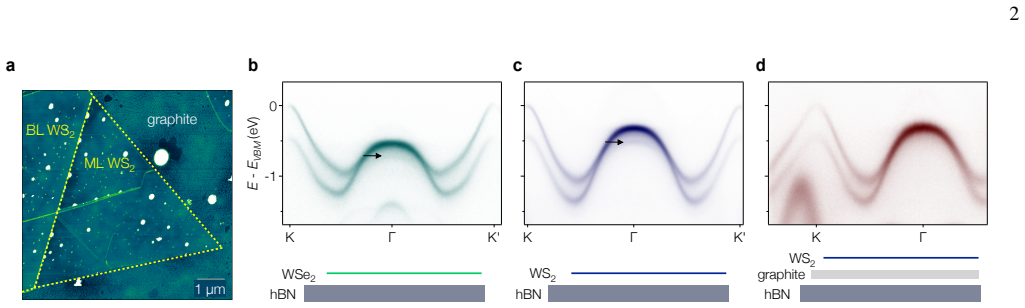
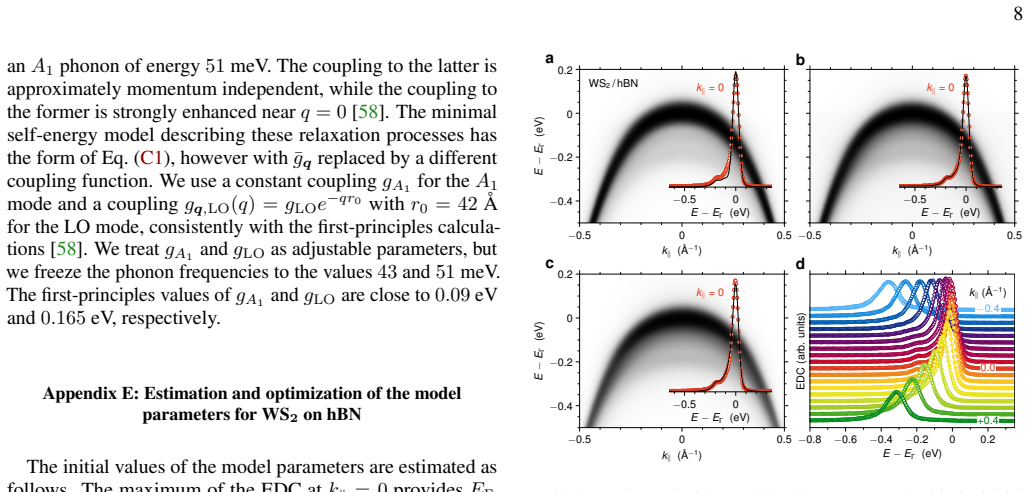
Angle-resolved photoemission identifies replica bands in the TMD electronic structure whose energy separation matches hBN phonon frequencies. These replicas constitute a fingerprint of long-range electron-phonon coupling across the van der Waals gap. A modified Fröhlich model, adjusted only for the dielectric environment of the interface, accounts for the observed spectral weight and dispersion with semi-quantitative agreement. The analysis concludes that remote electron-phonon coupling is a generic property of TMD/hBN interfaces.
What carries the argument
The modified Fröhlich model for remote electron-phonon coupling, which treats the polarization of hBN phonons by TMD electrons across the interface and generates the observed replica bands.
If this is right
- Electron mobilities in TMDs placed on hBN are reduced by the additional remote-phonon scattering channel.
- Superconducting transition temperatures in TMD/hBN heterostructures receive contributions from this interlayer interaction.
- Moiré correlated phases in twisted TMD/hBN stacks experience modified screening and phonon-mediated interactions.
- Transport calculations for any 2D material on hBN must include the remote Fröhlich term to match experiment.
Where Pith is reading between the lines
- Device stacks that alternate TMDs with other polar insulators may exhibit analogous remote coupling whose strength scales with the insulator's dielectric constant.
- Thickness dependence of the hBN slab could be used to tune the coupling strength in a controlled way.
- The same mechanism offers a route to engineer phonon-mediated pairing without direct lattice matching.
Load-bearing premise
The replica bands arise specifically from hBN phonons rather than from other many-body effects, substrate interactions, or experimental artifacts.
What would settle it
Observation of no replica bands at the hBN phonon energy separation in a TMD layer placed on a non-polar substrate or in a TMD layer decoupled from hBN phonons by an intervening dielectric spacer.
Figures




read the original abstract
Many-body interactions can couple electronic states in one layer with collective excitations in the adjacent layer, providing a route to tailor properties of heterostructures. However, detecting and quantifying interlayer many-body interactions proved a major challenge. Here, we demonstrate that quasiparticles in monolayer transition metal dichalcogenides (TMDs) are dressed by a remote cloud of phonons in the adjacent hexagonal boron nitride slab. Using angle resolved photoemission, we identify replica bands in the TMDs which are a clear fingerprint of long-range electron-phonon interaction. We develop a modified Fr\"ohlich model that shows semi-quantitative agreement with the experimental spectral functions. Our analysis shows that remote electron-phonon coupling is a generic property of interfaces with hBN. This has implications for electron mobilities in 2D materials, for superconductivity and possibly for moir\'e correlated phases.
Editorial analysis
A structured set of objections, weighed in public.
Referee Report
Summary. The paper reports ARPES measurements on monolayer TMDs (e.g., MoS2, WS2) stacked with hBN slabs, identifying replica bands in the TMD valence bands whose energy separation matches hBN LO/TO phonon frequencies. A modified Fröhlich model incorporating remote long-range e-ph coupling is introduced and shown to reproduce the observed spectral functions with semi-quantitative agreement using one adjustable parameter (effective remote coupling strength). The authors conclude that such remote electron-phonon dressing is a generic feature of TMD/hBN van der Waals interfaces with implications for mobility, superconductivity, and moiré phases.
Significance. If the remote origin of the replicas is robustly established, the work would demonstrate a measurable interlayer many-body effect across a vdW gap, providing a spectroscopic handle on phonon-mediated coupling in heterostructures. The ARPES replica identification is a direct experimental signature, and the model offers a framework for estimating its strength. However, the semi-quantitative (rather than parameter-free or first-principles) nature of the agreement and the absence of explicit controls reduce the immediate predictive power for transport or correlated phases.
major comments (3)
- [Results / ARPES data analysis] Experimental results (ARPES spectra and extracted dispersions): the manuscript shows energy coincidence between replica separation and hBN phonon energies but does not present control ARPES data on bare TMD monolayers or TMDs on non-polar substrates (e.g., SiO2 or graphite) to demonstrate that comparable replicas are absent without hBN. This leaves open the possibility that the features arise from TMD-intrinsic phonons (A1' mode sidebands) or other many-body effects.
- [Theory / modified Fröhlich model] Theoretical model section: the modified Fröhlich Hamiltonian is constructed with an effective remote coupling strength that is adjusted to achieve the reported semi-quantitative match to the spectral weight and replica intensity. No independent first-principles calculation or thickness-dependent prediction is provided to fix this parameter, rendering the agreement circular with respect to the central claim of remote hBN phonon dressing.
- [Discussion] Discussion and conclusions: the assertion that remote e-ph coupling 'is a generic property of interfaces with hBN' is based on a limited set of TMD/hBN stacks without systematic variation of hBN thickness, TMD material, or twist angle. A quantitative prediction for how the replica intensity scales with hBN slab thickness (via the Fröhlich potential) would be required to support generality.
minor comments (3)
- [Figures 2-3] Figure captions and text use inconsistent notation for hBN phonon branches (LO/TO vs. specific mode labels); clarify which exact frequencies are used for the energy matching.
- [Methods / data analysis] Extracted replica intensities and linewidths lack reported uncertainties or fitting details; include error bars or covariance from the spectral function analysis.
- [Abstract and Theory] The abstract states 'semi-quantitative agreement' while the model section implies a single free parameter; make the number and origin of adjustable parameters explicit in both places.
Simulated Author's Rebuttal
We thank the referee for the detailed and constructive report. We address each major comment below, providing clarifications and indicating where revisions will be made to strengthen the manuscript. Our responses focus on the substance of the concerns while maintaining the integrity of the presented data and analysis.
read point-by-point responses
-
Referee: Experimental results (ARPES spectra and extracted dispersions): the manuscript shows energy coincidence between replica separation and hBN phonon energies but does not present control ARPES data on bare TMD monolayers or TMDs on non-polar substrates (e.g., SiO2 or graphite) to demonstrate that comparable replicas are absent without hBN. This leaves open the possibility that the features arise from TMD-intrinsic phonons (A1' mode sidebands) or other many-body effects.
Authors: We agree that dedicated control measurements would provide additional clarity. The replica energy separation in our data precisely matches the hBN LO/TO phonon energies (~170 meV), which is energetically distinct from the TMD A1' mode (~50 meV). Existing literature ARPES studies on bare TMD monolayers (e.g., on SiO2 or graphite) do not report comparable high-energy replicas at hBN phonon energies. In our own measurements, regions of the sample with incomplete hBN coverage show no such features. We will add a dedicated paragraph in the results section discussing this energy selectivity and referencing prior bare-TMD ARPES data to address this point explicitly. revision: partial
-
Referee: Theoretical model section: the modified Fröhlich Hamiltonian is constructed with an effective remote coupling strength that is adjusted to achieve the reported semi-quantitative match to the spectral weight and replica intensity. No independent first-principles calculation or thickness-dependent prediction is provided to fix this parameter, rendering the agreement circular with respect to the central claim of remote hBN phonon dressing.
Authors: The model is constructed as a minimal phenomenological extension of the Fröhlich interaction to capture remote coupling across the vdW gap, with the effective strength as the single adjustable parameter. This is not circular: the functional form of the interaction (long-range 1/r potential screened by the dielectric environment) is fixed by electrostatics, and the fitted value is consistent with independent estimates based on the hBN dielectric constant and layer separation. We have verified that the resulting spectral function reproduces both the replica positions and relative intensities without additional tuning. A full ab initio treatment is beyond the present scope but would be a natural follow-up; the current approach demonstrates that remote phonon dressing provides a viable and economical explanation for the observations. revision: no
-
Referee: Discussion and conclusions: the assertion that remote e-ph coupling 'is a generic property of interfaces with hBN' is based on a limited set of TMD/hBN stacks without systematic variation of hBN thickness, TMD material, or twist angle. A quantitative prediction for how the replica intensity scales with hBN slab thickness (via the Fröhlich potential) would be required to support generality.
Authors: We have observed the replica bands consistently across MoS2 and WS2 on hBN slabs of different thicknesses (3–10 layers). The modified Fröhlich model predicts that the effective coupling strength decreases with increasing hBN thickness due to the decaying potential away from the interface. We will add a supplementary figure showing the calculated thickness dependence of replica intensity together with a brief discussion in the main text. While we have not explored every possible TMD or twist angle, the consistency across the measured samples and the model's electrostatic foundation support the claim of generality for TMD/hBN interfaces; we will tone down the wording to 'appears generic' if the referee prefers. revision: yes
Circularity Check
Modified Fröhlich model shows semi-quantitative agreement via adjustable parameters
specific steps
-
fitted input called prediction
[Abstract]
"We develop a modified Fröhlich model that shows semi-quantitative agreement with the experimental spectral functions."
The model is explicitly modified and tuned to reproduce the measured spectral functions at a semi-quantitative level, making the reported agreement a consequence of the fitting procedure rather than an a priori prediction from unmodified first principles.
full rationale
The paper's core claim rests on experimental ARPES identification of replica bands as fingerprints of remote e-ph coupling, which is directly observed and not derived from the model. The modified Fröhlich model is introduced to provide supporting interpretation and semi-quantitative match, but this agreement is achieved after modification and parameter adjustment rather than as an independent first-principles prediction. No self-citation chains, self-definitional equations, or renaming of known results are evident in the provided text. This constitutes mild circularity only in the strength of the model-based validation step, not in the primary experimental result.
Axiom & Free-Parameter Ledger
free parameters (1)
- effective remote coupling strength
axioms (2)
- domain assumption Replica bands in ARPES are a direct and unambiguous fingerprint of long-range electron-phonon coupling
- domain assumption The Fröhlich interaction can be straightforwardly modified for remote interlayer geometry in van der Waals stacks
Reference graph
Works this paper leans on
-
[1]
The resulting expression of the matrix element is ¯g2 q = Ze2 4ϵ 2 1 Scell 1√M1 + 1√M2 2 ℏ ω0 × |n· ˆq+in z|2e−2qd 1−e −2qNsc 1−e −2qc .(C2) The approximation cos(q·τ)≈1 has been used, which is justified in the region q <1/|τ| of interest, where the q depen- dence is dominated by the exponential factors in Eq. (C2). The two relevant zone-center phonons of...
-
[2]
C. R. Dean, A. F. Young, I. Meric, C. Lee, L. Wang, S. Sor- genfrei, K. Watanabe, T. Taniguchi, P. Kim, K. L. Shepard, and J. Hone, Boron nitride substrates for high-quality graphene electronics, Nature Nanotechnology5, 722 (2010)
2010
-
[3]
Yankowitz, Q
M. Yankowitz, Q. Ma, P. Jarillo-Herrero, and B. J. LeRoy, Van der Waals heterostructures combining graphene and hexagonal boron nitride, Nature Reviews Physics1, 112 (2019)
2019
-
[4]
C. R. Dean, L. Wang, P. Maher, C. Forsythe, F. Ghahari, Y . Gao, J. Katoch, M. Ishigami, P. Moon, M. Koshino, T. Taniguchi, K. Watanabe, K. L. Shepard, J. Hone, and P. Kim, Hofstadter’s butterfly and the fractal quantum Hall effect in moir´e superlat- tices, Nature497, 598 (2013)
2013
-
[5]
C. R. Woods, P. Ares, H. Nevison-Andrews, M. J. Holwill, R. Fabregas, F. Guinea, A. K. Geim, K. S. Novoselov, N. R. Walet, and L. Fumagalli, Charge-polarized interfacial super- lattices in marginally twisted hexagonal boron nitride, Nature Communications12, 347 (2021)
2021
-
[6]
Yasuda, X
K. Yasuda, X. Wang, K. Watanabe, T. Taniguchi, and P. Jarillo- Herrero, Stacking-engineered ferroelectricity in bilayer boron nitride, Science372, 1458 (2021)
2021
-
[7]
M. V . Stern, Y . Waschitz, W. Cao, I. Nevo, K. Watanabe, T. Taniguchi, E. Sela, M. Urbakh, O. Hod, and M. B. Shalom, Interfacial ferroelectricity by van der Waals sliding, Science372, 1462 (2021)
2021
-
[8]
Kiper, H
N. Kiper, H. S. Adlong, A. Christianen, M. Kroner, K. Watan- abe, T. Taniguchi, and A.˙Imamo˘glu, Confined Trions and Mott- Wigner States in a Purely Electrostatic Moir ´e Potential, Phys. Rev. X15, 011049 (2025)
2025
-
[9]
Ma and D
N. Ma and D. Jena, Charge Scattering and Mobility in Atom- ically Thin Semiconductors, Physical Review X4, 011043 (2014). 14
2014
-
[10]
Sohier, M
T. Sohier, M. Gibertini, and M. J. Verstraete, Remote free- carrier screening to boost the mobility of Fr ¨ohlich-limited two-dimensional semiconductors, Physical Review Materials 5, 024004 (2021)
2021
-
[11]
J. C. Johannsen, S. Ulstrup, F. Cilento, A. Crepaldi, M. Za- cchigna, C. Cacho, I. C. E. Turcu, E. Springate, F. Fromm, C. Raidel, T. Seyller, F. Parmigiani, M. Grioni, and P. Hofmann, Direct View of Hot Carrier Dynamics in Graphene, Phys. Rev. Lett.111, 027403 (2013)
2013
-
[12]
Principi, M
A. Principi, M. B. Lundeberg, N. C. H. Hesp, K.-J. Tielrooij, F. H. L. Koppens, and M. Polini, Super-Planckian Electron Cool- ing in a van der Waals Stack, Phys. Rev. Lett.118, 126804 (2017)
2017
-
[13]
W. Yang, S. Berthou, X. Lu, Q. Wilmart, A. Denis, M. Rosticher, T. Taniguchi, K. Watanabe, G. F`eve, J.-M. Berroir, G. Zhang, C. V oisin, E. Baudin, and B. Plac ¸ais, A graphene Zener–Klein transistor cooled by a hyperbolic substrate, Nature Nanotechnol- ogy13, 47 (2018)
2018
-
[14]
F¨orst, C
M. F¨orst, C. Manzoni, S. Kaiser, Y . Tomioka, Y . Tokura, R. Mer- lin, and A. Cavalleri, Nonlinear phononics as an ultrafast route to lattice control, Nature Physics7, 854 (2011)
2011
-
[15]
X. Zhu, Y . Cao, J. Zhang, E. W. Plummer, and J. Guo, Classifica- tion of charge density waves based on their nature, Proceedings of the National Academy of Sciences112, 2367 (2015)
2015
-
[16]
Sohier, E
T. Sohier, E. Ponomarev, M. Gibertini, H. Berger, N. Marzari, N. Ubrig, and A. F. Morpurgo, Enhanced Electron-Phonon Inter- action in Multivalley Materials, Phys. Rev. X9, 031019 (2019)
2019
-
[17]
Allender, J
D. Allender, J. Bray, and J. Bardeen, Model for an Exciton Mechanism of Superconductivity, Phys. Rev. B7, 1020 (1973)
1973
-
[18]
J. C. Inkson and P. W. Anderson, Comment on ”Model for an Exciton Mechanism of Superconductivity”, Phys. Rev. B8, 4429 (1973)
1973
-
[19]
Kivelson, Making high T c higher: a theoretical proposal, Physica B: Condensed Matter318, 61 (2002), the Future of Materials Physics: A Festschrift for Zachary Fisk
S. Kivelson, Making high T c higher: a theoretical proposal, Physica B: Condensed Matter318, 61 (2002), the Future of Materials Physics: A Festschrift for Zachary Fisk
2002
-
[20]
Gariglio and J.-M
S. Gariglio and J.-M. Triscone, Oxide interface superconductiv- ity, Comptes Rendus. Physique12, 591 (2011)
2011
-
[21]
J. J. Lee, F. T. Schmitt, R. G. Moore, S. Johnston, Y . T. Cui, W. Li, M. Yi, Z. K. Liu, M. Hashimoto, Y . Zhang, D. H. Lu, T. P. Devereaux, D. H. Lee, and Z. X. Shen, Interfacial mode coupling as the origin of the enhancement of Tc in FeSe films on SrTiO3, Nature515, 245 (2014)
2014
-
[22]
Huang and J
D. Huang and J. E. Hoffman, Monolayer FeSe on SrTiO3, An- nual Review of Condensed Matter Physics8, 311 (2017)
2017
-
[23]
Z.-X. Li, T. P. Devereaux, and D.-H. Lee, Electronic and phononic properties of a two-dimensional electron gas cou- pled to dipolar phonons via small-momentum-transfer scattering, Phys. Rev. B100, 241101 (2019)
2019
-
[24]
M. P. Chamberlain and B. K. Ridley, Phonon hybridization in semiconductor superlattices, inPhonons in Semiconductor Nanostructures, edited by J.-P. Leburton, J. Pascual, and C. S. Torres (Springer Netherlands, Dordrecht, 1993) pp. 103–111
1993
-
[25]
Cheng, R
Z. Cheng, R. Li, X. Yan, G. Jernigan, J. Shi, M. E. Liao, N. J. Hines, C. A. Gadre, J. C. Idrobo, E. Lee, K. D. Hobart, M. S. Goorsky, X. Pan, T. Luo, and S. Graham, Experimental observa- tion of localized interfacial phonon modes, Nature Communica- tions12, 6901 (2021)
2021
-
[26]
Driza, S
N. Driza, S. Blanco-Canosa, M. Bakr, S. Soltan, M. Khalid, L. Mustafa, K. Kawashima, G. Christiani, H.-U. Habermeier, G. Khaliullin, C. Ulrich, M. Le Tacon, and B. Keimer, Long- range transfer of electron–phonon coupling in oxide superlat- tices, Nature Materials11, 675 (2012)
2012
-
[27]
Fr¨ohlich, Electrons in lattice fields, Advances in Physics3, 325 (1954)
H. Fr¨ohlich, Electrons in lattice fields, Advances in Physics3, 325 (1954)
1954
-
[28]
J. T. Devreese and A. S. Alexandrov, Fr¨ohlich polaron and bipo- laron: recent developments, Reports on Progress in Physics72, 066501 (2009)
2009
-
[29]
Ashida, A
Y . Ashida, A. m. c.˙Imamo˘glu, and E. Demler, Cavity quantum electrodynamics with hyperbolic van der waals materials, Phys. Rev. Lett.130, 216901 (2023)
2023
-
[30]
Q. Guo, I. Esin, C. Li, C. Chen, G. Han, S. Liu, J. H. Edgar, S. Zhou, E. Demler, G. Refael, and F. Xia, Hyperbolic phonon- polariton electroluminescence in 2D heterostructures, Nature 639, 915 (2025)
2025
-
[31]
R. Chau, S. Datta, M. Doczy, B. Doyle, J. Kavalieros, and M. Metz, High- κ metal-gate stack and its MOSFET charac- teristics, IEEE Electron Device Letters25, 408 (2004)
2004
-
[32]
Fratini and F
S. Fratini and F. Guinea, Substrate-limited electron dynamics in graphene, Phys. Rev. B77, 195415 (2008)
2008
-
[33]
J.-H. Chen, C. Jang, S. Xiao, M. Ishigami, and M. S. Fuhrer, Intrinsic and extrinsic performance limits of graphene devices on SiO2, Nature Nanotechnology3, 206 (2008)
2008
-
[34]
X. Li, E. A. Barry, J. M. Zavada, M. Buongiorno Nardelli, and K. W. Kim, Surface polar phonon dominated electron transport in graphene, Applied Physics Letters97, 232105 (2010)
2010
-
[35]
A. L. Vartanian, Possible Fr ¨ohlich surface polaron formation in graphene on a polar substrate, Physica E: Low-dimensional Systems and Nanostructures117, 113847 (2020)
2020
-
[36]
Ponc´e, M
S. Ponc´e, M. Royo, M. Stengel, N. Marzari, and M. Gibertini, Long-range electrostatic contribution to electron-phonon cou- plings and mobilities of two-dimensional and bulk materials, Physical Review B107, 155424 (2023)
2023
-
[37]
C. Chen, J. Avila, S. Wang, Y . Wang, M. Mucha-Kruczy´nski, C. Shen, R. Yang, B. Nosarzewski, T. P. Devereaux, G. Zhang, and M. C. Asensio, Emergence of Interfacial Polarons from Electron–Phonon Coupling in Graphene/h-BN van der Waals Heterostructures, Nano Letters18, 1082 (2018)
2018
-
[38]
W. H. Sio and F. Giustino, Polarons in two-dimensional atomic crystals, Nature Physics19, 629 (2023)
2023
-
[39]
Shahnazaryan, A
V . Shahnazaryan, A. Kudlis, and I. V . Tokatly, Polarons and exciton polarons in two-dimensional polar materials, Phys. Rev. Lett.135, 066202 (2025)
2025
-
[40]
C. Jin, J. Kim, J. Suh, Z. Shi, B. Chen, X. Fan, M. Kam, K. Watanabe, T. Taniguchi, S. Tongay, A. Zettl, J. Wu, and F. Wang, Interlayer electron–phonon coupling in WSe 2/hBN heterostructures, Nature Physics13, 127 (2017)
2017
-
[41]
C. M. Chow, H. Yu, A. M. Jones, J. Yan, D. G. Mandrus, T. Taniguchi, K. Watanabe, W. Yao, and X. Xu, Unusual Exciton– Phonon Interactions at van der Waals Engineered Interfaces, Nano Letters17, 1194 (2017)
2017
-
[42]
Merkl, C.-K
P. Merkl, C.-K. Yong, M. Liebich, I. Hofmeister, G. Bergh¨auser, E. Malic, and R. Huber, Proximity control of interlayer exciton- phonon hybridization in van der Waals heterostructures, Nature Communications12, 1719 (2021)
2021
-
[43]
Z. Y . Zhu, Y . C. Cheng, and U. Schwingenschl¨ogl, Giant spin- orbit-induced spin splitting in two-dimensional transition-metal dichalcogenide semiconductors, Physical Review B84, 153402 (2011)
2011
-
[44]
N. R. Wilson, P. V . Nguyen, K. Seyler, P. Rivera, A. J. Marsden, Z. P. L. Laker, G. C. Constantinescu, V . Kandyba, A. Barinov, N. D. M. Hine, X. Xu, and D. H. Cobden, Determination of band offsets, hybridization, and exciton binding in 2D semiconductor heterostructures, Science Advances3, e1601832 (2017)
2017
-
[45]
Waldecker, A
L. Waldecker, A. Raja, M. R ¨osner, C. Steinke, A. Bostwick, R. J. Koch, C. Jozwiak, T. Taniguchi, K. Watanabe, E. Roten- berg, T. O. Wehling, and T. F. Heinz, Rigid band shifts in two- dimensional semiconductors through external dielectric screen- ing, Physical Review Letters123, 206403 (2019). 15
2019
-
[46]
Cucchi, S
I. Cucchi, S. Lisi, F. Margot, H. Henck, A. Tamai, and F. Baum- berger, Electronic structure of 2D van der Waals crystals and heterostructures investigated by spatially- and angle-resolved photoemission, Comptes Rendus. Physique22, 107 (2021)
2021
-
[47]
A. S. Mishchenko, N. V . Prokof’ev, A. Sakamoto, and B. V . Svistunov, Diagrammatic quantum Monte Carlo study of the Fr¨ohlich polaron, Physical Review B62, 6317 (2000)
2000
-
[48]
Z. Wang, S. McKeown Walker, A. Tamai, Y . Wang, Z. Ristic, F. Y . Bruno, A. de la Torre, S. Ricc `o, N. C. Plumb, M. Shi, P. Hlawenka, J. S ´anchez-Barriga, A. Varykhalov, T. K. Kim, M. Hoesch, P. D. C. King, W. Meevasana, U. Diebold, J. Mesot, B. Moritz, T. P. Devereaux, M. Radovic, and F. Baumberger, Tailoring the nature and strength of electron–phonon ...
2016
-
[49]
Moser, L
S. Moser, L. Moreschini, J. Ja´cimovi´c, O. S. Bariˇsi´c, H. Berger, A. Magrez, Y . J. Chang, K. S. Kim, A. Bostwick, E. Roten- berg, L. Forr´o, and M. Grioni, Tunable Polaronic Conduction in Anatase TiO2, Physical Review Letters110, 196403 (2013)
2013
-
[50]
J. M. Riley, F. Caruso, C. Verdi, L. B. Duffy, M. D. Wat- son, L. Bawden, K. V olckaert, G. van der Laan, T. Hesjedal, M. Hoesch, F. Giustino, and P. D. C. King, Crossover from lat- tice to plasmonic polarons of a spin-polarised electron gas in ferromagnetic EuO, Nature Communications9, 2305 (2018)
2018
-
[51]
Xiang, X
M. Xiang, X. Ma, C. Gao, Z. Guo, C. Huang, Y . Xing, S. Tan, J. Zhao, B. Wang, and X. Shao, Revealing the Polaron State at the MoS2/TiO2 Interface, The Journal of Physical Chemistry Letters14, 3360 (2023), pMID: 36995045
2023
-
[52]
Caruso, P
F. Caruso, P. Amsalem, J. Ma, A. Aljarb, T. Schultz, M. Zacharias, V . Tung, N. Koch, and C. Draxl, Two-dimensional plasmonic polarons in n-doped monolayer MoS2, Physical Re- view B103, 205152 (2021)
2021
-
[53]
S. W. Jung, M. D. Watson, S. Mukherjee, D. V . Evtushinsky, C. Cacho, E. Martino, H. Berger, and T. K. Kim, Holstein Po- larons, Rashba-Like Spin Splitting, and Ising Superconductivity in Electron-Doped MoSe2, ACS Nano18, 33359 (2024), pMID: 39592141, https://doi.org/10.1021/acsnano.4c07805
-
[54]
Ulstrup, Y
S. Ulstrup, Y . in ’t Veld, J. A. Miwa, A. J. H. Jones, K. M. McCreary, J. T. Robinson, B. T. Jonker, S. Singh, R. J. Koch, E. Rotenberg, A. Bostwick, C. Jozwiak, M. R ¨osner, and J. Katoch, Observation of interlayer plasmon polaron in graphene/WS2 heterostructures, Nature Communications15, 3845 (2024)
2024
-
[55]
Molina-S´anchez and L
A. Molina-S´anchez and L. Wirtz, Phonons in single-layer and few-layer MoS 2 and WS 2, Physical Review B84, 155413 (2011)
2011
-
[56]
Geick, C
R. Geick, C. H. Perry, and G. Rupprecht, Normal modes in hexagonal boron nitride, Phys. Rev.146, 543 (1966)
1966
-
[57]
Fr¨ohlich, H
H. Fr¨ohlich, H. Pelzer, and S. Zienau, XX. Properties of slow electrons in polar materials, The London, Edinburgh, and Dublin Philosophical Magazine and Journal of Science41, 221 (1950)
1950
-
[59]
Sohier, M
T. Sohier, M. Calandra, and F. Mauri, Two-dimensional Fr¨ohlich interaction in transition-metal dichalcogenide monolayers: The- oretical modeling and first-principles calculations, Phys. Rev. B 94, 085415 (2016)
2016
-
[60]
S. J. Magorrian, A. J. Graham, N. Yeung, F. Ferreira, P. V . Nguyen, A. Barinov, V . I. Fal’ko, N. R. Wilson, and N. D. M. Hine, Band alignment and interlayer hybridisation in transition metal dichalcogenide/hexagonal boron nitride heterostructures, 2D Materials9, 045036 (2022)
2022
-
[61]
N. Ohba, K. Miwa, N. Nagasako, and A. Fukumoto, First- principles study on structural, dielectric, and dynamical prop- erties for three BN polytypes, Physical Review B63, 115207 (2001)
2001
-
[62]
Laturia, M
A. Laturia, M. L. Van de Put, and W. G. Vandenberghe, Dielec- tric properties of hexagonal boron nitride and transition metal dichalcogenides: from monolayer to bulk, npj 2D Materials and Applications2, 6 (2018)
2018
-
[63]
Ramasubramaniam, Large excitonic effects in monolayers of molybdenum and tungsten dichalcogenides, Phys
A. Ramasubramaniam, Large excitonic effects in monolayers of molybdenum and tungsten dichalcogenides, Phys. Rev. B86, 115409 (2012)
2012
-
[64]
Lanzara, P
A. Lanzara, P. V . Bogdanov, X. J. Zhou, S. A. Kellar, D. L. Feng, E. D. Lu, T. Yoshida, H. Eisaki, A. Fujimori, K. Kishio, J. I. Shimoyama, T. Noda, S. Uchida, Z. Hussain, and Z. X. Shen, Evidence for ubiquitous strong electron–phonon coupling in high-temperature superconductors, Nature412, 510 (2001)
2001
-
[65]
J. D. Caldwell, A. V . Kretinin, Y . Chen, V . Giannini, M. M. Fogler, Y . Francescato, C. T. Ellis, J. G. Tischler, C. R. Woods, A. J. Giles, M. Hong, K. Watanabe, T. Taniguchi, S. A. Maier, and K. S. Novoselov, Sub-diffractional volume-confined polari- tons in the natural hyperbolic material hexagonal boron nitride, Nature Communications5, 5221 (2014)
2014
-
[66]
Jaoui, I
A. Jaoui, I. Das, G. Di Battista, J. D´ıez-M´erida, X. Lu, K. Watan- abe, T. Taniguchi, H. Ishizuka, L. Levitov, and D. K. Efe- tov, Quantum critical behaviour in magic-angle twisted bilayer graphene, Nature Physics18, 633 (2022)
2022
-
[67]
F. Wu, A. H. MacDonald, and I. Martin, Theory of phonon- mediated superconductivity in twisted bilayer graphene, Phys. Rev. Lett.121, 257001 (2018)
2018
-
[68]
C. Chen, K. P. Nuckolls, S. Ding, W. Miao, D. Wong, M. Oh, R. L. Lee, S. He, C. Peng, D. Pei, Y . Li, C. Hao, H. Yan, H. Xiao, H. Gao, Q. Li, S. Zhang, J. Liu, L. He, K. Watan- abe, T. Taniguchi, C. Jozwiak, A. Bostwick, E. Rotenberg, C. Li, X. Han, D. Pan, Z. Liu, X. Dai, C. Liu, B. A. Bernevig, Y . Wang, A. Yazdani, and Y . Chen, Strong electron–phonon ...
2024
-
[69]
B. D. Faeth, S. Xie, S. Yang, J. K. Kawasaki, J. N. Nelson, S. Zhang, C. Parzyck, P. Mishra, C. Li, C. Jozwiak, A. Bost- wick, E. Rotenberg, D. G. Schlom, and K. M. Shen, Interfacial Electron-Phonon Coupling Constants Extracted from Intrinsic Replica Bands in Monolayer FeSe/SrTiO 3, Physical Review Letters127, 016803 (2021)
2021
-
[70]
Y . Wang, A. Linscheid, T. Berlijn, and S. Johnston, Ab initio study of cross-interface electron-phonon couplings in FeSe thin films on SrTiO3 and BaTiO3, Physical Review B93, 134513 (2016)
2016
-
[71]
D. Ding, Z. Qu, X. Han, C. Han, Q. Zhuang, X.-L. Yu, R. Niu, Z. Wang, Z. Li, Z. Gan, J. Wu, and J. Lu, Multivalley supercon- ductivity in monolayer transition metal dichalcogenides, Nano Letters22, 7919 (2022)
2022
-
[72]
V . A. Jhalani, J.-J. Zhou, and M. Bernardi, Ultrafast hot carrier dynamics in gan and its impact on the efficiency droop, Nano Letters17, 5012 (2017)
2017
-
[73]
Waldecker, R
L. Waldecker, R. Bertoni, H. H¨ubener, T. Brumme, T. Vasileiadis, D. Zahn, A. Rubio, and R. Ernstorfer, Momentum-Resolved View of Electron-Phonon Coupling in MultilayerWSe2, Phys. Rev. Lett.119, 036803 (2017)
2017
-
[74]
M. D. Johannes and I. I. Mazin, Fermi surface nesting and the ori- gin of charge density waves in metals, Phys. Rev. B77, 165135 (2008)
2008
-
[75]
Bulut and D
N. Bulut and D. J. Scalapino, dx2−y2 symmetry and the pairing mechanism, Phys. Rev. B54, 14971 (1996)
1996
-
[76]
Johnston, F
S. Johnston, F. Vernay, B. Moritz, Z.-X. Shen, N. Nagaosa, J. Zaanen, and T. P. Devereaux, Systematic study of electron- 16 phonon coupling to oxygen modes across the cuprates, Phys. Rev. B82, 064513 (2010)
2010
-
[77]
Rademaker, Y
L. Rademaker, Y . Wang, T. Berlijn, and S. Johnston, Enhanced superconductivity due to forward scattering in FeSe thin films on SrTiO3 substrates, New Journal of Physics18, 022001 (2016)
2016
-
[78]
Wang, Polymer-free assembly of ultraclean van der waals heterostructures, Nature Reviews Physics4, 504 (2022)
W. Wang, Polymer-free assembly of ultraclean van der waals heterostructures, Nature Reviews Physics4, 504 (2022)
2022
-
[79]
W. Wang, N. Clark, M. Hamer, A. Carl, E. Tovari, S. Sullivan- Allsop, E. Tillotson, Y . Gao, H. de Latour, F. Selles, J. Howarth, E. G. Castanon, M. Zhou, H. Bai, X. Li, A. Weston, K. Watan- abe, T. Taniguchi, C. Mattevi, T. H. Bointon, P. V . Wiper, A. J. Strudwick, L. A. Ponomarenko, A. V . Kretinin, S. J. Haigh, A. Summerfield, and R. Gorbachev, Clean ...
2023
-
[80]
G. D. Mahan,Many-Particle Physics, 3rd ed. (Kluwer Academic, New York, 2000)
2000
-
[81]
Bruus and K
H. Bruus and K. Flensberg,Many-Body Quantum Theory in Condensed Matter Physics(Oxford University Press, Oxford, 2016)
2016
discussion (0)
Sign in with ORCID, Apple, or X to comment. Anyone can read and Pith papers without signing in.