Liouville Quantum Duality and Random Planar Maps II
Pith reviewed 2026-05-08 01:25 UTC · model grok-4.3
The pith
Block-weighted planar maps at dual critical points have size distributions matching those from Liouville quantum gravity augmented by atomic contributions.
A machine-rendered reading of the paper's core claim, the machinery that carries it, and where it could break.
Core claim
At the dual critical point the conditional laws for root block size given total size and total size given root block size in block-weighted maps coincide with those obtained from the standard Liouville measure supplemented by atomic contributions; the dual-to-direct partition-function ratio with punctures is universal and equals its explicit expression computed in the modified LQG.
What carries the argument
The modified Liouville random measure with additional atomic contributions representing localized quantum areas, used to adjust the standard LQG so that its size and distance statistics match the scaling limits of the block-weighted combinatorial models.
If this is right
- The block distance profile of a doubly rooted map is rigorously determined by the distance profile of the underlying single-block map.
- Multifractal spectra of the usual and dual Liouville measures can be predicted from both quantum and Euclidean perspectives.
- For each illustrated model (quadrangulations, tree-like quartic maps, bicubic maps) the single non-universal constant fixes the atomic contribution and thereby determines all corresponding LQG observables.
- The universal ratio of dual to direct partition functions with punctures holds independently of the particular block-weighted model.
Where Pith is reading between the lines
- The single constant per model could be used to predict additional observables, such as higher moments of block sizes, that have not yet been computed combinatorially.
- The same atomic-modification technique may apply to other families of weighted maps whose scaling limits are expected to lie in the same universality class.
- Numerical generation of very large block-weighted maps would provide an independent test of the predicted multifractal spectra.
Load-bearing premise
That the scaling limit of each block-weighted model is precisely described by the modified Liouville measure with atomic contributions, and that a single non-universal constant per model can be chosen to make the distributions coincide.
What would settle it
For one of the concrete models, such as quadrangulations decomposed into simple blocks, compute the conditional distribution of root block size given total size from large samples and check whether it deviates from the LQG prediction for every choice of the atomic constant.
Figures




read the original abstract
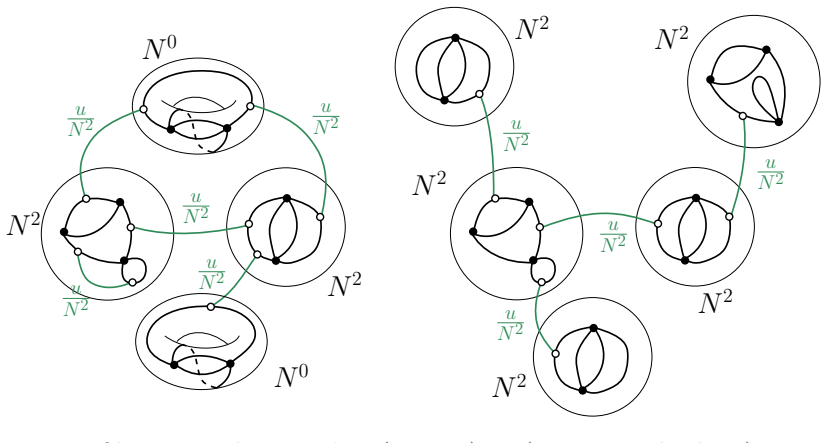
This is Part II of our project on block-weighted planar maps and Liouville quantum duality. Focusing on the scaling properties at the dual critical point, we derive the conditional distribution of the root block size given the total size, as well as, conversely, the distribution of the total size for a fixed root block size. We show that these laws are in perfect agreement with the results of Liouville quantum gravity (LQG), obtained by modifying the standard Liouville random measure with additional atomic contributions representing localized quantum areas. The ratio of dual and direct partition functions with punctures is shown to be universal, its explicit LQG expression exactly matching its combinatorial analogue. We also investigate the block distance profile for doubly rooted maps, which is here rigorously related to the distance profile of maps consisting of a single block. Finally, we analyze the multifractal properties of the usual and dual Liouville measures, predicting the associated spectra, from both quantum and Euclidean perpectives. We illustrate our results through specific realizations of block-weighted planar maps, i.e., quadrangulations decomposed into simple blocks, tree-like structures formed by attaching quartic maps, and bicubic maps decomposed into 3-connected blocks. For each model, we give the single non-universal constant which uniquely determines the strength of the corresponding atomic Liouville measure.
Editorial analysis
A structured set of objections, weighed in public.
Referee Report
Summary. This is Part II of a project on block-weighted planar maps and Liouville quantum duality. At the dual critical point the authors derive the conditional law of root-block size given total size (and the converse), claiming exact agreement with Liouville quantum gravity after the standard Liouville measure is augmented by atomic point masses whose intensity is fixed by one model-dependent constant. They further assert that the ratio of dual-to-direct punctured partition functions is universal and matches its LQG expression exactly, relate the block-distance profile of doubly-rooted maps to that of single-block maps, and predict the multifractal spectra of the usual and dual measures from both quantum and Euclidean viewpoints. The results are illustrated on three concrete families (quadrangulations decomposed into simple blocks, tree-like quartic structures, and bicubic maps decomposed into 3-connected blocks), each supplied with its fitted atomic-strength constant.
Significance. If the central identifications are rigorously justified, the work would furnish concrete evidence that the scaling limit of block-weighted maps is captured by an atomically modified Liouville measure, thereby extending the combinatorial-continuum dictionary in two-dimensional quantum gravity. The explicit matching of a universal ratio independent of the fitted constant, together with the provision of model-specific constants and multifractal predictions, supplies falsifiable statements that could be checked numerically or by other analytic methods.
major comments (2)
- [Scaling properties at the dual critical point and specific realizations] The central claim of perfect agreement rests on the assertion that the scaling limit of each block-weighted model is precisely the Liouville measure plus atomic contributions whose intensity is fixed by a single fitted constant (see the paragraph beginning 'For each model, we give the single non-universal constant'). Because this constant is calibrated to reproduce the conditional size distributions, an independent check is required that the same value also reproduces the block-distance profile or the multifractal spectrum; otherwise the identification remains an ansatz tuned to one observable rather than a derivation of the full scaling limit.
- [Ratio of dual and direct partition functions with punctures] The paper states that the ratio of dual and direct partition functions with punctures is universal and that its explicit LQG expression exactly matches the combinatorial one. It would strengthen the result to exhibit the explicit cancellation of the model-dependent atomic constant in this ratio (presumably in the derivation of the punctured partition functions) so that the matching is manifestly independent of the calibration step.
minor comments (1)
- The notation distinguishing the 'usual' and 'dual' Liouville measures, as well as the precise definition of the atomic intensity parameter, should be introduced with a displayed equation early in the text rather than only in the model-specific sections.
Simulated Author's Rebuttal
We thank the referee for the careful reading and constructive comments on our manuscript. We address the two major comments point by point below, indicating where revisions will be made to improve clarity and strengthen the presentation while preserving the analytic derivations.
read point-by-point responses
-
Referee: [Scaling properties at the dual critical point and specific realizations] The central claim of perfect agreement rests on the assertion that the scaling limit of each block-weighted model is precisely the Liouville measure plus atomic contributions whose intensity is fixed by a single fitted constant (see the paragraph beginning 'For each model, we give the single non-universal constant'). Because this constant is calibrated to reproduce the conditional size distributions, an independent check is required that the same value also reproduces the block-distance profile or the multifractal spectrum; otherwise the identification remains an ansatz tuned to one observable rather than a derivation of the full scaling limit.
Authors: The conditional block-size laws are derived combinatorially from the generating functions at the dual critical point and matched to the LQG expressions by fixing the atomic intensity for each model. The block-distance profile of doubly-rooted maps is rigorously reduced to the single-block distance profile (see the relation established in Section 3), which matches the LQG profile under the same atomically augmented measure. The multifractal spectra are likewise derived directly from the quantum and Euclidean properties of this measure, so they are fixed by the same constant with no additional calibration. While we agree that a numerical cross-check on one model would be valuable for further validation, the work is analytic and the agreement for all listed observables follows from the single identification. We will revise the introduction and the discussion of specific realizations to emphasize this consequence structure and to note the logical dependence on the conditional laws. revision: partial
-
Referee: [Ratio of dual and direct partition functions with punctures] The paper states that the ratio of dual and direct partition functions with punctures is universal and that its explicit LQG expression exactly matches the combinatorial one. It would strengthen the result to exhibit the explicit cancellation of the model-dependent atomic constant in this ratio (presumably in the derivation of the punctured partition functions) so that the matching is manifestly independent of the calibration step.
Authors: We agree that an explicit demonstration of the cancellation would make the universality more transparent. In the derivation of the punctured partition functions, the atomic contributions enter both the direct and dual LQG expressions but cancel exactly in the ratio, leaving only universal factors that match the combinatorial expression independently of the model-specific constant. We will add a short subsection (or appendix paragraph) that carries out this cancellation step by step, showing the independence from the fitted atomic intensity. revision: yes
Circularity Check
Size-distribution laws matched to atomically modified LQG by fitting one model-dependent constant; agreement asserted after calibration
specific steps
-
fitted input called prediction
[Abstract]
"We show that these laws are in perfect agreement with the results of Liouville quantum gravity (LQG), obtained by modifying the standard Liouville random measure with additional atomic contributions representing localized quantum areas. ... For each model, we give the single non-universal constant which uniquely determines the strength of the corresponding atomic Liouville measure."
The combinatorial laws are derived first; the modified LQG measure is then introduced and its single free parameter per model is chosen so that the size distributions coincide exactly. The claimed 'perfect agreement' for these laws is therefore enforced by the calibration step rather than emerging as an independent check.
full rationale
The combinatorial conditional laws (root-block size given total size, and converse) are derived from recursions at the dual critical point. These are then identified with the laws under the standard Liouville measure plus atomic point masses, where the atomic intensity is fixed by a single non-universal constant chosen per model to achieve the match. The abstract explicitly states that the laws are 'in perfect agreement' with this modified LQG construction and that the constant 'uniquely determines the strength'. While the universal punctured partition-function ratio is asserted to match independently, the central scaling-limit claim for the block-size statistics reduces to a fit. This constitutes partial circularity (fitted input called prediction) for the model-specific identification, though the combinatorial derivations themselves and the multifractal predictions retain independent content. No self-citation chain or self-definitional loop is exhibited in the provided text.
Axiom & Free-Parameter Ledger
free parameters (1)
- model-specific atomic strength constant
axioms (2)
- domain assumption Scaling limits of block-weighted planar maps exist and are described by Liouville quantum gravity
- domain assumption The ratio of dual and direct partition functions is universal across models
invented entities (1)
-
atomic contributions to the Liouville random measure
no independent evidence
Reference graph
Works this paper leans on
-
[1]
Phase Transition for Tree-Rooted Maps
Marie Albenque, Éric Fusy, and Zéphyr Salvy. Phase Transition for Tree-Rooted Maps. In Cécile Mailler and Sebastian Wild, editors,35th International Confer- ence on Probabilistic, Combinatorial and Asymptotic Methods for the Analysis of Algorithms (AofA 2024), volume 302 ofLeibniz International Proceedings in In- formatics (LIPIcs), pages 6:1–6:14, Dagstu...
work page 2024
-
[2]
L. Alvarez-Gaumé, J. L. F. Barbón, and Č. Crnković. A proposal for strings at D >1.Nucl. Phys. B, 394:383–422, 1993
work page 1993
-
[3]
J. Ambjørn, B. Durhuus, and T. Jonsson. A Solvable 2d Gravity Model withγ >0. Mod. Phys. Lett. A, 9:1221–1228, 1994
work page 1994
-
[4]
Two perspectives of the 2d unit area quantum sphere and their equivalence.Commun
Juhan Aru, Yichao Huang, and Xin Sun. Two perspectives of the 2d unit area quantum sphere and their equivalence.Commun. Math. Phys., 356(1):261–283, 2017
work page 2017
-
[5]
C. Banderier, P. Flajolet, G. Schaeffer, and M. Soria. Random maps, coalescing saddles, singularity analysis, and Airy phenomena.Random Structures Algorithms, 19(3-4):194–246, 2001
work page 2001
-
[6]
J. L. F. Barbón, K. Demeterfi, I. R. Klebanov, and C. Schmidhuber. Correlation functions in matrix models modified by wormhole terms.Nucl. Phys. B, 440:189– 214, 1995. 50
work page 1995
- [7]
-
[8]
Julien Barral and Stéphane Seuret. The singularity spectrum of Lévy processes in multifractal time.Advances in Mathematics, 214(1):437–468, 2007
work page 2007
-
[9]
Julien Barral and Stéphane Seuret. The Frisch-Parisi conjecture I: Prescribed mul- tifractal behavior, and a partial solution.Journal de Mathématiques Pures et Ap- pliquées, 175:76–108, 2023
work page 2023
-
[10]
Julien Barral and Stéphane Seuret. The Frisch-Parisi conjecture II: Besov spaces in multifractal environment, and a full solution.Journal de Mathématiques Pures et Appliquées, 175:281–329, 2023
work page 2023
-
[11]
Integral means spec- trum of whole-plane SLE.Commun
Dmitry Beliaev, Bertrand Duplantier, and Michel Zinsmeister. Integral means spec- trum of whole-plane SLE.Commun. Math. Phys., 353(1):119–133, 2017
work page 2017
-
[12]
Harmonic measure and SLE.Commun
Dmitry Beliaev and Stanislas Smirnov. Harmonic measure and SLE.Commun. Math. Phys., 290(2):577–595, 2009
work page 2009
-
[13]
Federico Bertacco. Multifractal analysis of Gaussian multiplicative chaos and appli- cations.Electronic Journal of Probability, 28(none):1 – 36, 2023
work page 2023
-
[14]
Federico Bertacco. On Gaussian multiplicative chaos and random geometry - PhD Thesis, Imperial College London, July 1st, 2025
work page 2025
-
[15]
Federico Bertacco, Ewain Gwynne, and Scott Sheffield. Scaling limits of planar maps under the Smith embedding.The Annals of Probability, 53(3):1138 – 1196, 2025
work page 2025
-
[16]
Formal multidimensional integrals, stuffed maps, and topological recursion.Ann
Gaëtan Borot. Formal multidimensional integrals, stuffed maps, and topological recursion.Ann. Inst. Henri Poincaré D, Comb. Phys. Interact., 1(2):225–264, 2014
work page 2014
-
[17]
Jérémie Bouttier and Emmanuel Guitter. Distance statistics in quadrangulations with no multiple edges and the geometry of minbus.Journal of Physics A: Mathe- matical and Theoretical, 43(20):205207, apr 2010
work page 2010
-
[18]
S. R. Das, A. Dhar, A. M. Sengupta, and S. R. Wadia. New critical behavior in d= 0large-Nmatrix models.Mod. Phys. Lett. A, 5:1041–1056, 1990
work page 1990
-
[19]
F. David. Conformal field theories coupled to2-D gravity in the conformal gauge. Mod. Phys. Lett. A, 3(17):1651–1656, 1988
work page 1988
-
[20]
Liouville quantum gravity on the Riemann sphere.Comm
François David, Antti Kupiainen, Rémi Rhodes, and Vincent Vargas. Liouville quantum gravity on the Riemann sphere.Comm. Math. Phys., 342(3):869–907, 2016
work page 2016
-
[21]
P. Di Francesco, P. Ginsparg, and J. Zinn-Justin.2D gravity and random matrices. Phys. Rep., 254:1–133, 1995. 51
work page 1995
-
[22]
J. Distler and H. Kawai. Conformal field theory and2D quantum gravity.Nucl. Phys. B, 321:509–527, 1989
work page 1989
-
[23]
B. Duplantier. Conformally invariant fractals and potential theory.Phys. Rev. Lett., 84:1363–1367, 2000
work page 2000
-
[24]
B. Duplantier. Conformal fractal geometry & boundary quantum gravity. InFractal geometry and applications: a jubilee of Benoît Mandelbrot, Part 2, volume 72 of Proc. Sympos. Pure Math., pages 365–482. Amer. Math. Soc., Providence, RI, 2004
work page 2004
-
[25]
B. Duplantier. A rigorous perspective on Liouville quantum gravity and the KPZ relation. In S. Ouvry, J. Jacobsen, V. Pasquier, D. Serban, and L. Cugliandolo, ed- itors,Exact methods in low-dimensional statistical physics and quantum theory (Les Houches Summer School, Session LXXXIX, 2008), pages 529–561. Oxford Univer- sity Press, Great Clarendon Street, 2009
work page 2008
-
[26]
B. Duplantier and S. Sheffield. Duality and KPZ in Liouville Quantum Gravity. Phys. Rev. Lett., 102:150603, 2009
work page 2009
-
[27]
B. Duplantier and S. Sheffield. Liouville quantum gravity and KPZ.Invent. Math., 185:333–393, 2011
work page 2011
-
[28]
Conformally invariant fractals and potential theory.Phys
Bertrand Duplantier. Conformally invariant fractals and potential theory.Phys. Rev. Lett., 84(7):1363–1367, 2000
work page 2000
-
[29]
Liouville quantum gravity, KPZ and Schramm-Loewner evo- lution
Bertrand Duplantier. Liouville quantum gravity, KPZ and Schramm-Loewner evo- lution. InProceedings of the international congress of mathematicians (ICM 2014), Seoul, Korea, August 13–21, 2014. Vol. III: Invited lectures, pages 1035–1061. Seoul: KM Kyung Moon Sa, 2014
work page 2014
-
[30]
Liouville quantum duality and random planar maps.arXiv:2507.12203 [math-ph], 2025
Bertrand Duplantier and Emmanuel Guitter. Liouville quantum duality and random planar maps.arXiv:2507.12203 [math-ph], 2025
-
[31]
Liouville Quantum Gravity as a Mating of Trees.Astérisque., 427:1–258, 2021
Bertrand Duplantier, Jason Miller, and Scott Sheffield. Liouville Quantum Gravity as a Mating of Trees.Astérisque., 427:1–258, 2021
work page 2021
-
[32]
Renor- malization of Critical Gaussian Multiplicative Chaos and KPZ Relation.Commun
Bertrand Duplantier, Rémi Rhodes, Scott Sheffield, and Vincent Vargas. Renor- malization of Critical Gaussian Multiplicative Chaos and KPZ Relation.Commun. Math. Phys., 330(1):283 – 330, 2014
work page 2014
-
[33]
B. Durhuus. Multi-spin systems on a randomly triangulated surface.Nucl. Phys. B, 426:203–222, 1994
work page 1994
-
[34]
M. E. Fisher. Shape of a self-avoiding walk or polymer chain.J. Chem. Phys., 44:616–622, 1966
work page 1966
-
[35]
Cambridge Uni- versity Press, 2009
Philippe Flajolet and Robert Sedgewick.Analytic Combinatorics. Cambridge Uni- versity Press, 2009. 52
work page 2009
-
[36]
William Fleurat and Zéphyr Salvy. A phase transition in block-weighted random maps.Electronic Journal of Probability, 29(none):1 – 61, 2024
work page 2024
-
[37]
P. Ginsparg and G. Moore. Lectures on 2D gravity and 2D string theory (TASI 1992). In J. Harvey and J. Polchinski, editors,Recent direction in particle theory, Proceedings of the 1992 TASI. World Scientific, Singapore, 1993
work page 1992
-
[38]
M. Goulian and M. Li. Correlation functions in Liouville theory.Phys. Rev. Lett., 66:2051–2055, Apr 1991
work page 2051
-
[39]
Ewain Gwynne, Jason Miller, and Scott Sheffield. The Tutte embedding of the mated-CRT map converges to Liouville quantum gravity.The Annals of Probability, 49(4):1677 – 1717, 2021
work page 2021
-
[40]
Almost sure multifractal spectrum of Schramm-Loewner evolution.Duke Math
Ewain Gwynne, Jason Miller, and Xin Sun. Almost sure multifractal spectrum of Schramm-Loewner evolution.Duke Math. J., 167(6):1099–1237, 2018
work page 2018
-
[41]
T. C. Halsey, M. H. Jensen, L. P. Kadanoff, I. Procaccia, and B. I. Shraiman. Fractal measures and their singularities - The characterization of strange sets.Phys. Rev. A, 33:1141–1151, 1986
work page 1986
-
[42]
T. C. Halsey, M. H. Jensen, L. P. Kadanoff, I. Procaccia, and B. I. Shraiman. Fractal measures and their singularities: The characterization of strange sets; Erratum: [Phys. Rev. A 33, 1141 (1986)].Phys. Rev. A, 34:1601–1601, 1986
work page 1986
-
[43]
H. G. E. Hentschel and Itamar Procaccia. The infinite number of generalized di- mensions of fractals and strange attractors.Physica D, 8:435–444, 1983
work page 1983
-
[44]
R. Høegh-Krohn. A general class of quantum fields without cut-offs in two space- time dimensions.Commun. Math. Phys., 21:244–255, 1971
work page 1971
-
[45]
S. Jain and S. D. Mathur. World-sheet geometry and baby universes in 2D quantum gravity.Phys. Lett. B, 286:239–246, 1992
work page 1992
-
[46]
J.-P. Kahane. Sur le chaos multiplicatif.Ann. Sci. Math. Québec, 9(2):105–150, 1985
work page 1985
-
[47]
I. R. Klebanov. Touching random surfaces and Liouville gravity.Phys. Rev. D, 51:1836–1841, 1995
work page 1995
-
[48]
I. R. Klebanov and A. Hashimoto. Non-perturbative solution of matrix models modified by trace-squared terms.Nucl. Phys. B, 434:264–282, 1995
work page 1995
-
[49]
I. R. Klebanov and A. Hashimoto. Wormholes, matrix models, and Liouville gravity. Nucl. Phys. B Proc. Suppl., 45:135–148, 1996
work page 1996
-
[50]
V. G. Knizhnik, A. M. Polyakov, and A. B. Zamolodchikov. Fractal structure of 2D-quantum gravity.Mod. Phys. Lett. A, 3:819–826, 1988. 53
work page 1988
-
[51]
G. P. Korchemsky. Loops in the curvature matrix model.Phys. Lett. B, 296:323–334, 1992
work page 1992
-
[52]
G. P. Korchemsky. Matrix model perturbed by higher order curvature terms.Mod. Phys. Lett. A, 7:3081–3100, 1992
work page 1992
-
[53]
Im- perial College Press, 2010
Francesco Mainardi.Fractional Calculus and Waves in Linear Viscoelasticity. Im- perial College Press, 2010
work page 2010
-
[54]
The Wright functions of the second kind in mathematical physics.Mathematics, 8(6), 2020
Francesco Mainardi and Armando Consiglio. The Wright functions of the second kind in mathematical physics.Mathematics, 8(6), 2020
work page 2020
-
[55]
B. B. Mandelbrot. Multiplications aléatoires itérées et distributions invariantes par moyenne pondérée aléatoire.Comptes Rendus (Paris), 278A:289–292 and 355–358, 1974
work page 1974
-
[56]
Benoît B. Mandelbrot. Intermittent turbulence in self-similar cascades: Divergence of high moments and dimension of the carrier.Journal of Fluid Mechanics, 62(2):331 – 358, 1974
work page 1974
-
[57]
G. Parisi and U. Frisch. On the singularity structure of fully developed turbulence. In M. Ghil, R. R. Benzi, and G. Parisi, editors,Turbulence and predictability in geophysical fluid dynamics and climate dynamics, Proceedings of the International School of Physics Enrico Fermi, course LXXXVIII, pages 84–87. North Holland, New York, 1985
work page 1985
-
[58]
A. M. Polyakov. Quantum geometry of bosonic strings.Phys. Lett. B, 103:207–210, 1981
work page 1981
-
[59]
R. Rhodes and V. Vargas. KPZ formula for log-infinitely divisible multifractal ran- dom measures.ESAIM: Probability and Statistics, 15:358–371, 2011
work page 2011
-
[60]
Gaussian multiplicative chaos and applications: a review.Probab
Rémi Rhodes and Vincent Vargas. Gaussian multiplicative chaos and applications: a review.Probab. Surv., 11:315–392, 2014
work page 2014
-
[61]
Gaussian multiplicative chaos revisited.Ann
Raoul Robert and Vincent Vargas. Gaussian multiplicative chaos revisited.Ann. Probab., 38(2):605–631, 2010
work page 2010
-
[62]
Zéphyr Salvy. Unified study of the phase transition for block-weighted random planar maps.Eurocomb’23, page 790–798, 2023
work page 2023
-
[63]
PhD thesis, Université Gustave Eiffel, Dec 2024
Zéphyr Salvy.Unified study of block-weighted planar maps: combinatorial and prob- abilistic properties. PhD thesis, Université Gustave Eiffel, Dec 2024. Available at https://igm.univ-mlv.fr/~salvy/data/manuscrit.pdf
work page 2024
-
[64]
Conformal weldings of random surfaces: SLE and the quantum gravity zipper.Ann
Scott Sheffield. Conformal weldings of random surfaces: SLE and the quantum gravity zipper.Ann. Probab., 44(5):3474–3545, 2016
work page 2016
-
[65]
W. T. Tutte. A census of planar maps.Canadian Journal of Mathematics, 15:249–271, 1963. 54
work page 1963
discussion (0)
Sign in with ORCID, Apple, or X to comment. Anyone can read and Pith papers without signing in.