Sub-Nyquist Sampling for Reaching Theoretical Minimal Sampling Rate Boundary
Pith reviewed 2026-05-08 01:20 UTC · model grok-4.3
The pith
The dual-frequency aliasing wideband converter samples unknown multiband signals at the theoretical minimum rate.
A machine-rendered reading of the paper's core claim, the machinery that carries it, and where it could break.
Core claim
Under mild conditions on the signal and the system, the DAWC partitions the multiband spectrum into non-uniform frequency intervals and selectively samples only a subset of them, achieving perfect subband localization and waveform reconstruction at the theoretical minimum sampling rate. The MSSP algorithm exploits the common support structure inherent in the signal column submatrices to recover the spectrum support set exactly, with stable recovery guarantees derived from the restricted isometry property in the presence of noise.
What carries the argument
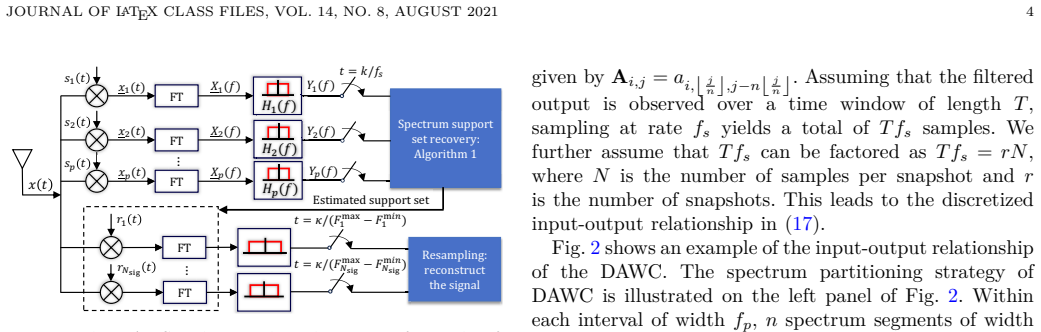
The dual-frequency aliasing wideband converter (DAWC), which partitions the multiband spectrum into non-uniform frequency intervals and selectively samples a subset to produce distinguishable aliasing patterns for arbitrary unknown subband locations.
If this is right
- Spectrum sensing hardware can operate at half the rate demanded by prior blind methods while still localizing and reconstructing the signal.
- The MSSP algorithm delivers exact support recovery for the spectrum set by exploiting shared column structure across submatrices.
- Stable reconstruction holds in noise whenever the sensing matrix satisfies the restricted isometry property.
- Numerical tests confirm higher spectrum recovery accuracy than existing sub-Nyquist schemes.
Where Pith is reading between the lines
- The non-uniform partitioning idea could extend to other blind sparse recovery settings such as radar or medical imaging where location priors are absent.
- Explicitly characterizing the mild conditions would allow direct hardware mapping and performance bounds for specific signal classes.
- Links to standard compressive sensing matrices might permit further reductions in the number of channels or sampling points.
Load-bearing premise
The mild conditions on the signal and system suffice to ensure that the dual-frequency aliasing produces distinguishable patterns without destructive overlaps for arbitrary unknown subband locations.
What would settle it
A concrete multiband signal and set of system parameters that meet the mild conditions but yield identical aliased samples for two different unknown subband configurations at the minimum rate.
Figures


read the original abstract
Wideband spectrum sensing motivates sub-Nyquist sampling architectures that exploit spectral sparsity, yet in blind scenarios where subband locations are unknown, existing schemes require sampling rates at least twice the theoretical minimum. To this end, we propose a dual-frequency aliasing wideband converter (DAWC), which partitions the multiband spectrum into non-uniform frequency intervals and selectively samples only a subset of them, requiring no prior knowledge of subband locations. We demonstrate that under mild conditions on the signal and the system, DAWC achieves perfect subband localization and waveform reconstruction at the theoretical minimum rate. Moreover, we introduce an innovative side-information-aided subspace pursuit (MSSP) algorithm exploiting the common support structure inherent in the signal column submatrices for exact recovery of the spectrum support set. Based on the restricted isometry property (RIP), we provide stable recovery guarantees for MSSP in the presence of noise. Numerical simulations show that the proposed scheme achieves superior spectrum recovery accuracy compared to state-of-the-art methods.
Editorial analysis
A structured set of objections, weighed in public.
Referee Report
Summary. The paper proposes a dual-frequency aliasing wideband converter (DAWC) architecture that partitions the multiband spectrum into non-uniform intervals and selectively samples a subset to enable blind sub-Nyquist sampling of signals with unknown subband locations. It claims that under mild conditions on the signal and system, DAWC achieves perfect subband localization and waveform reconstruction at the theoretical minimum (Landau) rate. The work also introduces a side-information-aided subspace pursuit (MSSP) algorithm that exploits common support structure for exact support recovery and provides RIP-based stable recovery guarantees in the presence of noise, with simulations showing superior accuracy over state-of-the-art methods.
Significance. If the central claims hold, this would be a notable advance in compressive sensing for wideband spectrum sensing by attaining the information-theoretic minimum sampling rate in the fully blind case, where prior architectures require at least twice that rate. The non-uniform partitioning combined with dual-frequency aliasing and the MSSP algorithm leveraging side information represent genuine technical innovations, and the provision of RIP guarantees plus numerical validation strengthens the contribution.
major comments (2)
- [Abstract] Abstract: The central claim that 'under mild conditions on the signal and the system, DAWC achieves perfect subband localization and waveform reconstruction at the theoretical minimum rate' is load-bearing but leaves the conditions unspecified. Without an explicit characterization (e.g., minimum subband separation, bandwidth ratios, or relative positions ensuring distinguishable aliasing patterns without destructive overlaps for arbitrary unknown locations), it is impossible to verify whether the scheme truly reaches the Landau rate in the general blind scenario or implicitly restricts the signal class.
- [Theoretical analysis (RIP section for MSSP)] Theoretical analysis section (referenced via the RIP guarantees for MSSP): The manuscript asserts RIP-based stable recovery guarantees but provides no derivation details, explicit statement of the mild conditions, or verification that the dual-frequency aliasing produces unique non-overlapping patterns without post-hoc assumptions. This absence directly impacts the soundness of the perfect-recovery claim for arbitrary subband locations.
minor comments (2)
- [Abstract] Abstract: The expansion 'side-information-aided subspace pursuit (MSSP)' leaves the leading 'M' unexplained; clarify the acronym origin or correct to 'SISP' if it is simply 'side-information-aided subspace pursuit'.
- [Notation and definitions] Notation throughout: Ensure consistent use of symbols for the non-uniform partitions and aliasing frequencies; the abstract introduces DAWC and MSSP but the full text should define all parameters before their first use to aid readability.
Simulated Author's Rebuttal
We thank the referee for the constructive and detailed review, as well as the positive assessment of the work's significance. The comments correctly identify areas where greater precision is needed regarding the mild conditions and the theoretical derivations. We have revised the manuscript to provide explicit characterizations, full derivations, and supporting proofs while preserving the core contributions.
read point-by-point responses
-
Referee: [Abstract] Abstract: The central claim that 'under mild conditions on the signal and the system, DAWC achieves perfect subband localization and waveform reconstruction at the theoretical minimum rate' is load-bearing but leaves the conditions unspecified. Without an explicit characterization (e.g., minimum subband separation, bandwidth ratios, or relative positions ensuring distinguishable aliasing patterns without destructive overlaps for arbitrary unknown locations), it is impossible to verify whether the scheme truly reaches the Landau rate in the general blind scenario or implicitly restricts the signal class.
Authors: We agree that the abstract's reference to 'mild conditions' was insufficiently precise and could leave readers uncertain about the scope of the blind scenario. In the revised manuscript, we have added an explicit characterization of these conditions: subbands must maintain a minimum separation of 2B (B being the maximum subband bandwidth), and the non-uniform frequency partitioning combined with dual aliasing must produce unique, non-overlapping patterns for any unknown locations. These conditions are formally stated in a new subsection of the introduction with the corresponding mathematical requirements on bandwidth ratios and relative positions. The abstract has been updated to reference this characterization directly, ensuring the claim of achieving the Landau rate is verifiable without implicitly restricting the signal class beyond standard multiband sparsity assumptions. revision: yes
-
Referee: [Theoretical analysis (RIP section for MSSP)] Theoretical analysis section (referenced via the RIP guarantees for MSSP): The manuscript asserts RIP-based stable recovery guarantees but provides no derivation details, explicit statement of the mild conditions, or verification that the dual-frequency aliasing produces unique non-overlapping patterns without post-hoc assumptions. This absence directly impacts the soundness of the perfect-recovery claim for arbitrary subband locations.
Authors: We acknowledge that the original theoretical analysis section lacked sufficient derivation details for the RIP guarantees of the MSSP algorithm and did not explicitly verify the uniqueness of aliasing patterns. In the revised manuscript, we have expanded this section to include a complete, step-by-step derivation of the RIP bounds that incorporates the common support structure exploited by MSSP. We also provide a formal proof that the dual-frequency aliasing, under the now-explicit mild conditions (minimum subband separation of 2B and appropriate bandwidth ratios), generates unique non-overlapping patterns for arbitrary unknown locations. This proof relies solely on the properties of the aliasing matrices and the non-uniform partitioning, without post-hoc assumptions. These additions directly substantiate the perfect-recovery claims. revision: yes
Circularity Check
No circularity: derivation relies on novel architecture and standard RIP analysis
full rationale
The paper introduces a new DAWC sampling architecture with non-uniform partitioning and dual-frequency aliasing, plus the MSSP algorithm, and derives recovery guarantees from the standard restricted isometry property (RIP) of compressive sensing. No equations or claims reduce by construction to fitted parameters, self-definitions, or load-bearing self-citations; the central result (perfect reconstruction at Landau rate under mild conditions) is presented as following from the proposed scheme and established theory rather than tautologically from its own outputs. The derivation chain is therefore self-contained against external benchmarks.
Axiom & Free-Parameter Ledger
axioms (2)
- domain assumption Multiband signal is spectrally sparse with unknown subband locations
- ad hoc to paper Mild conditions on signal and system allow perfect localization and reconstruction
invented entities (2)
-
DAWC (dual-frequency aliasing wideband converter)
no independent evidence
-
MSSP (side-information-aided subspace pursuit) algorithm
no independent evidence
Reference graph
Works this paper leans on
-
[1]
Millimeter wave mobile communications for 5G cellular: It will work!
T. S. Rappaport, S. Sun, R. Mayzus, H. Zhao, Y. Azar, K. Wang, G. N. Wong, J. K. Schulz, M. Samimi, and F. Gutierrez, “Millimeter wave mobile communications for 5G cellular: It will work!” IEEE Access, vol. 1, pp. 335–349, 2013
2013
-
[2]
Compressive radar imaging,
R. G. Baraniuk and P. Steeghs, “Compressive radar imaging,” in 2007 IEEE Radar Conf., Apr. 2007, pp. 128–133
2007
-
[3]
Non-terrestrial networks in the 6G era: Challenges and opportunities,
M. Giordani and M. Zorzi, “Non-terrestrial networks in the 6G era: Challenges and opportunities,” IEEE Commun. Mag., vol. 59, no. 11, pp. 42–48, 2021
2021
-
[4]
Wideband spectrum sensing with sub-Nyquist sampling in cognitive radios,
H. Sun, W.-Y. Chiu, J. Jiang, A. Nallanathan, and H. V. Poor, “Wideband spectrum sensing with sub-Nyquist sampling in cognitive radios,” IEEE Trans. Signal Process., vol. 60, no. 11, pp. 6068–6073, 2012
2012
-
[5]
Analog-to-digital converter survey and analy- sis,
R. H. Walden, “Analog-to-digital converter survey and analy- sis,” IEEE J. Sel. Areas Commun., vol. 17, no. 4, pp. 539–550, 1999
1999
-
[6]
Sub-Nyquist sampling: Bridging theory and practice,
M. Mishali and Y. C. Eldar, “Sub-Nyquist sampling: Bridging theory and practice,” IEEE Signal Process. Mag., vol. 28, no. 6, pp. 98–118, 2011
2011
-
[7]
Compressed sensing,
D. L. Donoho, “Compressed sensing,” IEEE Trans. Inf. Theory, vol. 52, no. 4, pp. 1289–1306, 2006. JOURNAL OF LATEX CLASS FILES, VOL. 14, NO. 8, AUGUST 2021 14
2006
-
[8]
Theoretical results on sparse represen- tations of multiple-measurement vectors,
J. Chen and X. Huo, “Theoretical results on sparse represen- tations of multiple-measurement vectors,” IEEE Trans. Signal Process., vol. 54, no. 12, pp. 4634–4643, 2006
2006
-
[9]
Compressive wideband power spectrum estimation,
D. D. Ariananda and G. Leus, “Compressive wideband power spectrum estimation,” IEEE Trans. Signal Process., vol. 60, no. 9, pp. 4775–4789, 2012
2012
-
[10]
From theory to practice: Sub- Nyquist sampling of sparse wideband analog signals,
M. Mishali and Y. C. Eldar, “From theory to practice: Sub- Nyquist sampling of sparse wideband analog signals,” IEEE J. Sel. Topics Signal Process., vol. 4, no. 2, pp. 375–391, 2010
2010
-
[11]
Cooperative wide- band spectrum sensing based on Sub-Nyquist sparse Fast Fourier Transform,
A. Lopez-Parrado and J. Velasco-Medina, “Cooperative wide- band spectrum sensing based on Sub-Nyquist sparse Fast Fourier Transform,” IEEE Trans. Circuits Syst. II, Exp. Briefs, vol. 63, no. 1, pp. 39–43, 2016
2016
-
[12]
Blind multiband signal recon- struction: Compressed sensing for analog signals,
M. Mishali and Y. C. Eldar, “Blind multiband signal recon- struction: Compressed sensing for analog signals,” IEEE Trans. Signal Process., vol. 57, no. 3, pp. 993–1009, 2009
2009
-
[13]
Optimal Sub-Nyquist nonuniform sampling and reconstruction for multiband signals,
R. Venkataramani and Y. Bresler, “Optimal Sub-Nyquist nonuniform sampling and reconstruction for multiband signals,” IEEE Trans. Signal Process., vol. 49, no. 10, pp. 2301–2313, 2001
2001
-
[14]
Beyond Nyquist: Efficient sampling of sparse bandlimited signals,
J. A. Tropp, J. N. Laska, M. F. Duarte, J. K. Romberg, and R. G. Baraniuk, “Beyond Nyquist: Efficient sampling of sparse bandlimited signals,” IEEE Trans. Inf. Theory, vol. 56, no. 1, pp. 520–544, 2010
2010
-
[15]
Wide- band sparse signal acquisition with dual-rate time-interleaved undersampling hardware and multicoset signal reconstruction algorithms,
T. Moon, H. W. Choi, N. Tzou, and A. Chatterjee, “Wide- band sparse signal acquisition with dual-rate time-interleaved undersampling hardware and multicoset signal reconstruction algorithms,” IEEE Trans. Signal Process., vol. 63, no. 24, pp. 6486–6497, 2015
2015
-
[16]
Xampling: Signal acquisition and processing in union of subspaces,
M. Mishali, Y. C. Eldar, and A. J. Elron, “Xampling: Signal acquisition and processing in union of subspaces,” IEEE Trans. Signal Process., vol. 59, no. 10, pp. 4719–4734, 2011
2011
-
[17]
Theory and design of a quadrature analog-to- information converter for energy-efficient wideband spectrum sensing,
T. Haque, R. T. Yazicigil, K. J.-L. Pan, J. Wright, and P. R. Kinget, “Theory and design of a quadrature analog-to- information converter for energy-efficient wideband spectrum sensing,” IEEE Trans. Circuits Syst. I, Reg. Papers, vol. 62, no. 2, pp. 527–535, 2015
2015
-
[18]
Adaptive compressed spectrum sensing for multiband signals,
J. Yang, Z. Song, Y. Gao, X. Gu, and Z. Feng, “Adaptive compressed spectrum sensing for multiband signals,” IEEE Trans. Wirel. Commun., vol. 20, no. 11, pp. 7642–7654, 2021
2021
-
[19]
Approaching sub- Nyquist boundary: Optimized compressed spectrum sensing based on multicoset sampler for multiband signal,
Z. Song, J. Yang, H. Zhang, and Y. Gao, “Approaching sub- Nyquist boundary: Optimized compressed spectrum sensing based on multicoset sampler for multiband signal,” IEEE Trans. Signal Process., vol. 70, pp. 4225–4238, 2022
2022
-
[20]
Intentional aliasing method to improve sub-Nyquist sampling system,
J. Jang, S. Im, and H.-N. Lee, “Intentional aliasing method to improve sub-Nyquist sampling system,” IEEE Trans. Signal Process., vol. 66, no. 12, pp. 3311–3326, 2018
2018
-
[21]
Compressed sensing based multi-rate sub-Nyquist sampling system,
Y. Xiong, J. Zhang, and P. Zhang, “Compressed sensing based multi-rate sub-Nyquist sampling system,” J. China Univ. Posts Telecommun., vol. 22, no. 2, pp. 89–95, 2015
2015
-
[22]
A novel fast two-stage method for wideband spectrum sensing,
A. Molazadeh, M. Ghasimi, and M. Ardebilipour, “A novel fast two-stage method for wideband spectrum sensing,” Phys. Commun., vol. 33, pp. 172–177, 2019
2019
-
[23]
Sub-Nyquist sampling for power spectrum sensing in cognitive radios: A unified approach,
D. Cohen and Y. C. Eldar, “Sub-Nyquist sampling for power spectrum sensing in cognitive radios: A unified approach,” IEEE Trans. Signal Process., vol. 62, no. 15, pp. 3897–3910, 2014
2014
-
[24]
Sub-Nyquist cyclostationary detection for cognitive ra- dio,
——, “Sub-Nyquist cyclostationary detection for cognitive ra- dio,” IEEE Trans. Signal Process., vol. 65, no. 11, pp. 3004–3019, 2017
2017
-
[25]
Sub-Nyquist spectrum sensing of sparse wideband signals using low-density measurement matrices,
Y. Vasavada and C. Prakash, “Sub-Nyquist spectrum sensing of sparse wideband signals using low-density measurement matrices,” IEEE Trans. Signal Process., vol. 68, pp. 3723–3737, 2020
2020
-
[26]
Fast compressed power spectrum estimation: Toward a practical solution for wideband spectrum sensing,
L. Yang, J. Fang, H. Duan, and H. Li, “Fast compressed power spectrum estimation: Toward a practical solution for wideband spectrum sensing,” IEEE Trans. Wirel. Commun., vol. 19, no. 1, pp. 520–532, 2020
2020
-
[27]
Sparsity order estimation and its application in compressive spectrum sensing for cognitive radios,
Y. Wang, Z. Tian, and C. Feng, “Sparsity order estimation and its application in compressive spectrum sensing for cognitive radios,” IEEE Trans. Wirel. Commun., vol. 11, no. 6, pp. 2116– 2125, 2012
2012
-
[28]
Revisiting model order selection: A sub-Nyquist sampling blind spectrum sensing scheme,
H. Ma, X. Yuan, J. Wang, and B. Li, “Revisiting model order selection: A sub-Nyquist sampling blind spectrum sensing scheme,” IEEE Trans. Wirel. Commun., vol. 22, no. 5, pp. 3371– 3383, 2023
2023
-
[29]
Algorithms for simultaneous sparse approximation. Part I: Greedy pursuit,
J. A. Tropp, A. C. Gilbert, and M. J. Strauss, “Algorithms for simultaneous sparse approximation. Part I: Greedy pursuit,” Signal Process., vol. 86, no. 3, pp. 572–588, 2006
2006
-
[30]
Compressive MUSIC: Revisiting the link between compressive sensing and array signal processing,
J. M. Kim, O. K. Lee, and J. C. Ye, “Compressive MUSIC: Revisiting the link between compressive sensing and array signal processing,” IEEE Trans. Inf. Theory, vol. 58, no. 1, pp. 278– 301, 2012
2012
-
[31]
Joint sparse recovery using signal space matching pursuit,
J. Kim, J. Wang, L. T. Nguyen, and B. Shim, “Joint sparse recovery using signal space matching pursuit,” IEEE Trans. Inf. Theory, vol. 66, no. 8, pp. 5072–5096, 2020
2020
-
[32]
Recovery of sparse signals using multiple orthogonal least squares,
J. Wang and P. Li, “Recovery of sparse signals using multiple orthogonal least squares,” IEEE Trans. Signal Process., vol. 65, no. 8, pp. 2049–2062, 2017
2049
-
[33]
Robust recovery of signals from a structured union of subspaces,
Y. C. Eldar and M. Mishali, “Robust recovery of signals from a structured union of subspaces,” IEEE Trans. Inf. Theory, vol. 55, no. 11, pp. 5302–5316, 2009
2009
-
[34]
A two stage gener- alized block orthogonal matching pursuit (TSGBOMP) algo- rithm,
S. Mukhopadhyay and M. Chakraborty, “A two stage gener- alized block orthogonal matching pursuit (TSGBOMP) algo- rithm,” IEEE Trans. Signal Process., vol. 69, pp. 5846–5858, 2021
2021
-
[35]
Block-sparse signals: Uncertainty relations and efficient recovery,
Y. C. Eldar, P. Kuppinger, and H. Bölcskei, “Block-sparse signals: Uncertainty relations and efficient recovery,” IEEE Trans. Signal Process., vol. 58, no. 6, pp. 3042–3054, 2010
2010
-
[36]
Model selection and estimation in regression with grouped variables,
M. Yuan and Y. Lin, “Model selection and estimation in regression with grouped variables,” J. Roy. Statist. Soc. B, vol. 68, no. 1, pp. 49–67, 2006
2006
-
[37]
Extension of SBL algorithms for the recovery of block sparse signals with intra-block correlation,
Z. Zhang and B. D. Rao, “Extension of SBL algorithms for the recovery of block sparse signals with intra-block correlation,” IEEE Trans. Signal Process., vol. 61, no. 8, pp. 2009–2015, Apr. 2013
2009
-
[38]
Decoding by linear programming,
E. J. Candès and T. Tao, “Decoding by linear programming,” IEEE Trans. Inf. Theory, vol. 51, no. 12, pp. 4203–4215, 2005
2005
-
[39]
Sub-Nyquist sampling for power spectrum sensing in cognitive radios: A unified approach,
D. Cohen and Y. C. Eldar, “Sub-Nyquist sampling for power spectrum sensing in cognitive radios: A unified approach,” IEEE Trans. Signal Process., vol. 62, no. 15, pp. 3897–3910, Aug. 2014
2014
-
[40]
Subspace pursuit for compressive sensing signal reconstruction,
W. Dai and O. Milenkovic, “Subspace pursuit for compressive sensing signal reconstruction,” IEEE Trans. Inf. Theory, vol. 55, no. 5, pp. 2230–2249, 2009
2009
-
[41]
Improved analysis for subspace pursuit algorithm in terms of restricted isometry constant,
C.-B. Song, S.-T. Xia, and X.-J. Liu, “Improved analysis for subspace pursuit algorithm in terms of restricted isometry constant,” IEEE Signal Process. Lett., vol. 21, no. 11, pp. 1365– 1369, 2014
2014
-
[42]
Matching pursuit with time- frequency dictionaries,
S. G. Mallat and Z. Zhang, “Matching pursuit with time- frequency dictionaries,” IEEE Trans. Signal Process., vol. 41, no. 12, pp. 3397–3415, 1993
1993
-
[43]
G. H. Golub and C. F. V. Loan, Matrix Computations, 4th ed. Baltimore, MD: Johns Hopkins Univ. Press, 2013
2013
discussion (0)
Sign in with ORCID, Apple, or X to comment. Anyone can read and Pith papers without signing in.