Recognition: unknown
The spin state of asteroid Apophis and a prediction of its change during the 2029 close encounter with Earth
Pith reviewed 2026-05-08 01:14 UTC · model grok-4.3
The pith
All acceptable models of Apophis's spin from past light curves converge on the same pre-2029 orientation and preserve the short-axis mode after the flyby.
A machine-rendered reading of the paper's core claim, the machinery that carries it, and where it could break.
Core claim
Light-curve inversion for tumbling asteroids applied to data from 2012-2013 and 2020-2021 yields several acceptable period solutions, all of which produce nearly identical pre-encounter orientation in early 2029. Numerical modeling of the spin evolution under Earth's gravitational torque during the close approach then shows that the short-axis mode is preserved with high likelihood, although post-encounter uncertainty grows substantially.
What carries the argument
Light-curve inversion method for tumbling asteroids that fits precession and rotation periods to produce a convex shape model, which is then used as the initial condition for numerical integration of rotational dynamics under planetary torque.
If this is right
- Additional observations in 2027 and 2028 will resolve the ambiguity among the current period solutions.
- The short-axis spin mode will be preserved with high likelihood after the 2029 encounter.
- Post-encounter uncertainty in the spin state will increase substantially because of the close approach.
- All currently acceptable models share approximately the same pre-encounter orientation in early 2029.
- The stable mode prediction can be used for impact-risk assessments and mission planning.
Where Pith is reading between the lines
- The same inversion-plus-torque approach could be tested on other tumbling near-Earth asteroids ahead of their own planetary encounters.
- If post-2029 photometry matches the predicted mode, it would support the assumption that gravitational torque dominates the spin change.
- Future radar or spacecraft data after 2029 could provide an independent check on the post-encounter uncertainty growth.
Load-bearing premise
The light-curve inversion from the two apparitions correctly maps the fitted periods onto a reliable pre-encounter orientation, and non-gravitational forces do not significantly alter the spin during the flyby.
What would settle it
New photometric observations in 2027 or 2028 that yield a pre-encounter orientation inconsistent with all current acceptable models would demonstrate that the period solutions do not reliably predict the 2029 state.
Figures



read the original abstract
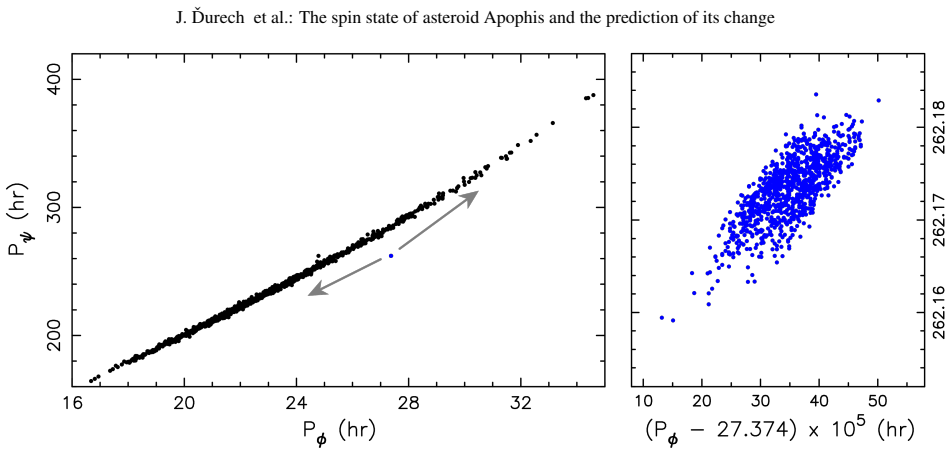
On April 13, 2029, the asteroid Apophis will pass near Earth at a geocentric distance of about 38,000 km. Numerical models have suggested that the post-encounter spin state will critically depend on the orientation of Apophis during the flyby. We aim to determine the spin state of Apophis from its photometric observations collected during two apparitions in 2012-2013 and 2020-2021. This will enable us to accurately predict the pre-encounter rotation state and, by accounting for Earth's gravitational torque, predict a range of possible post-encounter states. We used the light curve inversion method for tumbling asteroids to reconstruct the spin state of Apophis and its convex shape model. The result is adopted as the initial condition of a numerical model describing Apophis's future rotation state. The data from the two apparitions are insufficient to determine Apophis's rotation and precession periods uniquely. The formally best-fit solution is 27.374 +/- 0.001 h for the precession period and 262.2 +/- 0.1 h for the rotation period, but at least two other combinations of the periods provide a similarly good fit to the available data. All the currently acceptable models result in approximately the same pre-encounter orientation of Apophis in early 2029. This is because the accurate photometric data were collected during two apparitions separated by 8 years, which is the same interval as from 2021 to 2029. Although the close encounter with Earth in April 2029 hugely increases the post-encounter uncertainty of Apophis's spin state, the short-axis spin mode will be preserved with a high likelihood. Additional observations taken in 2027 and 2028 will break the ambiguity in Apophis's pre-encounter spin solution and allow us to get a more accurate post-encounter spin state prediction
Editorial analysis
A structured set of objections, weighed in public.
Referee Report
Summary. The paper applies light-curve inversion to photometric data from Apophis's 2012-2013 and 2020-2021 apparitions to reconstruct its tumbling spin state and convex shape. While the precession period (best-fit 27.374 ± 0.001 h) and rotation period (262.2 ± 0.1 h) are not uniquely determined, the authors show that all acceptable period combinations produce approximately the same body orientation in early 2029 because the 8-year observational baseline matches the interval to the encounter. They then integrate the gravitational torque from Earth during the 38,000 km flyby and conclude that the short-axis spin mode is preserved with high likelihood, although post-encounter uncertainty grows substantially. Additional 2027-2028 observations are recommended to resolve the ambiguity.
Significance. If the central claim is substantiated, the work supplies a concrete, observationally anchored prediction for Apophis's spin evolution across the 2029 encounter. This is directly relevant to planning for the OSIRIS-APEX mission and to any ground-based or spacecraft observations timed around closest approach. The demonstration that multiple period solutions converge on the same pre-encounter state is a useful methodological point for tumbling-asteroid studies, and the use of standard torque integration provides a clear, falsifiable forecast.
major comments (2)
- [results on acceptable period solutions] The central claim that 'all currently acceptable models result in approximately the same pre-encounter orientation' (abstract and results section) is load-bearing for the post-encounter prediction, yet the manuscript provides no quantitative measure of the dispersion in 2029 orientations across the family of acceptable solutions. Given the stated period uncertainties, an explicit propagation of phase errors over the ~8-year interval (or a table/figure showing the range of Euler angles at the 2029 epoch) is required to confirm that the torque integration always yields short-axis-mode preservation at the edges of the solution space.
- [numerical integration of future rotation state] The post-encounter analysis assumes that only gravitational torque from Earth acts during the flyby and that non-gravitational forces (outgassing, YORP, etc.) are negligible. While this is stated, no quantitative bound is placed on the possible contribution of such effects over the encounter timescale, which directly affects the claimed 'high likelihood' of short-axis-mode preservation.
minor comments (2)
- [abstract and results] The abstract states that 'at least two other combinations of the periods provide a similarly good fit' but does not list their values or goodness-of-fit metrics; these should be tabulated in the main text for reproducibility.
- [figures] Figure captions and axis labels for the orientation plots should explicitly note the time epoch (e.g., 'early 2029') and the coordinate frame used.
Simulated Author's Rebuttal
We thank the referee for the positive evaluation of the manuscript's relevance to OSIRIS-APEX planning and for the constructive comments. We agree that the two major points require strengthening and will revise the manuscript to address them directly.
read point-by-point responses
-
Referee: The central claim that 'all currently acceptable models result in approximately the same pre-encounter orientation' (abstract and results section) is load-bearing for the post-encounter prediction, yet the manuscript provides no quantitative measure of the dispersion in 2029 orientations across the family of acceptable solutions. Given the stated period uncertainties, an explicit propagation of phase errors over the ~8-year interval (or a table/figure showing the range of Euler angles at the 2029 epoch) is required to confirm that the torque integration always yields short-axis-mode preservation at the edges of the solution space.
Authors: We agree that an explicit quantitative measure of dispersion is needed to make the claim robust. In the revised manuscript we will add a new figure (and accompanying text) that propagates the stated period uncertainties forward to the 2029 epoch for every acceptable period combination. The figure will display the resulting range of Euler angles at the start of the encounter, demonstrating that the orientations remain clustered within a few degrees and that short-axis-mode preservation holds at the boundaries of the solution space. revision: yes
-
Referee: The post-encounter analysis assumes that only gravitational torque from Earth acts during the flyby and that non-gravitational forces (outgassing, YORP, etc.) are negligible. While this is stated, no quantitative bound is placed on the possible contribution of such effects over the encounter timescale, which directly affects the claimed 'high likelihood' of short-axis-mode preservation.
Authors: The referee correctly notes the absence of a quantitative bound. The encounter duration is only a few hours, during which YORP-induced spin changes for an Apophis-sized body are expected to be <10^{-5} deg and outgassing (if present) would produce negligible torque compared with Earth's gravitational effect. We will revise the text to include this order-of-magnitude estimate and a short paragraph justifying why non-gravitational contributions can be neglected on this timescale, thereby supporting the stated high likelihood of short-axis-mode preservation. revision: yes
Circularity Check
No circularity; spin-state fitting and torque integration remain independent
full rationale
The derivation begins with light-curve inversion applied to photometric data from two apparitions (2012-2013 and 2020-2021) to obtain candidate period pairs and a convex shape. These fitted parameters are then used as initial conditions for a separate numerical integration of Earth's gravitational torque during the 2029 encounter. The statement that all acceptable models produce approximately the same pre-encounter orientation in early 2029 is reported as a direct computational outcome of propagating the fitted periods over the matching 8-year baseline; it is not imposed by definition or by renaming the input data. Post-encounter mode preservation is likewise an output of the independent torque physics applied to those orientations. No self-citations are invoked as load-bearing uniqueness theorems, no fitted quantities are relabeled as predictions, and no ansatz is smuggled via prior work. The chain is therefore self-contained against external photometric data and standard rigid-body dynamics.
Axiom & Free-Parameter Ledger
free parameters (3)
- precession period =
27.374 h
- rotation period =
262.2 h
- convex shape model parameters
axioms (2)
- domain assumption Light-curve inversion for tumbling asteroids can reconstruct spin state and convex shape from photometric data.
- domain assumption Earth's gravitational torque during the flyby can be modeled numerically to predict spin-state evolution.
Reference graph
Works this paper leans on
-
[1]
& Destiny + Team
Arai, T. & Destiny + Team. 2025, in LPI Contributions, V ol. 3083, Apophis T-4 Y ears, 2061
2025
-
[2]
L., Graninger, D
Ballouz, R. L., Graninger, D. M., Adams, E. Y ., et al. 2024b, in LPI Contribu- tions, V ol. 3006, Apophis T-5 Workshop, 2060
2060
-
[3]
J., Scheeres, D
Benson, C. J., Scheeres, D. J., Brozovi ´c, M., et al. 2023, Icarus, 390, 115324
2023
-
[4]
P ., Rivkin, A
Binzel, R. P ., Rivkin, A. S., Thomas, C. A., et al. 2009, Icarus, 200, 480
2009
-
[5]
F., V okrouhlický, D., Rubincam, D
Bottke, Jr., W. F., V okrouhlický, D., Rubincam, D. P ., & Nesvorný, D. 2006, Annual Review of Earth and Planetary Sciences, 34, 157
2006
-
[6]
2009, A&A, 507, 1073
Breiter, S., Bartczak, P ., Czekaj, M., Oczujda, B., & V okrouhlický, D. 2009, A&A, 507, 1073
2009
-
[7]
2011, MNRAS, 417, 2478 Brož, M., Binzel, R
Breiter, S., Ro˙ zek, A., & V okrouhlický, D. 2011, MNRAS, 417, 2478 Brož, M., Binzel, R. P ., V ernazza, P ., et al. 2026, A&A, 708, A162 Brozovi´c, M., Benner, L. A. M., McMichael, J. G., et al. 2018, Icarus, 300, 115
2011
-
[8]
Brozovic, M., Benner, L. A. M., Naidu, S. P ., et al. 2022, in LPI Contributions, V ol. 2681, Apophis T-7 Y ears: Knowledge Opportunities for the Science of Planetary Defense, 2023 ˇCapek, D. & V okrouhlický, D. 2004, Icarus, 172, 526 Cicalò, S. & Scheeres, D. J. 2010, Celestial Mechanics and Dynamical Astron- omy, 106, 301
2022
-
[9]
N., Nolan, M
DellaGiustina, D. N., Nolan, M. C., Polit, A. T., et al. 2023, PSJ, 4, 198
2023
-
[10]
V ., Richardson, D
DeMartini, J. V ., Richardson, D. C., Barnouin, O. S., et al. 2019, Icarus, 328, 93
2019
-
[11]
& Elipe, A
Deprit, A. & Elipe, A. 1993, Journal of the Astronautical Sciences, 41, 603
1993
-
[12]
Dobrovolskis, A. R. 1996, Icarus, 124, 698 ˇDurech, J., V okrouhlický, D., Pravec, P ., et al. 2024, A&A, 682, A93
1996
-
[13]
2013, Icarus, 224, 192
Farnocchia, D., Chesley, S., Chodas, P ., et al. 2013, Icarus, 224, 192
2013
-
[14]
& Chesley, S
Farnocchia, D. & Chesley, S. R. 2022, in LPI Contributions, V ol. 2681, Apophis T-7 Y ears: Knowledge Opportunities for the Science of Planetary Defense, 2007
2022
-
[15]
R., & DellaGiustina, D
Farnocchia, D., V okrouhlický, D., ˇCapek, D., Chesley, S. R., & DellaGiustina, D. N. 2024, in LPI Contributions, V ol. 3006, Apophis T-5 Workshop, 2046
2024
-
[16]
2025, A&A, 695, A139
Fatka, P ., Pravec, P ., Scheirich, P ., et al. 2025, A&A, 695, A139
2025
-
[17]
M., Burke, C
Fausnaugh, M. M., Burke, C. J., Caldwell, D. A., et al. 2021, TESS Data Release Notes:Sector 35, DR51, NASA Technical Memorandum, NASA /STI Acces- sion number: 20210014771
2021
-
[18]
1970, Principles of Celestial Mechanics (Academic Press, New Y ork)
Fitzpatrick, P . 1970, Principles of Celestial Mechanics (Academic Press, New Y ork)
1970
-
[19]
& Krugly, Y
Golubov, O. & Krugly, Y . N. 2012, ApJ, 752, L11
2012
-
[20]
1986, Icarus, 67, 264
Hapke, B. 1986, Icarus, 67, 264
1986
-
[21]
2012, Theory of Reflectance and Emittance Spectroscopy (Cambridge University Press)
Hapke, B. 2012, Theory of Reflectance and Emittance Spectroscopy (Cambridge University Press)
2012
-
[22]
& V everka, J
Helfenstein, P . & V everka, J. 1989, in Asteroids II, ed. R. P . Binzel, T. Gehrels, & M. S. Matthews (Tucson: University of Arizona Press), 557–593
1989
-
[23]
2021, Icarus, 365, 114493
Hirabayashi, M., Kim, Y ., & Brozovi´c, M. 2021, Icarus, 365, 114493
2021
-
[24]
Humes, O. A. & Hanuš, J. 2024, PSJ, 5, 271
2024
-
[25]
2011, The Messenger, 145, 2
Jehin, E., Gillon, M., Queloz, D., et al. 2011, The Messenger, 145, 2
2011
-
[26]
2001, Astron
Kaasalainen, M. 2001, Astron. Astrophys., 376, 302
2001
-
[27]
& Torppa, J
Kaasalainen, M. & Torppa, J. 2001, Icarus, 153, 24
2001
-
[28]
V ., Richardson, D
Kim, Y ., DeMartini, J. V ., Richardson, D. C., & Hirabayashi, M. 2023, MNRAS, 520, 3405
2023
-
[29]
& Lifshitz, E
Landau, L. & Lifshitz, E. 1969, Mechanics (Pergamon Press, Oxford)
1969
-
[30]
Landolt, A. U. 1992, AJ, 104, 340 Article number, page 12 J. ˇDurech et al.: The spin state of asteroid Apophis and the prediction of its change
1992
-
[31]
2025, in EPSC-DPS Joint Meeting 2025, V ol
Lazzarin, M., Michel, P ., Kueppers, M., et al. 2025, in EPSC-DPS Joint Meeting 2025, V ol. 2025, EPSC–DPS2025–806
2025
-
[32]
J., Kim, M
Lee, H. J., Kim, M. J., Marciniak, A., et al. 2022, A&A, 661, L3
2022
-
[33]
2021, AJ, 161, 112
Lee, H.-J., ˇDurech, J., V okrouhlický, D., et al. 2021, AJ, 161, 112
2021
-
[34]
J., Takir, D., & Clark, B
Li, J.-Y ., Helfenstein, P ., Burrati, B. J., Takir, D., & Clark, B. E. 2015, in Aster- oids IV, ed. P . Michel, F. E. DeMeo, & W. F. Bottke (Tucson: University of Arizona Press), 129–150
2015
-
[35]
2016, Astron- omy and Astrophysics, 585, 1
Licandro, J., Müller, T., Álvarez, C., Alí-Lagoa, V ., & Delbo, M. 2016, Astron- omy and Astrophysics, 585, 1
2016
-
[36]
Lobanova, K. S. & Melnikov, A. V . 2024, Solar System Research, 58, 208
2024
-
[37]
2025, in LPI Contributions, V ol
Michel, P ., Lazzazin, M., Küppers, M., et al. 2025, in LPI Contributions, V ol. 3083, Apophis T-4 Y ears, 2012 Müller, T. G., Kiss, C., Scheirich, P ., et al. 2014, A&A, 566, A22
2025
-
[38]
C., DellaGiustina, D
Nolan, M. C., DellaGiustina, D. N., Polit, A. T., et al. 2025, in EPSC-DPS Joint Meeting 2025, V ol. 2025, EPSC–DPS2025–187 Pál, A., Szakáts, R., Kiss, C., et al. 2020, ApJS, 247, 26
2025
-
[39]
& Aharonson, O
Polishook, D. & Aharonson, O. 2020, Icarus, 336, 113415
2020
-
[40]
& ˇDurech, J
Pravec, P . & ˇDurech, J. 2024, in LPI Contributions, V ol. 3006, Apophis T-5 Workshop, 2008
2024
-
[41]
2014, Icarus, 233, 48
Pravec, P ., Scheirich, P .,ˇDurech, J., et al. 2014, Icarus, 233, 48
2014
-
[42]
S., Dotson, J., et al
Reddy, V ., Kelley, M. S., Dotson, J., et al. 2022, PSJ, 3, 123
2022
-
[43]
R., Winn, J
Ricker, G. R., Winn, J. N., V anderspek, R., et al. 2015, Journal of Astronomical
2015
-
[44]
Rubincam, D. P . 2000, Icarus, 148, 2
2000
-
[45]
2016, Minor Planet Bulletin, 43, 205
Santana-Ros, T., Marciniak, A., & Bartczak, P . 2016, Minor Planet Bulletin, 43, 205
2016
-
[46]
R., et al
Satpathy, A., Mainzer, A., Masiero, J. R., et al. 2022, PSJ, 3, 124
2022
-
[47]
J., Abe, M., Y oshikawa, M., et al
Scheeres, D. J., Abe, M., Y oshikawa, M., et al. 2007, Icarus, 188, 425
2007
-
[48]
J., Benner, L
Scheeres, D. J., Benner, L. A. M., Ostro, S. J., et al. 2005, Icarus, 178, 281
2005
-
[49]
2018, A&A, 617, A74
Souchay, J., Lhotka, C., Heron, G., et al. 2018, A&A, 617, A74
2018
-
[50]
W., & Scheeres, D
Takahashi, Y ., Busch, M. W., & Scheeres, D. J. 2013, AJ, 146, 95 V okrouhlický, D., Bottke, W. F., Chesley, S. R., Scheeres, D. J., & Statler, T. S. 2015a, in Asteroids IV, ed. P . Michel, F. E. DeMeo, & W. F. Bottke (Tucson: University of Arizona Press), 509–531 V okrouhlický, D., Breiter, S., Nesvorný, D., & Bottke, W. F. 2007, Icarus, 191, 636 V okrou...
2013
-
[51]
1917, A Treatise on the Analytical Dynamics of Particles and Rigid Bodies (Cambridge University Press, Cambridge) Y u, Y ., Richardson, D
Whittaker, E. 1917, A Treatise on the Analytical Dynamics of Particles and Rigid Bodies (Cambridge University Press, Cambridge) Y u, Y ., Richardson, D. C., Michel, P ., Schwartz, S. R., & Ballouz, R.-L. 2014, Icarus, 242, 82
1917
-
[52]
E., Bhatta, G., & Caton, D
Zola, S., Kouprianov, V ., Reichart, D. E., Bhatta, G., & Caton, D. B. 2021, in Revista Mexicana de Astronomia y Astrofisica Conference Series, V ol. 53, Revista Mexicana de Astronomia y Astrofisica Conference Series, 206–214
2021
-
[53]
2025, in Revista Mexicana de As- tronomia y Astrofisica Conference Series, V ol
Zola, S., Stachowski, G., Kurowski, S., et al. 2025, in Revista Mexicana de As- tronomia y Astrofisica Conference Series, V ol. 59, Revista Mexicana de As- tronomia y Astrofisica Conference Series, 31–36 Article number, page 13 A&A proofs: manuscript no. Apophis_arxiv_5_ Appendix A: Aspect data Table A.1. Aspect data for new observations from 2020–2021 take...
2025
discussion (0)
Sign in with ORCID, Apple, or X to comment. Anyone can read and Pith papers without signing in.