Quantum vs. Classical Spin: A Comparative Study of Dipolar Spin Dynamics and the Onset of Chaos
Pith reviewed 2026-05-08 04:11 UTC · model grok-4.3
The pith
Quantum and classical spins produce significantly different free induction decay despite similar overall patterns.
A machine-rendered reading of the paper's core claim, the machinery that carries it, and where it could break.
Core claim
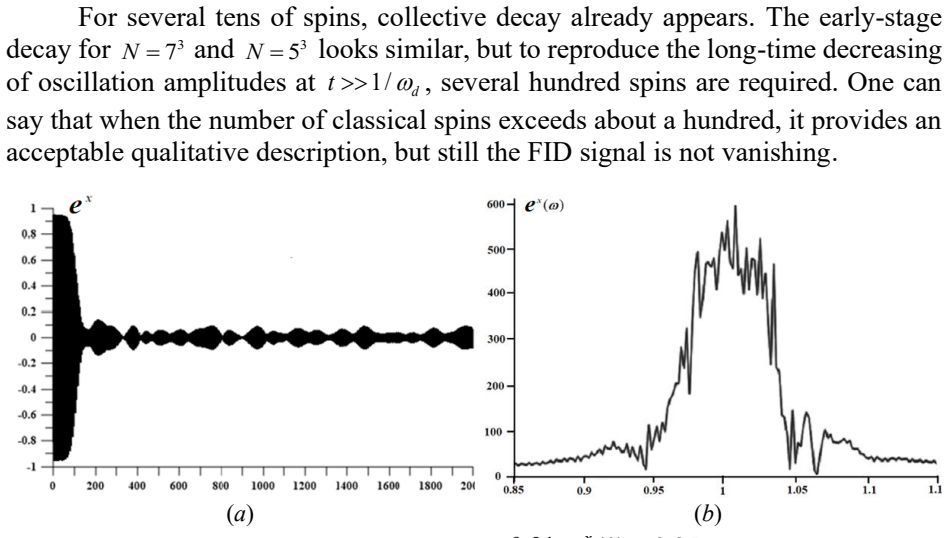
Although classical spins have long been used in microscopic spin dynamics simulations, their results differ significantly from those of quantum spins in a dipole-coupled system. When benchmarked against free induction decay, the overall patterns are qualitatively similar yet significant discrepancies appear at both short and long timescales, which can be traced to fundamental distinctions in the two descriptions.
What carries the argument
Free induction decay as the comparative metric between direct Schrödinger-equation solutions for quantum spins and classical spin simulations in a dipole-coupled system.
If this is right
- Classical simulations cannot be assumed to reproduce quantum spin dynamics reliably at all timescales in dipolar systems.
- The onset of chaos in spin systems may be described differently under quantum versus classical rules.
- Precise predictions for dipolar spin evolution require quantum treatments rather than classical approximations.
Where Pith is reading between the lines
- Similar discrepancies could appear in other observables beyond free induction decay, such as spin correlation functions.
- The result suggests testing whether quantum-classical differences persist or diminish as system size increases toward the thermodynamic limit.
- This comparison framework could be applied to other interaction types, like exchange or Zeeman terms, to map where classical approximations break down.
Load-bearing premise
The chosen system size, initial conditions, and free induction decay metric provide a fair and representative comparison between the quantum and classical models without hidden approximations that favor one over the other.
What would settle it
Repeating the comparison for substantially larger numbers of spins or different initial states and finding that the short- and long-time discrepancies in free induction decay vanish would falsify the claim of significant fundamental differences.
Figures




read the original abstract
We investigate the spin dynamics of a dipole-coupled system by comparing a direct solution of the Schrodinger equation for quantum spins with simulations of classical spins. Although classical spins have long been used in microscopic spin dynamics simulations, we demonstrate that their results differ significantly from those of quantum spins. Using Free Induction Decay as a benchmark, we find that while the overall patterns are qualitatively similar, significant discrepancies emerge at both short and long timescales. We trace these differences to fundamental distinctions in the two descriptions.
Editorial analysis
A structured set of objections, weighed in public.
Referee Report
Summary. The manuscript compares quantum spin dynamics, obtained by direct solution of the Schrödinger equation, with classical spin simulations for a dipole-coupled system. It uses Free Induction Decay (FID) as the primary benchmark and reports that, while overall patterns are qualitatively similar, significant quantitative discrepancies appear at both short and long timescales. These differences are attributed to fundamental distinctions between the quantum (operator) and classical (vector) descriptions.
Significance. If the discrepancies are shown to arise from intrinsic quantum-classical differences rather than finite-size artifacts, the work would usefully caution against routine use of classical spins in microscopic dipolar simulations, especially for small clusters or when entanglement matters. The direct side-by-side comparison is a strength, but its interpretive weight depends on controls that are not yet demonstrated.
major comments (2)
- [Abstract and Results (FID comparison)] The central claim (abstract and concluding discussion) that observed FID discrepancies trace to 'fundamental distinctions' is load-bearing yet untested against finite-N effects. Quantum exact diagonalization is feasible only for N ≲ 8–10; classical vector dynamics at the same small N need not reproduce the large-N limit in which classical approximations are normally justified. No N-scaling study, alternative initial states, or comparison to larger classical ensembles is described, leaving open the possibility that the reported differences are dominated by finite-size artifacts rather than intrinsic quantum features.
- [Methods and Results sections] No quantitative error analysis, specific Hamiltonian parameters (e.g., dipolar coupling strengths, lattice geometry), or explicit initial-state definitions are provided to allow independent assessment of whether the short- and long-time discrepancies are robust or sensitive to choices. The absence of these details makes it impossible to judge whether the 'significant discrepancies' exceed numerical or statistical uncertainties.
minor comments (2)
- [Abstract] The abstract contains no equations, system sizes, or numerical values, forcing the reader to consult the full text for even basic context; adding a concise statement of N, initial polarization, and the FID observable would improve accessibility.
- [Methods] Notation for the classical equations of motion and the precise definition of the FID metric should be stated explicitly (e.g., as an equation) rather than left implicit.
Simulated Author's Rebuttal
We thank the referee for the careful review and for identifying key issues regarding finite-size effects and methodological details. We respond to each major comment below and indicate the changes we will incorporate in the revised manuscript.
read point-by-point responses
-
Referee: [Abstract and Results (FID comparison)] The central claim (abstract and concluding discussion) that observed FID discrepancies trace to 'fundamental distinctions' is load-bearing yet untested against finite-N effects. Quantum exact diagonalization is feasible only for N ≲ 8–10; classical vector dynamics at the same small N need not reproduce the large-N limit in which classical approximations are normally justified. No N-scaling study, alternative initial states, or comparison to larger classical ensembles is described, leaving open the possibility that the reported differences are dominated by finite-size artifacts rather than intrinsic quantum features.
Authors: We agree that finite-N effects must be addressed explicitly. Our direct comparison is performed at identical small N for both quantum and classical descriptions, which isolates the impact of quantum operator non-commutativity and correlations versus the classical vector model. While classical dynamics at small N does not automatically match its own large-N limit, the discrepancies we report are already present in this regime and align with the absence of quantum entanglement in the classical case. In the revision we will add classical simulations at larger N (up to N=50) to show that the short- and long-time discrepancies persist qualitatively, and we will revise the abstract and discussion to state that the differences are demonstrated within the N range accessible to exact quantum calculations rather than claiming they are proven in the thermodynamic limit. revision: partial
-
Referee: [Methods and Results sections] No quantitative error analysis, specific Hamiltonian parameters (e.g., dipolar coupling strengths, lattice geometry), or explicit initial-state definitions are provided to allow independent assessment of whether the short- and long-time discrepancies are robust or sensitive to choices. The absence of these details makes it impossible to judge whether the 'significant discrepancies' exceed numerical or statistical uncertainties.
Authors: We acknowledge that these details were insufficiently specified. In the revised manuscript we will add: (i) explicit initial-state definitions (e.g., fully polarized product states along a chosen axis), (ii) concrete Hamiltonian parameters (dipolar coupling strength normalized to 1, lattice geometry and nearest-neighbor distances), and (iii) quantitative error analysis including time-step convergence for classical integration and numerical tolerance for the quantum diagonalization. These additions will allow readers to verify that the reported discrepancies exceed numerical uncertainties. revision: yes
- Exact quantum diagonalization remains computationally infeasible for N ≫ 10, so a direct quantum-classical comparison at large N cannot be provided.
Circularity Check
No circularity: direct numerical comparison without self-referential derivations
full rationale
The paper conducts a side-by-side numerical study of quantum (exact Schrödinger evolution) versus classical (vector) dipolar spin dynamics, benchmarking both against free induction decay for small N. No derivation chain, fitted parameters, or predictions are described that reduce by construction to the inputs; the central claim is an observed discrepancy attributed to operator versus vector mechanics. No self-citations are invoked as load-bearing uniqueness theorems, no ansatz is smuggled, and no known result is renamed. The work is self-contained as an empirical comparison.
Axiom & Free-Parameter Ledger
Reference graph
Works this paper leans on
-
[1]
S. J. Knak Jensen, O. Platz, Free-Induction-Decay Shapes in a Dipolar-Coupled Rigid Lattice of Infinite Nuclear Spins, Phys. Rev. B 7 (1973) 31
work page 1973
-
[2]
S. J. Jensen and E. K. Hansen, Dynamics of classical spins with dipolar coupling in a rigid lattice at high temperatures, Phys. Rev. B 13 (1976) 1903
work page 1976
-
[3]
A. A. Lundin, V. E. Zobov, Simulation of the nuclear magnetic system of a crystal by the system of classical magnetic moments, J. Magn. Reson. 26 (1977) 229
work page 1977
-
[4]
C. Tang, J. S. Waugh, Dynamics of classical spins on a lattice: Spin diffusion, Phys. Rev. B 45 (1992) 748
work page 1992
-
[5]
T. A. Elsayed, B. V. Fine, Effectiveness of classical spin simulations for describing NMR relaxation of quantum spins, Phys. Rev. B 91 (2015) 094424
work page 2015
- [6]
- [7]
-
[8]
K. Tsiberkin, T. Belozerova, V. Henner, Simulation of free induction decay at low-temperature with spin waves and classical spins, Eur. Phys. J. B 92 (2019) 140
work page 2019
- [9]
- [10]
-
[11]
P. Kharebov, V. Henner, V. Yukalov, Optimal conditions for magnetization reversal of nanocluster assemlies with random properties, J. Appl. Phys. 113 (2013) 043902. 27
work page 2013
- [12]
-
[13]
A.S. de Wijn, B. Hess and B.V. Fine, Largest Lyapunov Exponents for Lattices of Interacting Classical Spins, Phys. Rev. Lett. 109 (2012) 034101
work page 2012
-
[14]
G. E. Pake, Nuclear Resonance Absorption in Hydrated Crystals: Fine Structure of the Proton Line, J. Chem. Phys. 16 (1948) 327-336
work page 1948
-
[15]
Abragam, Principles of Nuclear Magnetism (Clarendon Press, Oxford, 1961)
A. Abragam, Principles of Nuclear Magnetism (Clarendon Press, Oxford, 1961)
work page 1961
-
[16]
A. Pikovsky and A. Politi, Lyapunov Exponents: A Tool to Explore Complex Dynamics , (Cambridge University Press, 2016)
work page 2016
discussion (0)
Sign in with ORCID, Apple, or X to comment. Anyone can read and Pith papers without signing in.