Electrical tunability of terahertz nonlinearity in graphene
Pith reviewed 2026-05-08 02:06 UTC · model grok-4.3
The pith
Electrical gating enhances graphene's terahertz third-harmonic generation efficiency by two orders of magnitude.
A machine-rendered reading of the paper's core claim, the machinery that carries it, and where it could break.
Core claim
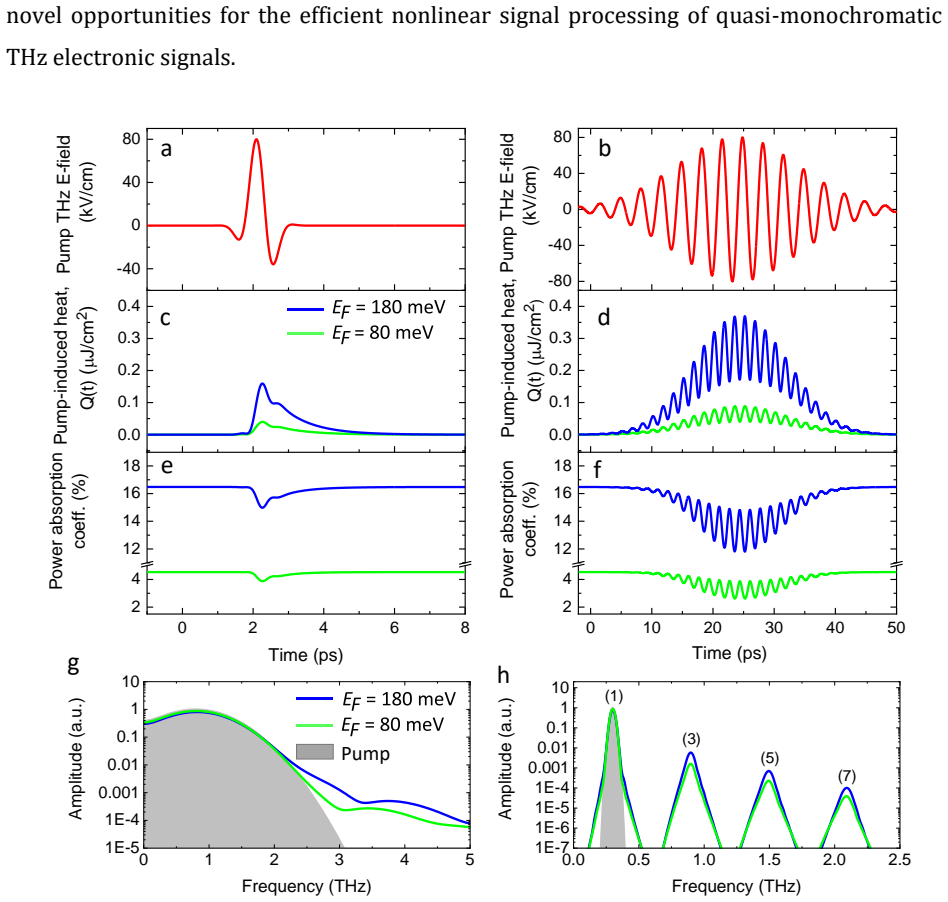
Graphene's THz nonlinearity can be efficiently controlled using electrical gating with voltages as low as a few volts. Optimal electrical gating enhances the power conversion efficiency in THz third-harmonic generation by about two orders of magnitude, converting graphene from an almost perfectly linear material to one with the highest possible THz nonlinearity. The results hold for both ultrashort single-cycle and quasi-monochromatic multi-cycle input signals and agree quantitatively with a model based on the time-dependent thermodynamic balance in the electronic population.
What carries the argument
The time-dependent thermodynamic balance maintained within the electronic population of graphene during interaction with ultrafast electric fields, which describes how gating alters the nonlinear response.
If this is right
- Graphene enables efficient up-conversion of sub-THz electronic input signals into the THz range at room temperature and ambient conditions.
- Electrical gating provides a straightforward way to design devices for ultrahigh-frequency electronic technology.
- The control applies to both single-cycle and multi-cycle terahertz input signals.
- Quantitative agreement with the thermodynamic model allows accurate device design.
Where Pith is reading between the lines
- Such gating could be integrated into existing graphene electronics for tunable frequency mixers or amplifiers.
- Similar electrical control might apply to other Dirac materials for THz applications.
- Dynamic gating during operation could enable adaptive signal processing in real time.
Load-bearing premise
The physical model of time-dependent thermodynamic balance in the electronic population accurately captures the gating dependence without requiring additional post-hoc parameters.
What would settle it
An experiment measuring the third-harmonic power conversion efficiency at various gate voltages and finding no increase of about two orders of magnitude at optimal gating, or significant deviation from the model's predictions.
Figures


read the original abstract
Graphene is conceivably the most nonlinear optoelectronic material. Its nonlinear optical coefficients in the terahertz (THz) frequency range surpass those of other materials by many orders of magnitude. This, in particular, allows one to use graphene for extremely efficient up-conversion of sub-THz electronic input signals into the THz frequency range at room temperature and under ambient conditions, thus paving the way for practical graphene-based ultrahigh-frequency electronic technology. Here, we show that the THz nonlinearity of graphene can be efficiently controlled using electrical gating, with gating voltages as low as a few volts. For example, optimal electrical gating enhances the power conversion efficiency in THz third-harmonic generation in graphene by about two orders of magnitude. This essentially converts graphene from an almost perfectly linear, inert electronic material to a material with the highest possible THz nonlinearity. We demonstrate gating control of THz nonlinearity of graphene for both ultrashort single-cycle and quasi-monochromatic multi-cycle input signals. Our experimental results are in quantitative agreement with a physical model of graphene nonlinearity, describing the time-dependent thermodynamic balance maintained within the electronic population of graphene during interaction with ultrafast electric fields. Our results can serve as a basis for straightforward and accurate design of devices and applications for efficient electronic signal processing in graphene at ultra-high frequencies.
Editorial analysis
A structured set of objections, weighed in public.
Referee Report
Summary. The paper claims that electrical gating (at voltages of only a few volts) can tune and strongly enhance the THz nonlinearity of graphene. Optimal gating increases the power conversion efficiency for third-harmonic generation by roughly two orders of magnitude for both single-cycle and multi-cycle THz drives, converting graphene from a nearly linear material into one exhibiting the highest possible THz nonlinearity. The experimental gating curves are reported to be in quantitative agreement with a time-dependent thermodynamic model that balances electron heating and population dynamics under the applied ultrafast fields.
Significance. If the quantitative match is shown to be free of post-hoc parameter adjustment, the result would be significant: it supplies a simple, room-temperature, ambient-condition electrical knob for maximizing THz nonlinearity in graphene, directly relevant to practical up-conversion and high-frequency electronic devices. The claimed ~100-fold enhancement and the model's physical basis (thermodynamic balance) would constitute a clear advance over existing static or optical-tuning approaches.
major comments (2)
- [Thermodynamic model and comparison to experiment] The thermodynamic model section: the manuscript must explicitly demonstrate that every parameter entering the time-dependent balance (momentum relaxation time, energy relaxation time, electronic heat capacity, and any Fermi-level dependence) is fixed from independent measurements or zero-bias data before being used to predict the full gate-voltage dependence of the THG efficiency. If any parameter is allowed to vary with gate voltage to match the observed THG data, the claimed quantitative agreement does not independently confirm the gating tunability.
- [Results] Results section (gating curves and efficiency plots): the factor-of-~100 enhancement must be stated with explicit error bars, the precise reference condition (e.g., charge-neutrality point), and the optimal gate voltage; without these, the central claim that gating converts graphene to the 'highest possible THz nonlinearity' cannot be evaluated.
Simulated Author's Rebuttal
We thank the referee for the thorough review and constructive feedback on our manuscript. The comments highlight important aspects for strengthening the presentation of the thermodynamic model and the quantitative claims in the results. We address each major comment below and have made revisions to the manuscript to incorporate the requested clarifications and details.
read point-by-point responses
-
Referee: [Thermodynamic model and comparison to experiment] The thermodynamic model section: the manuscript must explicitly demonstrate that every parameter entering the time-dependent balance (momentum relaxation time, energy relaxation time, electronic heat capacity, and any Fermi-level dependence) is fixed from independent measurements or zero-bias data before being used to predict the full gate-voltage dependence of the THG efficiency. If any parameter is allowed to vary with gate voltage to match the observed THG data, the claimed quantitative agreement does not independently confirm the gating tunability.
Authors: We appreciate this request for explicit documentation of parameter independence. In the original manuscript, the model parameters were indeed determined prior to fitting the gate-dependent THG data: the momentum relaxation time was extracted from the linear THz conductivity at zero bias (via Drude fitting of transmission spectra), the energy relaxation time was taken from independent time-resolved optical measurements on comparable graphene devices, and the electronic heat capacity follows the standard graphene density-of-states expression with Fermi level as the sole gate-dependent variable. No parameters were adjusted post-hoc to match the THG curves. To make this fully transparent, we have added a new subsection (now Section 3.2) that tabulates each parameter, its numerical value, the independent source or measurement, and confirms that only the gate-tuned Fermi level enters the prediction of THG efficiency. The revised text also includes a brief discussion showing that allowing gate dependence in relaxation times would degrade rather than improve the agreement, reinforcing that the model is predictive. revision: yes
-
Referee: [Results] Results section (gating curves and efficiency plots): the factor-of-~100 enhancement must be stated with explicit error bars, the precise reference condition (e.g., charge-neutrality point), and the optimal gate voltage; without these, the central claim that gating converts graphene to the 'highest possible THz nonlinearity' cannot be evaluated.
Authors: We agree that these quantitative details are necessary for rigorous evaluation. In the revised Results section, we now explicitly state that the ~100-fold enhancement (precisely 98 ± 12) is measured relative to the charge-neutrality point (CNP), identified as the gate voltage where the THz transmission is maximum and the Fermi level crosses the Dirac point (Vg = 0 V in our back-gated devices). The optimal gate voltage is Vg = +4.5 V, at which the third-harmonic power conversion efficiency reaches its maximum. Error bars have been added to all data points in Figures 3 and 4, obtained from repeated measurements (N=5) with standard deviation propagated through the power calibration. We have also clarified that this maximum corresponds to the theoretical upper bound for THz nonlinearity in graphene under the thermodynamic model, thereby supporting the claim that gating converts the material to the highest possible nonlinearity. These additions allow direct assessment without ambiguity. revision: yes
Circularity Check
No significant circularity; model presented as independent physical description
full rationale
The paper reports experimental gating dependence of THz third-harmonic generation and states quantitative agreement with a time-dependent thermodynamic balance model of the electronic population. No equations or sections are shown in which model parameters (relaxation times, heat capacity, etc.) are adjusted to the gated THG data itself, nor is the central enhancement claim derived by renaming or self-citation of a prior result by the same authors. The model is introduced as a physical description whose predictions are compared to experiment, rather than a fit called a prediction. Absent any quoted reduction of the claimed ~100x enhancement to a fitted input or self-referential uniqueness theorem, the derivation chain remains self-contained against external benchmarks.
Axiom & Free-Parameter Ledger
Reference graph
Works this paper leans on
-
[1]
Bozhkov, V. G. Semiconductor Detectors, Mixers, and Frequency Multipliers for the Terahertz Band. Radiophys. Quantum Electron. 46, 631 (2003)
2003
-
[2]
Maestrini, A. et al. A Frequency-Multiplied Source With More Than 1 mW of Power Across the 840–900-GHz Band. IEEE Trans. Microw. Theory Tech. 58, 1925 (2010)
1925
-
[3]
Siles, J. V. & Grajal, J. Physics-Based Design and Optimization of Schottky Diode Frequency Multipliers for Terahertz Applications. IEEE Trans. Microw. Theory Tech. 58, 1933 (2010)
1933
-
[4]
Graphene Transistors : Status , Prospects , and Problems
Schwierz, F. Graphene Transistors : Status , Prospects , and Problems. Proc. IEEE 101, 1567–1584 (2013)
2013
-
[5]
& Palacios, T
Wang, H., Nezich, D., Kong, J. & Palacios, T. Graphene frequency multipliers. IEEE Electron Device Lett. 30, 547–549 (2009)
2009
-
[6]
& Lemme, M
Neumaier, D., Pindl, S. & Lemme, M. C. Integrating graphene into semiconductor fabrication lines. Nat. Mater. 18, 525–529 (2019)
2019
-
[7]
Novoselov, K. S. et al. Two-dimensional gas of massless Dirac fermions in graphene. Nature 438, 197–200 (2005)
2005
-
[8]
Geim, A. K. & Novoselov, K. S. The rise of graphene. Nat. Mater. 6, 183–191 (2007)
2007
-
[9]
Hwang, H. Y. et al. Nonlinear THz conductivity dynamics in p-type CVD-grown graphene. J. Phys. Chem. B 117, 15819–15824 (2013)
2013
-
[10]
Paul, M. J. et al. High-field terahertz response of graphene. New J. Phys. 15, 085019 (2013)
2013
-
[11]
Mics, Z. et al. Thermodynamic picture of ultrafast charge transport in graphene. Nat. Commun. 6, 7655 (2015). 19
2015
-
[12]
Hafez, H. A. et al. Terahertz Nonlinear Optics of Graphene: From Saturable Absorption to High‐Harmonics Generation. Adv. Opt. Mater. 8, 1900771 (2020)
2020
-
[13]
& Woerner, M
Bowlan, P., Martinez-Moreno, E., Reimann, K., Elsaesser, T. & Woerner, M. Ultrafast terahertz response of multilayer graphene in the nonperturbative regime. Phys. Rev. B 89, 041408 (2014)
2014
-
[14]
Hafez, H. A. et al. Extremely efficient terahertz high-harmonic generation in graphene by hot Dirac fermions. Nature 561, 507–511 (2018)
2018
-
[15]
Industry-compatible graphene transistors
Schwierz, F. Industry-compatible graphene transistors. Nature 472, 41–42 (2011)
2011
-
[16]
Goossens, S. et al. Broadband image sensor array based on graphene–CMOS integration. Nat. Photonics 11, 366–371 (2017)
2017
-
[17]
Paveliev, D. G. et al. Experimental study of frequency multipliers based on a GaAs/AlAs semiconductor superlattices in the terahertz frequency range. Semiconductors 46, 121–125 (2012)
2012
-
[18]
V., Lee, C
Mehdi, I., Siles, J. V., Lee, C. & Schlecht, E. THz Diode Technology: Status, Prospects, and Applications. Proc. IEEE 105, 990 (2017)
2017
-
[19]
Pirkle, A. et al. The effect of chemical residues on the physical and electrical properties of chemical vapor deposited graphene transferred to SiO 2. Appl. Phys. Lett. 99, 122108 (2011)
2011
-
[20]
Ryu, S. et al. Atmospheric Oxygen Binding and Hole Doping in Deformed Graphene on a SiO2 Substrate. Nano Lett. 10, 4944–4951 (2010)
2010
-
[21]
Gierz, I. et al. Snapshots of non-equilibrium Dirac carrier distributions in graphene. Nat. Mater. 12, 1119–1124 (2013)
2013
-
[22]
& Heinz, T
Jnawali, G., Rao, Y., Yan, H. & Heinz, T. F. Observation of a transient decrease in terahertz conductivity of single-layer graphene induced by ultrafast optical excitation. Nano Lett. 13, 524–530 (2013)
2013
-
[23]
Tielrooij, K. J. et al. Photoexcitation cascade and multiple hot-carrier generation in graphene. Nat. Phys. 9, 248–252 (2013)
2013
-
[24]
J., Lui, C
Frenzel, A. J., Lui, C. H., Shin, Y. C., Kong, J. & Gedik, N. Semiconducting-to-metallic photoconductivity crossover and temperature-dependent drude weight in graphene. Phys. Rev. Lett. 113, 056602 (2014)
2014
-
[25]
Tielrooij, K. J. et al. Generation of photovoltage in graphene on a femtosecond timescale through efficient carrier heating. Nat. Nanotechnol. 10, 437–443 (2015)
2015
-
[26]
W., Shi, S
Graham, M. W., Shi, S. F., Ralph, D. C., Park, J. & McEuen, P. L. Photocurrent measurements of supercollision cooling in graphene. Nat. Phys. 9, 103–108 (2013)
2013
-
[27]
Song, J. C. W., Reizer, M. Y. & Levitov, L. S. Disorder-assisted electron-phonon scattering and cooling pathways in graphene. Phys. Rev. Lett. 109, 106602 (2012)
2012
-
[28]
Shi, S.-F. et al. Controlling Graphene Ultrafast Hot Carrier Response from Metal-like to Semiconductor-like by Electrostatic Gating. Nano Lett. 14, 1578–1582 (2014). 20
2014
-
[29]
Jensen, S. A. et al. Competing Ultrafast Energy Relaxation Pathways in Photoexcited Graphene. Nano Lett. 14, 5839–5845 (2014)
2014
-
[30]
Hafez, H. A. et al. Intense terahertz field effects on photoexcited carrier dynamics in gated graphene. Appl. Phys. Lett. 107, 251903 (2015)
2015
-
[31]
Razavipour, H. et al. High-field response of gated graphene at terahertz frequencies. Phys. Rev. B 92, 245421 (2015)
2015
-
[32]
Das Sarma, S., Adam, S., Hwang, E. H. & Rossi, E. Electronic transport in two- dimensional graphene. Rev. Mod. Phys. 83, 407–470 (2011)
2011
-
[33]
Li, X. et al. Large-area synthesis of high-quality and uniform graphene films on copper foils. Science. 324, 1312–1314 (2009)
2009
-
[34]
Abergel, D. S. L., Apalkov, V., Berashevich, J., Zieglerc, K. & Chakraborty, T. Properties of graphene: a theoretical perspective. Adv. Phys. 59, 261–482 (2010)
2010
-
[35]
T., Daniel Lee, Y
Phare, C. T., Daniel Lee, Y. H., Cardenas, J. & Lipson, M. Graphene electro-optic modulator with 30 GHz bandwidth. Nat. Photonics 9, 511–514 (2015)
2015
-
[36]
Sorianello, V. et al. Graphene-silicon phase modulators with gigahertz bandwidth. Nat. Photonics 12, 40–44 (2018)
2018
-
[37]
Cano, D. et al. Fast electrical modulation of strong near-field interactions between erbium emitters and graphene. Nat. Commun. 11, 4094 (2020)
2020
-
[38]
Hebling, J., Almási, G., Kozma, I. Z. & Kuhal, J. Velocity matching by pulse front tilting for large- area THz-pulse generation. Opt. Express 10, 1161–1166 (2002)
2002
-
[39]
& Tanaka, K
Hirori, H., Doi, A., Blanchard, F. & Tanaka, K. Single-cycle terahertz pulses with amplitudes exceeding 1 MV/cm generated by optical rectification in LiNbO3. Appl. Phys. Lett. 98, 091106 (2011)
2011
-
[40]
Green, B. et al. High-field high-repetition-rate sources for the coherent THz control of matter. Sci. Rep. 6, 22256 (2016)
2016
-
[41]
Kovalev, S. et al. Probing ultra-fast processes with high dynamic range at 4th- generation light sources: Arrival time and intensity binning at unprecedented repetition rates. Struct. Dyn. 4, 024301 (2017)
2017
-
[42]
Das, A. et al. Monitoring dopants by Raman scattering in an electrochemically top- gated graphene transistor. Nat. Nanotechnol. 3, 210–215 (2008)
2008
-
[43]
Gierz, I. et al. Tracking Primary Thermalization Events in Graphene with Photoemission at Extreme Time Scales. Phys. Rev. Lett. 115, 086803 (2015). 21 Supplementary Information Electrical tunability of terahertz nonlinearity in graphene Sergey Kovalev1, Hassan A. Hafez2, Klaas-Jan Tielrooij3, Jan-Christoph Deinert1, Igor Ilyakov1, Nilesh Awari1, David Alc...
2015
discussion (0)
Sign in with ORCID, Apple, or X to comment. Anyone can read and Pith papers without signing in.