Recognition: unknown
Conflict Forecasting via Conformal Prediction for Markov Processes
Pith reviewed 2026-05-07 15:44 UTC · model grok-4.3
The pith
Conformal prediction on Markov processes produces valid sets of possible future conflict sequences.
A machine-rendered reading of the paper's core claim, the machinery that carries it, and where it could break.
Core claim
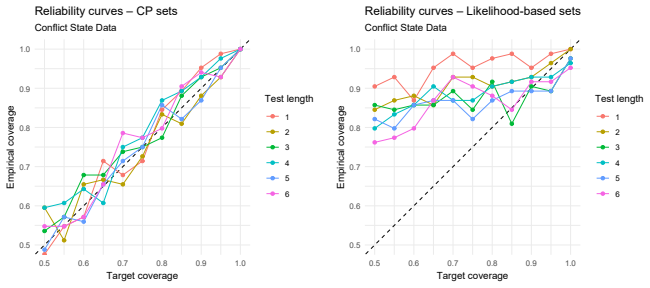
Conformal prediction can be used on temporally dependent data assumed to arise from a discrete-state Markov process to obtain prediction sets of possible future conflict state-sequences, yielding valid uncertainty quantification that is robust to model misspecification and outperforming point predictions when the cost of error is high, as shown by comparisons with likelihood-based strategies and by producing real forecasts across countries.
What carries the argument
Conformal prediction sets built from nonconformity scores on observed Markov trajectories to produce multi-step-ahead regions for discrete state sequences.
If this is right
- Policy decisions receive intervals of possible conflict paths with explicit coverage guarantees instead of single guesses that carry extreme penalties when wrong.
- The same conformal procedure remains usable when the Markov model is only approximately correct, unlike likelihood methods that can degrade under misspecification.
- Real-data forecasts for multiple countries illustrate how the sets can be computed and interpreted for actual policy-relevant horizons.
- The approach highlights the need to adjust standard conformal techniques when data exhibit temporal dependence rather than full exchangeability.
Where Pith is reading between the lines
- The same construction could be tested on other sequential categorical data, such as economic regime switches or ecological state changes, where dependence is also present.
- Efficiency gains might come from developing Markov-specific nonconformity scores that exploit the transition structure rather than treating trajectories as generic sequences.
- If the coverage guarantee holds in practice, the sets could serve as inputs to downstream decision models that optimize actions over ranges of possible futures.
Load-bearing premise
The sequence of conflict states for each country follows a discrete-state Markov process so that conformal prediction still achieves its nominal coverage despite the dependence that violates exchangeability.
What would settle it
Future observed conflict sequences falling outside the conformal prediction sets at a rate substantially above the nominal level, for example more than 5 percent of the time when 95 percent coverage is claimed.
Figures




read the original abstract
Whether or not a country is at war, or experiencing escalating or deescalating levels of conflict, has massive ramifications on a country's national and foreign policy. Given a country's history of conflict, or lack thereof, future predictions about the war-status of a country are valuable information. In this paper, we present the use of conformal prediction on temporally-dependent data to obtain prediction sets of possible future conflict state-sequences. More specifically, we compare the results of conformal prediction to a likelihood-based prediction strategy when the data are assumed to come from a discrete-state Markov process. A point-prediction may not supply sufficient information because the penalty for a wrong prediction is extreme, and so we consider a machine learning alternative that gives valid uncertainty quantification and is robust to model misspecification. In the data analysis, we present real forecasts of conflict dynamics across multiple countries. Lastly, we comment on the possible limitations of existing approaches for applying conformal prediction to Markovian data, where the exchangeability assumption is violated.
Editorial analysis
A structured set of objections, weighed in public.
Referee Report
Summary. The manuscript proposes the use of conformal prediction on temporally dependent data to generate prediction sets for sequences of future conflict states across countries. It assumes the underlying process is a discrete-state Markov chain, compares the conformal approach to likelihood-based prediction, presents real-data forecasts, and discusses limitations arising from the violation of exchangeability.
Significance. If a valid finite-sample coverage guarantee can be established for the conformal sets under Markov dependence, the work would provide a useful non-parametric tool for uncertainty quantification in high-stakes forecasting where point predictions are insufficient. The real-data application to conflict dynamics adds practical value and allows direct comparison to parametric alternatives.
major comments (2)
- [Abstract and §2] Abstract and §2 (Method): the central claim of 'valid uncertainty quantification' for future state-sequences rests on an unspecified adaptation of conformal prediction to non-exchangeable Markov data. Standard split conformal requires exchangeable calibration scores for the coverage bound, yet no blocking, state-conditioning, or mixing adjustment is described; without this construction the robustness-to-misspecification claim cannot be evaluated.
- [§4] §4 (Data Analysis): the reported real forecasts and comparison to likelihood methods are presented without accompanying coverage diagnostics or simulation checks under the Markov assumption. If the procedure does not explicitly restore exchangeability (e.g., via last-state conditioning), the empirical results do not substantiate the theoretical validity asserted in the abstract.
minor comments (2)
- [§2] Notation for the nonconformity score and the resulting prediction set C(X_{n+1}) should be introduced with an explicit equation rather than described only in prose.
- [§5] The discussion of limitations of existing conformal approaches for Markovian data would benefit from citing the specific references being critiqued.
Simulated Author's Rebuttal
We are grateful to the referee for the detailed and insightful comments, which have helped us identify areas for improvement in our manuscript. Below we provide point-by-point responses to the major comments and indicate the revisions we intend to make.
read point-by-point responses
-
Referee: [Abstract and §2] Abstract and §2 (Method): the central claim of 'valid uncertainty quantification' for future state-sequences rests on an unspecified adaptation of conformal prediction to non-exchangeable Markov data. Standard split conformal requires exchangeable calibration scores for the coverage bound, yet no blocking, state-conditioning, or mixing adjustment is described; without this construction the robustness-to-misspecification claim cannot be evaluated.
Authors: We thank the referee for highlighting this important point. Our manuscript applies the standard split conformal prediction procedure to the Markov chain data without introducing a new adaptation such as blocking or state-conditioning to restore exchangeability. The discussion section explicitly comments on the limitations arising from the violation of the exchangeability assumption. The robustness claim refers to the non-parametric nature of conformal prediction, which does not require correct specification of the transition probabilities, unlike the likelihood-based approach. However, we agree that the finite-sample coverage guarantee does not hold strictly due to dependence. In the revision, we will clarify this distinction in §2 and the abstract, and add a note that the coverage is heuristic under the Markov model. This constitutes a partial revision as the main empirical comparison is retained. revision: partial
-
Referee: [§4] §4 (Data Analysis): the reported real forecasts and comparison to likelihood methods are presented without accompanying coverage diagnostics or simulation checks under the Markov assumption. If the procedure does not explicitly restore exchangeability (e.g., via last-state conditioning), the empirical results do not substantiate the theoretical validity asserted in the abstract.
Authors: The referee is correct that §4 presents real-data forecasts without simulation-based coverage checks. Because the forecasts are for future unobserved sequences, direct coverage cannot be assessed on the real data. We will add a new subsection with Monte Carlo simulations under controlled Markov processes to evaluate the empirical coverage of the conformal sets and compare it to the nominal level. This will help substantiate the practical performance even if the theoretical guarantee is approximate. We plan to include these diagnostics in the revised version. revision: yes
Circularity Check
No significant circularity detected
full rationale
The paper applies conformal prediction to temporally dependent Markov chain data for conflict state-sequence forecasting and compares the resulting prediction sets against a likelihood-based baseline under the Markov assumption. The abstract explicitly flags the exchangeability violation and comments on limitations of prior approaches without claiming a new theorem or fit that reduces to the inputs by construction. No self-definitional equations, fitted parameters renamed as predictions, or load-bearing self-citations appear in the provided text; the comparison to likelihood methods supplies an independent benchmark. The derivation therefore remains self-contained against external statistical procedures.
Axiom & Free-Parameter Ledger
axioms (2)
- domain assumption Conflict dynamics follow a discrete-state Markov process
- ad hoc to paper Conformal prediction remains valid for temporally dependent sequences
Reference graph
Works this paper leans on
-
[1]
The 2023/24 views prediction challenge: Predicting the number of fatalities in armed conflict, with uncertainty.Journal of Peace Research, 62(6):2070–2087,
H˚ avard Hegre, Paola Vesco, Michael Colaresi, Jonas Vestby, Alexa Timlick, Noorain Syed Kazmi, Angelica Lindqvist-McGowan, Friederike Becker, Marco Binetti, Tobias Boden- tien, et al. The 2023/24 views prediction challenge: Predicting the number of fatalities in armed conflict, with uncertainty.Journal of Peace Research, 62(6):2070–2087,
2023
-
[2]
Bayesian hidden markov models for latent variable labeling as- signments in conflict research: Application to the role ceasefires play in conflict dynamics
Jonathan P Williams, Gudmund H Hermansen, H˚ avard Strand, Govinda Clayton, and H˚ avard Mokleiv Nyg˚ ard. Bayesian hidden markov models for latent variable labeling as- signments in conflict research: Application to the role ceasefires play in conflict dynamics. Annals of Applied Statistics, 18(3):2034–2061,
2034
-
[3]
David Randahl and Johan Vegelius. Forecasting densities of fatalities from state-based conflicts using observed markov models.arXiv preprint arXiv:2410.12374,
-
[4]
Algorithmic Learning in a Random World
ISBN 9783031066481. doi: 10.1007/978-3-031-06649-8. Anders Hjort, Jonathan P Williams, and Johan Pensar. Clustered conformal prediction for the housing market.Proceedings of Machine Learning Research, 230:1–21,
-
[5]
Safe merging in mixed traffic with confidence.arXiv preprint arXiv:2403.05742,
Heeseung Bang, Aditya Dave, and Andreas A Malikopoulos. Safe merging in mixed traffic with confidence.arXiv preprint arXiv:2403.05742,
-
[6]
Network traffic demand prediction with confidence
Mikhail Dashevskiy and Zhiyuan Luo. Network traffic demand prediction with confidence. InIEEE GLOBECOM 2008-2008 IEEE Global Telecommunications Conference, pages 1–5. IEEE,
2008
-
[7]
Conformal predictions under markovian data
Fr´ ed´ eric Zheng and Alexandre Proutiere. Conformal predictions under markovian data. arXiv preprint arXiv:2407.15277,
-
[8]
Conformal inference for time series over graphs.arXiv preprint arXiv:2510.11049,
Sonakshi Dua, Gonzalo Mateos, and Sundeep Prabhakar Chepuri. Conformal inference for time series over graphs.arXiv preprint arXiv:2510.11049,
-
[9]
Bronstein, and Filippo Maria Bianchi
Roberto Neglia, Andrea Cini, Michael M Bronstein, and Filippo Maria Bianchi. Rescp: Reservoir conformal prediction for time series forecasting.arXiv preprint arXiv:2510.05060,
-
[10]
Xiaoyi Su, Zhixin Zhou, and Rui Luo. Adaptive conformal inference by particle filtering under hidden markov models.arXiv preprint arXiv:2411.01558,
-
[11]
Organized violence 1989–2024, and the challenges of identifying civilian victims.Journal of Peace Research, 62(4):1223–1240,
Shawn Davies, Ther´ ese Pettersson, Margareta Sollenberg, and Magnus ¨Oberg. Organized violence 1989–2024, and the challenges of identifying civilian victims.Journal of Peace Research, 62(4):1223–1240,
1989
discussion (0)
Sign in with ORCID, Apple, or X to comment. Anyone can read and Pith papers without signing in.