Parallel distributed quantum gates for dual-species quantum emitters
Pith reviewed 2026-05-07 16:51 UTC · model grok-4.3
The pith
A protocol enables parallel nonlocal gates on multiple dual-species qubit pairs via a single high-dimensional entangled photon pair acting as a frequency-distinct quantum bus.
A machine-rendered reading of the paper's core claim, the machinery that carries it, and where it could break.
Core claim
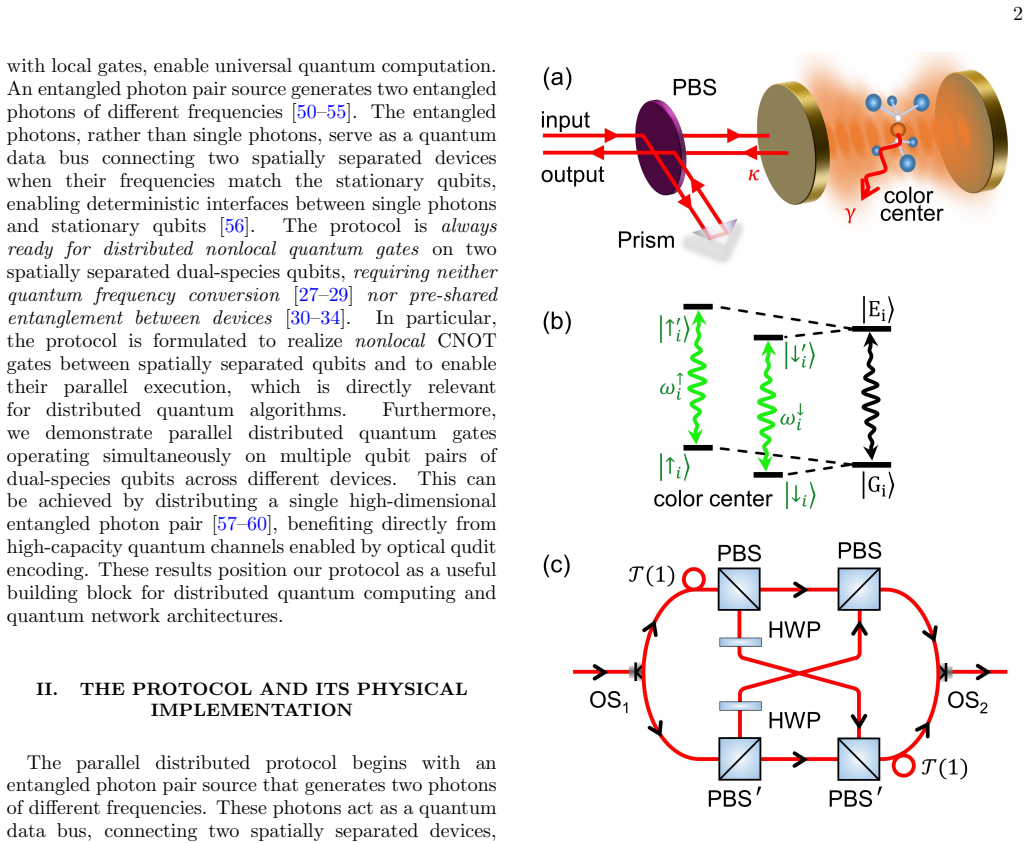
We propose a parallel protocol for implementing distributed nonlocal quantum gates between spatially separated stationary qubits encoded in dual-species quantum emitters (i.e., color-center and superconducting qubits) by utilizing entangled photon pairs with distinct frequencies as a quantum data bus, while maintaining an always-ready and resource-efficient property.
Load-bearing premise
The protocol assumes that entangled photon pairs with distinct frequencies can be generated, transmitted, and interfaced with both color-center and superconducting emitters with sufficiently low loss and decoherence to preserve quantum coherence during gate operations.
Figures


read the original abstract
We propose a parallel protocol for implementing distributed nonlocal quantum gates between spatially separated stationary qubits encoded in dual-species quantum emitters (i.e., color-center and superconducting qubits). By utilizing entangled photon pairs with distinct frequencies as a quantum data bus, our approach connects spatially separated devices without requiring quantum frequency conversion or preshared entanglement, while maintaining an always-ready and resource-efficient property for distributed quantum computing and networks. Furthermore, we demonstrate the feasibility of implementing parallel distributed nonlocal quantum gates on multiple pairs of spatially separated qubits using a single high-dimensional entangled photon pair, which directly benefits from the enhanced quantum capacity provided by optical qudit encoding. Our protocol establishes a scalable and practically implementable framework for distributed quantum networks, potentially enabling the development of future large-scale quantum computing architectures.
Editorial analysis
A structured set of objections, weighed in public.
Referee Report
Summary. The manuscript proposes a parallel protocol for implementing distributed nonlocal quantum gates between spatially separated stationary qubits encoded in dual-species emitters (color-center and superconducting qubits). It uses entangled photon pairs with distinct frequencies (optical and microwave) as a quantum data bus, avoiding quantum frequency conversion and preshared entanglement while claiming an always-ready, resource-efficient architecture. The work further claims that a single high-dimensional entangled photon pair enables parallel gates on multiple qubit pairs, establishing a scalable framework for distributed quantum networks.
Significance. If the transmission and interfacing losses can be shown to permit high-fidelity operation, the protocol would provide a concrete route to hybrid quantum networks that directly couple dissimilar qubit technologies without intermediate conversion steps, potentially reducing overhead in modular quantum computing architectures.
major comments (2)
- [§III and §IV] §III (Protocol) and §IV (Feasibility): The central claim that the scheme is 'practically implementable' and 'resource-efficient' rests on the transmission of microwave-frequency photons (~5 GHz) to the superconducting qubits. No loss budget, attenuation calculation, or fidelity estimate is supplied for realistic distances; standard coaxial or free-space channels incur exponential loss that would destroy coherence for separations beyond a few meters. This directly undermines the 'always-ready' property and must be quantified or mitigated (e.g., via low-loss waveguides or source-side conversion) before feasibility can be asserted.
- [§IV] §IV (Parallel-gate demonstration): The assertion that one high-dimensional entangled pair suffices for multiple independent gates lacks an error model incorporating photon loss, mode mismatch, and detector inefficiency. Without such analysis or numerical simulation, the claimed enhancement in quantum capacity cannot be evaluated against the added complexity of qudit encoding.
minor comments (2)
- [§II] Notation for the two distinct frequencies and the high-dimensional encoding should be introduced with explicit symbols in the protocol section rather than only in the abstract.
- [Introduction] The manuscript would benefit from a short table comparing the proposed scheme to existing distributed-gate protocols that do employ frequency conversion or preshared entanglement.
Simulated Author's Rebuttal
We thank the referee for the constructive and detailed report. We address each major comment point by point below. We agree that quantitative loss analysis and an error model are required to support the claims of practical implementability and enhanced capacity, and we will incorporate these elements in the revised manuscript.
read point-by-point responses
-
Referee: [§III and §IV] §III (Protocol) and §IV (Feasibility): The central claim that the scheme is 'practically implementable' and 'resource-efficient' rests on the transmission of microwave-frequency photons (~5 GHz) to the superconducting qubits. No loss budget, attenuation calculation, or fidelity estimate is supplied for realistic distances; standard coaxial or free-space channels incur exponential loss that would destroy coherence for separations beyond a few meters. This directly undermines the 'always-ready' property and must be quantified or mitigated (e.g., via low-loss waveguides or source-side conversion) before feasibility can be asserted.
Authors: We acknowledge that the absence of an explicit loss budget for the ~5 GHz microwave photons is a limitation in the current manuscript. The protocol description in §III and feasibility discussion in §IV assume transmission channels compatible with the dual-species architecture (e.g., cryogenic environments typical for superconducting qubits), but we did not provide numerical attenuation estimates or fidelity projections. In the revised version we will add a dedicated paragraph and simple calculation in §IV that quantifies attenuation for realistic cryogenic coaxial or waveguide links, identifies viable distances (typically meters within a dilution refrigerator or short-range network), and discusses mitigation via low-loss superconducting transmission lines. This will clarify the regime in which the always-ready property holds without overstating generality. revision: yes
-
Referee: [§IV] §IV (Parallel-gate demonstration): The assertion that one high-dimensional entangled pair suffices for multiple independent gates lacks an error model incorporating photon loss, mode mismatch, and detector inefficiency. Without such analysis or numerical simulation, the claimed enhancement in quantum capacity cannot be evaluated against the added complexity of qudit encoding.
Authors: We agree that a quantitative error model is necessary to substantiate the parallel-gate advantage. The demonstration in §IV relies on the higher-dimensional Hilbert space of the optical qudit to enable multiple independent gates from a single entangled pair, but we did not include loss, mismatch, or inefficiency terms. In the revision we will add an error analysis subsection (or appendix) that derives approximate fidelity expressions including these imperfections and provides numerical estimates for small numbers of parallel operations. This will allow direct comparison of net capacity gain versus the overhead of qudit encoding and control, thereby strengthening the scalability claim. revision: yes
Circularity Check
No circularity: proposal rests on standard quantum optics concepts
full rationale
The manuscript is a protocol proposal that invokes established quantum optics tools (entangled photon pairs of distinct frequencies as a data bus, dual-species emitters) without presenting equations, fitted parameters, or derivations that reduce to the inputs by construction. No self-citation chains, ansatzes smuggled via prior work, or uniqueness theorems are load-bearing in the abstract or described structure. The central claims remain independent of the paper's own outputs, satisfying the self-contained criterion for a score of 0.
Axiom & Free-Parameter Ledger
axioms (1)
- domain assumption Entangled photon pairs with distinct frequencies can function as a lossless quantum data bus between dual-species emitters without requiring frequency conversion.
Reference graph
Works this paper leans on
-
[1]
The subscriptsAandBdenote photons sent to nodesAandB, which are of frequencies around ω↑ A andω ↑ B of the transitions of the SiV− and GeV− color center, respectively. Suppose now that the stationary qubitss 1 ands 2 are initialized in the normalized states|φ 1⟩=α 1 |↑A⟩+ β1 |↓A⟩and|φ 2⟩=α 2 |↑B⟩+β 2 |↓B⟩, within the ground branch|G i⟩[62]. On arriving at...
-
[2]
Then photonAis directed to interact withs 1 and photon B is directed to interact withs 2, before and after which the Hadamard transformation [i.e.,|↑ B⟩ →(|↑ B⟩+|↓B⟩)/ √ 2 and|↓ B⟩ → (|↑B⟩ − |↓ B⟩)/ √ 2] is performed ons 2. The combined states of photonsAandBand qubitss 1 ands 2 evolves into |Φ1⟩= 1 2 α1 ˆX2| ↑ s1⟩|D⟩|H⟩+β 1 ˆX2| ↓ s1⟩|A⟩|H⟩ +α1 ˆI2| ↑ s1...
work page 2023
-
[3]
The combined state of photonsAandBand the four stationary qubitss 1 −s 4 evolves into | ˜Ψ1⟩= 1√2η0 |HA⟩|HB⟩(r↑ Aα1| ↑ s1 ⟩+r ↓ Aβ1| ↓ s1 ⟩) +|V A⟩|HB⟩(α 1| ↑ s1 ⟩+β 1| ↓ s1 ⟩) R+ 2 | ↑ s2 ⟩ +R − 2 | ↓ s2 ⟩ −2 |HA⟩|VB⟩(r↑ Aα1| ↑ s1 ⟩ +r ↓ Aβ1| ↓ s1 ⟩))− |V A⟩|VB⟩(α1| ↑ s1 ⟩+β 1| ↓ s1 ⟩) ⊗(α 2| ↑ s2 ⟩+β 2| ↓ s2 ⟩) ,(A4) where the normalized coefficient isη...
-
[4]
Two SiV − qubits embedded in CPF gates in node B are initialized as|ϕ s2 ⟩= (α 2 |↑s2 ⟩+ β2 |↓s2 ⟩)/ √ 2 and|ϕ s4 ⟩= (α 4 |↑s4 ⟩+β 4 |↓s4 ⟩)/ √
-
[5]
An auxiliary entangled-photon source generates a pair of hybrid entangled photons in the state |ϕp⟩= 1 2 1X i=0 ˆTA(i) ˆTB(i) + ˆTA(i+ 2) ˆTB(i) ˆXp |1A⟩|HB⟩, (D2) where photon A (B) is in the microwave (optical) regime and nearly resonant with the SC qubit (SiV−) transition. ˆXp flips the polarization of photon B, and ˆTA(i) [ ˆTB(i)] introduces a time d...
-
[6]
T. D. Ladd, F. Jelezko, R. Laflamme, Y. Nakamura, C. Monroe, and J. L. O’Brien,Quantum computers, Nature (London)464, 45 (2010)
work page 2010
-
[7]
I. M. Georgescu, S. Ashhab, and F. Nori,Quantum simulation, Rev. Mod. Phys.86, 153 (2014)
work page 2014
-
[8]
Long,Grover algorithm with zero theoretical failure rate, Phys
G.-L. Long,Grover algorithm with zero theoretical failure rate, Phys. Rev. A64, 022307 (2001)
work page 2001
-
[9]
Y. Zhou, E. M. Stoudenmire, and X. Waintal,What limits the simulation of quantum computers?, Phys. Rev. X10, 041038 (2020)
work page 2020
- [10]
- [11]
-
[12]
L. S. Madsen, F. Laudenbach, M. F. Askarani,et al., Quantum computational advantage with a programmable photonic processor, Nature (London)606, 75 (2022)
work page 2022
-
[13]
S. Wei, Y. Chen, Z. Zhou, and G.-L. Long,A quantum convolutional neural network on NISQ devices, AAPPS Bull.32, 2 (2022)
work page 2022
-
[14]
B. Cheng, X.-H. Deng, X. Gu,et al.,Noisy intermediate- scale quantum computers, Front. Phys.18, 21308 (2023)
work page 2023
-
[15]
J. I. Cirac, A. K. Ekert, S. F. Huelga, and C. Mac- chiavello,Distributed quantum computation over noisy channels, Phys. Rev. A59, 4249 (1999)
work page 1999
- [16]
-
[17]
A. Reiserer and G. Rempe,Cavity-based quantum networks with single atoms and optical photons, Rev. Mod. Phys.87, 1379 (2015)
work page 2015
-
[18]
Y.-B. Sheng and L. Zhou,Blind quantum computation with a noise channel, Phys. Rev. A98, 052343 (2018)
work page 2018
-
[19]
Y. L. Lim, A. Beige, and L. C. Kwek,Repeat-until-success linear optics distributed quantum computing, Phys. Rev. Lett.95, 030505 (2005)
work page 2005
- [20]
-
[21]
S.-B. Zheng, C.-P. Yang, and F. Nori,Arbitrary control 13 of coherent dynamics for distant qubits in a quantum network, Phys. Rev. A82, 042327 (2010)
work page 2010
- [22]
-
[23]
L.-M. Duan, B. Wang, and H. J. Kimble,Robust quantum gates on neutral atoms with cavity-assisted photon scattering, Phys. Rev. A72, 032333 (2005)
work page 2005
- [24]
-
[25]
C. Y. Hu, A. Young, J. L. O’Brien, W. J. Munro, and J. G. Rarity,Giant optical faraday rotation induced by a single-electron spin in a quantum dot: Applications to entangling remote spins via a single photon, Phys. Rev. B78, 085307 (2008)
work page 2008
-
[26]
I. Cohen and K. Mølmer,Deterministic quantum network for distributed entanglement and quantum computation, Phys. Rev. A98, 030302(R) (2018)
work page 2018
- [27]
-
[28]
G. Vittorini, D. Hucul, I. V. Inlek, C. Crocker, and C. Monroe,Entanglement of distinguishable quantum memories, Phys. Rev. A90, 040302(R) (2014)
work page 2014
-
[29]
R. Stockill, M. J. Stanley, L. Huthmacher, E. Clarke, M. Hugues, A. J. Miller, C. Matthiesen, C. Le Gall, and M. Atat¨ ure,Phase-tuned entangled state generation between distant spin qubits, Phys. Rev. Lett.119, 010503 (2017)
work page 2017
-
[30]
A. M. Dibos, M. Raha, C. M. Phenicie, and J. D. Thompson,Atomic source of single photons in the telecom band, Phys. Rev. Lett.120, 243601 (2018)
work page 2018
-
[31]
L. Zhai, G. N. Nguyen, C. Spinnler, J. Ritzmann, M. C. L¨ obl, A. D. Wieck, A. Ludwig, A. Javadi, and R. J. Warburton,Quantum interference of identical photons from remote GaAs quantum dots, Nat. Nanotechnol.17, 829 (2022)
work page 2022
-
[32]
T. van Leent, M. Bock, R. Garthoff, K. Redeker, W. Zhang, T. Bauer, W. Rosenfeld, C. Becher, and H. Weinfurter,Long-distance distribution of atom-photon entanglement at telecom wavelength, Phys. Rev. Lett. 124, 010510 (2020)
work page 2020
-
[33]
Y. Zhou, P. Malik, F. Fertig, M. Bock, T. Bauer, T. van Leent, W. Zhang, C. Becher, and H. Weinfurter,Long- lived quantum memory enabling atom-photon entangle- ment over 101 km of telecom fiber, PRX Quantum5, 020307 (2024)
work page 2024
-
[34]
C. M. Knaut, A. Suleymanzade, Y. C. Wei,et al., Entanglement of nanophotonic quantum memory nodes in a telecom network, Nature (London)629, 573 (2024)
work page 2024
-
[35]
D. Gottesman and I. L. Chuang,Demonstrating the viability of universal quantum computation using telepor- tation and single-qubit operations, Nature (London)402, 390 (1999)
work page 1999
-
[36]
N. Sangouard, C. Simon, H. de Riedmatten, and N. Gisin, Quantum repeaters based on atomic ensembles and linear optics, Rev. Mod. Phys.83, 33 (2011)
work page 2011
- [37]
-
[38]
T.-J. Wang, S.-Y. Song, and G.-L. Long,Quantum repeater based on spatial entanglement of photons and quantum-dot spins in optical microcavities, Phys. Rev. A 85, 062311 (2012)
work page 2012
-
[39]
W. J. Munro, K. Azuma, K. Tamaki, and K. Nemoto, Inside quantum repeaters, IEEE J. Sel. Top. Quantum Electron.21, 78 (2015)
work page 2015
-
[40]
K. S. Chou, J. Z. Blumoff, C. S. Wang, P. C. Reinhold, C. J. Axline, Y. Y. Gao, L. Frunzio, M. H. Devoret, L. Jiang, and R. J. Schoelkopf,Deterministic teleportation of a quantum gate between two logical qubits, Nature (London)561, 368 (2018)
work page 2018
-
[41]
Y. Wanet al.,Quantum gate teleportation between separated qubits in a trapped-ion processor, Science364, 875 (2019)
work page 2019
-
[42]
J. Qiuet al.,Deterministic quantum state and gate teleportation between distant superconducting chips, Sci. Bull.70, 351 (2025)
work page 2025
-
[43]
Liuet al.,Nonlocal photonic quantum gates over 7.0 km, Nat
X. Liuet al.,Nonlocal photonic quantum gates over 7.0 km, Nat. Commun.15, 8529 (2024)
work page 2024
- [44]
-
[45]
L.-T. Feng, M. Zhang, D. Liu, Y.-J. Cheng, X.-Y. Song, Y.-Y. Ding, D.-X. Dai, G.-P. Guo, G.-C. Guo, and X.- F. Ren,Chip-to-chip quantum photonic controlled-NOT gate teleportation, Phys. Rev. Lett.135, 020802 (2025)
work page 2025
-
[46]
D. Main, P. Drmota, D. P. Nadlinger, E. M. Ainley, A. Agrawal, B. C. Nichol, R. Srinivas, G. Araneda, and D. M. Lucas,Distributed quantum computing across an optical network link, Nature (London)638, 383 (2025)
work page 2025
-
[47]
X. Liu, J. Hu, Z.-F. Li, X. Li, P.-Y. Li, P.-J. Liang, Z.-Q. Zhou, C.-F. Li, and G.-C. Guo,Heralded entanglement distribution between two absorptive quantum memories, Nature (London)594, 41 (2021)
work page 2021
-
[48]
S. Barz, G. Cronenberg, A. Zeilinger, and P. Walther, Heralded generation of entangled photon pairs, Nat. Photonics4, 553 (2010)
work page 2010
- [49]
-
[50]
J. Hofmann, M. Krug, N. Ortegel, L. G´ erard, M. Weber, W. Rosenfeld, and H. Weinfurter,Heralded entanglement between widely separated atoms, Science337, 72 (2012)
work page 2012
-
[51]
H. Bernienet al.,Heralded entanglement between solid- state qubits separated by three metres, Nature (London) 497, 86 (2013)
work page 2013
-
[52]
R. Riedinger, A. Wallucks, I. Marinkovi´ c, C. L¨ oschnauer, M. Aspelmeyer, S. Hong, and S. Gr¨ oblacher,Remote quantum entanglement between two micromechanical oscillators, Nature (London)556, 473 (2018)
work page 2018
-
[53]
S. Wengerowsky, S. K. Joshi, F. Steinlechner, H. H¨ ubel, and R. Ursin,An entanglement-based wavelength- multiplexed quantum communication network, Nature (London)564, 225 (2018)
work page 2018
-
[54]
C.-P. Yang, Q.-P. Su, and F. Nori,Entanglement generation with superconducting quantum interference devices coupled to a transmission line resonator, New J. Phys.15, 115003 (2013)
work page 2013
-
[55]
H. Yan, S. Zhang, J. F. Chen, M. M. T. Loy, G. K. L. Wong, and S. Du,Generation of narrow-band hyperentangled nondegenerate paired photons, Phys. Rev. Lett.106, 033601 (2011)
work page 2011
-
[56]
M.-X. Dong, W. Zhang, S. Shi, K. Wang, Z.-Y. Zhou, S.-L. Liu, D.-S. Ding, and B.-S. Shi,Two-color hyper- entangled photon pairs generation in a cold 85Rb atomic ensemble, Opt. Express25, 10145 (2017). 14
work page 2017
-
[57]
X. Lu, Q. Li, D. A. Westly, G. Moille, A. Singh, V. Anant, and K. Srinivasan,Chip-integrated visible–telecom entan- gled photon pair source for quantum communication, Nat. Phys.15, 373 (2019)
work page 2019
-
[58]
T.-M. Zhao, H. Zhang, J. Yang, Z.-R. Sang, X. Jiang, X.-H. Bao, and J.-W. Pan,Entangling different-color photons via time-resolved measurement and active feed forward, Phys. Rev. Lett.112, 103602 (2014)
work page 2014
-
[59]
J. Yang, T. Fandrich, F. Benthin, R. Keil, N. L. Sharma, W. Nie, C. Hopfmann, O. G. Schmidt, M. Zopf, and F. Ding,Photoneutralization of charges in gaas quantum dot based entangled photon emitters, Phys. Rev. B105, 115301 (2022)
work page 2022
-
[60]
C. Schimpf, M. Reindl, F. Basso Basset, K. D. J¨ ons, R. Trotta, and A. Rastelli,Quantum dots as potential sources of strongly entangled photons: Perspectives and challenges for applications in quantum networks, Appl. Phys. Lett.118, 100502 (2021)
work page 2021
-
[61]
H. K. C. Beukers, M. Pasini, H. Choi, D. Englund, R. Hanson, and J. Borregaard,Remote-entanglement protocols for stationary qubits with photonic interfaces, PRX Quantum5, 010202 (2024)
work page 2024
- [62]
-
[63]
F.-G. Deng, B.-C. Ren, and X.-H. Li,Quantum hyperentanglement and its applications in quantum information processing, Sci. Bull.62, 46 (2017)
work page 2017
- [64]
-
[65]
F.-F. Du, M. Ma, Z.-Y. Bai, and Q.-L. Tan,Generation of arbitrary high-dimensional qudit-based entangled states, Phys. Rev. A111, 032604 (2025)
work page 2025
-
[66]
D. D. Awschalom, R. Hanson, J. Wrachtrup, and B. B. Zhou,Quantum technologies with optically interfaced solid-state spins, Nat. Photonics12, 516 (2018)
work page 2018
-
[67]
C. T. Nguyenet al.,Quantum network nodes based on diamond qubits with an efficient nanophotonic interface, Phys. Rev. Lett.123, 183602 (2019)
work page 2019
- [68]
-
[69]
H. Zhou, T. Li, and K. Xia,Parallel and heralded mul- tiqubit entanglement generation for quantum networks, Phys. Rev. A107, 022428 (2023)
work page 2023
- [70]
-
[71]
F. Bouchard, D. England, P. J. Bustard, K. Heshami, and B. Sussman,Quantum communication with ultrafast time-bin qubits, PRX Quantum3, 010332 (2022)
work page 2022
-
[72]
J. Borregaard, H. Pichler, T. Schr¨ oder, M. D. Lukin, P. Lodahl, and A. S. Sørensen,One-way quantum repeater based on near-deterministic photon-emitter interfaces, Phys. Rev. X10, 021071 (2020)
work page 2020
-
[73]
M. O. Scully and M. S. Zubairy,Quantum Optics (Cambridge University, Cambridge, 1997)
work page 1997
-
[74]
D. S. Levonian, R. Riedinger, B. Machielse, E. N. Knall, M. K. Bhaskar, C. M. Knaut, R. Bekenstein, H. Park, M. Lonˇ car, and M. D. Lukin,Optical entanglement of distinguishable quantum emitters, Phys. Rev. Lett.128, 213602 (2022)
work page 2022
-
[75]
D. D. Sukachev, A. Sipahigil, C. T. Nguyen, M. K. Bhaskar, R. E. Evans, F. Jelezko, and M. D. Lukin, Silicon-vacancy spin qubit in diamond: A quantum memory exceeding 10 ms with single-shot state readout, Phys. Rev. Lett.119, 223602 (2017)
work page 2017
-
[76]
K. Senkalla, G. Genov, M. H. Metsch, P. Siyushev, and F. Jelezko,Germanium vacancy in diamond quantum memory exceeding 20 ms, Phys. Rev. Lett.132, 026901 (2024)
work page 2024
-
[77]
N. B. Lingaraju, H.-H. Lu, D. E. Leaird, S. Estrella, J. M. Lukens, and A. M. Weiner,Bell state analyzer for spectrally distinct photons, Optica9, 280 (2022)
work page 2022
-
[78]
C. Wagenknecht, C.-M. Li, A. Reingruber, X.-H. Bao, A. Goebel, Y.-A. Chen, Q. Zhang, K. Chen, and J.-W. Pan,Experimental demonstration of a heralded entanglement source, Nat. Photonics4, 549 (2010)
work page 2010
-
[79]
P.-S. Yan, L. Zhou, W. Zhong, and Y.-B. Sheng, Advances in quantum entanglement purification, Sci. China Phys. Mech. Astron.66, 250301 (2023)
work page 2023
-
[80]
R. Uppu, L. Midolo, X. Zhou, J. Carolan, and P. Lo- dahl,Quantum-dot-based deterministic photon–emitter interfaces for scalable photonic quantum technology, Nat. Nanotechnol.16, 1308 (2021)
work page 2021
discussion (0)
Sign in with ORCID, Apple, or X to comment. Anyone can read and Pith papers without signing in.