Recognition: unknown
Value-Sensitive AI for Prayer: Balancing the Agencies Between Human and AI Agents in Spiritual Context
Pith reviewed 2026-05-07 15:43 UTC · model grok-4.3
The pith
AI prayer assistants risk eroding authenticity unless they preserve human agency and interpretive openness.
A machine-rendered reading of the paper's core claim, the machinery that carries it, and where it could break.
Core claim
Through speculative designs of AI-assisted prayer systems, the study reveals that participants value authenticity in their spiritual connection above all, viewing AI's high agency as a threat to that genuineness, and proposes that future systems maintain user control and openness for personal meaning-making.
What carries the argument
Speculative value-sensitive AI designs for prayer that probe the balance of agency between user and system to protect felt authenticity.
If this is right
- Designs should maintain interpretive openness so users can construct personal meaning from AI output.
- AI's inherent lack of full explainability can be treated as a resource rather than a flaw for spiritual meaning-making.
- Recognizing non-use of AI as a legitimate design choice respects users who prefer unaided prayer.
- Systems for other deeply personal value-laden activities should similarly prioritize preserving user agency over optimization.
Where Pith is reading between the lines
- The same agency-preservation logic could be tested in adjacent reflective practices such as meditation or ethical decision support.
- Designers might explore minimal-response AI that activates only on explicit user request, leaving long periods of silence intact.
- The findings point toward design patterns that treat AI as an optional background presence rather than an active guide in intimate domains.
Load-bearing premise
That reflections on imagined AI systems in workbooks will match how real AI would affect ongoing prayer outside a research setting.
What would settle it
A field study in which participants use an actual deployed AI prayer assistant for weeks and report no drop in authenticity scores relative to their unaided prayer baseline would undermine the central claim.
Figures


read the original abstract
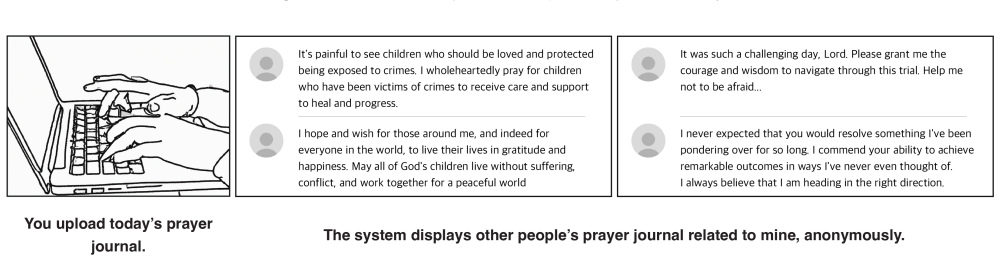
We present four conceptual value-sensitive AI systems to examine how the presence of AI could influence praying experiences. Drawing on key values and practices associated with praying identified through a diary study, we designed AI systems intended to "assist" prayer practices. These designs were presented to participants through speculative design workbooks, serving as provocations to co-reflect on how the intervention of AI systems might shape their praying experiences. Our findings suggest that a sense of authenticity (or feeling a genuine connection to the divine) is a crucial value, while the presence of AI was often perceived as diminishing this authenticity, particularly when AI assumed too much agency in guiding praying practices. Based on our findings, we argue that AI system designs for deeply value-laden experiences should preserve users' agency in shaping their own experiences by maintaining interpretive openness, perhaps by leveraging AI's inexplicability as a resource for personal meaning-making or by recognizing non-use of AI as a legitimate design choice.
Editorial analysis
A structured set of objections, weighed in public.
Referee Report
Summary. The paper describes a two-stage qualitative study: a diary study to surface values and practices associated with prayer, followed by the design of four conceptual AI systems intended to assist prayer. These designs were presented to participants via speculative design workbooks as provocations for co-reflection. The central claim is that authenticity (a genuine connection to the divine) is a crucial value that AI presence tends to diminish, especially when the AI assumes high agency in guiding the practice; the authors therefore recommend preserving user agency through interpretive openness or explicit non-use options in value-laden AI designs.
Significance. If the reported perceptions hold, the work extends value-sensitive design methods into spiritual and personal domains, offering concrete design implications for AI systems that interact with deeply held human values. The diary-to-speculative-design sequence is a recognized strength in HCI for surfacing tensions before deployment, and the emphasis on agency and non-use as legitimate choices provides a useful counterpoint to purely assistive framings of AI.
major comments (2)
- [§5 and §6] §5 (Workbook Study) and §6 (Findings): the manuscript does not report the number of participants, recruitment criteria, or the analytic procedure (e.g., thematic analysis steps or inter-rater process) used to derive the claim that AI diminishes authenticity. Without these details the strength of the link between the elicited reflections and the central claim cannot be evaluated.
- [§7] §7 (Discussion): the argument that workbook-based reflections justify design principles for real AI systems (preserving interpretive openness or treating non-use as a feature) rests on an untested assumption that hypothetical perceptions will persist or be mitigated under actual, repeated use. This extrapolation is load-bearing for the downstream recommendations yet lacks any empirical anchor in observed interaction with deployed prototypes.
minor comments (2)
- [Abstract and §4] The four conceptual designs are referenced in the abstract and §4 but never summarized even briefly; a one-paragraph overview of each would help readers map the provocations to the reported themes.
- [Figures and §6] Figure captions and workbook excerpts could be clarified to indicate whether quotes are verbatim participant responses or researcher paraphrases.
Simulated Author's Rebuttal
Thank you for the opportunity to respond to the referee's comments. We value the feedback and have addressed the major concerns by providing additional methodological details and clarifying the scope of our claims in the revised manuscript.
read point-by-point responses
-
Referee: [§5 and §6] §5 (Workbook Study) and §6 (Findings): the manuscript does not report the number of participants, recruitment criteria, or the analytic procedure (e.g., thematic analysis steps or inter-rater process) used to derive the claim that AI diminishes authenticity. Without these details the strength of the link between the elicited reflections and the central claim cannot be evaluated.
Authors: We thank the referee for highlighting this gap in our methodological reporting. We will revise the manuscript to include detailed information on the number of participants in the workbook study, the recruitment criteria used (focusing on individuals engaged in personal prayer practices), and a comprehensive description of the analytic procedure, including the steps of thematic analysis and how inter-author discussions were used to refine themes. This will allow readers to better assess the robustness of our findings regarding AI's impact on authenticity. revision: yes
-
Referee: [§7] §7 (Discussion): the argument that workbook-based reflections justify design principles for real AI systems (preserving interpretive openness or treating non-use as a feature) rests on an untested assumption that hypothetical perceptions will persist or be mitigated under actual, repeated use. This extrapolation is load-bearing for the downstream recommendations yet lacks any empirical anchor in observed interaction with deployed prototypes.
Authors: We recognize that our use of speculative design workbooks means the data consists of participants' reflections on conceptual designs rather than observations from actual AI interactions. This is inherent to the method's goal of exploring value implications in advance of technology development. We have partially revised §7 to more clearly position our design principles as informed by these reflections and to note the need for future studies involving real deployments to validate whether the perceived diminishment of authenticity persists. We maintain that this approach provides valuable early insights for value-sensitive AI design. revision: partial
Circularity Check
No circularity: qualitative claims derive directly from participant reflections without self-referential reduction
full rationale
The paper conducts a diary study to surface values, creates four conceptual AI designs as provocations, presents them via speculative workbooks, and reports participant co-reflections on authenticity and agency. No equations, fitted parameters, predictions, or uniqueness theorems appear; the findings are presented as direct outputs of the elicited reflections rather than reductions to prior self-citations or definitional loops. The derivation remains self-contained and externally falsifiable through the reported participant data.
Axiom & Free-Parameter Ledger
axioms (1)
- domain assumption Prayer practices centrally involve a felt sense of authenticity and direct connection to the divine.
Reference graph
Works this paper leans on
-
[1]
James Auger. 2013. Speculative design: crafting the speculation.Digital Creativ- ity24, 1 (2013), 11–35
2013
-
[2]
Jeffrey Bardzell and Shaowen Bardzell. 2015. The user reconfigured: on subjec- tivities of information. InProceedings of The Fifth Decennial Aarhus Conference on Critical Alternatives. 133–144
2015
-
[3]
Shaowen Bardzell. 2010. Feminist HCI: taking stock and outlining an agenda for design. InProceedings of the SIGCHI Conference on Human Factors in Com- puting Systems(Atlanta, Georgia, USA)(CHI ’10). Association for Computing Machinery, New York, NY, USA, 1301–1310. doi:10.1145/1753326.1753521
-
[4]
Eric PS Baumer, Phil Adams, Vera D Khovanskaya, Tony C Liao, Madeline E Smith, Victoria Schwanda Sosik, and Kaiton Williams. 2013. Limiting, leaving, and (re) lapsing: an exploration of facebook non-use practices and experiences. InProceedings of the SIGCHI conference on human factors in computing systems. 3257–3266
2013
-
[5]
Eric PS Baumer, Morgan G Ames, Jed R Brubaker, Jenna Burrell, and Paul Dourish. 2014. Refusing, limiting, departing: why we should study technology non-use. InCHI’14 Extended Abstracts on Human Factors in Computing Systems. 65–68
2014
-
[6]
Eric PS Baumer, Jenna Burrell, Morgan G Ames, Jed R Brubaker, and Paul Dourish. 2015. On the importance and implications of studying technology non-use.interactions22, 2 (2015), 52–56
2015
-
[7]
Eric PS Baumer and M Six Silberman. 2011. When the implication is not to design (technology). InProceedings of the SIGCHI Conference on Human Factors in Computing Systems. 2271–2274
2011
-
[8]
Genevieve Bell. 2006. No more SMS from Jesus: Ubicomp, religion and techno-spiritual practices. InInternational Conference on Ubiquitous Computing. Springer, 141–158
2006
-
[9]
Elizabeth Biddlecombe. 2004. Cell phone users are finding God.Wired, August 19 (2004)
2004
-
[10]
Julian Bleecker. 2015. Design fiction: A short essay on design, science, fact and fiction. 2009.Retrieved June16 (2015)
2015
-
[11]
Mark Blythe. 2014. Research through design fiction: narrative in real and imaginary abstracts. InProceedings of the SIGCHI conference on human factors in computing systems. 703–712
2014
-
[12]
Susanne Bødker. 2006. When second wave HCI meets third wave challenges. In Proceedings of the 4th Nordic conference on Human-computer interaction: changing roles. 1–8
2006
-
[13]
Alan Borning and Michael Muller. 2012. Next steps for value sensitive design. InProceedings of the SIGCHI conference on human factors in computing systems. 1125–1134
2012
-
[14]
Josiah D Boucher, Gillian Smith, and Yunus Doğan Telliel. 2024. Is Resistance Futile?: Early Career Game Developers, Generative AI, and Ethical Skepticism. InProceedings of the CHI Conference on Human Factors in Computing Systems. 1–13
2024
-
[15]
Karen Boyd. 2022. Designing up with value-sensitive design: Building a field guide for ethical ML development. InProceedings of the 2022 ACM conference on fairness, accountability, and transparency. 2069–2082
2022
-
[16]
2021.Thematic analysis: A practical guide
Virginia Braun and Victoria Clarke. 2021.Thematic analysis: A practical guide. SAGE Publications
2021
-
[17]
Elizabeth Buie. 2019. Let Us Say What We Mean: Towards Operational Defini- tions for Techno-Spirituality Research. InExtended Abstracts of the 2019 CHI Conference on Human Factors in Computing Systems. 1–10
2019
-
[18]
Elizabeth Buie and Mark Blythe. 2013. Spirituality: There’s an App for That! (But Not a Lot of Research). InCHI ’13 Extended Abstracts on Human Factors in Computing Systems. Association for Computing Machinery, New York, NY, USA, 2315–2324. doi:10.1145/2468356.2468754
-
[19]
Scott Carter and Jennifer Mankoff. 2005. When participants do the capturing: the role of media in diary studies. InProceedings of the SIGCHI conference on Human factors in computing systems. 899–908
2005
-
[20]
Karen A Cerulo and Andrea Barra. 2008. In the name of. . . : Legitimate interac- tants in the dialogue of prayer.Poetics36, 5-6 (2008), 374–388
2008
-
[21]
Inha Cha and Richmond Y Wong. 2025. Understanding Socio-technical Factors Configuring AI Non-Use in UX Work Practices. InProceedings of the 2025 CHI Conference on Human Factors in Computing Systems. 1–17
2025
-
[22]
Li Chen and Luole Qi. 2010. A diary study of understanding contextual infor- mation needs during leisure traveling. InProceedings of the third symposium on Information interaction in context. 265–270
2010
-
[23]
Hyungjun Cho, Jiyeon Amy Seo, Jiwon Lee, Chang-Min Kim, and Tek-Jin Nam
-
[24]
InProceedings of the 2025 CHI Conference on Human Factors in Computing Systems
ShamAIn: Designing Superior Conversational AI Inspired by Shamanism. InProceedings of the 2025 CHI Conference on Human Factors in Computing Systems. 1–18
2025
-
[25]
John Joon Young Chung, Wooseok Kim, Kang Min Yoo, Hwaran Lee, Eytan Adar, and Minsuk Chang. 2022. TaleBrush: Sketching stories with generative pretrained language models. InProceedings of the 2022 CHI Conference on Human Factors in Computing Systems. 1–19
2022
-
[26]
Caroline Claisse. 2024. Designing for Spiritual Informatics: Exploring a Design Space to Support People’s Spiritual Journey. InCompanion Publication of the 2024 ACM Designing Interactive Systems Conference(IT University of Copenhagen, Denmark)(DIS ’24 Companion). Association for Computing Machinery, New York, NY, USA, 140–143. doi:10.1145/3656156.3663723
-
[27]
Caroline Claisse and Abigail C Durrant. 2023. ‘Keeping our Faith Alive’: Inves- tigating Buddhism Practice during COVID-19 to Inform Design for the Online Community Practice of Faith. InProceedings of the 2023 CHI conference on human factors in computing systems. 1–19
2023
-
[28]
Martin Colbert. 2001. A diary study of rendezvousing: implications for position- aware computing and communications for the general public. InProceedings of the 2001 International ACM SIGGROUP Conference on Supporting Group Work. 15–23
2001
-
[29]
Anna L Cox, Sandy JJ Gould, Marta E Cecchinato, Ioanna Iacovides, and Ian Ren- free. 2016. Design frictions for mindful interactions: The case for microbound- aries. InProceedings of the 2016 CHI conference extended abstracts on human factors in computing systems. 1389–1397
2016
-
[30]
Andy Crabtree, Terry Hemmings, Tom Rodden, Keith Cheverst, Karen Clarke, Guy Dewsbury, John Hughes, and Mark Rouncefield. 2003. Designing with care: Adapting cultural probes to inform design in sensitive settings. InProceedings of the 2004 Australasian Conference on Computer-Human Interaction (OZCHI2004). 4–13
2003
-
[31]
Mary Czerwinski, Eric Horvitz, and Susan Wilhite. 2004. A diary study of task switching and interruptions. InProceedings of the SIGCHI conference on Human factors in computing systems. 175–182
2004
-
[32]
Paul Dourish. 2006. Implications for design. InProceedings of the SIGCHI confer- ence on Human Factors in computing systems. 541–550
2006
-
[33]
2013.Speculative everything: design, fiction, and social dreaming
Anthony Dunne and Fiona Raby. 2013.Speculative everything: design, fiction, and social dreaming. MIT press
2013
-
[34]
Rudresh Dwivedi, Devam Dave, Het Naik, Smiti Singhal, Rana Omer, Pankesh Patel, Bin Qian, Zhenyu Wen, Tejal Shah, Graham Morgan, et al. 2023. Explain- able AI (XAI): Core ideas, techniques, and solutions.Comput. Surveys55, 9 (2023), 1–33
2023
-
[35]
Lindsay Ems. 2014. ICT non-use among the Amish. InACM CHI Conference on Human Factors in Computing Systems, Toronto, Canada
2014
-
[36]
Hasan Shahid Ferdous, Frank Vetere, Hilary Davis, Bernd Ploderer, Kenton O’hara, Rob Comber, and Geremy Farr-Wharton. 2017. Celebratory technology to orchestrate the sharing of devices and stories during family mealtimes. In Proceedings of the 2017 CHI Conference on Human Factors in Computing Systems. 6960–6972
2017
-
[37]
Pin Sym Foong, Natasha Ureyang, Charisse Foo, Sajeban Antonyrex, and Ger- ald CH Koh. 2024. Designing for Caregiver-facing Values Elicitation Tools. In Value-Sensitive AI for Prayer DIS ’26, June 13–17, 2026, Singapore, Singapore Proceedings of the CHI Conference on Human Factors in Computing Systems. 1–20
2024
-
[38]
Batya Friedman. 1996. Value-Sensitive Design.Interactions3, 6 (dec 1996), 16–23. doi:10.1145/242485.242493
-
[39]
Batya Friedman, Peter H Kahn, Alan Borning, and Alina Huldtgren. 2013. Value sensitive design and information systems.Early engagement and new technolo- gies: Opening up the laboratory(2013), 55–95
2013
-
[40]
Batya Friedman and Helen Nissenbaum. 1996. User autonomy: who should con- trol what and when?. InConference Companion on Human Factors in Computing Systems. 433
1996
-
[41]
Iason Gabriel. 2020. Artificial intelligence, values, and alignment.Minds and machines30, 3 (2020), 411–437
2020
-
[42]
Bill Gaver, Tony Dunne, and Elena Pacenti. 1999. Design: cultural probes. interactions6, 1 (1999), 21–29
1999
-
[43]
William Gaver. 2011. Making spaces: how design workbooks work. InProceed- ings of the SIGCHI conference on human factors in computing systems. 1551–1560
2011
-
[44]
William Gaver. 2014. Science and design: The implications of different forms of accountability. InWays of Knowing in HCI. Springer, 143–165
2014
-
[45]
William Gaver, Mark Blythe, Andy Boucher, Nadine Jarvis, John Bowers, and Peter Wright. 2010. The prayer companion: openness and specificity, materiality and spirituality. InProceedings of the SIGCHI conference on Human factors in computing systems. 2055–2064
2010
-
[46]
Donna Haraway. 2013. Situated knowledges: The science question in feminism and the privilege of partial perspective 1. InWomen, science, and technology. Routledge, 455–472
2013
-
[47]
Eiji Hayashi and Jason Hong. 2011. A diary study of password usage in daily life. InProceedings of the SIGCHI Conference on Human Factors in Computing Systems. 2627–2630
2011
-
[48]
Gillian R Hayes. 2011. The relationship of action research to human-computer interaction.ACM Transactions on Computer-Human Interaction (TOCHI)18, 3 (2011), 1–20
2011
-
[49]
Christopher Helland. 2007. Diaspora on the electronic frontier: Developing virtual connections with sacred homelands.Journal of computer-mediated communication12, 3 (2007), 956–976
2007
-
[50]
Michelle Hlubinka, Jennifer Beaudin, Emmanuel Munguia Tapia, and John S An. 2002. AltarNation: interface design for meditative communities. InCHI’02 extended abstracts on Human factors in computing systems. 612–613
2002
-
[51]
2003.The varieties of religious experience: A study in human nature
William James. 2003.The varieties of religious experience: A study in human nature. Routledge
2003
-
[52]
Sangsu Jang, Nari Kim, Nanum Kim, Jin-young Moon, Choong-Wan Woo, and Young-Woo Park. 2025. Journey to My Past: Exploring and Journaling Past Memories Evoked by Questions Framed as Proud Moments. InProceedings of the 2025 CHI Conference on Human Factors in Computing Systems. 1–19
2025
-
[53]
Jialun Aaron Jiang, Kandrea Wade, Casey Fiesler, and Jed R Brubaker. 2021. Sup- porting serendipity: Opportunities and challenges for Human-AI Collaboration in qualitative analysis.Proceedings of the ACM on human-computer interaction 5, CSCW1 (2021), 1–23
2021
-
[54]
Tero Jokela, Jarno Ojala, and Thomas Olsson. 2015. A diary study on combining multiple information devices in everyday activities and tasks. InProceedings of the 33rd annual ACM conference on human factors in computing systems. 3903–3912
2015
-
[55]
Estelle Smith, and Loren Terveen
Avleen Kaur, C. Estelle Smith, and Loren Terveen. 2021. Sway Together, Stay Together: Visualizing Spiritual Support Networks Through the Soul- Garden Prototype. InCompanion Publication of the 2021 Conference on Com- puter Supported Cooperative Work and Social Computing(Virtual Event, USA) (CSCW ’21). Association for Computing Machinery, New York, NY, USA,...
-
[56]
Subin Kim, Sangsu Jang, Jin-young Moon, Minjoo Han, and Young-Woo Park
-
[57]
InProceedings of the 2022 ACM Designing Interactive Systems Conference
Slide2Remember: an interactive wall frame enriching reminiscence expe- riences by providing re-encounters of taken photos and heard music in a similar period. InProceedings of the 2022 ACM Designing Interactive Systems Conference. 288–300
2022
-
[58]
Neal Krause, Linda M Chatters, Tina Meltzer, and David L Morgan. 2000. Using focus groups to explore the nature of prayer in late life.Journal of Aging Studies 14, 2 (2000), 191–212
2000
-
[59]
1970.The structure of scientific revolutions
Thomas S Kuhn and Ian Hacking. 1970.The structure of scientific revolutions. Vol. 2. University of Chicago press Chicago
1970
- [60]
-
[61]
Measuring Private Prayer: Development, Validation, and Clinical Application of the Multidimensional Prayer Inventory
Steven P Laird, C Richard Snyder, Michael A Rapoff, and Sam Green. 2004. " Measuring Private Prayer: Development, Validation, and Clinical Application of the Multidimensional Prayer Inventory".The International Journal for the Psychology of Religion14, 4 (2004), 251–272
2004
-
[62]
Le Dantec, Erika Shehan Poole, and Susan P
Christopher A. Le Dantec, Erika Shehan Poole, and Susan P. Wyche. 2009. Values as lived experience: evolving value sensitive design in support of value discovery. InProceedings of the SIGCHI Conference on Human Factors in Computing Systems (Boston, MA, USA)(CHI ’09). Association for Computing Machinery, New York, NY, USA, 1141–1150. doi:10.1145/1518701.1518875
- [63]
-
[64]
Joseph Lindley and Paul Coulton. 2015. Back to the future: 10 years of design fiction. InProceedings of the 2015 British HCI conference. 210–211
2015
-
[65]
Conor Linehan, Ben J Kirman, Stuart Reeves, Mark A Blythe, Theresa Jean Tanenbaum, Audrey Desjardins, and Ron Wakkary. 2014. Alternate endings: using fiction to explore design futures. InCHI’14 Extended Abstracts on Human Factors in Computing Systems. 45–48
2014
-
[66]
Enrico Liscio, Michiel van der Meer, Luciano Cavalcante Siebert, Catholijn M Jonker, Niek Mouter, and Pradeep K Murukannaiah. 2021. Axies: Identifying and Evaluating Context-Specific Values.. InAAMAS. 799–808
2021
-
[67]
Mark W MacWilliams. 2013. Virtual Pilgrimage to Ireland’s Croagh Patrick. In Religion Online. Routledge, 223–238
2013
-
[68]
Robert B Markum and Kentaro Toyama. 2020. Digital technology, meditative and contemplative practices, and transcendent experiences. InProceedings of the 2020 CHI Conference on Human Factors in Computing Systems. 1–14
2020
-
[69]
Robert B Markum, Sara Wolf, Caroline Claisse, and Michael Hoefer. 2024. Medi- ating the Sacred: Configuring a Design Space for Religious and Spiritual Tangible Interactive Artifacts. InProceedings of the Eighteenth International Conference on Tangible, Embedded, and Embodied Interaction. 1–22
2024
-
[70]
Robert B Markum, Sara Wolf, Michael Hoefer, and Franzisca Maas. 2023. De- signing Tangible Interactive Artifacts for Religious and Spiritual Purposes. In Companion Publication of the 2023 ACM Designing Interactive Systems Conference. 117–120
2023
-
[71]
Nusrat Jahan Mim, Prajna Devi Upadhyay, Priyanka Paul, and Dipanjan Chakraborty. 2026. Making the Sacred: Craft, Ritual, and Computational Imaginaries in Postcolonial HCI. InProceedings of the 2026 CHI Conference on Human Factors in Computing Systems(Barcelona, Spain)(CHI ’26). Associ- ation for Computing Machinery, New York, NY, USA, Article 1264, 18 pag...
-
[72]
Tommy Nilsson, Joel E Fischer, Andy Crabtree, Murray Goulden, Jocelyn Spence, and Enrico Costanza. 2020. Visions, Values, and Videos: Revisiting Envisionings in Service of UbiComp Design for the Home. InProceedings of the 2020 ACM Designing Interactive Systems Conference. 827–839
2020
-
[73]
William Odom, Ron Wakkary, Jeroen Hol, Bram Naus, Pepijn Verburg, Tal Amram, and Amy Yo Sue Chen. 2019. Investigating slowness as a frame to design longer-term experiences with personal data: A field study of olly. In Proceedings of the 2019 CHI Conference on Human Factors in Computing Systems. 1–16
2019
-
[74]
Teresa K O’Leary, Dhaval Parmar, Stefan Olafsson, Michael Paasche-Orlow, Timothy Bickmore, and Andrea G Parker. 2022. Community dynamics in tech- nospiritual interventions: lessons learned from a church-based mHealth pilot. In Proceedings of the 2022 CHI Conference on Human Factors in Computing Systems. 1–23
2022
-
[75]
Teresa K O’Leary, Elizabeth Stowell, Everlyne Kimani, Dhaval Parmar, Stefan Olafsson, Jessica Hoffman, Andrea G Parker, Michael K Paasche-Orlow, and Timothy Bickmore. 2020. Community-based cultural tailoring of virtual agents. Inproceedings of the 20th ACM international conference on intelligent virtual agents. 1–8
2020
-
[76]
Leysia Palen and Marilyn Salzman. 2002. Voice-mail diary studies for naturalistic data capture under mobile conditions. InProceedings of the 2002 ACM conference on Computer supported cooperative work. 87–95
2002
-
[77]
Margaret M Poloma and Brian F Pendleton. 1991. The effects of prayer and prayer experiences on measures of general weil-being.Journal of Psychology and Theology19, 1 (1991), 71–83
1991
-
[78]
John Rieman. 1993. The diary study: a workplace-oriented research tool to guide laboratory efforts. InProceedings of the INTERACT’93 and CHI’93 conference on Human factors in computing systems. 321–326
1993
-
[79]
Cynthia Rudin. 2019. Stop explaining black box machine learning models for high stakes decisions and use interpretable models instead.Nature machine intelligence1, 5 (2019), 206–215
2019
-
[80]
Malak Sadek, Rafael A Calvo, and Céline Mougenot. 2024. The value-sensitive conversational agent co-design framework.International Journal of Human– Computer Interaction(2024), 1–32
2024
discussion (0)
Sign in with ORCID, Apple, or X to comment. Anyone can read and Pith papers without signing in.