Second Harmonic Generation Through Backward Raman Scattering in Magnetized Plasmas Driven by Circularly Polarized Intense Lasers
Pith reviewed 2026-05-07 14:24 UTC · model grok-4.3
The pith
Right-handed circular laser polarization resonant with the magnetic field boosts second-harmonic radiation generated through backward Raman scattering in magnetized plasmas.
A machine-rendered reading of the paper's core claim, the machinery that carries it, and where it could break.
Core claim
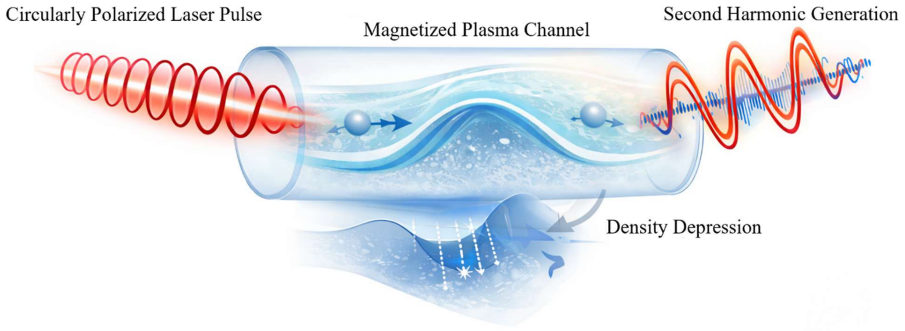
A fluid-based theoretical framework is developed to describe the nonlinear cascade linking primary BRS-driven plasma wave amplification, oscillating two-stream instability (OTSI), nonlinear current generation within a self-formed ponderomotive channel, and radiation of the secondary electromagnetic mode. Systematic parameter studies reveal a strong sensitivity of the entire cascade to the relative handedness of laser polarization and axial magnetic field direction, as well as to cyclotron resonance strength. Resonant right-handed circular polarization significantly enhances ponderomotive expulsion, channel depth, BRS and OTSI growth rates, nonlinear current density, and the amplitude of the
What carries the argument
the fluid-based theoretical framework that links BRS-driven plasma-wave amplification to OTSI, ponderomotive channel formation, nonlinear current generation, and secondary electromagnetic radiation
If this is right
- Resonant right-handed polarization increases ponderomotive expulsion and deepens the self-formed plasma channel.
- It raises the growth rates of both backward Raman scattering and the oscillating two-stream instability.
- It increases the nonlinear current density inside the channel and therefore the radiated second-harmonic amplitude.
- Axial magnetization provides a tunable control over the intensity, spectral position, bandwidth, and stability of multi-peak Raman spectra.
Where Pith is reading between the lines
- The demonstrated polarization control could be combined with density-gradient engineering to further shape the emitted harmonic spectrum.
- The same handedness dependence may appear in other laser-driven plasma instabilities that rely on ponderomotive channeling.
- Quantitative scaling of the harmonic yield with cyclotron detuning could be extracted from the model for use in parameter scans of forthcoming experiments.
Load-bearing premise
The fluid model accurately captures the full nonlinear cascade from BRS through OTSI and ponderomotive channeling to second-harmonic radiation without kinetic corrections that would change the polarization dependence.
What would settle it
A laboratory measurement showing markedly lower second-harmonic amplitude for left-handed versus right-handed circular polarization at the same laser intensity and magnetic-field strength in a magnetized plasma.
Figures



read the original abstract
A fluid-based theoretical framework is developed to describe the nonlinear cascade linking primary BRS-driven plasma wave amplification, oscillating two-stream instability (OTSI), nonlinear current generation within a self-formed ponderomotive channel, and radiation of the secondary electromagnetic mode. Systematic parameter studies reveal a strong sensitivity of the entire cascade to the relative handedness of laser polarization and axial magnetic field direction, as well as to cyclotron resonance strength. Resonant right-handed circular polarization significantly enhances ponderomotive expulsion, channel depth, BRS and OTSI growth rates, nonlinear current density, and the amplitude of the secondary harmonic, whereas non-resonant left-handed polarization effectively suppresses these processes. Fully kinetic particle in cell simulations using EPOCH, together with macroscopic finite-element modelling in COMSOL Multiphysics, corroborate the polarization- and magnetization dependent wake modulation and channelling efficiency across a wide range of laser wavelengths, pulse durations, and plasma densities. The temporal evolution and saturation of OTSI, resilience to density inhomogeneities, and wavenumber-resolved resonance tuning illustrate axial magnetization as a flexible control mechanism for adjusting the intensity, spectral position, bandwidth, and stability of multi peak Raman spectra. These findings demonstrate that cyclotron resonance and polarization control are effective methods for manipulating nonlinear Raman emission in high-intensity laser magnetized plasma interactions, offering predictive insights for forthcoming kinetic simulations and experimental implementations.
Editorial analysis
A structured set of objections, weighed in public.
Referee Report
Summary. The manuscript develops a fluid-based theoretical framework describing the nonlinear cascade from backward Raman scattering (BRS) and oscillating two-stream instability (OTSI) to ponderomotive channel formation, nonlinear current generation, and second-harmonic radiation in axially magnetized plasmas driven by circularly polarized lasers. Systematic analysis shows strong dependence on laser polarization handedness relative to the background B-field and on cyclotron resonance, with resonant right-handed polarization enhancing channel depth, growth rates, current density, and harmonic amplitude while left-handed polarization suppresses them. Predictions are corroborated by EPOCH particle-in-cell simulations and COMSOL finite-element modeling across ranges of laser wavelength, pulse duration, and plasma density, with additional discussion of OTSI saturation, density inhomogeneity resilience, and resonance tuning for multi-peak Raman spectra.
Significance. If the polarization and cyclotron-resonance dependence holds, the work supplies a practical external control knob for nonlinear Raman processes and harmonic generation in magnetized laser-plasma interactions. The explicit linkage of fluid theory to two independent numerical methods (kinetic PIC and macroscopic FEM) and the demonstration of handedness-selective enhancement constitute a clear strength, offering testable predictions for both future simulations and experiments in high-intensity laser-plasma physics.
major comments (2)
- [Section 3.2, Eq. (12)] Section 3.2, Eq. (12): the fluid expression for the OTSI growth rate includes a cyclotron-resonance factor that is stated to produce the observed enhancement; however, the subsequent comparison with EPOCH data (Section 5.1) reports only qualitative agreement in channel depth and harmonic amplitude, without a direct quantitative test of the predicted scaling with resonance detuning. This weakens the claim that the fluid model fully captures the cascade without kinetic corrections.
- [Figure 8, Section 5.3] Figure 8 and accompanying text in Section 5.3: the reported factor-of-three increase in second-harmonic amplitude for right-handed versus left-handed polarization is shown for a single density and intensity; the parameter scan does not include a systematic variation of the cyclotron frequency ratio that would confirm the resonance tuning effect across the full range claimed in the abstract.
minor comments (3)
- [Section 2] The definition of right- versus left-handed polarization relative to the axial B-field direction should be stated explicitly once in the theory section and repeated in the simulation setup to prevent ambiguity when comparing theory and EPOCH runs.
- [Table 1] Table 1 (parameter ranges) lists plasma densities but omits the corresponding electron cyclotron frequency values; adding these would make the resonance condition transparent.
- [Abstract] The abstract refers to 'multi peak Raman spectra' without specifying whether the additional peaks arise from the primary BRS or from the secondary harmonic; a brief clarification in the introduction or results would improve readability.
Simulated Author's Rebuttal
We thank the referee for the detailed and constructive review of our manuscript. The positive assessment and recommendation for minor revision are appreciated. We address the major comments point by point below, and will incorporate revisions to strengthen the presentation of our results.
read point-by-point responses
-
Referee: [Section 3.2, Eq. (12)] Section 3.2, Eq. (12): the fluid expression for the OTSI growth rate includes a cyclotron-resonance factor that is stated to produce the observed enhancement; however, the subsequent comparison with EPOCH data (Section 5.1) reports only qualitative agreement in channel depth and harmonic amplitude, without a direct quantitative test of the predicted scaling with resonance detuning. This weakens the claim that the fluid model fully captures the cascade without kinetic corrections.
Authors: We agree with the referee that the comparison between the fluid model and EPOCH simulations in Section 5.1 is primarily qualitative. The fluid expression in Eq. (12) predicts the resonance enhancement, and the simulations show corresponding trends in channel depth and harmonic amplitude. However, to provide a more rigorous validation, we will add a quantitative comparison of the OTSI growth rate scaling with resonance detuning in the revised manuscript. This will include plotting the simulated growth rates against the analytical prediction for varying cyclotron frequencies, thereby addressing the potential need for kinetic corrections. revision: yes
-
Referee: [Figure 8, Section 5.3] Figure 8 and accompanying text in Section 5.3: the reported factor-of-three increase in second-harmonic amplitude for right-handed versus left-handed polarization is shown for a single density and intensity; the parameter scan does not include a systematic variation of the cyclotron frequency ratio that would confirm the resonance tuning effect across the full range claimed in the abstract.
Authors: The factor-of-three increase in Figure 8 is presented for a specific set of parameters to highlight the polarization effect. The broader resonance tuning is demonstrated through the parameter scans in Sections 4 and 5, where variations in plasma density and laser wavelength effectively change the cyclotron frequency ratio ω_c/ω_0. Nevertheless, to explicitly confirm the tuning across the claimed range, we will include an additional analysis or figure in Section 5.3 showing the second-harmonic amplitude versus the cyclotron frequency ratio for both handednesses. revision: yes
Circularity Check
No significant circularity in derivation chain
full rationale
The paper constructs a fluid model for the BRS-OTSI-ponderomotive-second-harmonic cascade and then validates polarization and resonance dependence using independent, fully kinetic EPOCH PIC simulations plus COMSOL finite-element modeling across parameter ranges. No load-bearing step reduces by construction to a fitted parameter, self-definition, or self-citation chain; the kinetic runs serve as external corroboration rather than tautological confirmation of the fluid outputs. The derivation remains self-contained against external benchmarks.
Axiom & Free-Parameter Ledger
axioms (1)
- domain assumption Fluid approximation sufficiently describes the nonlinear cascade of BRS, OTSI, and ponderomotive channeling
Reference graph
Works this paper leans on
-
[1]
Next Generation Driver for Attosecond and Laser-plasma Physics
D. E. Rivas, et al. "Next Generation Driver for Attosecond and Laser-plasma Physics." Sci Rep., 7(1), 5224, (2017)
work page 2017
-
[2]
Information transfer via temporal convolution in nonlinear optics
Ph. Lassonde, et al. "Information transfer via temporal convolution in nonlinear optics." Sci Rep., 10(1), 14969, (2020)
work page 2020
-
[3]
Ultrafast Photon-Induced Tunneling Microscopy
M. Garg, et al. "Ultrafast Photon-Induced Tunneling Microscopy." ACS Nano., 15(11), 18071-18084, (2021)
work page 2021
-
[4]
Two-plasmon decay instability and 3/2 harmonic generation in inhomogeneous magnetized plasma
A. A. Molavi Choobini, S. S. Ghaffar-Oskooei "Two-plasmon decay instability and 3/2 harmonic generation in inhomogeneous magnetized plasma." Journal of the Optical Society of America B, 42(7), (2025)
work page 2025
-
[5]
F. Ding, et al. "Single-shot complete characterization of synthesized laser pulses and the nonlinear frequency- conversion process." Opt Express., 32(14), 24262-24274, (2024)
work page 2024
-
[6]
Efficient second- and higher-order harmonic generation from LiNbO3 metasurfaces
Y. Zhao, et al. "Efficient second- and higher-order harmonic generation from LiNbO3 metasurfaces." Nanoscale., 15(31), 12926-12932, (2023)
work page 2023
-
[7]
Multicycle terahertz pulse generation by optical rectification in LiNbO3, LiTaO3, and BBO crystals
D. Jang, K. Y. Kim, "Multicycle terahertz pulse generation by optical rectification in LiNbO3, LiTaO3, and BBO crystals." Opt Express., 28(14), 21220-21235, (2020)
work page 2020
-
[8]
Nonlinear photonics on integrated platforms
W. Geng, et al. "Nonlinear photonics on integrated platforms." Nanophotonics., 13(18), 3253-3278, (2024)
work page 2024
-
[9]
Exploring the frontier: nonlinear optics in low dimensional materials
M. A. Adeshina, H. Kim "Exploring the frontier: nonlinear optics in low dimensional materials." Nanophotonics., 14(10), 1451-1473, (2025)
work page 2025
-
[10]
Plasma modulator for high-power intense lasers
Y. Zhao, et al. "Plasma modulator for high-power intense lasers." Opt Express., 28(11), 15794-15804, (2020)
work page 2020
-
[11]
M. R. Edwards, J. M Mikhailova, " The X-Ray Emission Effectiveness of Plasma Mirrors: Reexamining Power-Law Scaling for Relativistic High-Order Harmonic Generation." Sci Rep., 10(1), 5154, (2020)
work page 2020
-
[12]
Spatio-temporal characterization of attosecond pulses from plasma mirrors
L. Chopineau, et al. "Spatio-temporal characterization of attosecond pulses from plasma mirrors." Nature Physics., 17(8), 968-973, (2021)
work page 2021
-
[13]
Eugene Oks, et al. " Revealing the second harmonic generation in a femtosecond laser-driven cluster-based plasma by analyzing shapes of Ar XVII spectral lines." Optics Express, 23, 25, (2015)
work page 2015
-
[14]
q-Gaussian laser beam for second-harmonic generation from unmagnetized plasma
A. S. Ahmed, et al. "q-Gaussian laser beam for second-harmonic generation from unmagnetized plasma." J Opt, 53(2), 1328–1335, (2024)
work page 2024
-
[15]
N. Gupta, et al. "Second-harmonic generation of two cross-focused q-Gaussian laser beams by nonlinear frequency mixing in plasmas." J Opt, 53(1), 18–29, (2024)
work page 2024
-
[16]
K. Walia, "Nonlinear Dynamics of Intense Laser Beam in Unmagnetized Plasma and its Influence on Second Harmonic Generation." Journal of Fusion Energy, 41:21, (2022)
work page 2022
-
[17]
Resonant second-harmonic generation of self-focused oblique incident laser beam in plasma
V. Sharma, et al. "Resonant second-harmonic generation of self-focused oblique incident laser beam in plasma." Laser Phys. 34, 035401 (7pp), (2024)
work page 2024
-
[18]
High-order harmonics enhancement in laser-induced plasma
R. A. Ganeev, "High-order harmonics enhancement in laser-induced plasma." Scientific Reports, 13, 13951, (2023)
work page 2023
-
[19]
Two-color high-harmonic generation from relativistic plasma mirrors
N. F. Beier, F. Dollar, "Two-color high-harmonic generation from relativistic plasma mirrors." Physical Review E, 108, 015201 (2023)
work page 2023
-
[20]
Sub-cycle dynamics in two-color high-harmonic generation from laser-produced plasmas
J. Mathijssen, et al. "Sub-cycle dynamics in two-color high-harmonic generation from laser-produced plasmas." Optics Express, 32, 17, 30824, (2024)
work page 2024
-
[21]
Observation of strong terahertz field-induced second harmonic generation in plasma filaments
K. J. G. Francis, et al. "Observation of strong terahertz field-induced second harmonic generation in plasma filaments." Optics Letters, 47, 23, 6297, (2022)
work page 2022
-
[22]
Local measurement of terahertz field-induced second harmonic generation in plasma filaments
K. J. G. Francis, X. Ch. Zhang, "Local measurement of terahertz field-induced second harmonic generation in plasma filaments." Frontiers of Optoelectronics,16, 44, (2023)
work page 2023
-
[23]
Lim Pac Chong, et al. "Single-shot local measurement of terahertz correlated second harmonic generation in laser air plasma filaments." Optics Letters, 49, 2, (2024)
work page 2024
-
[24]
Conservation of angular momentum in second harmonic generation from under- dense plasmas
Chen-Kang Huang, et al. "Conservation of angular momentum in second harmonic generation from under- dense plasmas." Communication Physics, 3, 213, (2020)
work page 2020
-
[25]
Enhanced second harmonic generation in laser-induced air plasma
Shing Yiu Fu, et al. "Enhanced second harmonic generation in laser-induced air plasma." Optics Letters, 48, 12, 3199, (2024)
work page 2024
-
[26]
High-harmonic generation from a flat liquid-sheet plasma mirror
Yang Hwan Kim, et al. "High-harmonic generation from a flat liquid-sheet plasma mirror." Nature Communications, 14, 2328, (2023)
work page 2023
-
[27]
Self-focusing and guiding of short laser pulses in ionizing gases and plasmas
Esarey, Eric, et al. "Self-focusing and guiding of short laser pulses in ionizing gases and plasmas." IEEE journal of quantum electronics 33, 11, 1879-1914, (1997)
work page 1914
-
[28]
Weipeng Yao, et al. "Dynamics of nanosecond laser pulse propagation and of associated instabilities in a magnetized underdense plasma." arXiv, (2022)
work page 2022
-
[29]
M. Bailly-Grandvaux, et al. "Validation of magnetized gas-jet experiments to investigate the effects of an external magnetic field on laser-plasma instabilities." J. Plasma Phys., vol. 89, 175890201, (2023)
work page 2023
-
[30]
I. Tazes, et al. "Efficient Magnetic Vortex Acceleration by femtosecond laser interaction with long living optically shaped gas targets in the near critical density plasma regime." Scientific Reports, 14:4945, (2024)
work page 2024
-
[31]
S. Bolaños, et al. "Direct evidence of the effect of a moderate external magnetic field on stimulated Raman scattering in the kinetic regime." Phys. Plasmas 32, 092102 (2025)
work page 2025
-
[32]
Experimental evidence of stimulated Raman re-scattering in laser-plasma interaction
J.-R. Marqu`es, et al. "Experimental evidence of stimulated Raman re-scattering in laser-plasma interaction." arXiv, (2025)
work page 2025
-
[33]
G. Cristoforetti, et al. "Observation and modelling of stimulated Raman scattering driven by an optically smoothed laser beam in experimental conditions relevant for shock ignition." High Power Laser Science and Engineering, 9, e60, (2021). List of Figures & Captions Fig. 1. Schematic illustration of the interaction of a circularly polarized laser pulse w...
work page 2021
discussion (0)
Sign in with ORCID, Apple, or X to comment. Anyone can read and Pith papers without signing in.