Recognition: unknown
Electronic structures of spin-orbit-coupled metal candidate PbRe₂O₆: one dimensionality and molecular orbital formation
Pith reviewed 2026-05-07 16:05 UTC · model grok-4.3
The pith
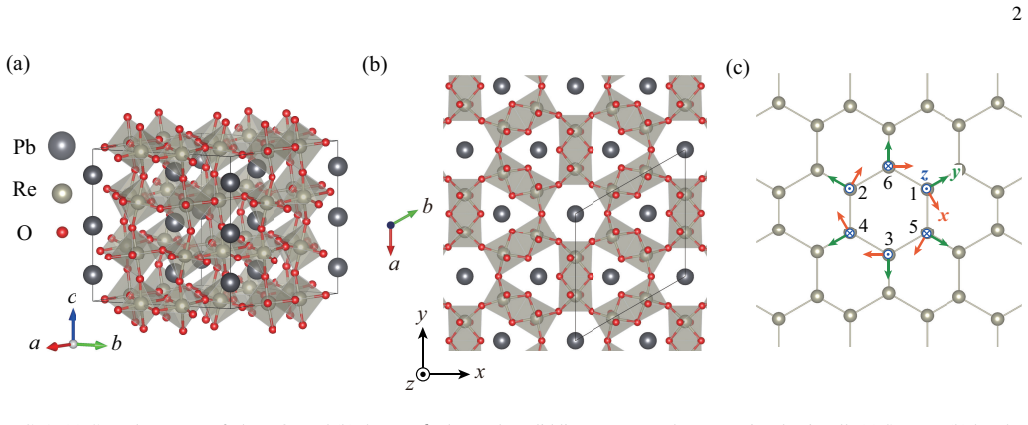
First-principles calculations on PbRe₂O₆ reveal quasi-one-dimensional Fermi surfaces from d_yz and d_zx orbitals alongside nearly flat E_g bands from molecular orbitals of d_x²-y² orbitals on Re hexagons, providing a possible origin for its
A machine-rendered reading of the paper's core claim, the machinery that carries it, and where it could break.
Core claim
First-principles calculations reveal that the Fermi surfaces derived from the d_yz and d_zx orbitals exhibit pronounced one-dimensional characteristics, which naturally account for the highly anisotropic charge transport observed experimentally. In addition, the d_x²-y² orbitals on each Re hexagon form molecular orbitals, where the resulting E_g molecular states generate nearly dispersionless bands in close proximity to the Fermi level. The coexistence of these quasi-1D Fermi surfaces and molecular-orbital-induced flat bands provides a possible microscopic origin for the successive phase transitions observed in PbRe₂O₆.
What carries the argument
Quasi-1D Fermi surfaces from d_yz and d_zx orbitals combined with nearly dispersionless E_g bands from molecular orbitals formed by d_x²-y² orbitals on Re hexagons
If this is right
- The one-dimensional Fermi surfaces explain the observed highly anisotropic charge transport.
- Molecular orbital formation on Re hexagons produces nearly dispersionless bands close to the Fermi level.
- Coexistence of the two features supplies a possible microscopic mechanism for the successive phase transitions.
Where Pith is reading between the lines
- Angle-resolved photoemission spectroscopy could directly map the predicted 1D Fermi surfaces and flat bands.
- Analogous molecular-orbital flat bands may appear in other rhenium compounds with hexagonal metal arrangements.
- Stronger electron correlations than assumed in the calculations could enhance instabilities driven by the flat bands.
Load-bearing premise
Standard first-principles methods without explicit strong-correlation corrections or additional spin-orbit details accurately capture the orbital characters and band dispersions near the Fermi level.
What would settle it
Angle-resolved photoemission spectroscopy that fails to detect either the quasi-one-dimensional Fermi surface contours or the nearly flat bands near the Fermi energy would contradict the calculated electronic structure.
Figures


read the original abstract
We present a first-principles investigation of the electronic structure of the inversion-symmetry-broken spin-orbit-coupled metal candidate PbRe$_2$O$_6$. Our calculations reveal that the Fermi surfaces derived from the $d_{yz}$ and $d_{zx}$ orbitals exhibit pronounced one-dimensional characteristics, which naturally account for the highly anisotropic charge transport observed experimentally. In addition, the $d_{x^2-y^2}$ orbitals on each Re haxagon form molecular orbitals, where the resulting $E_g$ molecular states generate nearly dispersionless bands in close proximity to the Fermi level. The coexistence of these quasi-1D Fermi surfaces and molecular-orbital-induced flat bands provides a possible microscopic origin for the successive phase transitions observed in PbRe$_2$O$_6$.
Editorial analysis
A structured set of objections, weighed in public.
Referee Report
Summary. The manuscript presents a first-principles study of the electronic structure of the inversion-symmetry-broken spin-orbit-coupled metal candidate PbRe₂O₆. It claims that the Fermi surfaces arising from the d_yz and d_zx orbitals display pronounced quasi-one-dimensional character that explains the observed anisotropic charge transport, while the d_x²-y² orbitals on Re hexagons form molecular orbitals whose E_g states produce nearly dispersionless bands near the Fermi level; the coexistence of these features is proposed as a microscopic origin for the successive phase transitions in the material.
Significance. If the reported band features and their orbital characters prove robust, the work would supply a concrete orbital-resolved mechanism linking one-dimensional Fermi-surface nesting with molecular-orbital flat bands in a 5d oxide, offering a plausible explanation for the sequence of phase transitions and providing a template for similar analyses in other spin-orbit-coupled candidates.
major comments (2)
- The central claim that the E_g molecular-orbital flat bands lie in close proximity to E_F (and thereby coexist with the quasi-1D d_yz/d_zx Fermi surfaces to drive the phase transitions) rests on conventional GGA+SOC calculations. For Re 5d oxides, effective Hubbard U values of 2–4 eV are typical; even modest U can shift these flat bands by several hundred meV or alter their orbital character, removing them from the vicinity of E_F. No DFT+U, hybrid-functional, or DMFT calculations are presented to test this sensitivity, leaving the load-bearing assertion about band positions unverified.
- The abstract states that the calculations reveal the claimed quasi-1D Fermi surfaces and flat bands, yet supplies no information on the exchange-correlation functional, spin-orbit coupling implementation, k-point mesh, energy cutoff, or convergence tests. Without these details or error estimates, the quantitative reliability of the reported dispersions and orbital characters near E_F cannot be assessed.
minor comments (1)
- The abstract contains a typographical error: 'haxagon' should read 'hexagon'.
Simulated Author's Rebuttal
We thank the referee for the positive evaluation of the significance of our work and for the constructive comments. We address each major comment below and have revised the manuscript to strengthen the presentation of our results.
read point-by-point responses
-
Referee: The central claim that the E_g molecular-orbital flat bands lie in close proximity to E_F (and thereby coexist with the quasi-1D d_yz/d_zx Fermi surfaces to drive the phase transitions) rests on conventional GGA+SOC calculations. For Re 5d oxides, effective Hubbard U values of 2–4 eV are typical; even modest U can shift these flat bands by several hundred meV or alter their orbital character, removing them from the vicinity of E_F. No DFT+U, hybrid-functional, or DMFT calculations are presented to test this sensitivity, leaving the load-bearing assertion about band positions unverified.
Authors: We agree that testing the sensitivity of the flat-band positions to Hubbard U is important for 5d systems. Our original calculations employed the standard GGA+SOC framework, which is appropriate for this metallic candidate and consistent with prior work on related Re oxides. To directly address the concern, we have performed additional DFT+U calculations (U_eff = 2 eV and 3 eV) that confirm the E_g molecular-orbital bands remain within ~200 meV of E_F and preserve their orbital character, although they shift modestly. These results and a brief discussion of correlation effects will be added to the revised manuscript. revision: yes
-
Referee: The abstract states that the calculations reveal the claimed quasi-1D Fermi surfaces and flat bands, yet supplies no information on the exchange-correlation functional, spin-orbit coupling implementation, k-point mesh, energy cutoff, or convergence tests. Without these details or error estimates, the quantitative reliability of the reported dispersions and orbital characters near E_F cannot be assessed.
Authors: We thank the referee for noting this omission. The full computational details (PBE functional, SOC via fully relativistic pseudopotentials, 12×12×6 k-mesh, 600 eV cutoff, and convergence criteria) are provided in the Computational Methods section. We have revised the abstract to include the key parameters and a statement on the convergence tests performed, thereby improving the standalone readability of the abstract. revision: yes
Circularity Check
No circularity: direct outputs of first-principles calculations
full rationale
The manuscript reports electronic band structures, Fermi surfaces, and orbital characters obtained from standard DFT (PBE+SOC) calculations on PbRe2O6. No analytic derivation chain, fitted parameters renamed as predictions, self-citation load-bearing uniqueness theorems, or ansatz smuggling is present. The central claim (coexistence of quasi-1D FS from d_yz/d_zx and E_g flat bands from molecular orbitals) is stated as a direct computational result, with no reduction to its own inputs by construction. This is the expected non-circular outcome for a computational materials paper whose evidence consists of reproducible numerical outputs rather than a closed logical loop.
Axiom & Free-Parameter Ledger
Reference graph
Works this paper leans on
-
[1]
D. I. Khomskii and S. V . Streltsov, Orbital effects in solids: Ba- sics, recent progress, and opportunities, Chem. Rev.121, 2992 (2021)
2021
-
[2]
Nagaosa, Conducting multiferroics, J
N. Nagaosa, Conducting multiferroics, J. Phys. Soc. Jpn.92, 081002 (2023)
2023
-
[3]
Hayami and H
S. Hayami and H. Kusunose, Unified description of electronic orderings and cross correlations by complete multipole repre- sentation, J. Phys. Soc. Jpn.93, 072001 (2024)
2024
-
[4]
Fu, Parity-breaking phases of spin-orbit-coupled metals with gyrotropic, ferroelectric, and multipolar orders, Phys
L. Fu, Parity-breaking phases of spin-orbit-coupled metals with gyrotropic, ferroelectric, and multipolar orders, Phys. Rev. Lett. 115, 026401 (2015)
2015
-
[5]
Witczak-Krempa, G
W. Witczak-Krempa, G. Chen, Y . B. Kim, and L. Balents, Cor- related quantum phenomena in the strong spin-orbit regime, Annu. Rev. Condens. Matter Phys.5, 57 (2014)
2014
-
[6]
Takayama, J
T. Takayama, J. Chaloupka, A. Smerald, G. Khaliullin, and H. Takagi, Spin–orbit-entangled electronic phases in 4d and 5d transition-metal compounds, J. Phys. Soc. Jpn.90, 062001 (2021)
2021
-
[7]
B. J. Kim, H. Jin, S. J. Moon, J.-Y . Kim, B.-G. Park, C. S. Leem, J. Yu, T. W. Noh, C. Kim, S.-J. Oh, J.-H. Park, V . Durairaj, G. Cao, and E. Rotenberg, NovelJeff= 1/2mott state induced by relativistic spin-orbit coupling insr 2iro4, Phys. Rev. Lett. 101, 076402 (2008)
2008
-
[8]
B. J. Kim, H. Ohsumi, T. Komesu, S. Sakai, T. Morita, H. Tak- agi, and T. Arima, Phase-sensitive observation of a spin-orbital mott state in sr2iro4, Science323, 1329 (2009)
2009
-
[9]
Watanabe, T
H. Watanabe, T. Shirakawa, and S. Yunoki, Microscopic study of a spin-orbit-induced mott insulator in ir oxides, Phys. Rev. Lett.105, 216410 (2010)
2010
-
[10]
Tokura, Y
Y . Tokura, Y . Motome, and K. Ueda, Metal-insulator transitions in pyrochlore oxides, Rep. Prog. Phys.88, 056001 (2025)
2025
-
[11]
Shinaoka, T
H. Shinaoka, T. Miyake, and S. Ishibashi, Noncollinear magnetism and spin-orbit coupling in5dpyrochlore oxide cd2os2o7, Phys. Rev. Lett.108, 247204 (2012)
2012
-
[12]
Yamaura, K
J. Yamaura, K. Ohgushi, H. Ohsumi, T. Hasegawa, I. Yamauchi, K. Sugimoto, S. Takeshita, A. Tokuda, M. Takata, M. Udagawa, M. Takigawa, H. Harima, T. Arima, and Z. Hiroi, Phys. Rev. Lett.108, 247205 (2012)
2012
-
[13]
Shinaoka, Y
H. Shinaoka, Y . Motome, T. Miyake, S. Ishibashi, and P. Werner, First-principles studies of spin-orbital physics in py- rochlore oxides, J. Phys.: Condens. Matter31, 323001 (2019)
2019
-
[14]
Jackeli and G
G. Jackeli and G. Khaliullin, Mott insulators in the strong spin- orbit coupling limit: From heisenberg to a quantum compass and kitaev models, Phys. Rev. Lett.102, 017205 (2009)
2009
-
[15]
I. I. Mazin, H. O. Jeschke, K. Foyevtsova, R. Valentí, and D. I. Khomskii,na 2iro3 as a molecular orbital crystal, Phys. Rev. Lett.109, 197201 (2012)
2012
-
[16]
S. M. Winter, Y . Li, H. O. Jeschke, and R. Valentí, Challenges in design of kitaev materials: Magnetic interactions from com- peting energy scales, Phys. Rev. B93, 214431 (2016)
2016
-
[17]
Yamaji, Y
Y . Yamaji, Y . Nomura, M. Kurita, R. Arita, and M. Imada, First- principles study of the honeycomb-lattice iridatesna 2iro3 in the presence of strong spin-orbit interaction and electron corre- lations, Phys. Rev. Lett.113, 107201 (2014)
2014
-
[18]
Singh and P
Y . Singh and P. Gegenwart, Antiferromagnetic mott insulat- ing state in single crystals of the honeycomb lattice material na2iro3, Phys. Rev. B82, 064412 (2010)
2010
-
[19]
Kitagawa, T
K. Kitagawa, T. Takayama, Y . Matsumoto, A. Kato, R. Takano, Y . Kishimoto, S. Bette, R. Dinnebier, G. Jackeli, and H. Tak- agi, A spin–orbital-entangled quantum liquid on a honeycomb lattice, Nature554, 341 (2018)
2018
-
[20]
Takagi, T
H. Takagi, T. Takayama, G. Jackeli, G. Khaliullin, and S. E. Nagler, Concept and realization of kitaev quantum spin liquids, Nat. Rev. Phys.1, 264 (2019)
2019
-
[21]
Motome, R
Y . Motome, R. Sano, S. Jang, Y . Sugita, and Y . Kato, Materi- als design of kitaev spin liquids beyond the jackeli–khaliullin mechanism, J. Phys.: Condens. Matter32, 404001 (2020)
2020
-
[22]
G. Chen, R. Pereira, and L. Balents, Exotic phases induced by strong spin-orbit coupling in ordered double perovskites, Phys. Rev. B82, 174440 (2010)
2010
-
[23]
Paramekanti, D
A. Paramekanti, D. D. Maharaj, and B. D. Gaulin, Octupolar order ind-orbital mott insulators, Phys. Rev. B101, 054439 (2020)
2020
-
[24]
H. Kubo, T. Ishitobi, and K. Hattori, Electronic origin of ferroic quadrupole moment under antiferroic quadrupole order and fi- nite magnetic moment inJ eff= 3 2 systems, Phys. Rev. B107, 235134 (2023)
2023
-
[25]
A. S. Erickson, S. Misra, G. J. Miller, R. R. Gupta, Z. Schlesinger, W. A. Harrison, J. M. Kim, and I. R. Fisher, Ferromagnetism in the mott insulatorba 2naoso6, Phys. Rev. Lett.99, 016404 (2007)
2007
-
[26]
L. Lu, M. Song, W. Liu, A. P. Reyes, P. Kuhns, H. O. Lee, I. R. Fisher, and V . F. Mitrovi´c, Magnetism and local symmetry breaking in a mott insulator with strong spin orbit interactions, Nat. Commun.8, 14407 (2017)
2017
-
[27]
Hirai and Z
D. Hirai and Z. Hiroi, Successive symmetry breaking in a jeff = 3/2 quartet in the spin–orbit coupled insulator ba2mgreo6, J. Phys. Soc. Jpn.88, 064712 (2019)
2019
-
[28]
Ishikawa, T
H. Ishikawa, T. Takayama, R. K. Kremer, J. Nuss, R. Dinnebier, K. Kitagawa, K. Ishii, and H. Takagi, Ordering of hidden mul- tipoles in spin-orbit entangled5d 1 ta chlorides, Phys. Rev. B 100, 045142 (2019)
2019
-
[29]
Yamaura and Z
J.-I. Yamaura and Z. Hiroi, Low temperature symmetry of py- rochlore oxide cd2re2o7, J. Phys. Soc. Jpn.71, 2598 (2002)
2002
-
[30]
Hiroi, J.-i
Z. Hiroi, J.-i. Yamaura, T. C. Kobayashi, Y . Matsubayashi, and D. Hirai, Pyrochlore oxide superconductor cd2re2o7 revisited, J. Phys. Soc. Jpn.87, 024702 (2018)
2018
-
[31]
Hanawa, Y
M. Hanawa, Y . Muraoka, T. Tayama, T. Sakakibara, J. Yamaura, and Z. Hiroi, Superconductivity at 1 k incd 2re2o7, Phys. Rev. Lett.87, 187001 (2001)
2001
-
[32]
R. Jin, J. He, J. R. Thompson, M. F. Chisholm, B. C. Sales, and D. Mandrus, Fluctuation effects on the physical properties of cd2re2o7 near 200 k, J. Phys.: Condens. Matter14, L117 (2002)
2002
-
[33]
Hiroi, J.-I
Z. Hiroi, J.-I. Yamaura, Y . Muraoka, and M. Hanawa, Second phase transition in pyrochlore oxide cd2re2o7, J. Phys. Soc. 6 Jpn.71, 1634 (2002)
2002
-
[34]
I. A. Sergienko and S. H. Curnoe, Structural order parameter in the pyrochlore superconductor cd2re2o7, J. Phys. Soc. Jpn.72, 1607 (2003)
2003
-
[35]
M. R. Norman, Dichroism as a probe for parity-breaking phases of spin-orbit coupled metals, Phys. Rev. B92, 075113 (2015)
2015
-
[36]
Di Matteo and M
S. Di Matteo and M. R. Norman, Nature of the tensor order in cd2re2o7, Phys. Rev. B96, 115156 (2017)
2017
-
[37]
Hayami, Y
S. Hayami, Y . Yanagi, H. Kusunose, and Y . Motome, Electric toroidal quadrupoles in the spin-orbit-coupled metalcd 2re2o7, Phys. Rev. Lett.122, 147602 (2019)
2019
-
[38]
Wentzell, H
I. Wentzell, H. Fuess, J. W. Bats, and A. K. Cheetham, Prepara- tion and crystal structure of pbre2o6. an example of the re2o10 unit with no metal-metal bonding, Z. Anorg. Allg. Chem.528, 48 (1985)
1985
-
[39]
Tajima, D
S. Tajima, D. Hirai, T. Yajima, D. Nishio-Hamane, Y . Mat- subayashi, and Z. Hiroi, Spin–orbit-coupled metal candidate pbre2o6, J. Solid State Chem.288, 121359 (2020)
2020
-
[40]
Hirai and Z
D. Hirai and Z. Hiroi, private communication
-
[41]
Blaha, K
P. Blaha, K. Schwarz, G. Madsen, D. Kvasnicka, and J. Luitz, An augmented plane wave + local orbitals program for calcu- lating crystal properties (Technische Universität Wien Vienna, 2001)
2001
-
[42]
Blaha, K
P. Blaha, K. Schwarz, F. Tran, R. Laskowski, G. K. H. Madsen, and L. D. Marks, Wien2k: An apw+lo program for calculating the properties of solids, J. Chem. Phys.152, 074101 (2020)
2020
-
[43]
Pizzi, V
G. Pizzi, V . Vitale, R. Arita, S. Blügel, F. Freimuth, G. Géran- ton, M. Gibertini, D. Gresch, C. Johnson, T. Koretsune, J. Ibañez-Azpiroz, H. Lee, J.-M. Lihm, D. Marchand, A. Mar- razzo, Y . Mokrousov, J. I. Mustafa, Y . Nohara, Y . Nomura, L. Paulatto, S. Poncé, T. Ponweiser, J. Qiao, F. Thöle, S. S. Tsirkin, M. Wierzbowska, N. Marzari, D. Vanderbilt, ...
2020
-
[44]
Kuneš, R
J. Kuneš, R. Arita, P. Wissgott, A. Toschi, H. Ikeda, and K. Held, Wien2wannier: From linearized augmented plane waves to maximally localized wannier functions, Comput. Phys. Commun.181, 1888 (2010)
2010
-
[45]
G. H. Olsen, M. H. Sørby, B. C. Hauback, S. M. Selbach, and T. Grande, Revisiting the crystal structure of rhombohedral lead metaniobate, Inorganic Chemistry53, 9715 (2014)
2014
-
[46]
Momma and F
K. Momma and F. Izumi,VESTA3for three-dimensional visu- alization of crystal, volumetric and morphology data, J. Appl. Crystallogr.44, 1272 (2011)
2011
-
[47]
Kawamura, Fermisurfer: Fermi-surface viewer providing multiple representation schemes, Comput
M. Kawamura, Fermisurfer: Fermi-surface viewer providing multiple representation schemes, Comput. Phys. Commun.239, 197 (2019)
2019
discussion (0)
Sign in with ORCID, Apple, or X to comment. Anyone can read and Pith papers without signing in.