Random Number Generators in Advanced Optical Experiments: A Comparative Analysis of Semiclassical, Quantum, and Hybrid Architectures
Pith reviewed 2026-05-07 10:38 UTC · model grok-4.3
The pith
A hybrid architecture mixing attenuated laser and single-photon light generates raw random sequences that can surpass those refined by randomness extractors.
A machine-rendered reading of the paper's core claim, the machinery that carries it, and where it could break.
Core claim
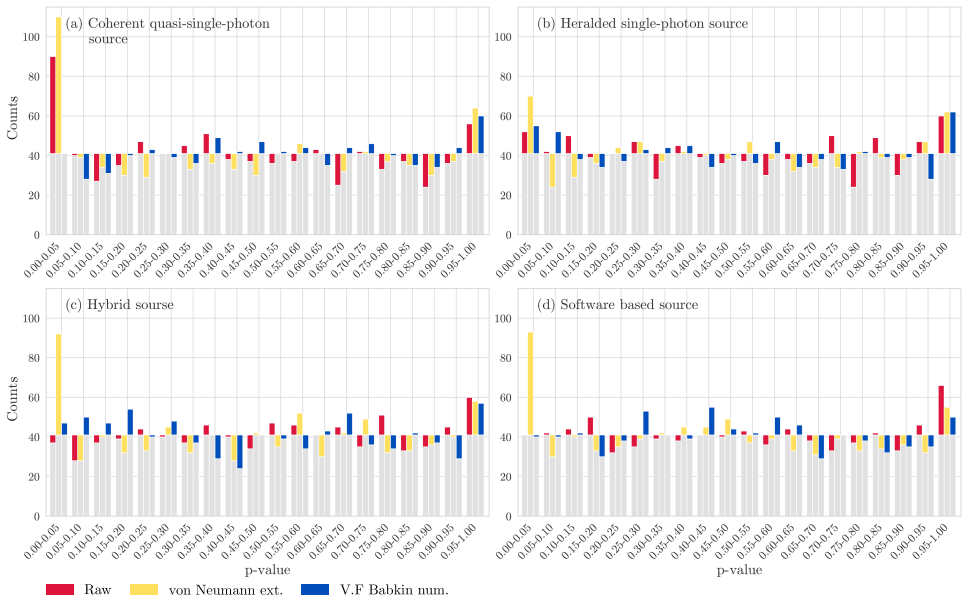
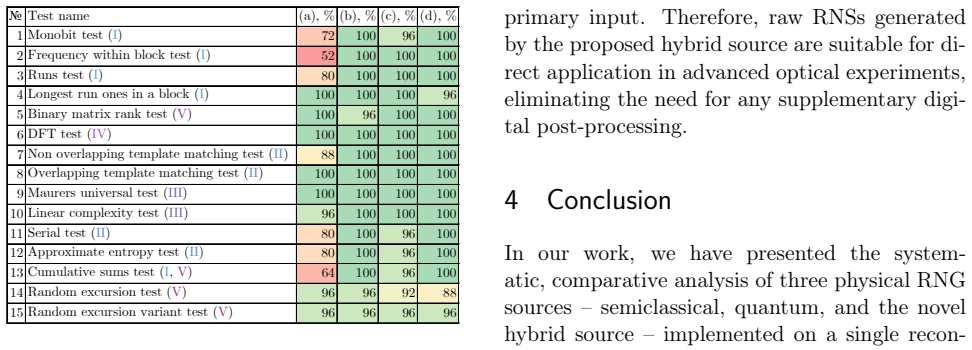
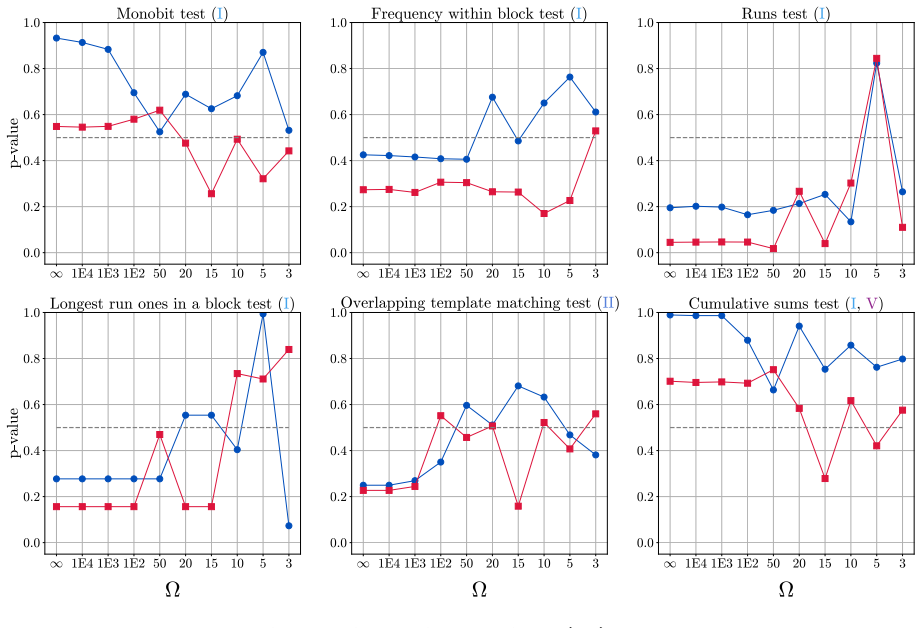
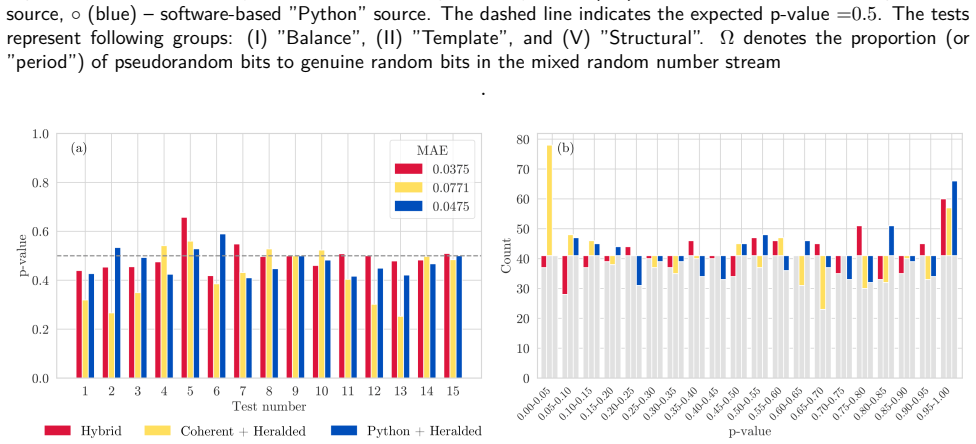
By mixing radiation from an attenuated laser and a heralded single-photon source, the hybrid architecture generates random number sequences at enhanced rates while maintaining or improving statistical quality, such that the unprocessed sequences sometimes outperform those subjected to randomness extractors.
What carries the argument
The hybrid architecture that combines mixed radiation from an attenuated laser as a quasi-single-photon source and a heralded single-photon source to balance generation rate with entropy.
Load-bearing premise
The mixed radiation from the attenuated laser and heralded single-photon sources maintains statistical independence and high entropy without introducing unforeseen correlations or biases from the combination process.
What would settle it
An experiment that measures unexpected correlations or entropy loss in the hybrid raw output, making its randomness fall below that of extracted sequences from the individual sources, would disprove the claim.
Figures
read the original abstract
Random numbers sequences (RNSs) play a vital role in various scientific and engineering applications. They are critical to the integrity of classical and quantum cryptography, the accuracy of mathematical modeling and Monte Carlo simulations, and the core mechanics of applications in fields as diverse as gambling and statistical sampling. While the primary criteria for RNSs sources are their quality and generation rate, their integration into experimental designs is equally significant for many fundamental physical tests and applications. This work presents a comparative analysis of optical random number generation architectures, which can be seamlessly included into various advanced classical and quantum optical experimental schemes. In particular, we evaluate the trade-off between the high generation rate of an attenuated laser (a quasi-single-photon source) and the superior statistical quality of a heralded single-photon source operating at a much lower frequency. To overcome the limitations of each individual source, we propose and examine a novel hybrid architecture that utilizes their mixed radiation, enabling the generation of highquality RNSs at an enhanced rate. Furthermore, we demonstrate that the raw sequences generated by such a source can not only exhibit but, in some cases, even surpass the degree of randomness achieved by sequences processed through powerful randomness extractors.
Editorial analysis
A structured set of objections, weighed in public.
Referee Report
Summary. The manuscript conducts a comparative analysis of semiclassical (attenuated laser), quantum (heralded single-photon), and hybrid optical random number generator architectures for use in advanced experiments. It highlights the trade-off between generation rate and statistical quality, introduces a hybrid source combining both, and claims that raw output from the hybrid can, in some cases, exceed the randomness quality of extractor-processed sequences from the individual sources.
Significance. Should the empirical claims be verified, this could offer a valuable practical advancement in random number generation for optical setups, allowing higher rates with maintained or improved quality without extractor overhead. It addresses a real need in integrating RNG into quantum and classical optical experiments. The work would benefit from explicit comparisons to existing methods in the literature.
major comments (2)
- Abstract: The assertion that 'the raw sequences generated by such a source can not only exhibit but, in some cases, even surpass the degree of randomness achieved by sequences processed through powerful randomness extractors' is not accompanied by any quantitative data, specific randomness metrics (such as min-entropy estimates or test suite results), error bars, or statistical analysis, rendering the claim unverifiable from the provided text.
- Hybrid architecture description: The hybrid architecture's ability to maintain or increase min-entropy without introducing correlations from the mixing process is central to the claim of surpassing extractors, yet no analytic derivation, covariance matrix analysis, or empirical cross-correlation measurements are presented to support the independence assumption.
minor comments (1)
- Abstract: The abstract refers to 'evaluation and demonstration' but does not outline the specific experimental setup, number of samples, or randomness testing procedures used.
Simulated Author's Rebuttal
We thank the referee for their careful reading of the manuscript and for highlighting these important points regarding verifiability and supporting analysis. We address each major comment below and indicate the corresponding revisions.
read point-by-point responses
-
Referee: Abstract: The assertion that 'the raw sequences generated by such a source can not only exhibit but, in some cases, even surpass the degree of randomness achieved by sequences processed through powerful randomness extractors' is not accompanied by any quantitative data, specific randomness metrics (such as min-entropy estimates or test suite results), error bars, or statistical analysis, rendering the claim unverifiable from the provided text.
Authors: We agree that the abstract, as currently written, does not contain the quantitative details needed to make the claim immediately verifiable. The body of the manuscript (Sections 3 and 4) presents the supporting min-entropy estimates, NIST test-suite results, and statistical comparisons, but these are not summarized in the abstract. In the revised version we will shorten the abstract slightly and insert the key quantitative metrics (average min-entropy per bit for each architecture, representative p-value ranges, and error-bar information) so that the claim is self-contained and directly supported by data. revision: yes
-
Referee: Hybrid architecture description: The hybrid architecture's ability to maintain or increase min-entropy without introducing correlations from the mixing process is central to the claim of surpassing extractors, yet no analytic derivation, covariance matrix analysis, or empirical cross-correlation measurements are presented to support the independence assumption.
Authors: The referee is correct that the manuscript does not presently contain an analytic derivation, an explicit covariance-matrix treatment, or tabulated cross-correlation measurements. The current text relies on the physical separation of the two sources and the low mean photon number to argue for statistical independence. We will add the requested material in a new subsection: (i) a short analytic argument based on the independent Poissonian statistics of the attenuated laser and the heralded single-photon detections, (ii) the measured cross-correlation function between the two input streams, and (iii) the covariance matrix of the resulting bit sequences, all with appropriate error bars. These additions will directly substantiate the independence assumption underlying the min-entropy claim. revision: yes
Circularity Check
No circularity: empirical comparison without derivations or self-referential reductions
full rationale
The manuscript is a comparative experimental analysis of optical RNG sources (attenuated laser, heralded single-photon, and their hybrid mix) with the central claim that raw hybrid sequences can match or exceed post-extractor randomness. No equations, parameter fits, uniqueness theorems, or derivation steps appear in the provided text. The hybrid independence assumption is an unverified modeling premise rather than a self-definitional loop or a fitted quantity renamed as a prediction. No self-citations are invoked to justify load-bearing steps, and the result is presented as a demonstration rather than a closed mathematical reduction to its own inputs. The paper is therefore self-contained against external benchmarks with no detectable circularity.
Axiom & Free-Parameter Ledger
Reference graph
Works this paper leans on
-
[1]
SharonL.Lohr. “Sampling: Designandanal- ysis”. Chapman and Hall/CRC. (2021). 3 edition
work page 2021
-
[2]
Strong quantum com- putational advantage using a superconduct- ing quantum processor
Yulin Wu and et al. “Strong quantum com- putational advantage using a superconduct- ing quantum processor”. Phys. Rev. Lett. 127, 180501 (2021)
work page 2021
-
[3]
Quantum supremacy using a programmable superconducting pro- cessor
Frank Arute and et al. “Quantum supremacy using a programmable superconducting pro- cessor”. Nature574, 505–510 (2019)
work page 2019
-
[4]
Com- putational advantage of quantum ran- dom sampling
Dominik Hangleiter and Jens Eisert. “Com- putational advantage of quantum ran- dom sampling”. Rev. Mod. Phys.95, 035001 (2023)
work page 2023
-
[5]
James e. gentle: Ran- dom number generation and monte carlo method
Volker Schmidt. “James e. gentle: Ran- dom number generation and monte carlo method”. Metrika64, 251–252 (2006)
work page 2006
-
[6]
Quantum trajectories and open many-body quantum systems
Andrew J. Daley. “Quantum trajectories and open many-body quantum systems”. Adv. Phys.63 (2), 77–149 (2014)
work page 2014
-
[7]
Alejandro Blanco-Gonzalez, Madushanka Manathunga, Xuchun Yang, and Massimo Olivucci. “Comparative quantum-classical dynamics of natural and synthetic molecular rotors show how vibrational synchronization modulates the photoisomerization quantum efficiency”. Nat. Commun.15, 3499 (2024)
work page 2024
-
[8]
Modeling diffusion in networks with communities: A multitype branching process approach
Alina Dubovskaya, Caroline B. Pena, and David J. P. O’Sullivan. “Modeling diffusion in networks with communities: A multitype branching process approach”. Phys. Rev. E 111, 034310 (2025)
work page 2025
-
[9]
Applied cryptography: pro- tocols, algorithms, and source code in c
Bruce Schneier. “Applied cryptography: pro- tocols, algorithms, and source code in c”. John Wiley Sons. (2015). 20th anniversary edition
work page 2015
-
[10]
Secure quan- tum key distribution with realistic devices
Feihu Xu, Xiongfeng Ma, Qiang Zhang, Hoi- Kwong Lo, and Jian-Wei Pan. “Secure quan- tum key distribution with realistic devices”. Rev. Mod. Phys.92, 025002 (2020)
work page 2020
-
[11]
Security in quantum cryptography
Christopher Portmann and Renato Renner. “Security in quantum cryptography”. Rev. Mod. Phys.94, 025008 (2022)
work page 2022
-
[12]
Topological and dynamical complexity of random neural networks
Gilles Wainrib and Jonathan Touboul. “Topological and dynamical complexity of random neural networks”. Phys. Rev. Lett. 110, 118101 (2013)
work page 2013
-
[13]
Mean-field dynamics of a random neural network with noise
Vladimir Klinshov and Igor Franović. “Mean-field dynamics of a random neural network with noise”. Phys. Rev. E92, 062813 (2015)
work page 2015
-
[14]
Noise- resilient quantum random access codes
H. S. Karthik, S. Gómez, F. M. Quinteros, Akshata Shenoy H., M. Pawłowski, S. P. Walborn, G. Lima, and E. S. Gómez. “Noise- resilient quantum random access codes”. Phys. Rev. A111, 032613 (2025)
work page 2025
-
[15]
Halv- ing the cost of quantum algorithms with randomization
John M. Martyn and Patrick Rall. “Halv- ing the cost of quantum algorithms with randomization”. npj Quantum Inf.11, 47 (2025)
work page 2025
-
[16]
Karan P. Patel, Andrew Maicke, Jared Arzate, Jaesuk Kwon, J. Darby Smith, James B. Aimone, Jean Anne C. Incorvia, Suma G. Cardwell, and Catherine D. Schu- man. “AI-guided framework for the design of materials and devices for magnetic-tunnel- junction-based true random number genera- tors”. Commun. Eng.4, 43 (2025)
work page 2025
-
[17]
Magic spreading in random quantum circuits
Xhek Turkeshi, Emanuele Tirrito, and Pi- otr Sierant. “Magic spreading in random quantum circuits”. Nat. Commun.16, 2575 (2025)
work page 2025
-
[18]
Hardik Prabhu, Charan M. Ravishankar, Abhishek Ganesan, Mayur Pandya, Hrushikesh Bhosale, Renu Dhadwal, Naren Rajan Parlikkad, Patrick Siarry, and Jayaraman Krishnamoorthy Valadi. “Enhancing random forest model predic- tion of gas holdup in internal draft airlift loop contactors with genetic algorithms tuning and interpretability”. Sci. Rep.15, 9325 (2025)
work page 2025
-
[19]
A semi-infinite random walkassociatedwiththegameofroulette
M. A. El-Shehawey. “A semi-infinite random walkassociatedwiththegameofroulette”. J. Phys. A: Math. Gen.35, 1813–1820 (2002)
work page 2002
-
[20]
Emer- gence of multilevel selection in the prisoner’s dilemma game on coevolving random net- works
Attila Szolnoki and Matjaž Perc. “Emer- gence of multilevel selection in the prisoner’s dilemma game on coevolving random net- works”. New J. Phys.11, 093033 (2009)
work page 2009
-
[21]
Double- dealing behavior potentially promotes coop- eration in evolutionary prisoner’s dilemma games
Qionglin Dai, Haihong Li, Hongyan Cheng, Yuting Li, and Junzhong Yang. “Double- dealing behavior potentially promotes coop- eration in evolutionary prisoner’s dilemma games”. New J. Phys.12, 113015 (2010)
work page 2010
-
[22]
Optimal solutions in dif- ferential games with random duration
E. V. Shevkoplyas. “Optimal solutions in dif- ferential games with random duration”. J. Math. Sci.199, 715–722 (2014)
work page 2014
-
[23]
Com- petition of tolerant strategies in the spa- 19 tial public goods game
Attila Szolnoki and Matjaž Perc. “Com- petition of tolerant strategies in the spa- 19 tial public goods game”. New J. Phys.18, 083021 (2016)
work page 2016
-
[24]
Linear game non- contextuality and bell inequalities—a graph- theoretic approach
M. Rosicka, R. Ramanathan, P. Gnaciński, K. Horodecki, M. Horodecki, P. Horodecki, and S. Severini. “Linear game non- contextuality and bell inequalities—a graph- theoretic approach”. New J. Phys.18, 045020 (2016)
work page 2016
-
[25]
John Kelsey. “Nist special publication 800- 90a: recommendation for random number generation using deterministic random bit generators.”. EISENBRAUNS. (2012)
work page 2012
-
[26]
Monkey tests for random number generators
G. Marsaglia and A. Zaman. “Monkey tests for random number generators”. Comput. Math. Appl.26 (9), 1–10 (1993)
work page 1993
-
[27]
Tomasz R. Działa. “Collatz-weyl genera- tors: High quality and high throughput pa- rameterized pseudorandom number genera- tors” (2023)
work page 2023
-
[28]
High performance physical random number generator
K.H. Tsoi, K.H. Leung, and P.H.W. Leong. “High performance physical random number generator”. IET Comput. Digit. Tech.1, 349–352 (2007)
work page 2007
-
[29]
True random number generators using electri- cal noise
Lishuang Gong, Jianguo Zhang, Haifang Liu, Luxiao Sang, and Yuncai Wang. “True random number generators using electri- cal noise”. IEEE Access7, 125796– 125805 (2019)
work page 2019
-
[30]
Mario Stipčević and Çetin Kaya Koç. “True random number generators”. Pages 275–
- [31]
-
[32]
Frédéric Monet, Jean-Sébastien Boisvert, and Raman Kashyap. “A simple high- speed random number generator with min- imal post-processing using a random raman fiber laser”. Sci. Rep.11, 13182 (2021)
work page 2021
-
[33]
Shuiying Xiang, Bo Wang, Yang Wang, Yanan Han, Aijun Wen, and Yue Hao. “2.24-tb/s physical random bit generation with minimal post-processing based on chaotic semiconductor lasers network”. J. Lightwave Technol.37, 3987–3993 (2019). url:https://opg.optica.org/jlt/ abstract.cfm?URI=jlt-37-16-3987
work page 2019
-
[34]
Lehan Zhao, Weiqiang Xie, Mingjie Wu, Yanlan Xiao, Zihan Shen, Jin Deng, Haitang Li, Zhengmao Wu, Junbo Yang, Wenqi Wei, Zihao Wang, Ting Wang, Jianjun Zhang, Yikai Su, Heng Zhou, and Jiagui Wu. “126 tbits/s massive parallel physical random bits generator with broadband chaos of inte- grated AlGaAs micro-resonator”. Laser Pho- tonics Rev.19 (24), e00671 (2025)
work page 2025
-
[35]
100- gbit/s integrated quantum random number generator based on vacuum fluctuations
Cédric Bruynsteen, Tobias Gehring, Cosmo Lupo, Johan Bauwelinck, and Xin Yin. “100- gbit/s integrated quantum random number generator based on vacuum fluctuations”. PRX Quantum4, 010330 (2023-03-22)
work page 2023
-
[36]
Fast physi- cal random bit generation with chaotic semi- conductor lasers
Atsushi Uchida, Kazuya Amano, Masaki In- oue, KunihitoHirano, SunaoNaito, Hiroyuki Someya, Isao Oowada, Takayuki Kurashige, Masaru Shiki, Shigeru Yoshimori, Kazuyuki Yoshimura, and Peter Davis. “Fast physi- cal random bit generation with chaotic semi- conductor lasers”. Nature Photon.2, 728– 732 (2008)
work page 2008
-
[37]
Fast physical random number generator using amplified spontaneous emis- sion
Caitlin R. S. Williams, Julia C. Salevan, Xiaowen Li, Rajarshi Roy, and Thomas E. Murphy. “Fast physical random number generator using amplified spontaneous emis- sion”. Opt. Express18, 23584 (2010)
work page 2010
-
[38]
Ran- dom number generation from spontaneous raman scattering
M.J.Collins, A.S.Clark, C.Xiong, E.Mägi, M. J. Steel, and B. J. Eggleton. “Ran- dom number generation from spontaneous raman scattering”. Appl. Phys. Lett.107, 141112 (2015)
work page 2015
-
[39]
New hash functions for message authentication
Hugo Krawczyk. “New hash functions for message authentication”. Volume 921, pages 301–310. Springer Berlin Heidelberg. (1995)
work page 1995
-
[40]
Extraction of quantum randomness
Igor M. Arbekov and Sergey N. Molotkov. “Extraction of quantum randomness”. Phys. Usp.64, 617–634 (2021)
work page 2021
-
[41]
Extracting randomness: How and why
N. Nisan. “Extracting randomness: How and why.”. In Proceedings of the 11th IEEE Con- ference on Computational ComplexityPages 44–58 (1996)
work page 1996
-
[42]
Bell’s theorem without inequalities
Daniel M. Greenberger, Michael A. Horne, Abner Shimony, and Anton Zeilinger. “Bell’s theorem without inequalities”. Am. J. Phys. 58, 1131–1143 (1990)
work page 1990
-
[43]
Random numbers certified by bell’s theorem
S. Pironio, A. Acin, S. Massar, A. Boyer De La Giroday, D. N. Matsukevich, P. Maunz, S. Olmschenk, D. Hayes, L. Luo, T. A. Manning, and C. Monroe. “Random numbers certified by bell’s theorem”. Nature 464, 1021–1024 (2010)
work page 2010
-
[44]
Quantum RNG integration in an NG-PON2 20 transceiver
Nemanja Vokić, Dinka Milovančev, Christoph Pacher, Martin Achleitner, Hannes Hübel, and Bernhard Schrenk. “Quantum RNG integration in an NG-PON2 20 transceiver”. In Optical Fiber Communica- tion Conference (OFC) 2021. Page F4E.7. Optica Publishing Group (2021)
work page 2021
-
[45]
A tunable quantum random number generator based on a fiber- optical sagnac interferometer
Joakim Argillander, Alvaro Alarcón, and Guilherme B Xavier. “A tunable quantum random number generator based on a fiber- optical sagnac interferometer”. J. Opt.24, 064010 (2022)
work page 2022
-
[46]
Quantum random num- ber generation using an on-chip nanowire plasmonic waveguide
C. Strydom, S. Soleymani, S. K. Özdemir, and M. S. Tame. “Quantum random num- ber generation using an on-chip nanowire plasmonic waveguide”. New J. Phys.26, 043002 (2024)
work page 2024
-
[47]
A random number gen- erator based on quantum entangled pho- ton pairs
Ma Hai-Qiang, Wang Su-Mei, Zhang Da, Chang Jun-Tao, Ji Ling-Ling, Hou Yan-Xue, and Wu Ling-An. “A random number gen- erator based on quantum entangled pho- ton pairs”. Chinese Phys. Lett.21, 1961– 1964 (2004)
work page 1961
-
[48]
Multi-bit quan- tum random number generator from path- entangled single photons
K. Muhammed Shafi, Prateek Chawla, Ab- haya S. Hegde, R. S. Gayatri, A. Padhye, and C. M. Chandrashekar. “Multi-bit quan- tum random number generator from path- entangled single photons”. EPJ Quantum Technol.10 (1), 43 (2023)
work page 2023
-
[49]
Ultraviolet laser- induced degradation of cslib6o10 andβ- bab2o4
Kei Takachiho, Masashi Yoshimura, Yoshi- nori Takahashi, Mamoru Imade, Takatomo Sasaki, and Yusuke Mori. “Ultraviolet laser- induced degradation of cslib6o10 andβ- bab2o4”. Opt. Mater. Express4, 559– 567 (2014)
work page 2014
-
[50]
Andrew Rukhin, Juan Soto, James Nech- vatal, Miles Smid, Elaine Barker, Stefan Leigh, Mark Levenson, Mark Vangel, David Banks, Alan Heckert, James Dray, and San Vo. “A statistical test suite for random and pseudorandom number generators for cryptographic applications”. Tech- nical Report NIST Special Publication 800-22rev1a. National Institute of Stan- da...
work page 2010
-
[51]
V. F. Babkin. “A method of universal coding of a source of independent messages with nonexponential work expenditure”. Prob- lemy Peredachi Informacii7 (4)(1971). url:https://mathscinet.ams.org/ mathscinet/relay-station?mr=335127
work page 1971
-
[52]
Igor M. Arbekov and Sergei N. Molotkov. “Quantum random number generators, ex- traction of provably random bit sequences from Markov chain trajectories”. Phys. Usp. 67, 919–937 (2024)
work page 2024
-
[53]
Statistical cal- ibration of the sequest xcorr function
Aaron A. Klammer, Christopher Y. Park, and William Stafford Noble. “Statistical cal- ibration of the sequest xcorr function”. J. Proteome Res.8, 2106–2113 (2009)
work page 2009
-
[54]
Integrated sources of photon quantum states based on nonlinear optics
Lucia Caspani, Chunle Xiong, Benjamin J Eggleton, Daniele Bajoni, Marco Liscidini, Matteo Galli, Roberto Morandotti, and David J Moss. “Integrated sources of photon quantum states based on nonlinear optics”. Light Sci. Appl.6, e17100 (2017)
work page 2017
-
[55]
Qi Wu, Domenico Ribezzo, Giammarco Di Sciullo, SebastianoCocchi, DivyaAnnShaji, Lucas Alves Zischler, Ruben Luis, Paolo Ser- ena, Chiara Lasagni, Alberto Bononi, Tet- suya Hayashi, Alessandro Gagliano, Paolo Martelli, Alberto Gatto, Paola Parolari, Pierpaolo Boffi, Davide Bacco, Alessan- dro Zavatta, Yixiao Zhu, Weisheng Hu, ZhaopengXu, MarkShtaif, Andrea...
work page 2025
discussion (0)
Sign in with ORCID, Apple, or X to comment. Anyone can read and Pith papers without signing in.