Semi-supervised learning with max-margin graph cuts
Pith reviewed 2026-05-07 13:09 UTC · model grok-4.3
The pith
A novel semi-supervised algorithm learns max-margin graph cuts using labels induced by the harmonic function solution.
A machine-rendered reading of the paper's core claim, the machinery that carries it, and where it could break.
Core claim
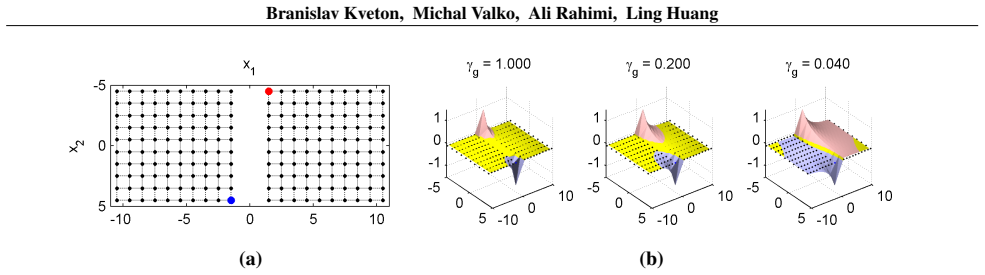
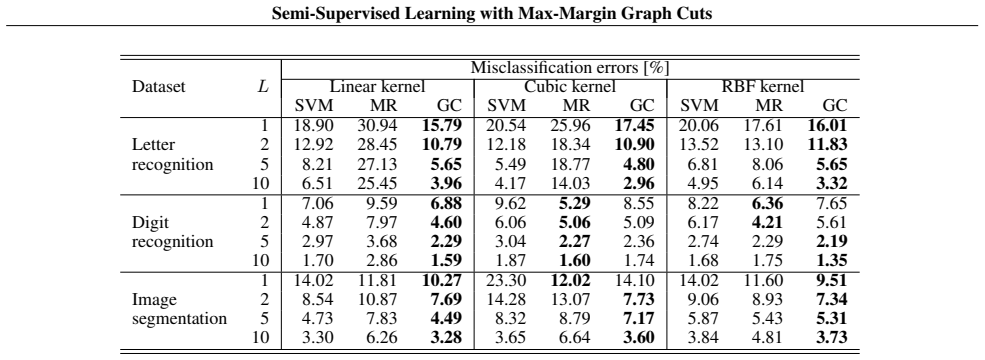
This paper proposes a novel algorithm for semisupervised learning. This algorithm learns graph cuts that maximize the margin with respect to the labels induced by the harmonic function solution. We motivate the approach, compare it to existing work, and prove a bound on its generalization error. The quality of our solutions is evaluated on a synthetic problem and three UCI ML repository datasets. In most cases, we outperform manifold regularization of support vector machines, which is a state-of-the-art approach to semi-supervised max-margin learning.
What carries the argument
Max-margin graph cuts that use pseudo-labels induced by the harmonic function solution on the graph.
If this is right
- The algorithm has a proven bound on its generalization error.
- It outperforms manifold-regularized SVMs on most tested datasets including UCI ML repository ones.
- The method is suitable for classification tasks with both labeled and unlabeled data connected via a graph structure.
Where Pith is reading between the lines
- The reliance on harmonic functions suggests the method works best when the data manifold is well-approximated by the graph.
- Combining label propagation with margin maximization could inspire hybrid approaches in other semi-supervised settings.
- Testing on larger scale problems or with noisy graphs would reveal practical limitations.
Load-bearing premise
The labels induced by the harmonic function solution are accurate enough to allow effective margin maximization in the subsequent graph cut optimization.
What would settle it
A dataset where the harmonic function produces highly inaccurate labels on the unlabeled points, leading to graph cuts with poor classification performance.
Figures


read the original abstract
This paper proposes a novel algorithm for semisupervised learning. This algorithm learns graph cuts that maximize the margin with respect to the labels induced by the harmonic function solution. We motivate the approach, compare it to existing work, and prove a bound on its generalization error. The quality of our solutions is evaluated on a synthetic problem and three UCI ML repository datasets. In most cases, we outperform manifold regularization of support vector machines, which is a state-of-the-art approach to semi-supervised max-margin learning.
Editorial analysis
A structured set of objections, weighed in public.
Referee Report
Summary. The paper proposes a two-stage semi-supervised learning algorithm: it first computes the harmonic function solution on the graph Laplacian to induce labels for unlabeled points, then optimizes a max-margin graph-cut objective that treats these induced labels as fixed targets. It motivates the method by comparison to existing work, proves a generalization bound, and reports empirical results on one synthetic problem and three UCI datasets, claiming outperformance over manifold regularization of SVMs in most cases.
Significance. If the conditional generalization bound can be shown to be non-vacuous and the empirical gains hold under proper statistical controls, the work would usefully extend max-margin SSL by grafting a margin step onto harmonic pseudo-labeling. The combination is conceptually straightforward and could be practically relevant when the manifold assumption is only approximately satisfied.
major comments (3)
- [theoretical section / generalization bound] The generalization bound (abstract and theoretical section) is derived conditional on the harmonic-function labels being fixed and correct; the manuscript does not propagate uncertainty from the first stage or provide a bound that accounts for errors in the harmonic solution when the graph violates the manifold assumption. This makes the bound's practical relevance unclear.
- [experimental evaluation] Experiments (synthetic and UCI sections) compare the full two-stage pipeline against manifold-regularized SVMs but contain no ablation that isolates the contribution of the max-margin graph-cut step versus simply using the harmonic labels directly. Without this, it is impossible to determine whether margin maximization adds value beyond the harmonic baseline.
- [results and discussion] The claim of outperformance “in most cases” (abstract and results) is not accompanied by statistical significance tests, standard deviations across multiple runs, or details of the exact experimental protocol (e.g., label ratios, graph construction parameters, cross-validation).
minor comments (2)
- [method and theory] Notation for the graph Laplacian, harmonic solution, and margin parameters should be introduced once and used consistently; several symbols appear to be redefined between the method and theory sections.
- [abstract] The abstract states that a bound is proved but gives no indication of its tightness or the key assumptions; a one-sentence summary of the bound's form would improve readability.
Simulated Author's Rebuttal
We thank the referee for the constructive and detailed comments. We address each major comment below and indicate the planned revisions to improve the manuscript.
read point-by-point responses
-
Referee: The generalization bound (abstract and theoretical section) is derived conditional on the harmonic-function labels being fixed and correct; the manuscript does not propagate uncertainty from the first stage or provide a bound that accounts for errors in the harmonic solution when the graph violates the manifold assumption. This makes the bound's practical relevance unclear.
Authors: The generalization bound is derived conditional on the harmonic-function labels being fixed because the max-margin graph-cut optimization treats these induced labels as the targets for margin maximization. This conditional bound quantifies the generalization performance of the second stage given the output of the first stage. We agree that the bound does not propagate uncertainty from the harmonic solution or explicitly account for violations of the manifold assumption, which limits its applicability in such cases. In the revised manuscript, we will add a discussion in the theoretical section clarifying the conditional nature of the bound and its practical implications. revision: partial
-
Referee: Experiments (synthetic and UCI sections) compare the full two-stage pipeline against manifold-regularized SVMs but contain no ablation that isolates the contribution of the max-margin graph-cut step versus simply using the harmonic labels directly. Without this, it is impossible to determine whether margin maximization adds value beyond the harmonic baseline.
Authors: Our primary empirical focus is on comparing the full method to manifold-regularized SVMs as a state-of-the-art baseline for semi-supervised max-margin learning. However, we recognize that an ablation against the harmonic labels alone would better isolate the contribution of the max-margin graph-cut step. We will add this ablation to the revised experimental section, reporting results for the harmonic function baseline on the same synthetic and UCI datasets under identical settings. revision: yes
-
Referee: The claim of outperformance “in most cases” (abstract and results) is not accompanied by statistical significance tests, standard deviations across multiple runs, or details of the exact experimental protocol (e.g., label ratios, graph construction parameters, cross-validation).
Authors: We will revise the experimental section and results discussion to include full details of the experimental protocol, such as label ratios, graph construction parameters (e.g., k-NN and kernel settings), and cross-validation procedures. We will also report standard deviations across multiple runs and add statistical significance tests (e.g., paired t-tests) to substantiate the outperformance claims where they hold. revision: yes
Circularity Check
No significant circularity; two-stage procedure with external bound and comparisons
full rationale
The derivation proceeds in two explicit stages: (1) compute harmonic-function labels on the graph Laplacian, then (2) solve a max-margin graph-cut problem treating those labels as fixed targets. The generalization bound is stated for the overall algorithm and the empirical comparisons are performed against an external baseline (manifold-regularized SVMs). No equation reduces the bound or the margin objective to the harmonic labels by algebraic identity, no parameter is fitted on a subset and then renamed a prediction, and no load-bearing uniqueness theorem or ansatz is imported via self-citation. The method is therefore self-contained against external benchmarks and receives the default non-circularity finding.
Axiom & Free-Parameter Ledger
Reference graph
Works this paper leans on
-
[1]
Asuncion, A., & Newman, D. (2007). UCI machine learn- ing repository
work page 2007
-
[2]
Belkin, M., Matveeva, I., & Niyogi, P. (2004). Regulariza- tion and semi-supervised learning on large graphs. In Proceeding of the 17th Annual Conference on Learn- ing Theory, pp. 624–638
work page 2004
-
[3]
Belkin, M., Niyogi, P., & Sindhwani, V . (2006). Manifold regularization: A geometric framework for learning from labeled and unlabeled examples.Journal of Machine Learning Research,7, 2399–2434
work page 2006
-
[4]
Bennett, K., & Demiriz, A. (1999). Semi-supervised sup- port vector machines. InAdvances in Neural Infor- mation Processing Systems 11, pp. 368–374
work page 1999
-
[5]
Bousquet, O., & Elisseeff, A. (2002). Stability and gener- alization.Journal of Machine Learning Research,2, 499–526
work page 2002
-
[6]
(2001).LIBSVM: a library for support vector machines
Chang, C.-C., & Lin, C.-J. (2001).LIBSVM: a library for support vector machines. Software available at http://www.csie.ntu.edu.tw/ cjlin/libsvm
work page 2001
-
[7]
Cortes, C., Mohri, M., Pechyony, D., & Rastogi, A. (2008). Stability of transductive regression algorithms. In Proceedings of the 25th International Conference on Machine Learning, pp. 176–183
work page 2008
-
[8]
Smola, A., & Kondor, R. (2003). Kernels and regulariza- tion on graphs. InProceedings of the 16th Annual Conference on Learning Theory and the 7th Work- shop on Kernel Machines
work page 2003
-
[9]
(1995).The Nature of Statistical Learning The- ory
Vapnik, V . (1995).The Nature of Statistical Learning The- ory. Springer-Verlag, New York, NY
work page 1995
-
[10]
(1999).Support Vector Machines, Reproducing Kernel Hilbert Spaces, and Randomized GACV, pp
Wahba, G. (1999).Support Vector Machines, Reproducing Kernel Hilbert Spaces, and Randomized GACV, pp. 69–88. MIT Press, Cambridge, MA
work page 1999
-
[11]
Zhu, X. (2008). Semi-supervised learning literature survey. Tech. rep. 1530, University of Wisconsin-Madison
work page 2008
-
[12]
Zhu, X., Ghahramani, Z., & Lafferty, J. (2003). Semi- supervised learning using gaussian fields and har- monic functions. InProceedings of the 20th Inter- national Conference on Machine Learning, pp. 912– 919
work page 2003
discussion (0)
Sign in with ORCID, Apple, or X to comment. Anyone can read and Pith papers without signing in.