Ground-state energy of a particle in a space with minimal length and minimal momentum
Pith reviewed 2026-05-07 11:16 UTC · model grok-4.3
The pith
In spaces with minimal length and minimal momentum, the ground-state energy has a rigorous lower bound that is the absolute physical minimum for a class of one-dimensional potentials.
A machine-rendered reading of the paper's core claim, the machinery that carries it, and where it could break.
Core claim
In deformed spaces with minimal coordinate and momentum uncertainties, the ground-state energy for a broad class of one-dimensional potentials has a rigorous lower bound that represents the physically attainable minimum. For the harmonic oscillator this energy is calculated directly. Generalization yields an equation for the coordinate uncertainty at minimal energy, solvable numerically, with a linear approximation providing a general expression, and the domain of existence determined for anharmonic oscillators.
What carries the argument
Deformed commutation relations that enforce minimal uncertainties in both position and momentum, used to derive a variational lower bound on the ground-state energy.
If this is right
- The ground-state energy of the harmonic oscillator can be calculated explicitly in this deformed space.
- For general potentials the minimal energy corresponds to a specific coordinate uncertainty that solves a derived equation.
- A linear approximation in the deformation parameters yields an explicit general formula for the ground-state energy.
- The anharmonic oscillator has solutions only inside a restricted domain of the deformation parameters.
Where Pith is reading between the lines
- The bound could constrain allowable values of deformation parameters when modeling real systems.
- The same bounding method might extend to time-dependent or multi-dimensional potentials.
- In the limit of vanishing deformation parameters the expressions recover the standard quantum-mechanical ground-state energies.
Load-bearing premise
The deformed commutation relations that enforce minimal uncertainties in both position and momentum allow a well-defined variational or operator-based lower bound to be derived that remains valid for the full class of potentials considered.
What would settle it
A numerical or experimental ground-state energy for the harmonic oscillator that lies below the derived lower bound when the deformation parameters are nonzero would disprove the central claim.
Figures


read the original abstract
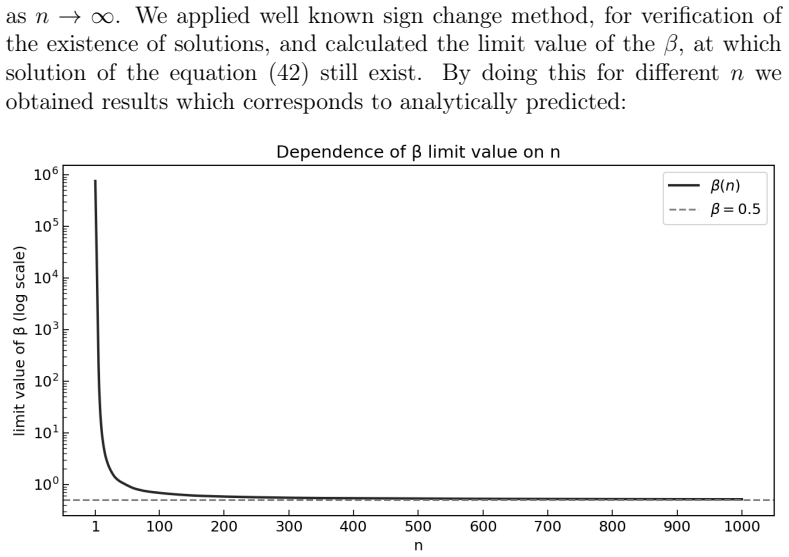
In this article, we derived a rigorous lower bound on the ground-state energy for a class of one-dimensional quantum systems in deformed space with minimal coordinate and momentum uncertainties, representing the absolute minimum energy that is physically attainable. We considered a harmonic oscillator in such a space and calculate its ground-state energy. We generalized the problem to an a sufficiently broad class of potentials, deriving an equation for the coordinate uncertainty corresponding to the minimal energy, which can be solved numerically. Using a linear approximation in the deformation parameters, we obtained a general expression for the ground-state energy. We determined the domain of existence of solutions for the anharmonic oscillator potential with respect to the deformation parameters.
Editorial analysis
A structured set of objections, weighed in public.
Referee Report
Summary. The manuscript derives a lower bound on the ground-state energy for one-dimensional quantum systems in a deformed space with minimal uncertainties in both position and momentum, presented as the absolute minimum physically attainable energy. For the harmonic oscillator, the ground-state energy is calculated explicitly. The approach is then generalized to a broad class of potentials by deriving and numerically solving an equation for the coordinate uncertainty that minimizes the energy; a linear approximation in the deformation parameters is applied to obtain a general closed-form expression. The domain of existence of solutions is mapped for the anharmonic oscillator as a function of the deformation parameters.
Significance. If the linear approximation can be shown to preserve the lower-bound property with controlled error for finite deformations, the result would supply a practical, semi-analytic tool for estimating minimal energies in minimal-length quantum mechanics. The numerical treatment of the uncertainty equation for general potentials is a constructive element that could be extended to other deformed algebras.
major comments (1)
- [Abstract and generalization to class of potentials] Abstract and the section deriving the general expression: the claim of a 'rigorous lower bound' that is 'the absolute minimum energy' is obtained only after a first-order truncation in the deformation parameters. No error bound, remainder estimate, or direct comparison between the linear result and the exact numerical minimization for finite deformation values is supplied. This truncation is load-bearing for the central assertion that the bound remains valid and physically attainable across the stated class of potentials.
Simulated Author's Rebuttal
We thank the referee for the careful review and for highlighting the need to clarify the scope of our claims regarding the lower bound. We address the major comment below and will incorporate revisions to strengthen the presentation.
read point-by-point responses
-
Referee: Abstract and the section deriving the general expression: the claim of a 'rigorous lower bound' that is 'the absolute minimum energy' is obtained only after a first-order truncation in the deformation parameters. No error bound, remainder estimate, or direct comparison between the linear result and the exact numerical minimization for finite deformation values is supplied. This truncation is load-bearing for the central assertion that the bound remains valid and physically attainable across the stated class of potentials.
Authors: We agree that the abstract and the generalization section require clarification on this point. The derivation of the uncertainty equation for the coordinate variance that minimizes the energy is exact within the deformed algebra for any potential in the considered class, and the subsequent numerical solution yields the precise minimal ground-state energy for given deformation parameters. The linear approximation in the deformation parameters is applied only afterward to obtain a closed-form analytic expression. For the harmonic oscillator, the ground-state energy is computed exactly without truncation. To address the concern, we will revise the abstract to explicitly state that the general expression relies on the first-order approximation, and we will add a new subsection in the generalization section that compares the linear-approximation results against the exact numerical minimization of the uncertainty equation for finite (but small) deformation values, using the anharmonic oscillator as an example. This will include quantitative error estimates over the domain of existence of solutions. A fully rigorous remainder bound for arbitrary potentials lies beyond the present scope, but the added numerical validation will delineate the practical accuracy of the approximation. revision: yes
Circularity Check
No significant circularity; derivation follows from deformed algebra
full rationale
The paper starts from the given deformed commutation relations enforcing minimal uncertainties, applies standard variational or operator-based methods to bound the ground-state energy for the harmonic oscillator, then generalizes by deriving an equation for the minimizing coordinate uncertainty (solved numerically) and applies a first-order expansion in the deformation parameters. None of these steps reduce by construction to the inputs: the uncertainty equation is obtained from energy minimization rather than being presupposed, the linear approximation is an explicit truncation with no claim that it equals the exact result, and no load-bearing self-citation or uniqueness theorem from the same authors is invoked to force the result. The bound is therefore self-contained and externally falsifiable in the zero-deformation limit.
Axiom & Free-Parameter Ledger
axioms (1)
- domain assumption Deformed commutation relations that enforce nonzero minimal uncertainties in both position and momentum.
Reference graph
Works this paper leans on
-
[1]
H. S. Snyder, “Quantized Space-Time,” Phys. Rev.71(1947), 38–41 doi:10.1103/PhysRev.71.38
-
[2]
A. Kempf, G. Mangano and R. B. Mann, “Hilbert space representation of the minimal length uncertainty relation,” Phys. Rev. D52(1995), 1108–1118 doi:10.1103/PhysRevD.52.1108
-
[3]
Deformed Heisen- berg algebra and minimal length,
T. Maslowski, A. Nowicki and V. M. Tkachuk, “Deformed Heisen- berg algebra and minimal length,” J. Phys. A45(2012), 075309 doi:10.1088/1751-8113/45/7/075309 [arXiv:1201.5545 [quant-ph]]
-
[4]
Aspects of Pre-quantum De- scription of Deformed Theories,
A. M. Frydryszak and V. M. Tkachuk, “Aspects of Pre-quantum De- scription of Deformed Theories,” Czech. J. Phys.53(2003), 1035-1040 doi:10.1023/B:CJOP.0000010529.32268.03
-
[5]
C. Quesne and V. M. Tkachuk, “Generalized Deformed Commutation Relations with Nonzero Minimal Uncertainties in Position and/or Mo- mentum and Applications to Quantum Mechanics,” SIGMA3(2007), 016 doi:10.3842/SIGMA.2007.016
-
[6]
A. N. Tawfik and A. M. Diab, “A review of the generalized uncer- tainty principle,” Rep. Prog. Phys.78(2015), 126001 doi:10.1088/0034- 4885/78/12/126001
-
[7]
L. N. Chang, D. Minic, N. Okamura and T. Takeuchi, “Exact so- lution of the harmonic oscillator in arbitrary dimensions with min- imal length uncertainty relations,” Phys. Rev. D65(2002), 125027 doi:10.1103/PhysRevD.65.125027
-
[10]
Regularization of1/X2 potential in general case of deformed space with minimal length,
M. I. Samar and V. M. Tkachuk, “Regularization of1/X2 potential in general case of deformed space with minimal length,” J. Math. Phys.61 (2020), 092101 doi:10.1063/1.5111597
-
[11]
Regularization of the singular inverse square potential in quantum mechanics with a minimal length,
D. Bouaziz and M. Bawin, “Regularization of the singular inverse square potential in quantum mechanics with a minimal length,” Phys. Rev. A 76(2007), 032112 doi:10.1103/PhysRevA.76.032112
-
[12]
Minimal length uncertainty relation and the hydrogen atom,
F. Brau, “Minimal length uncertainty relation and the hydrogen atom,” J. Phys. A32(1999), 7691–7696 doi:10.1088/0305-4470/32/44/308
-
[13]
Perturbation hydrogen-atom spec- trum in deformed space with minimal length,
M. M. Stetsko and V. M. Tkachuk, “Perturbation hydrogen-atom spec- trum in deformed space with minimal length,” Phys. Rev. A74(2006), 012101 doi:10.1103/PhysRevA.74.012101
-
[14]
Hydrogen-atom spectrum under a minimal-length hypothesis,
S. Benczik, L. N. Chang, D. Minic and T. Takeuchi, “Hydrogen-atom spectrum under a minimal-length hypothesis,” Phys. Rev. A72(2005), 012104 doi:10.1103/PhysRevA.72.012104
-
[15]
One-dimensional Coulomb-like problem in deformed space with minimal length,
T. V. Fityo, I. O. Vakarchuk and V. M. Tkachuk, “One-dimensional Coulomb-like problem in deformed space with minimal length,” J. Phys. A39(2006), 2143–2152 doi:10.1088/0305-4470/39/9/010
-
[16]
One-dimensional Coulomb-like prob- lem in general case of deformed space with minimal length,
M. I. Samar and V. M. Tkachuk, “One-dimensional Coulomb-like prob- lem in general case of deformed space with minimal length,” J. Math. Phys.57(2016), 082108 doi:10.1063/1.4961320
-
[17]
Exact solutions for two-body problems in 1D deformed space with minimal length,
M. I. Samar and V. M. Tkachuk, “Exact solutions for two-body problems in 1D deformed space with minimal length,” J. Math. Phys.58(2017), 122108 doi:10.1063/1.4998461
-
[18]
Regularization ofδ′(x)potential in general case of deformed space with minimal length,
M. I. Samar and V. M. Tkachuk, “Regularization ofδ′(x)potential in general case of deformed space with minimal length,” J. Phys. A55 (2022), 395303 doi:10.1088/1751-8121/ac90fe 22
-
[19]
C. Quesne and V. M. Tkachuk, “Harmonic oscillator with nonzero minimal uncertainties in both position and momentum in a SUSYQM framework,” J. Phys. A36(2003), 10373–10391 doi:10.1088/0305- 4470/36/41/009
-
[20]
Uncertainty relation in quantum mechanics with quan- tum group symmetry,
A. Kempf, “Uncertainty relation in quantum mechanics with quan- tum group symmetry,” J. Math. Phys.35(1994), 4483–4496 doi:10.1063/1.530798
-
[21]
Maximal localization in the presence of minimal uncertainties in positions and in momenta,
H. Hinrichsen and A. Kempf, “Maximal localization in the presence of minimal uncertainties in positions and in momenta,” J. Math. Phys.37 (1996), 2121–2137 doi:10.1063/1.531371
-
[22]
Quantum group symmetric Bargmann-Fock space: Integral kernels, Green functions, driving forces,
A. Kempf, “Quantum group symmetric Bargmann-Fock space: Integral kernels, Green functions, driving forces,” J. Math. Phys.34(1993), 969– 987 doi:10.1063/1.530204
-
[23]
A. O. Panas and V. M. Tkachuk, “Lower Boundary Estimation of the Ground State Energy for an Anharmonic Oscillator in Deformed Space With Minimal Length,” J. Phys. Stud.28(2024) no.4, 4001 doi:10.30970/jps.28.4001
-
[24]
New approach to nonperturbative quantum mechanics with minimal length uncertainty,
P. Pedram, “New approach to nonperturbative quantum mechanics with minimal length uncertainty,” Phys. Rev. D85(2012), 024016 doi:10.1103/PhysRevD.85.024016 23
discussion (0)
Sign in with ORCID, Apple, or X to comment. Anyone can read and Pith papers without signing in.