Ratio-Dependent Contrarian Activation in Opinion Dynamics
Pith reviewed 2026-05-07 08:58 UTC · model grok-4.3
The pith
Making contrarian activation depend on the local majority-minority ratio allows the model to be tuned so the initial majority either wins or the outcome becomes a random fifty-fifty tie.
A machine-rendered reading of the paper's core claim, the machinery that carries it, and where it could break.
Core claim
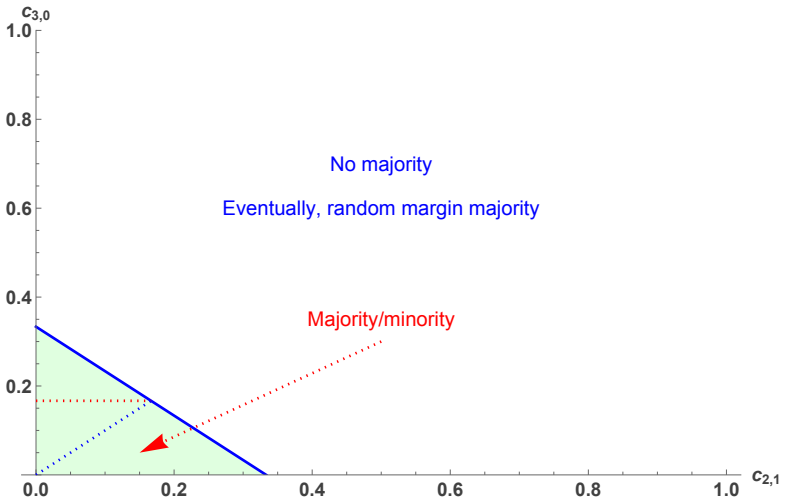
With independent contrarian proportions c_{3,0} for three-to-zero groups and c_{2,1} for two-to-one groups, the update equation yields fixed points and stability thresholds that can be adjusted across the parameter plane. Equal values of the two proportions recover the uniform-contrarian case; unequal values open regimes in which the initial majority opinion is guaranteed to prevail or in which a single attractor sits at fifty-fifty support, making the final winner random irrespective of starting conditions.
What carries the argument
The two independent ratio-dependent contrarian activation rates c_{3,0} and c_{2,1} that rescale the probability an individual flips opinion inside local groups of three.
If this is right
- Appropriate choice of c_{3,0} and c_{2,1} can force the opinion that starts with larger support to become the unique stable outcome.
- Other choices can make the fifty-fifty point the sole attractor, so the winner is decided by random fluctuations around that point.
- When the two rates are set equal the dynamics reduce exactly to the earlier uniform-contrarian results.
- The parameter plane therefore supplies a spectrum of new interventions that secure either a majority-driven ending or a tie-driven random ending.
Where Pith is reading between the lines
- The same ratio dependence might be tested in field data by checking whether people change opinions more readily in clearly one-sided versus narrowly divided conversations.
- Extending the framework to groups of varying size would reveal whether the ability to tune between majority and tie regimes persists or requires the fixed size-three restriction.
- Memory effects or repeated interactions could alter the stability thresholds, offering a concrete way to check how robust the derived landscape remains under more realistic conditions.
Load-bearing premise
The activation rates c_{3,0} and c_{2,1} can be chosen independently of the underlying population heterogeneity and that local groups remain strictly of size three with no overlap or memory effects.
What would settle it
Numerical simulation of the same model but with groups of size four or with overlapping discussion rounds that produce different effective activation statistics would show whether the two-dimensional landscape of controllable attractors survives or collapses.
Figures


read the original abstract
I study the impact of mixed contrarians on the opinion dynamics of an heterogenous population with conformists using Galam Majority Model. Activation of contrarians is a function of the ratio majority/minority in the local groups of discussion. Restricting the group size to 3, two types of contrarians are included in respective proportions $c_{3,0}$ for configurations with ratio 3 to 0 and $c_{2,1}$ for ratio 2 to 1. I then derive the explicit update Equation and obtained analytically the fixed points, their stability, and the resulting full two-dimensional landscape of the dynamics of opinion. Setting $c_{3,0} =c_{2,1} = c$ recovers the original results obtained with uniform contrarians. The findings allow for considering a wide spectrum of new disruptive strategies to secure either a majority/minority ending ensuring the opinion having the larger initial support to win, or a single attractor dynamics at fifty/fifty, which implies a random winner regardless of initial supports.
Editorial analysis
A structured set of objections, weighed in public.
Referee Report
Summary. The paper extends the Galam Majority Model by introducing ratio-dependent contrarian activation in an heterogeneous population using local discussion groups of size 3. Two contrarian proportions are defined: c_{3,0} for 3-0 majority/minority configurations and c_{2,1} for 2-1 configurations. An explicit update equation is derived, fixed points and stability are obtained analytically, and the full two-dimensional dynamical landscape is mapped. Setting c_{3,0}=c_{2,1} recovers the uniform-contrarian results from prior work. The findings are used to propose strategies for controlling outcomes such as majority/minority endings or a unique 50/50 attractor.
Significance. If the mean-field assumptions hold, the work supplies an analytically tractable, two-parameter extension that maps how independent tuning of ratio-specific contrarian activation can reshape attractor basins and enable targeted control over opinion dynamics. The explicit derivation of the update rule, fixed points, and landscape constitutes a clear technical advance over uniform-contrarian models and could support falsifiable predictions about disruptive interventions.
major comments (3)
- [update equation derivation] The derivation of the explicit update equation (abstract and the section presenting the probabilistic enumeration) assumes strictly independent, non-overlapping triples of size 3 with no memory or spatial correlations. This mean-field construction is load-bearing for the claimed fixed-point structure and basins; in heterogeneous populations where groups overlap or retain sequential information, the effective transition probabilities would change and could eliminate or shift the reported attractors.
- [fixed points and stability] The analytical fixed points, stability analysis, and resulting 2D landscape rest on the enumerated configurations without accompanying numerical integration or Monte-Carlo verification shown in the manuscript. Because the central claim concerns the full landscape and the possibility of securing specific endings, the absence of such checks leaves the algebra unverified and the basins unconfirmed.
- [recovery of uniform case] Recovery of the uniform-contrarian case when c_{3,0}=c_{2,1} occurs by direct substitution in the update rule and therefore provides only an internal consistency check rather than an independent validation of the ratio-dependent framework or the independence assumption.
minor comments (3)
- [abstract] Abstract contains grammatical errors: 'an heterogenous' should read 'a heterogeneous'; 'derive ... and obtained' should read 'derive ... and obtain'.
- [main text] The explicit form of the update equation and the expressions for the fixed points should be displayed in the main text (or an appendix) rather than asserted, to allow direct reader verification.
- [figures] Any figures depicting the 2D landscape should include clear labels for the fixed points, their stability, and the basin boundaries corresponding to the analytical results.
Simulated Author's Rebuttal
We thank the referee for the thorough review and insightful comments on our manuscript. We address each major comment below in a point-by-point manner. Where appropriate, we have revised the manuscript to incorporate clarifications and additional verification.
read point-by-point responses
-
Referee: [update equation derivation] The derivation of the explicit update equation (abstract and the section presenting the probabilistic enumeration) assumes strictly independent, non-overlapping triples of size 3 with no memory or spatial correlations. This mean-field construction is load-bearing for the claimed fixed-point structure and basins; in heterogeneous populations where groups overlap or retain sequential information, the effective transition probabilities would change and could eliminate or shift the reported attractors.
Authors: The model is explicitly formulated within the standard mean-field framework of the Galam Majority Model, in which discussion groups of size 3 are assembled randomly and independently at each time step in a well-mixed population. This assumption is stated in the manuscript and is required for the probabilistic enumeration that yields the closed-form update equation. The fixed-point analysis and basins therefore hold strictly under these conditions. Extensions incorporating spatial structure, overlapping groups, or sequential memory would indeed modify the transition probabilities and are beyond the present scope; we have added a clarifying paragraph in the discussion section that explicitly delimits the mean-field regime and notes that such variants constitute separate research directions. revision: partial
-
Referee: [fixed points and stability] The analytical fixed points, stability analysis, and resulting 2D landscape rest on the enumerated configurations without accompanying numerical integration or Monte-Carlo verification shown in the manuscript. Because the central claim concerns the full landscape and the possibility of securing specific endings, the absence of such checks leaves the algebra unverified and the basins unconfirmed.
Authors: The referee correctly notes the absence of numerical checks. We have now performed Monte Carlo simulations of the stochastic update process for representative values of c_{3,0} and c_{2,1}. The revised manuscript includes a new subsection that compares the analytically derived fixed points and basin boundaries with simulation trajectories averaged over many realizations. These comparisons confirm the locations and stability of the attractors, including the majority/minority and 50/50 outcomes, thereby providing independent verification of the algebraic results. revision: yes
-
Referee: [recovery of uniform case] Recovery of the uniform-contrarian case when c_{3,0}=c_{2,1} occurs by direct substitution in the update rule and therefore provides only an internal consistency check rather than an independent validation of the ratio-dependent framework or the independence assumption.
Authors: We agree that the substitution c_{3,0}=c_{2,1} functions as an internal consistency check with prior uniform-contrarian results. The primary validation of the ratio-dependent extension lies in the derivation of the general two-parameter update equation and the subsequent mapping of the full (c_{3,0}, c_{2,1}) parameter plane, which uncovers dynamical regimes (for example, tunable majority bias or a unique 50/50 attractor) that are inaccessible when the two proportions are forced to be equal. We have strengthened the revised introduction and conclusion to emphasize these novel features and their implications for control strategies. revision: partial
Circularity Check
Derivation self-contained; no circular reductions to inputs
full rationale
The paper defines a generalized contrarian model by introducing independent rates c_{3,0} and c_{2,1} for ratio-dependent activation in isolated size-3 groups, then enumerates all configurations to obtain the explicit update equation. Fixed points, stability, and the 2D landscape follow directly from algebraic solution of that equation. Setting the two rates equal recovers the uniform-contrarian case as a mathematical special case (internal consistency check), but the new landscape and attractor-control claims are generated by varying the free parameters within the stated mean-field assumptions rather than by fitting or self-referential closure. No load-bearing step reduces to a prior self-citation, imported uniqueness theorem, or ansatz smuggled via reference; the derivation chain is fully explicit and self-contained against the model's own probabilistic rules.
Axiom & Free-Parameter Ledger
free parameters (2)
- c_{3,0}
- c_{2,1}
axioms (2)
- domain assumption Local discussion groups are always of size three and apply strict majority rule.
- domain assumption Contrarian activation is a deterministic function of the local ratio only.
Reference graph
Works this paper leans on
-
[1]
P. Mullick and P. Sen, Sociophysics models inspired by the Ising model. Eur. Phys. J. B 98, 206 (2025)
work page 2025
-
[2]
Opinion dynamics: Statistical physics and beyond
M. Starnini, F. Baumann, T. Galla, D. Garcia, G. I´ niguez, M. Karsai, J. Lorenz and K.Sznajd-Weron, Opinion dynamics: Statistical physics and beyond, arXiv:2507.11521 (2025)
work page internal anchor Pith review arXiv 2025
-
[3]
Opinion dynamics: A comprehensive overview.arXiv preprint arXiv:2511.00401, 2025
M. Shirzadi, E. Cruciani and A. N. Zehmakan, Opinion Dynamics: A Comprehensive Overview, arXiv:2511.00401 (2025)
-
[4]
D. Tsintsaris, M. Tsompanoglou and E. Ioannidis, Dynamics of Social Influence and Knowledge in Networks: Sociophysics Models and Appli- 15 cations in Social Trading, Behavioral Finance and Business, Mathemat- ics12(8),1141 (2024)
work page 2024
-
[5]
Schweitzer, Sociophysics, Physics Today 71, 40-47 (2018)
F. Schweitzer, Sociophysics, Physics Today 71, 40-47 (2018)
work page 2018
-
[6]
Galam, Sociophysics: A Physicist’s Modeling of Psycho-political Phe- nomena, Springer (2012)
S. Galam, Sociophysics: A Physicist’s Modeling of Psycho-political Phe- nomena, Springer (2012)
work page 2012
-
[7]
B. K. Chakrabarti, A. Chakraborti and A. Chatterjee (Eds.), Econo- physics and Sociophysics: Trends and Perspectives, Wiley-VCH Verlag (2006)
work page 2006
-
[8]
S. Galam, Physicists, non physical topics, and interdisciplinarity, Fron- tiers in Physics 10, 986782 (2022)
work page 2022
-
[9]
M. G. E. da Luz, C. Anteneodo, N. Crokidakis and M. Perc, Socio- physics: Social collective behavior from the physics point of view, Chaos, Solitons and Fractals 170, 113379 (2023)
work page 2023
-
[10]
A. Ghosh and B. K. Chakrabarti, Do Successful Researchers Reach the Self-Organized Critical Point? Physics 6(1), 46-59 (2024)
work page 2024
-
[11]
Brazil, The physics of public opinion, Physics World, January issue (2020)
R. Brazil, The physics of public opinion, Physics World, January issue (2020)
work page 2020
- [12]
-
[13]
A. C. R. Martins, Agent Mental Models and Bayesian Rules as a Tool to Create Opinion Dynamics Models, Physics 6(3), 1013-1031 (2024)
work page 2024
-
[14]
K. Malarz and T. Mas lyk, Phase Diagram for Social Impact Theory in Initially Fully Differentiated Society, Physics 2023, 5(4), 1031-1047 (2023)
work page 2023
- [15]
-
[16]
M. Mobilia, Polarization and Consensus in a Voter Model under Time- Fluctuating Influences, Physics 5(2), 517-536 (2023) 16
work page 2023
-
[17]
J. Llabr´ es, S. Oliver-Bonafoux, C. Anteneodo and Ra` ul Toral, Aging in Some Opinion Formation Models: A Comparative Study, Physics 6(2), 515-528 (2024)
work page 2024
-
[18]
Guanyu Xu, Jiahang Chen, Xin Zhou and Yanting Wang, Phase transi- tions in voting simulated by an intelligent Ising model, Commun. Theor. Phys. 78 055601 (2026)
work page 2026
-
[19]
A. Khrennikov, Social laser theory: a quantum-like framework for collective social dynamics, Advances in Complex System (in press) https://doi.org/10.1142/S021952592630001X
-
[20]
M. O. Hase, A. A. Ferreira, A. C. R. Martins and F. F. Ferreira, An- nealing approximation in master-node network model, Phys. Rev. E 112, 064314 (2025)
work page 2025
-
[21]
Z. Kov´ acs, G. Palla and A. Zafeiris, The desire to avoid cognitive disso- nance drives community formation in a social network model, Scientific Reports 16, 1932 (2026)
work page 1932
-
[22]
A. Jdrzejewski and J. F. F. Mendes, When Does Population Diversity Matter? A Unified Framework for Binary-Choice Dynamics, Phys. Rev. Lett. 135, 217401 (2025)
work page 2025
-
[23]
G. Caldarelli, O. Artime, G. Fischetti, S. Guarino, A. Nowak, F. Saracco, P. Holme and M. de Domenico, The Physics of News, Rumors, and Opinions, arXiv:2510.15053 (2025)
- [24]
-
[25]
N. Crokidakis, Modeling the Fall of the Inca Empire: A Lotka-Volterra Approach to the Spanish Conquest, Physics 2026, 8(1), 7 (2026)
work page 2026
-
[26]
Galam, Minority Opinion Spreading in Random Geometry, Eur
S. Galam, Minority Opinion Spreading in Random Geometry, Eur. Phys. J. B 25 Rapid Note 403-406 (2002)
work page 2002
-
[27]
S. Galam and T. Cheon, Tipping points in opinion dynamics: a universal formula in five dimensions, Frontiers in physics, 8, 446 (2020) 17
work page 2020
-
[28]
C. Psaltis, Conclusion: Rejoinder, in Conflict and Change: Integrating Social and Developmental Psychology, C. Psaltis and B. Wagoner, eds., Cambridge University Press (2025) DOI: 10.1017/9781009393133.018
-
[29]
I. Markov´ a, Dialectics of Genesis and Structure,in Conflict and Change: Integrating Social and Developmental Psychology, C. Psaltis and B. Wagoner, eds., Cambridge University Press (2025) DOI: 10.1017/9781009393133.010
- [30]
-
[31]
N. Bellomo, D. Burini and Jie Liao, New trends in kinetic theory toward the complexity of living systems, Mathematical Models and Methods in Applied Sciences 36:02, 341-397 (2026)
work page 2026
-
[32]
K. Bukina and D. L. Shepelyansky, Opinion Formation at Ising Social Networks, Information 17(1), 41 (2026)
work page 2026
- [33]
-
[34]
V. Gezha and I. Kozitsin, Control over Recommendation Algorithms in Heterogeneous Modular Systems with Dynamic Opinions, Entropy 28, 333 (2026)
work page 2026
-
[35]
H. P´ erez-Martinez, S. Lamata-Otin, F. Malizia, L. M. Floria, J. G´ omez- Garde¨ nes and D. Soriano-Pa¨ nos, Social polarization promoted by sparse higher-order interactions, Commun Phys 8, 507 (2025)
work page 2025
-
[36]
F. De Domenico, F. Caccioli and G. Livan, Peer influence breaks ergod- icity in an opinion dynamics model with external information, J. Phys. Complex. 6, 045007 (2025)
work page 2025
-
[37]
K. Mohandas, P. J. G´ orski, K. Suchecki, G. Andres, G. Vaccario and J. A. Ho´lyst, Structurally balanced growing network as randomized P ´lya urn process, arXiv:2510.24659v2 (2025)
-
[38]
A. Mehdizadeh and M. Hilbert, When Your AI Agent Succumbs to Peer-Pressure: Studying Opinion-Change Dynamics of LLMs, arXiv:2510.19107 (2025) 18
-
[39]
D. Sabin-Miller and C. Harding, Data-Driven Modeling of U.S. Ideolog- ical Dynamics, arXiv:2510.11983 (2025)
-
[40]
V. Dornelas, C. Anteneodo, R. Nunes, E. Heinsalu and M. Patri, Role of zealots in the spread of linguistic traits, Phys. Rev. E 112, 044303 (2025)
work page 2025
-
[41]
J. A. Miszczak, Cooperation in public goods game on regular lattices with agents changing interaction groups, arXiv:2510.03772 (2025)
work page internal anchor Pith review arXiv 2025
- [42]
-
[43]
V. Gezha, Kozitsin, I. Control over Recommendation Algorithms in Het- erogeneous Modular Systems with Dynamic Opinions. Entropy 28, 333 (2026)
work page 2026
-
[44]
J. L. C. da C. Filho and N. Crokidakis, Opinion dynamics under elec- toral shocks in competitive campaigns, International Journal of Modern Physics C (2026) https://doi.org/10.1142/S0129183127500549
-
[45]
S. Galam and S. Moscovici, Serge, Towards a theory of collective phe- nomena: Consensus and attitude changes in groups, Euro. J. Social Psy. 21, 49-74 (1991)
work page 1991
-
[46]
S. Galam and F. Jacobs The role of inflexible minorities in the breaking of democratic opinion dynamics, Physica A 38, 366-376 (2007)
work page 2007
- [47]
-
[48]
M. Shirzadi and A. N. Zehmakan, Do Stubborn Users Always Cause More Polarization and Disagreement? A Mathematical Study, arXiv:2410.22577v1 (2024)
-
[49]
C. Shen, H. Guo, S. Hu, L. Shi, Z. Wang and J., Tanimoto, How Com- mitted Individuals Shape Social Dynamics: A Survey on Coordination Games and Social Dilemma Games, to appear in Eur. Phys. Lett (2023)
work page 2023
-
[50]
S. Galam, Contrarian Deterministic Effects on Opinion Dynamics: The Hung Elections Scenario, Physica A 333, 453-460 (2004) 19
work page 2004
-
[51]
C. Borghesi and S. Galam, Chaotic, staggered, and polarized dynamics in opinion forming: The contrarian effect, Phys. Rev. E 73, 066118 (2006)
work page 2006
-
[52]
No Ban, No Spread - With Sequestration
S. Galam, Fake News: “No Ban, No Spread - With Sequestration”, Physics 6, 859-876 (2024)
work page 2024
-
[53]
S. Galam and T. Cheon, Asymmetric Contrarians in Opinion Dynamics, Entropy 22(1), 25 (2020)
work page 2020
-
[54]
A. Pradhan, P. Mullick and P. Sen, Analyzing contrarian behavior using nonlinear biased-voter model, Phys. Rev. E 113, 034301 (2026)
work page 2026
-
[55]
A. Lipiecki and K. Sznajd-Weron, When heterogeneity drives hysteresis: Anticonformity in the multistate-voter model on networks, Phys. Rev. E 112, 054316 (2025)
work page 2025
-
[56]
M. Grabisch and F. Li, Anti-conformism in the Threshold Model of Collective Behavior, Dynamic Games and Applications 1, 444-477 (2020)
work page 2020
- [57]
-
[58]
Hamann, Opinion Dynamics With Mobile Agents: Contrarian Effects by Spatial Correlations, Front
H. Hamann, Opinion Dynamics With Mobile Agents: Contrarian Effects by Spatial Correlations, Front. Robot. AI 5:63 (2018)
work page 2018
-
[59]
L. Guo, Y. Cheng and Z. Luo, Opinion Dynamics with the Contrarian Deterministic Effect and Human Mobility on Lattice, Complexity 20, 43-49 (2015)
work page 2015
-
[60]
Toth, Models of opinion dynamics with random parametrisation, J
G. Toth, Models of opinion dynamics with random parametrisation, J. Math. Phys. 65, 073301 (2024)
work page 2024
-
[61]
A. Chacoma and D. H. Zanette, Critical phenomena in the spreading of opinion consensus and disagreement, Papers in Physics 6, 060003 (2014)
work page 2014
-
[62]
M.C. Gimenez, L. Reinaudi and F. Vazquez, Contrarian Voter Model under the Influence of an Oscillating Propaganda: Consensus, Bimodal Behavior and Stochastic Resonance. Entropy 24,1140 (2022) 20
work page 2022
-
[63]
E. Iacominia and P. Vellucci, Contrarian effect in opinion forming: In- sights from Greta Thunberg phenomenon, The Journal of Mathematical Sociology 47, 123?169 (2023)
work page 2023
-
[64]
F. Bagnoli and R. Rechtman, Bifurcations in models of a society of reasonable contrarians and conformists, Phys. Rev. E 92, 042913 (2015)
work page 2015
-
[65]
A. Pradhan, P. Sen and K. Malarz, Extending the Biswas-Chatterjee- Sen model with nonconformists and inflexibles, arXiv:2601.07432v2 (2026)
-
[66]
Galam, Democratic Thwarting of Majority Rule in Opinion Dynam- ics: 1
S. Galam, Democratic Thwarting of Majority Rule in Opinion Dynam- ics: 1. Unavowed Prejudices Versus Contrarians, Entropy 27 (3), 306 (2025)
work page 2025
-
[67]
S. Galam, Unanimity, Coexistence, and Rigidity: Three Sides of Polar- ization, Entropy 25(4), 622 (2023)
work page 2023
-
[68]
S. Galam, From 2000 Bush - Gore to 2006 Italian elections: voting at fifty-fifty and the contrarian effect, Quality & quantity 41, 579-589 (2007) 21
work page 2000
discussion (0)
Sign in with ORCID, Apple, or X to comment. Anyone can read and Pith papers without signing in.